
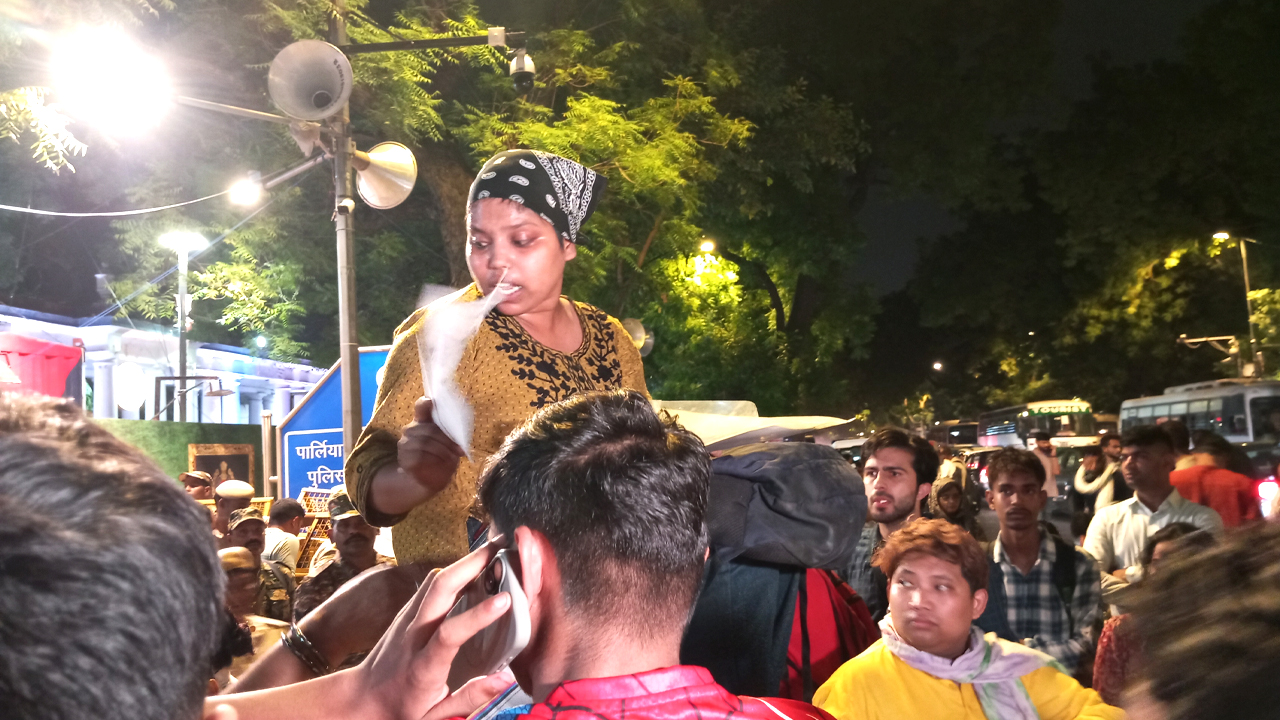
An independent journalist’s protest erupted outside the Parliament Street police station on 3 October 2026 after police refused to register an FIR in the case of an on duty female journalist’s complaint of molestation and assault against ACP Vivek Bhagat, only to find that several other FIRs had also not been registered. Repeated incidents of violence against women and journalists have surfaced during the protests against CEC Gyanesh Kumar.
New Delhi, 3 October 2026
by Mouli Sharma
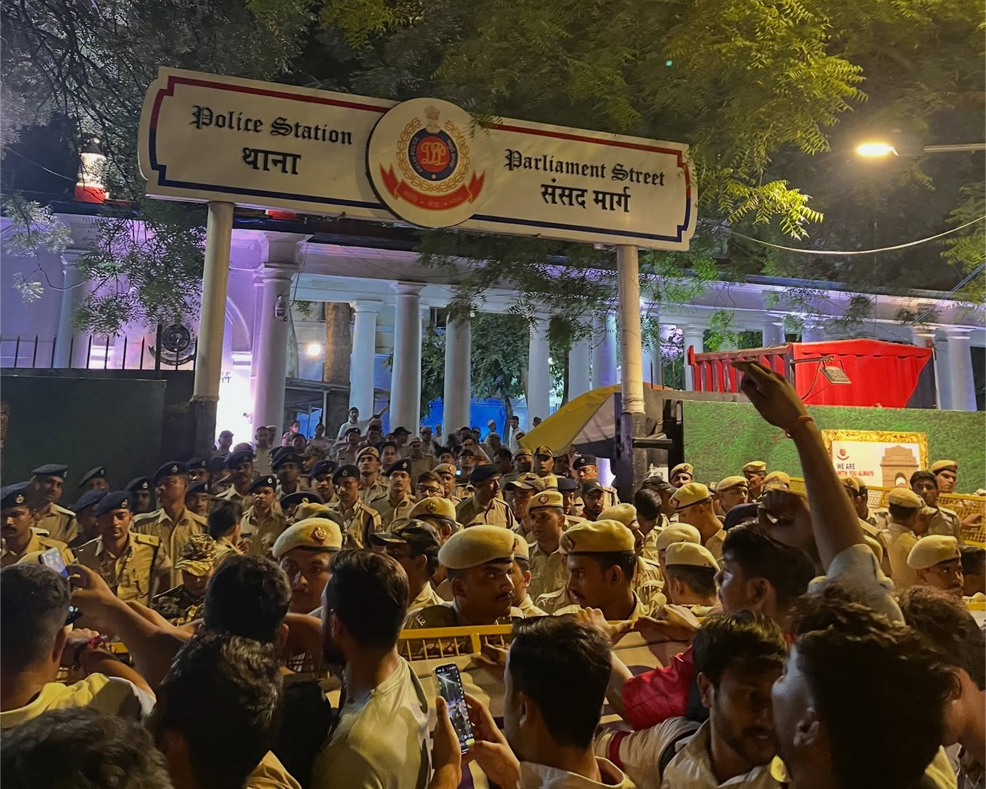
After a long, spontaneous demonstration by over a hundred people, largely independent journalists, outside the Parliament Street police station between the hours of 6 PM and 11 PM, the Delhi police reluctantly accepted three complaints of molestation and assault against its officials, including ACP Vivek Bhagat.
The agitation began after Rosy, a journalist from News Diggy was allegedly assaulted by Bhagat while on duty covering the protests against Gyanesh Kumar in the now blockaded region of Central Delhi, following which she attempted to file an FIR against the powerful official, which the police refused to register.
“The Delhi Police Act entails the provision for preliminary investigation in the case of an allegation against a police officer,” said Inspector Ramesh Kumar Singh of the Parliamentary Street Police Station, who spoke to the protesting reporters after nearly five hours of continuous agitation. For these five hours, the police delayed providing even a receiving copy of the complaint or registering it in the police diary. Despite sexual assault being a cognizable offence (BNS 76), the universal provision for the immediate registry of an FIR in such a case apparently does not extend to police officers under the Delhi Police Act, 1978, said Kumar. He also mentioned that the, “Lalita Kumari judgment has been overturned, and we are no longer required to follow it,” referring to the landmark judgment which ruled out the conduct of ‘preliminary investigations’ of the kind that the police is now set to undertake in the case, which seeks to ascertain a complaint’s ‘veracity’ before the criminal investigative process (which begins with the FIR) has even begun.
Further, after the News Diggy team gave a call for a spontaneous protest by the city’s independent journalists in the early evening to ensure the receipt of the complaint and registry of an FIR (the former of which they succeeded in achieving after five gruelling hours outside the barricaded station), it was found that two other women had been attempting to register sexual assault complaints against police officers for their conduct during ostensible “security operations” in the region. A fourth complainant withdrew her submission upon facing familial and social pressure, while a fifth complainant, independent journalist Suhana Khan was categorically denied entry into the station.
“The worst part of the way these male officers conduct their so-called security operations,” Khan said, “which just means beating people, is they’ll often ask your name first. I was beaten on my privates during the July protests, I had to get stitches. My clothes were torn. And because they asked my name before doing so, I can say with certainty that they did this to me because my name is Suhana Khan.”
Journalists from Molitics, Khabar Lehriyan, Caravan, News Diggy, Newswine, Nation Asks, AT Live, Hind Samachaar, Online News India, and of course, GroundXero, were among many dozens of news platforms whose correspondents were at the scene, alongside several independent content creators, social media news-makers, and influencers like Harsh Yadav, Gajendra Singh (@desiptrakar), etc. A number of lawyers had also been called to scene after the police initially denied to accept her complaint, with Adv. Vertika Mani, Adv. Mujibur Rehman, Adv. Anupradha and Adv. Bharat Kaushik eventually made their way inside the station to represent all complainants upon pressure from protesting journalists.
“I was screaming myself hoarse for them to let me do my duty,” said Adv. Vertika Mani. She describes the situation as one that made her feel immensely helpless, with a group of women lawyers standing outside the jail-like barricades and a victim begging to be allowed to speak to lawyers engulfed within a sea of officers inside. She describes how the police were attempting to manipulate the victim, by asking her to point out her lawyer from among the group, knowing full well that she did not have the resources to have brought legal counsel with herself.
“This is a cognizable offence. They are trying to make her settle without an FIR being registered immediately, as is one’s lawful right,” said Adv. Anupradha. “If an FIR isn’t registered immediately, there won’t be any action in this matter and it will rot in cold storage for two years, I’m willing to give it in writing,” she said. The police announced that they would conduct a preliminary investigation based on analysis of local CCTV footage of the area along with any videos that reporters and witnesses present at the scene would provide to them, but when asked to give a committed timeline for the process, they deferred again to statutes.
“We have 14 days’ time to conduct the independent inquiry,” Inspector Kumar said. When asked who would conduct the independent inquiry, Kumar declined to comment. He also refused to address allegations that the complainants were being pressurised by the DCP to drop the charges and make the matter “go away”, or answer why the police delayed receiving the complaint for over five hours or denied entry to another woman attempting to register a complaint.
The journalist’s clothes were torn by Vivek Bhagat, following which he groped her breasts, she alleges. The police state that any action against the senior officer would be contingent on the establishment of mens rea, or criminal intent, which is ordinarily the purview of the courts, not the investigative authority such as police. When asked if the police official is then uniquely positioned and protected to commit crimes such as outraging the modesty of women, with burden of proof weighing far more heavily against survivors than it would in a complaint against an ordinary citizen, the police declined comment.
“The law is supposed to be equal and blind. But the ground reality is that the police will never register an FIR without first checking what the identity of the woman making the complaint is, and more crucially, who the man is against whom the complaint is being made,” said Adv. Rehman.
“It is only because all of this happened in the public, amidst witnesses, and in a protest space, resulting in this kind of collective action, that things have even moved this swiftly,” said Adv. Vertika Mani. “If it was a usual case against someone as powerful as the ACP by an ordinary woman what would have happened, you can imagine.”
“Call him a potential rapist,” said Ujjwal Singh, a student present at the protest. “You are tearing women’s clothes and groping them in broad daylight, one can only imagine what you get up to when the cameras aren’t there. The Delhi police is filled with these potential rapists.”
The incident has united the disparate issues of electoral corruption and women’s safety, both of which have seen widespread public outrage over the past few weeks, after three men pretending to be police officers allegedly gang raped a seventeen year old in park in Delhi’s Kalkaji region. Repeated instances of targeted violence against women and women journalists in particular (a Maktoob reporter was also briefly detained on the 2nd October protest despite visibly wearing her press identification) in the ‘Jantar Mantar 2.0’ protests have sparked contempt amidst press and protesters alike, and a call for a citizen’s protest combining both issues has been made for 4 October 2026 from India Gate to Jantar Mantar.
ACP Vivek Bhagat must be arrested immediately! pic.twitter.com/Wm6OrS5Ix1
— Abhijeet Dipke (@abhijeet_dipke) October 3, 2026
In July earlier this year, Sabar Institute’s analysis of draft rolls also showed a disproportionate targeting of women, following which the ECI stopped disclosing the gender of voters preventing the exposure of such biases.
“This will prevent the kind of analysis by civil society watchdogs and journalists, who had previously shown a disproportionate impact of SIR on women in the previous two phases of the voter roll revision in 13 states and Union Territories (UT).”
Mouli Sharma is a journalist based in New Delhi. She currently writes for GroundXero, and her work has appeared in various publications.
Also Read: Barricades, Internet Shutdown, Mass Detentions: Delhi Police Violent Crack Down on Protest against CEC Gyanesh Kumar and SIR

Wow, that’s what I was searching for, what a information! present here at this website, thanks admin of this site.