
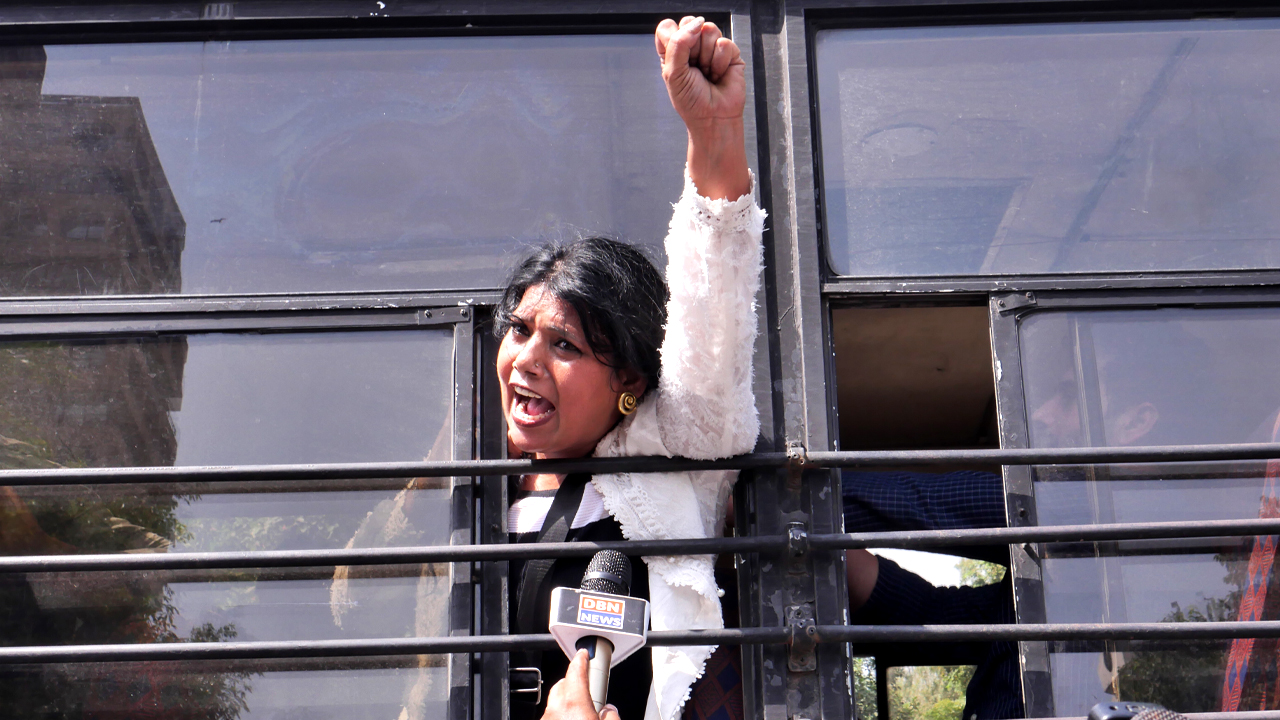
Thousands of protesters gathered around Delhi’s Jantar Mantar on 2 October, defying the denial of police permission and a sweeping security clampdown imposed to prevent the protests from taking place. Barricades sealed the designated protest site from all four directions, mobile internet was suspended across central Delhi, several Metro stations were shut, and riot-control forces were deployed in large numbers. What followed was a day of mass detentions, many involving the use of force against women, students, journalists and other protesters. The violent crackdown came amid a renewed call for mobilisation for a ‘Jail Bharo Andolan’ and ‘Jantar Mantar 2.0’ against the Special Intensive Revision (SIR) of electoral rolls and demands for the resignation of Chief Election Commissioner (CEC) Gyanesh Kumar, with organisers calling the 2 October action only the beginning of a wider protest movement.
New Delhi, 2 October 2026
by Mouli Sharma
“Thousand is a lowballed estimate,” said a lawyer’s group called Lawyers for Detainees, one of several such collectives formed after the historic protests that shook the national capital a mere three months ago after uproar against repeated failures and irregularities in the conduct of public examinations under the tenure of former Union Education Minister Dharmendra Pradhan. Now, recent history is attempting to recreate itself as a similar uproar against the government’s Special Intensive Revision of electoral rolls, and the recent revelations of Chief Election Commissioner Gyanesh Kumar’s alleged role in the same has led to widespread national outrage.
“85 people have been detained in this station alone,” said Adv. Surya Prakash, who was present at the Badarpur police station. “We have reports that at least 20 buses filled with detainees left the protest site during the day. Many detainees were released informally at random locations far away from the centre of the city, while still more were taken to stations like this one. The actual number of detentions is much higher than whatever numbers will be produced here at the stations,” he said.
The figure, though, may include repeat detentions, the most prominent case being of AISA president Neha Bora herself, who was detained at least three times from the same location outside the Royal Plaza Hotel, near the East entrance of the protest site near the Kerala Bhawan canteen, first alongside psephologist and activist Yogendra Yadav, a second time with several student protesters of other parties, and a third time again with fellow AISA leader Anjali of the Delhi University. Former Delhi CM Atishi, independent journalist Harsh Yadav, and at least 700 more students were detained through the day.
“700 is the count we have so far from police stations taken across the city,” said Adv. Vertika Mani, also a part of the lawyers’ collective. “But that obviously cannot account for the many detainees who were released at unofficial locations.”
The CJP’s ultimatum to the government of witnessing a ‘Jantar Mantar 2.0’ should Gyanesh Kumar fail to resign within 48 hours (given on 25 September, the deadline for which had long since passed) kicked off with a bang on Friday, as an identical call for the police-defying protest in Shivaji Park, Mumbai was given by countless student, labour, farmer and other political organisations at the eponymous Jantar Mantar in New Delhi, led by prominent activists including Neha Bora, Yogendra Yadav, Nandita Narain, and Prashant Bhushan. Hundreds of civilians took to the streets on the morning of 2 October, on the occasion of Gandhi Jayanti, only to be met with armed state forces deployed in massive numbers and a once-designated protest site cut off from their access through curfews (Section 163 of the BNS was declared in the region, without any justification beyond prevention of a ‘crowd forming’) and police barricades blockading entrances to the site from all four directions, dispersing protesters across a wide 2km radius.
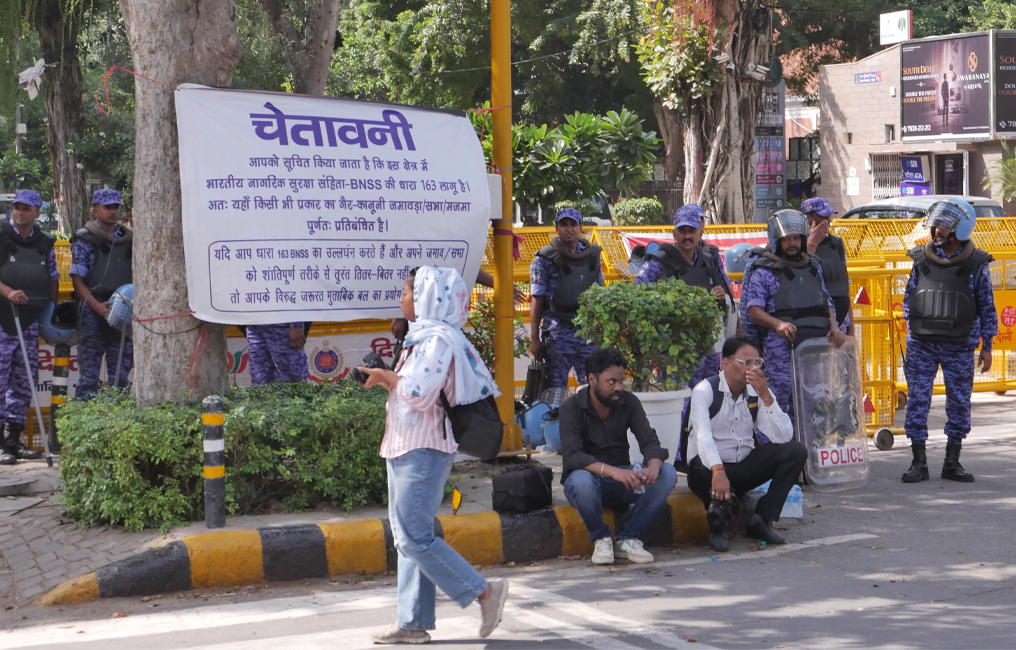
What followed was a circus of media, police, and protester, as for four hours following the 11 am time given for the assembly, bus after bus was filled with peaceful protesters ‘detained’ under the simple justification of following ‘orders from above’. At least one protester, a young man named Roveen from the All India Students’ Association (AISA) (of whom Neha Bora is national president), was grievously assaulted by the police and had to be taken to a hospital in Sarita Vihar before being released; and several other protesters (large numbers of whom were young women) could be seen being detained with the use of brutal force, often at the hands of male officers.
“I was detained twice,” said Roveen, who is the Vice President of AISA DU. “After the first time, I managed to get out of the bus along with Neha. But the second time, they deliberately assaulted me so I would not be able to resist. I was beaten badly and kicked in the privates,” he says. “I’ve been to more protests than I can count, and this is the first time that my condition has been so debilitating. I was crying in pain throughout the bus ride, and my fellow detainees had to beg the police to take me to a hospital.”
The Delhi police, who allegedly told him, “he would not be able to talk so much if they’d ‘really injured him’,” responded to the allegations of police brutality and use of force against peaceful protesters, stating, “They may be peaceful, but they attract crowds. If one man stands, ten stand behind him.”
The Delhi police, who allegedly told him, “he would not be able talk so much if they’d ‘really injured him’,” responded to the allegations of police brutality and use of force against peaceful protesters, stating, “They may be peaceful, but they attract crowds. If one man stands, ten stand behind him.”
Timeline of events
First, just past midnight on October 1, the Delhi police double barricaded all entrances toward the Jantar Mantar protest site: Mainly at the Janpath-Tolstoy crossroads cutting off the North entrance to the site and the radial intersection of the Jantar Mantar road with the Ashoka road toward the South. These two became the primary sites of protest and detention 11 hours later.
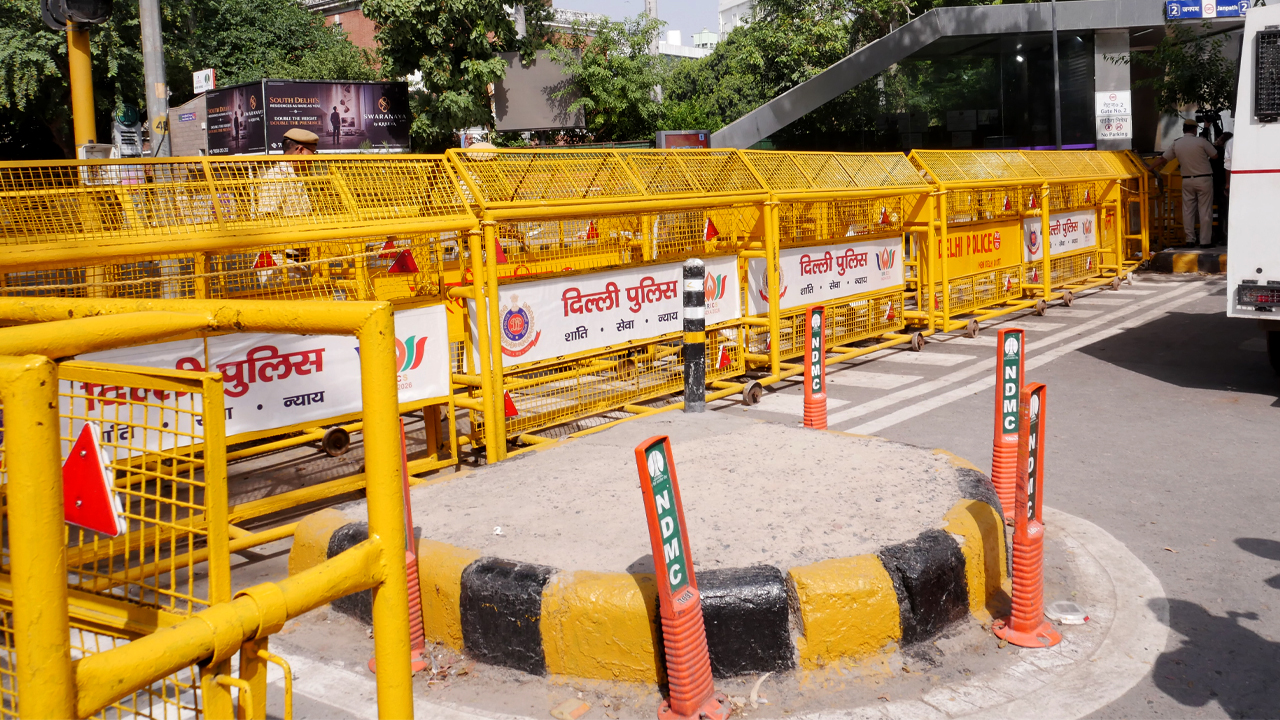
“I still remember the exact time,” said a group of independent journalists who audited the site anticipating such ‘preparations’. “It was 12:37 AM, and in the dead of night, they were busy turning the city into a mini-prison,” they said, painting a picture reminiscent of the protests following 20th July 2026 after the ‘forced hospitalisation’ of Ladakhi activist Sonam Wangchuk two days prior.
Following the playbook, the next was internet shutdown. Mobile networks were suspended on orders of the government issued directly to private network service providers throughout the central Delhi area. “As per government instructions Internet services have been stopped in your area till further notice,” read Jio’s version of the message thousands of citizens received while crossing or reaching the heart of the national capital from their respective ISPs—notably a privatised service. Metros were then shutdown, with the DMRC announcing at 8:52 am that 11 metro stations, namely: Janpath, Patel Chowk, Central Secretariat, Rajiv Chowk, Seva Teerth, Mandi House, Lok Kalyan Marg, INA, Chawri Bazar, Ramakrishna Ashram Marg, and New Delhi had been closed “until further notice”. Ironically, this announcement was not made physically at the stations or in trains where commuters could access them, but via X, which people in the region couldn’t even see due to the internet shutdown.
“It is not your father’s property that you will close whenever you want? You need to give a reason why you are closing,” wrote one user underneath the post. “Pay taxes so that govt can shut services,” wrote another. By 11:43 AM, Barakhamba Road was also closed.
“Someone should take them to court for causing public inconvenience through arbitrary shutdowns,” wrote ‘S’ on the site. “On whose order and why? Does the @OfficialDMRC hold any accountability to the people of India?” asked former Financial Express reporter Abhinay Singh via Twitter. A DMRC official at Central Secretariat Station at 9:35 AM told GroundXero that the orders had come “from the DCP”.
At 11 am, a round of violent detentions began on the dot as a medium-sized marching crowd including AAP leaders arrived from the Barakhamba side. AAP volunteers including a large number of women as well as unaffiliated protesters including a significant number of young women made up the crowd. The group was not allowed to enter through the barricading at Janpath metro’s gate number 2, and in protest, they sat down in front of the riot squad. What followed were a series of violent detentions, with the use of excessive force against women in particular, including a journalist from Maktoob. Women were dragged bodily into the bus, it was only upon the insistence of several male journalists that the Maktoob reporter, visibly wearing her press card, was released.
“I am showing them the press card repeatedly, I am shouting that I’m from the press and they don’t care,” she said.
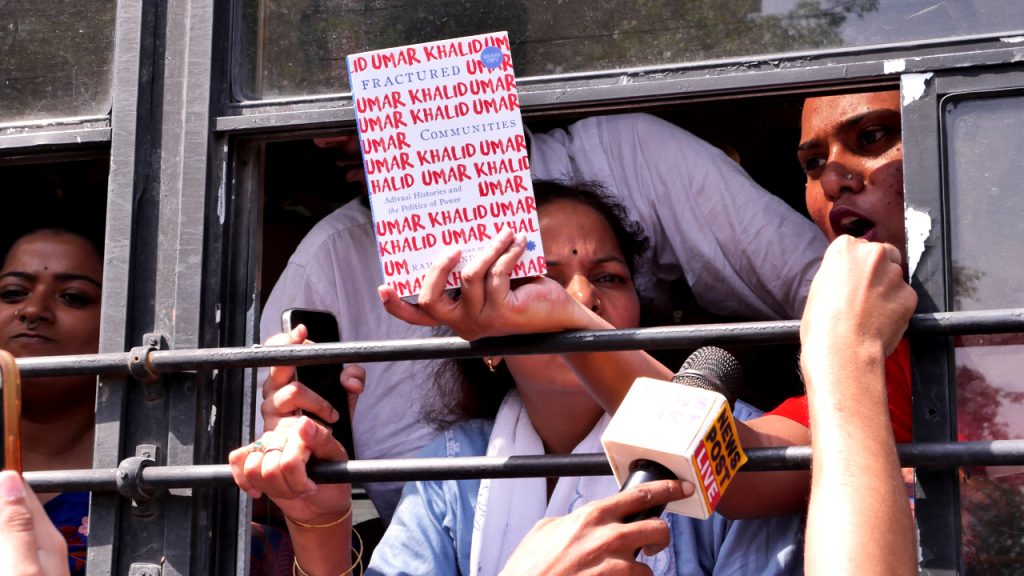
Another young woman was placed under detention seemingly only for holding up a book authored by Umar Khalid.
“Yes, I do support Umar Khalid,” she told a group of journalists seemingly more interested in her political ideology than in her arbitrary detention. “Is that a crime?”
Following this, at around 11:30 AM, the remaining protesters (around 100-200 civilians) began marching toward Barakhamba road. The police again picked out individuals from this crowd and physically detained them, likely targeting individuals who appeared to have been surveilled. On the other end of the radius at the Ashoka road barricading, outside the Royal Plaza hotel, things began to pick up speed as AISA members, Neha Bora, Yogendra Yadav, AICCTU members, CPI(M), CPI(ML) and several other organisations began arriving, gathering a massive crowd for a demonstration that seemed to have been terminated before it could begin. At least 65 individuals from the CPI(M), and at least 15 from the CPI-ML were detained alongside an unconfirmed number of unaffiliated participants.
DYFI and NSUI members were detained before Yogendra Yadav and Neha Bora led a highly anticipated march to the spot, only to be immediately shoved into buses. The detentions of Disha, RWPI, AISF, NSUI, Collective and more AISA members followed in the late afternoon, with crowds being almost entirely dispersed by 3 PM, which is when members of KYS were also picked up after a demonstration outside Janpath metro station.
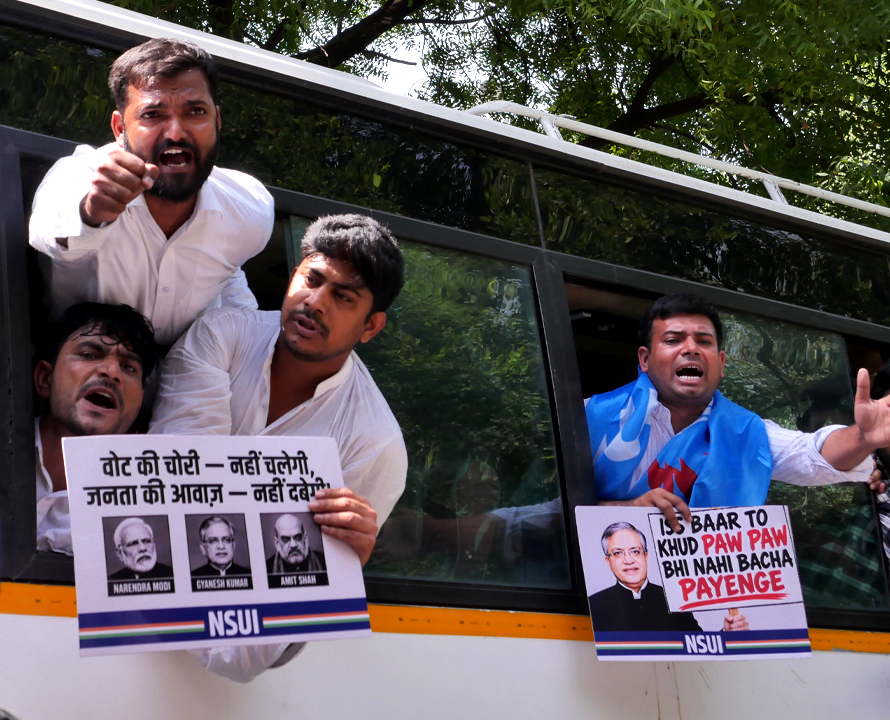
Even as the day rolled into evening, protesters continued to demand the arrest and resignation of Gyanesh Kumar, the immediate retraction of SIR and even the resignation of Narendra Modi having been elected through “illegitimate voters”. Hails of “Vote chor-gaddi chhod”, “Jab jab Modi darta hai, police ko aage karta hai” and endless outcry against the CEC took over the Jantar Mantar radius for those brief hours of the day as the roads themselves become the impromptu protest site in lieu of the main site having been entirely blockaded from all four sides.
Violence against detainees; women and journalists targeted
It is important to stress again, the excessively violent nature of these detentions, which resulted in countless injuries to the detainees (Roveen is the only one who was reportedly taken to the hospital, but countless more reached home battered, bruised and scratched from top to bottom) and raised questions of arrest procedure and stampede prevention training for officers seemingly allotted riot gear and weapons without any certification on how to use them.
“[One’s] experience as an activist who’s seen police brutality as a normal, everyday aspect of life—be it as a student [or citizen]—in fact serves only to desensitise one from the reality of it,” wrote Ramnit Kaur for The Voice Express of the normalisation of detentions and the violence activists learn to endure and accept as a part and parcel of protests. “It does become a matter of pride,” agreed Roveen. “But ultimately, the fact is that detentions are inherently violent. So many of the people with me were badly injured, but of course, no one would even demand medical care because it’ll just delay your process of release like it did mine.”
Further, gun toting CRPF officers roamed Connaught Place dining in local eateries as male officers outside could repeatedly be seen shoving, touching, and even attempting to detain female protesters. Like clockwork, it would only be upon witnessing outrage from the crowd regarding this protocol violation that they would desperately begin to call female officers to take over the job, almost as if the sole purpose of the presence of female officers on scene is to be able to “legally” assault women, as opposed to contribute to their safety in any meaningful capacity.
These policemen, and especially the policewomen, had removed their name tags as they carried out detentions, with many also wearing face coverings to hide their identities completely. The targeting of female protesters, like the aforementioned female journalist, was also noticeably more brutal, with young women in particular being picked out from placard carrying crowds to be dragged across the asphalt, pinched, scratched, and somehow shoved into detention vans. Two young women in particular, who managed to resist detention for an impressive thirty minutes, drew the ire of the police to such a degree that as many as ten female officers were sicced on them at the same time, and a group of more than twenty male police officers formed a human chain—a five-metre picket radius—around these women such that journalists would not be able to see what was being said or done to the women.
Most outlandish was when these policemen began to request ‘privacy’ from reporters, politely asking them to ‘please not take pictures’ and put their cameras away, as if potentially suffocating a woman lying limp in the street were a private matter being carried out within their homes, and the media meant to hold them accountable were, if anything, being a little rude by intruding.
“What is that cameraman doing inside?” A journalist asked, pointing to a neon vested photographer inside the makeshift picket. “Wo apna banda hai,” (“He’s our inside man.”) an inspector replied.
“Aur ham paraye hai?” (“And we’re outsiders?”) The reporter asked back.
The previously mentioned detention of journalist Harsh Yadav, who gained popularity on social media over the last year due to his bold, anti-sycophantic ground reportage and repeated emphasis on using the privilege and protection of the press identity to shield common people and demand accountability from those in positions of power, is not an isolated incident. A large number of media personnel were being detained alongside protesters on the site.
“It is because of confusion,” the Delhi Police said in response to the allegation of targeting journalists. “We request media persons to wear their id-cards at all times and remain standing off to the sides of the road.”
The recent boom of digital and internet access has led to change of guard within the media industry, resulting in a massive increase in independent reportage and citizen journalism, meaning that alongside police and protesters on ground on 2 October, mediapersons themselves formed a comparable faction.
But this democratisation has led to a parallel increase in contempt for reporters at the hand of authorities like police. Two of the aforementioned ‘difficult captures’ became the sole detainees in a DTC bus, with no visible female chauffeur, and no information on where they were being taken and till when they were going to be released. Independent reporters in this regard did not abandon the field as their mainstream counterparts from Aaj Tak, DW, and PTI did, but instead pursued the local SHO who had given the greenlight on them being taken away with questions regarding the girls’ safety.
“Where are you taking them?” asked a young man with an unbranded mic being filmed on a phone camera. “What is the guarantee that you won’t take them into some forest and assault them? No one was with them, they were alone in that bus. Who is going to take responsibility if something is going to happen?” The SHO simply hid his nametag and scurried away into his car and drove off.
“This entire government belongs to the rapists,” said protester Rachna Singh. “It belongs to those who steal this country’s land and its forests. The Ambani-Adanis of this country, rich men who are used to getting away with whatever they want, who are afraid if this government goes, no one will keep their open buffets going.”
Allegations of coverup
On 23 September 2026, after an investigative report by The Indian Express revealed that the Chief Election Commissioner of India, Gyanesh Kumar had knowingly suppressed discrepancies and statutory violations within its recent SIR process, a nationwide revision of voter rolls that has already been widely criticised as an inherently unconstitutional exercise and a deliberate attack against universal adult franchise seeking to take away the citizenship and voting rights of minorities—particularly religious minorities like Muslims and Christians; people belonging to Scheduled Castes and Scheduled Tribes; and landless migrant labourers at the most vulnerable margins of India’s economic strata.
“The people who voted for this government, if they are ‘illegitimate’, then why is the government even there?” asked 17 year old Ali, who came to the protest because his family’s voted had been struck off the rolls, and he was afraid that his name might never make it into them. “How is it that we are losing our votes and [Modi] is not losing his seat?”
An old woman who did not state her name, upon witnessing a reporter questioning certain protesters who did not speak English whether they knew the ‘full form of SIR’, intervened by showing her the list of her family’s forms, three of whose three members had been struck off the lists for reasons she did not understand. “I don’t know the full form of SIR either. Do you know why I, my husband and my mother-in-law who are all very much alive can no longer vote?” The reporter told her she wasn’t being interviewed and the cameraman stopped filming, said former members of KNS.
“The national rollout of the SIR has been under the supervision of all three Commissioners. But Sandhu and Joshi have formally objected, on record, at least 14 times over the last 10 months – four times on a single day – to decisions taken and orders issued, they say, without their knowledge,” says Ritika Chopra in the first of her series of reports for TIE.
The burden of scrutiny, as a result, has fallen on the last of three commissioners that constitute the Election Commission itself, Kumar, Chief amongst them and the foremost to have been appointed under the 2023 Act, under whose authority a massive 13 crore names have been struck off the draft rolls across 30 Indian States and Union Territories.
In response, the Cockroach Janta Party—initiator and face of the recent historic movement against Union Education minister Dharmendra Pradhan, who were at the time in the midst of their ‘School Theek Karo’ campaign, auditing remote rural and urban government schools on ground—gave an ultimatum to restart a massive national upsurge if Gyanesh Kumar did not resign within 28 hours. Those 28 hours passed quickly, and while Dipke and co. did not receive ‘police permission’ for their proposed 2 October demonstration at Shivaji Park, Mumbai (nor did a delegation of prominent activists seeking the same for a parallel demonstration at Jantar Mantar), they were quick to give the call for a ‘Jail Bharo’ (‘Fill the Prisons’) Andolan. This was in direct reference and contrast to the anticipation for the 20 July call, which ended up bringing over a lakh people onto the streets of the national capital and triggered a countrywide upheaval till Pradhan was compelled to resign (the first union minister to do so since the BJP-led NDA government first came to power in 2014).
Heavy police deployment was seen at the Shivaji Park protest at Mumbai as well, which was led by members of the CJP including founder Abhijeet Dipke and spokespersons Ratna Singh, Saurav Das and Ashutosh Ranka.
‘Modi-Shah are running the show’
The 2023 legislation (the Chief Election Commissioner and other Election Commissioners (Appointment, Conditions of Service, and Term of Office) Act, 2023) itself was controversial. It was meant to replace the Election Commission Act, 1991, which previously oversaw the appointment of Election Commissioners and had long been under scrutiny for providing “no meaningful protection” against the possibility of biased appointments by the ruling government according to political commentator Arkadeep Goswami. According to Goswami, though, it only ended up making the executive’s influence on said appointments all the more powerful.
“The [new act] replaced the Chief Justice with a Union Cabinet Minister, thereby ensuring executive predominance within the appointment process,” he said, in reference to the three-member committee empowered to appoint election commissioners alongside the President, which earlier were the Prime Minister, Leader of Opposition, and the Chief Justice. “The selection of one of the most important constitutional authorities was placed firmly within the control of the Union executive or the ruling party at the Centre.”
The Union Minister selected for this role was Home Minister Amit Shah. With PM Narendra Modi and LoO Rahul Gandhi forming the other two legs of the three-member committee, this means that the appointment of Election Commissioners is now dominated by the Modi-Shah duo.
The CJP has therefore stressed that Gyanesh Kumar’s resignation, to them, is merely the ‘starting point’. Founder Abhijeet Dipke said to Aaj Tak following the ultimatum on 25 September that, “clearly, [Kumar] was not doing this of his own volition,” referring to the alleged illegal operations.
“He is getting his orders from above and who is giving those orders, we all know. He is working on the directives of Amit Shah and Modi ji,” he said. “But [the resignation] will be a start. Following that, the current SIR lists need to be frozen. Because it is only with these revised rolls that we are seeing that BJP is winning so many seats that it couldn’t conquer even during the ‘Modi wave’. So many states that it could not conquer even during the peak of the Modi wave. So there needs to be an immediate return to the preexisting rolls because when you say that 13 crore voters were ‘illegitimate’, then does that mean that you, who are now the ruling majority, won through these illegitimate votes?”
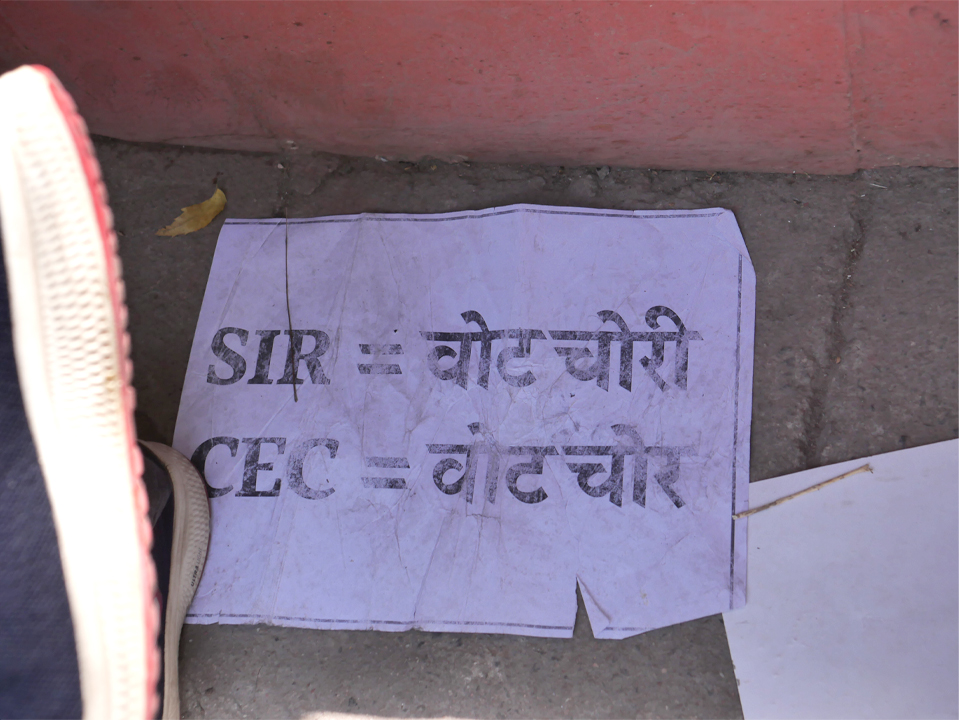
Unlike ‘Jantar Mantar 1.0’, the question of Dharmendra Pradhan’s resignation in this so-called season 2 is then irrevocably tied to accountability from these apex authorities, and the allegations of ‘vote-chori’. Similar to 6 June 2026, when Dipke first landed in India and when the Delhi police underestimated the public’s investment in the issues it was raising enough to actually grant it permission to demonstrate in Jantar Mantar, the 2 October protest is being described as only the start of another upheaval.
“20 July was the climax,” said a shopkeeper outside Barakhamba Road who’d spent his day watching unaware commuters foolishly pressing the elevator button on the station’s ramp entry only to realise five minutes too late that the station had been shut down as his afternoon entertainment. “I don’t think it matters what we do. We’ll be protesting here in Delhi and there BJP will win the UP elections while no one is watching,” he said morosely. “But I think this is only the beginning. I don’t think Delhi is in the mood to quiet down anytime soon.”
Protests resume tomorrow, Saturday, 3 October 2026, at 1 pm.
Mouli Sharma is a journalist based in New Delhi. She currently writes for GroundXero, and her work has appeared in various publications.