
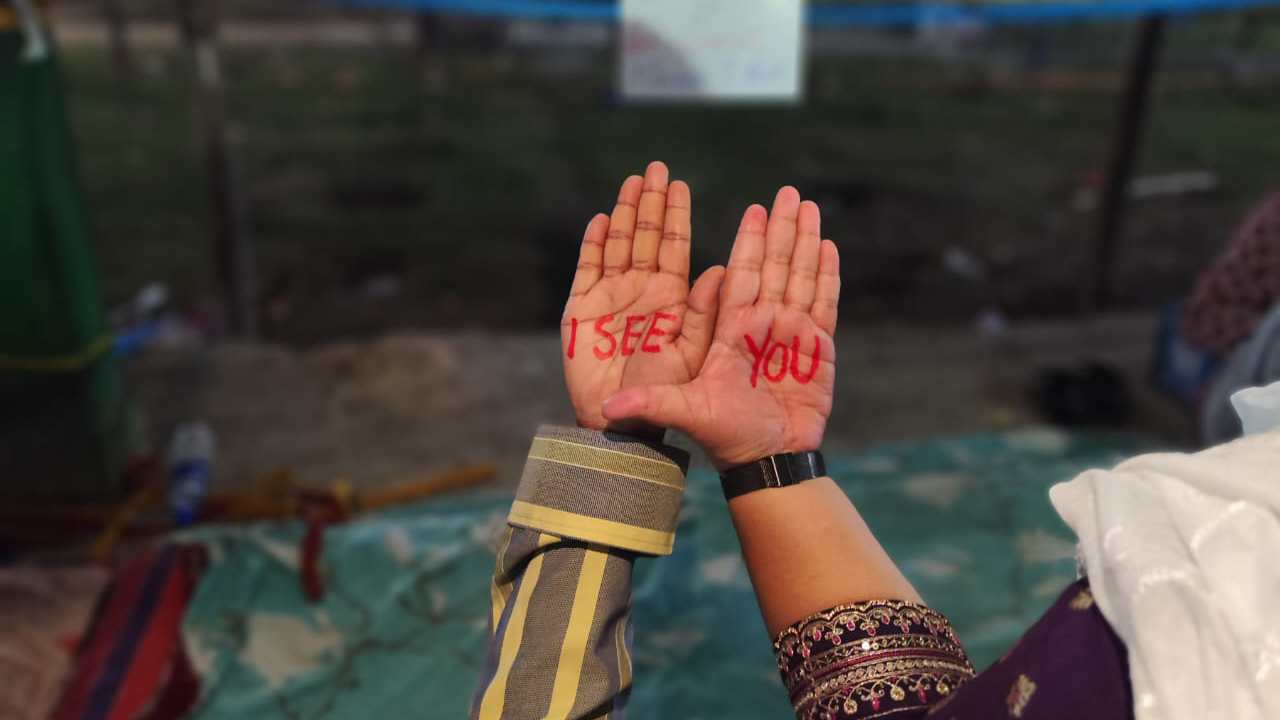
What does it mean to be reduced to a name on a list—one that can be erased by the State at its will? On International Working Women’s Day, women opposing the SIR process gathered at Park Circus Maidan in Kolkata, and answered that question not through slogans alone, but by reclaiming identity as something lived, shared, and fiercely defended.
By Pritha Paul
Throughout the history of the working women’s movement, one struggle that rears its head like the Hydra is the question of intersectionality in women’s identity. The reactionary forces have, time and again, attempted to establish women as one-dimensional beings devoid of socio-cultural history and politics, and continuously invisibilised the varied facets of their existence. As a result, Muslim women, Kashmiri women, Dalit women, Adivasi women – all have been reduced to their womanhood alone, despite their existence encompassing complex experiences associated with their identity as a Muslim, or a Kashmiri, or a Dalit, or an Adivasi individual. The Indian state, as all other fascist, occupying or imperialist states, has used this narrative of “liberating women” to delegitimize struggles within oppressed communities, and it has consistently ignored and silenced the voices of those very women who have demanded liberation for their communities from oppression and occupation.
It is in this spirit that the Hindutva regime which boasts of wanting to liberate Muslim women also disenfranchises them through the SIR process or disqualifies them through the CAA. It is within the folds of this narrative that a woman exists isolated from her community and divorced from the relations she has formed in society – familial, friendly or otherwise – that the state expects and assumes compliance from a woman while attacking her much loved ones. On the other hand, the fascist state contradicts itself when it views the women of the majority community as an extension of the community itself, and upholders of the honour and dignity of that community. They deny them any agency and expect them to be not only subservient but also representatives of their community, discarding their shared womanhood with the women of other, often persecuted and marginalized, communities. It is only through the fierce exercise of their agency that these women come together to not only demand an end to patriarchy but also an end to fascism, hatred and division.
This International Working Women’s Day witnessed this fierce determination in the women of West Bengal when across religions, across languages, across cultures, women gathered to celebrate 8 March 2026 at Park Circus Maidan. The gathering was not a one-off event. From 4 March 2026 onwards, an indefinite sit-in protest at Park Circus Maidan was announced by Votadhikar Raksha Manch in opposition to SIR and arbitrary voter deletion in West Bengal. Since then, every evening, people of different faiths have been breaking bread together at Iftar for the same cause. On 8 March the women planned to protest in a unique manner, rejecting the molds they are asked to fit in by the state and society and asserting and celebrating themselves through the eyes of their comrades and companions.
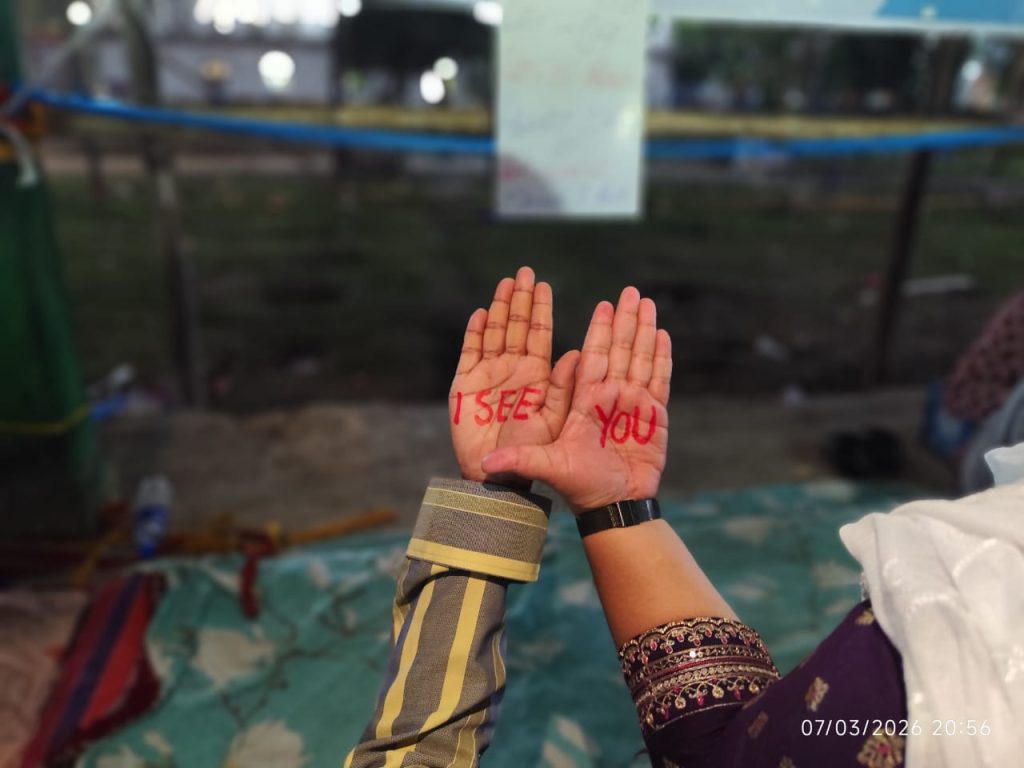
Poster for the event “Identity Beyond Labels”
In the event titled “Identity Beyond Labels”, women would write on each other’s palms and hands how they appreciate the women next to them when they see them. The invitation for the event read as follows:
“In this activity, women will write messages on each other’s hands expressing how they recognise the woman next to them, beyond the labels of daughter, wife, sister, or mother. The idea is to acknowledge women as individuals with their own identities, dignity, and citizenship.
This is a peaceful protest against the SIR process that reduces women to mere names in papers subject to documentation, deletion, hearing and adjudication ignoring their lived identities and contributions to society.
Through this collective gesture, we stand together to affirm that a woman’s identity is her own, and cannot be reduced to bureaucratic labels.”
As the clock struck three in the afternoon, women slowly but steadily formed a circle with markers and sketch pens in their hands. They saw each other, looked into each other’s eyes, thought for a few seconds and began writing on each other’s hands. Once everyone had finished writing, they held out their hands to show others what was written.
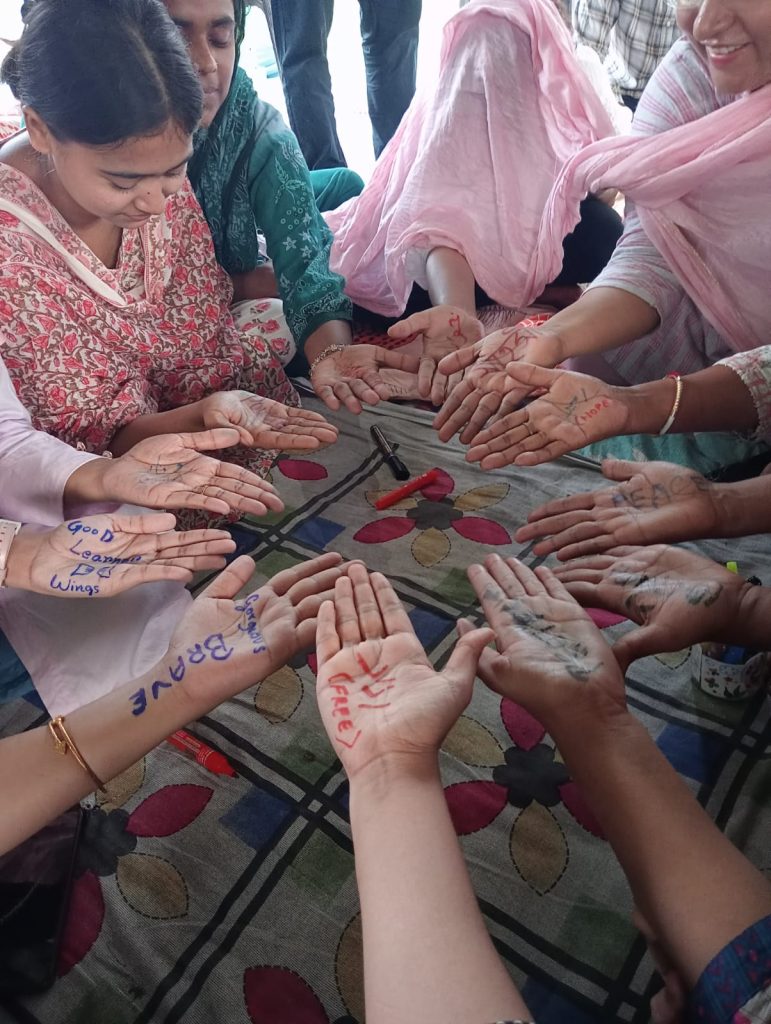
Women showing each other what words have been used to describe their identity beyond labels
Shampa Sirin, a social worker who was an active participant in the protests against NRC, wrote the word PROTEST on her partner Rojina Ahmed’s palm. Shampa said that the only way women can break away from oppression and silence is through protest. She said that not just on 8 March but for women to be free, they must rebel every day, everywhere. So, when she looks at Rojina, she is reminded of the word protest. Rojina herself wrote the word PEACE on Shampa’s palm. She said that they have all come together to peacefully demand what is rightfully theirs, their right to vote. She stated that she wants peace for all and when she turns to her friend, she is reminded of their determination for a peaceful resolution.
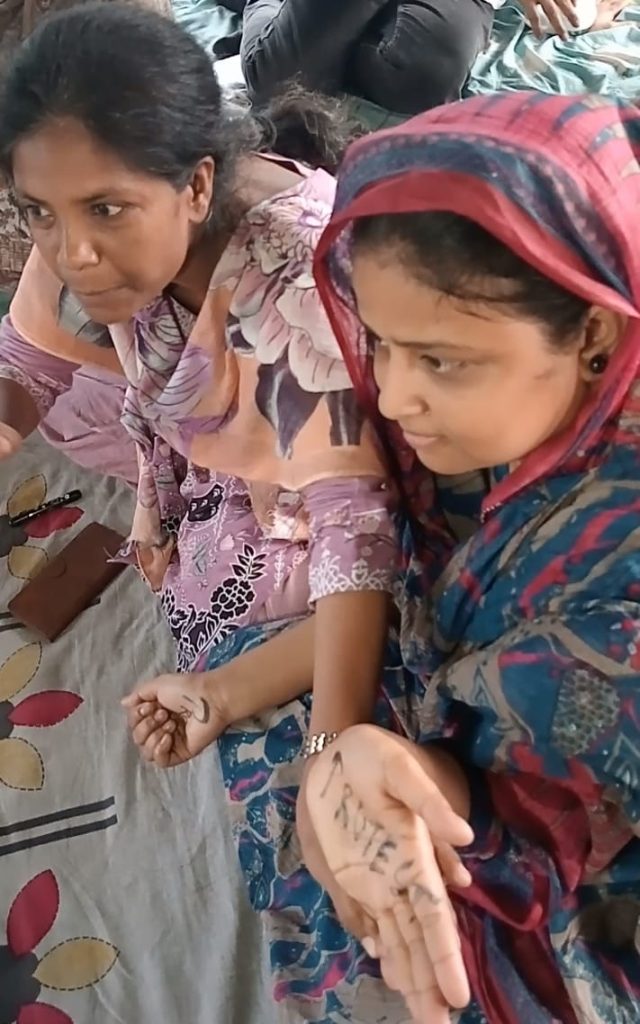
Shampa Sirin explaining the meaning behind her chosen word PROTEST
Dr. Nousheen Baba Khan, an activist and social worker involved in the movement against NRC back then and against SIR, wrote HOPE or UMEED on her partner Anwari ji’s palm. Nousheen explained her choice of word by drawing attention to how traditionally women have been associated with hope – they are the source of a new generation, they carry in their wombs the hope of the future. But Nousheen rejected this traditional lens of viewing women. She emphasized that her partner in the activity, as also every woman, brings her hope by rising above the labels. She stated that women have been the strongest pillar of society and they are the ones who can usher in a new future – not as a mother through their children, but as themselves through struggle and perseverance. She lamented the belief that men have undisputed authority on the bodies of marginalized women and also the fact that the state has been attacking the bodies of women with various weapons, be it CAA, the hijab ban, moral policing, casteist atrocities and now SIR. When women, who have been reduced to just their body, or to an object, or to their names, or to labels, rise up and demand to be seen, it gives immense hope to all of us.
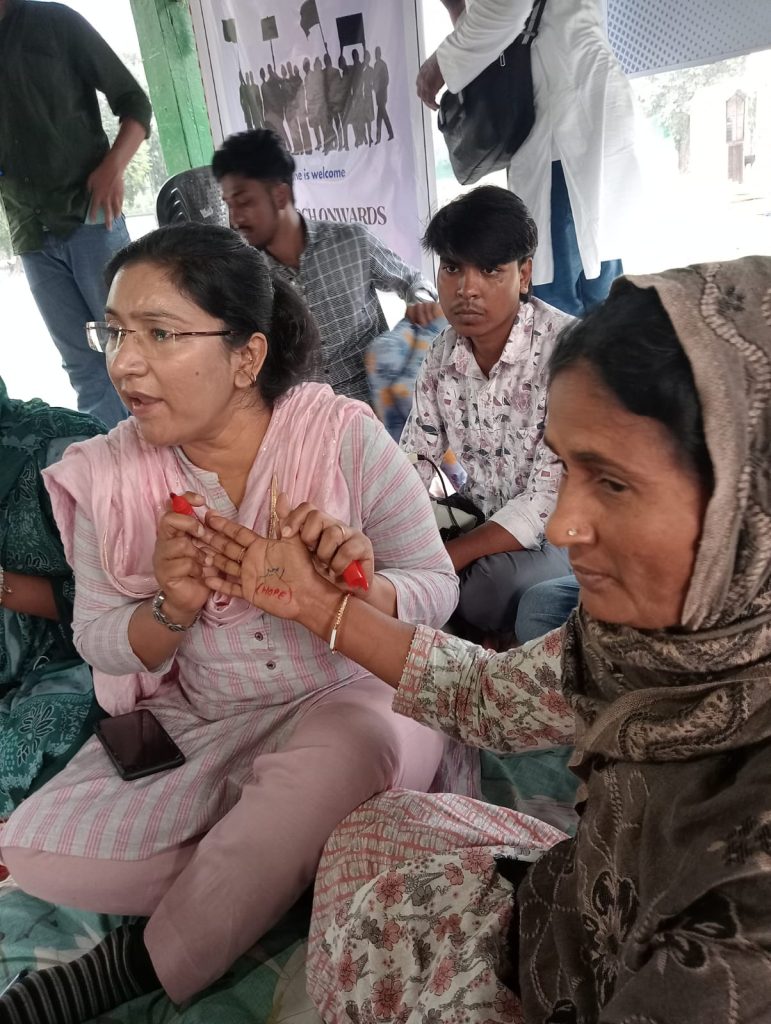
Nousheen explaining why she wrote the word HOPE on Anwari ji’s palm
Anwari ji came to the protest gathering all the way from Uttar Dinajpur. She said she came to the protest to understand the SIR process, to know what her rights are. She came with a heavy heart, drowning in unfathomable uncertainty. She stressed the practical ramifications of the name deletions. “We are poor people”, she said. “If our names are deleted, we will not receive any help from the government. How will we live, then? How will we survive? We need to know this. We need to understand this. This is why I am here today.” Indeed, Anwari ji had come to the demonstration with nothing but a lot of pain and even more hope. She came in search of people who would stand with her shoulder to shoulder and demand their rights and hers alike.
Meghomala is one among those women. She comes to the protest almost daily, solely in solidarity. Her name has been cleared by the ECI. But she keeps coming and coming back to the protest site, and she sits there patiently, raising slogans against SIR and for the unity of the people – “Awaz do… Hum Ek Hai”. AWAZ or VOICE is also written on her palm. When asked why she is here, she responds quickly and confidently, with no strain of hesitation in her voice, “the current regime at the Centre, with the help of the Election Commission, is attempting to silence us. I am here to not let that happen. It does not matter that my name is not deleted or disputed. I have come for others. So that tomorrow when I am pulled up by the State, they can come to my aid.”
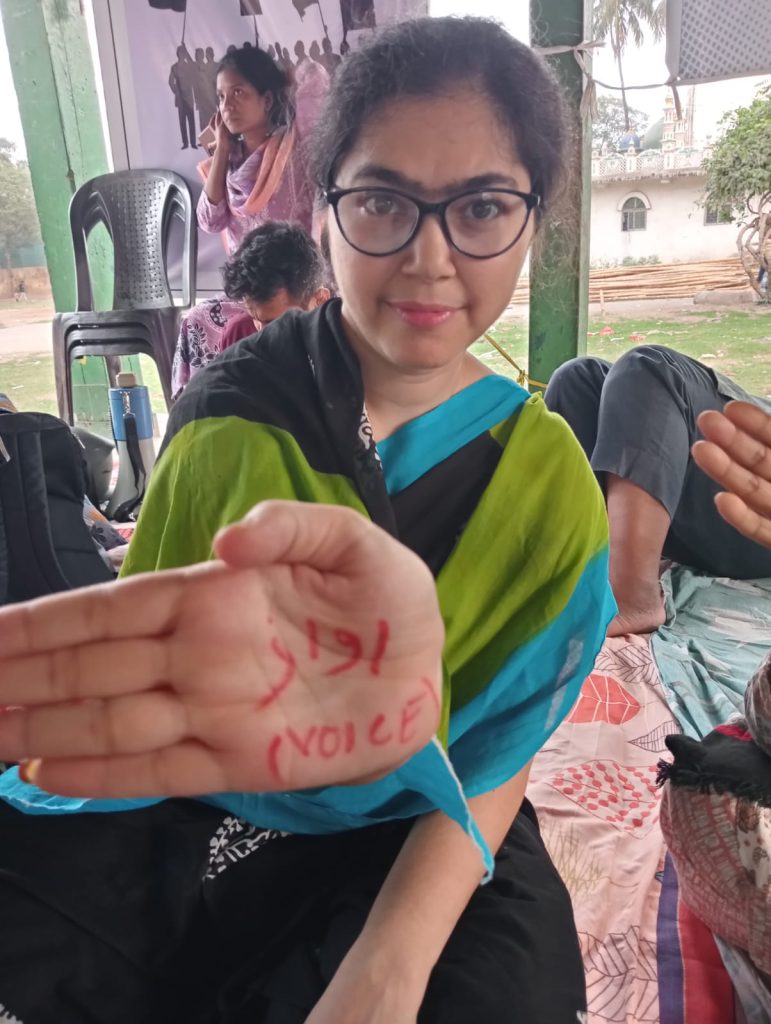
Meghomala showing her palm adorned with the word AWAZ or VOICE
Solidarity takes strength – of character, of conviction. So, it is hardly a surprise that Sadaf Noor wrote STRONG IS BEAUTIFUL on Chandana’s palm. Sadaf is accompanied by her daughter Maariya. Being in school, Maariya expressed her regret at not being able to come to the demonstration more often. “I also need to focus on my education. I can only come here when there is a holiday. But my mother comes here every day. My father too.” Maariya likes to study History and Life Science, but above all English. Mother and daughter took part in the activity sitting side by side. I asked Maariya what word she chose to describe Sadaf. Without missing a beat, she replied promptly: INSPIRING. “My mother always motivates me to explore new avenues. I am an entrepreneur and I am running my own business, all because she inspired me to. When I was young, I remember I used to come to this very place to participate in the anti-NRC movement. I was inspired by her. I do not know how many kids are fortunate enough to be so aware and active. I am extremely proud of her and proud to have someone like her in my life who teaches me and inspires me so much.”
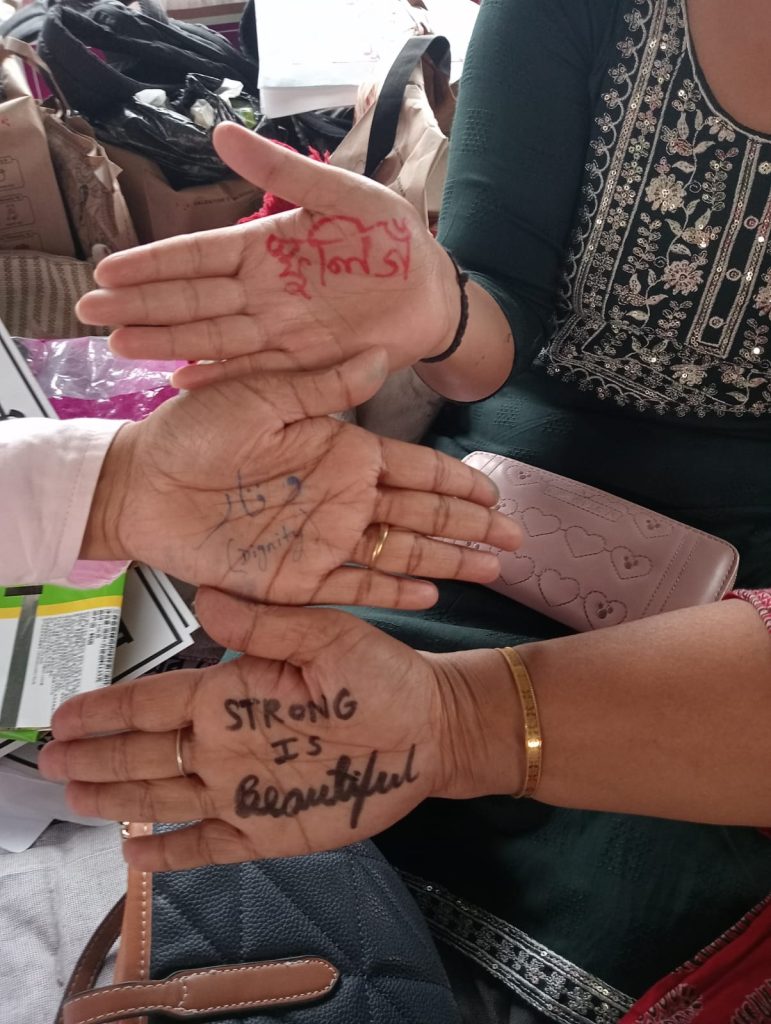
Palms of three women flaunting their qualities in three different languages
Sadaf, on the other hand, wrote the word SHATHI or COMPANION on Maariya’s palm. Sadaf candidly explained, “Maariya is the person closest to me. She has always supported me on happy and sad days. She stood by me through my mistakes. After my mother, she is someone I can call my companion as she has always been by my side. But today, I call her my companion, not with joy but in pain. The state has questioned my existence as a citizen, what future can I offer her? Yet she calls me inspiring, she looks up to me.” Sadaf’s agony became more and more visible as she spoke. Women have passed down precarity through generations, but also courage, resilience and resistance. Sadaf and Maariya are an example of precisely this inheritance.
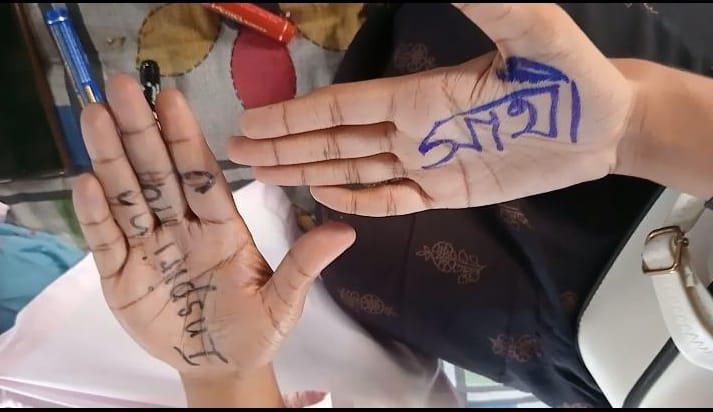
The palms of Sadaf Noor and Kazi Maariya
I am reminded of the several kids spending their day at the protest site. Be it Maariya, or her brother. Maariya informed me that her brother is now 8 years old, studying in the second standard. He was 2 years old during the anti-NRC movement. He hovered around his mother and sister and ran away as I tried to approach him. He is shy, Maariya consoled me. “He was so small during the last movement. It has been so many years, but we are back here,” she said. Then there was Nousheen’s son, studying in the third standard, who was busy reading a book during the event. When I asked Nousheen what she wanted her son to learn on that day, she proudly shared with me how despite her being a feminist, her son challenges her own subconscious patriarchal behaviour at times, and how he compels her to check herself time and again. She expressed happiness at the thought that not only has she taught her children well, but that she gets to learn from them as well. I remember wondering: can we leave behind a world worthy of these kids? The protest is perhaps just that attempt.
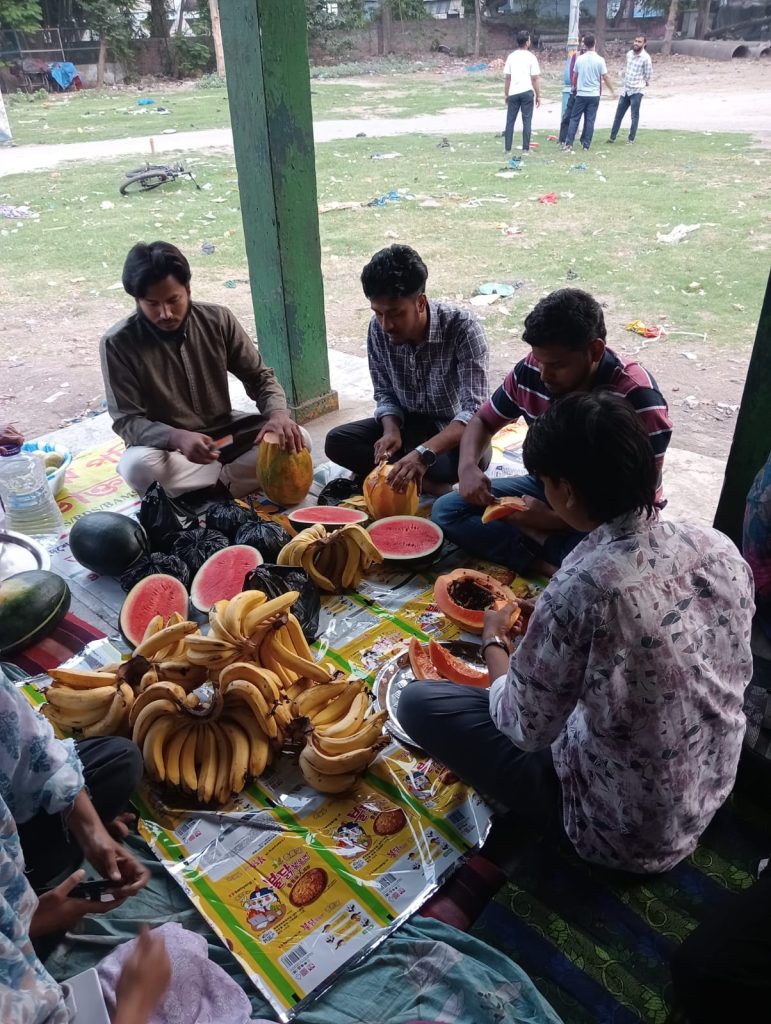
Protestors preparing for Iftar
By the time the event was wrapping up, some of the protestors had begun preparing for Iftar, as they do daily. The others, men and women, broke out into sloganeering and songs – Karar Oi Louho Kopat, Aise Dastoor Ko, Hum Dekhenge. They sang We Shall Overcome in three different languages, keeping to the theme of the event – of breaking barriers. As I sat there documenting the events of the day, Nousheen had glanced at my palm, clean and empty. She had asked me to extend my hand and said she would write her favourite word: AZAD or FREE. Written in red – the colour of blood, love, and revolution. I did not get a chance to ask her if she was describing or predicting. Azad. If not today, some day. Someday, for sure.
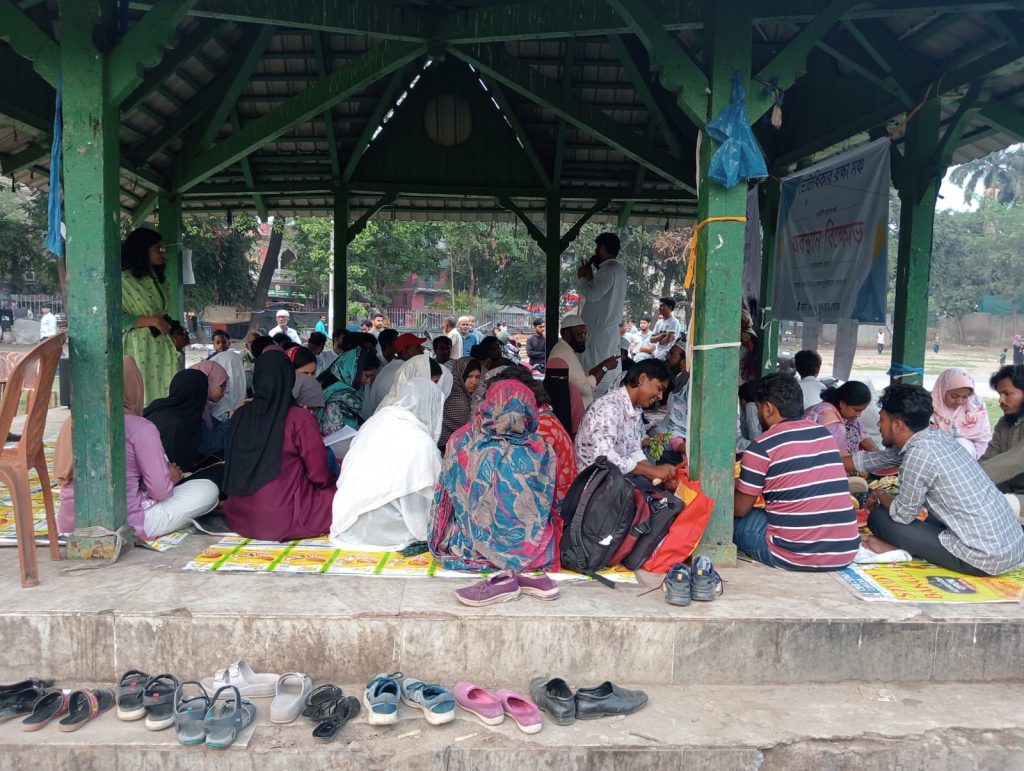
Anti-SIR dharna site at Park Circus Maidan
Pritha is a lawyer and activist. She is part of Groundxero collective.