
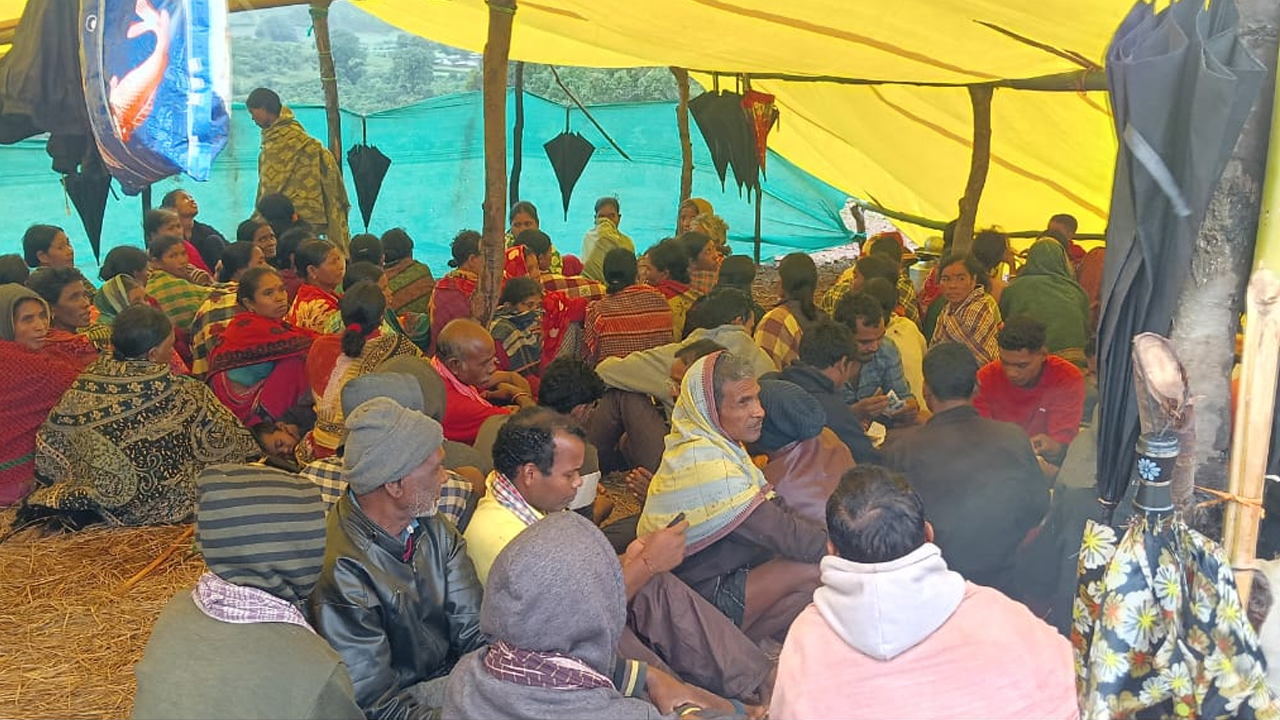
The Adivasi and Dalit communities of Tijimali continue to actively resist Vedanta’s proposed bauxite mining project in the region. An update on the struggle.
Groundxero | November 8, 2025
Since mid-2023, Adivasis and Dalits from Tijmali, Kuturumali, and Majhingmali—located in the Kashipur and Thuamul Rampur blocks of Rayagada and Kalahandi districts, respectively—have been actively resisting Vedanta’s proposed bauxite mining project in the region.
Led by the Ma Mati Mali Surakhya Manch, the movement aims to safeguard people’s livelihoods—deeply tied to the forests, hills, and streams—as well as the broader environment and entire ecosystem they inhabit. Their resistance continues even as news of more and more investment by Vedanta and Adani makes daily headlines in Odisha.
The protesting villagers have set up a camp on the hilltop and have been sitting in protest throughout the long monsoon period braving the inclement weather. Despite police summons to villagers and prohibitory orders imposed by the administration to stop mobilisation, the people are resolute in resistance to the takeover of their water -forest -and land (Jal Jangal Jameen) by the corporate. The last update was published in July, 2025.
This is a brief account of the past few months:
An Update of Events in Tijmali (Raygada-Kalahandi)
Nov 08, 2025
As mentioned in our last update, throughout June 2025 officials attempted going up the road to the mine area. Villagers had many physical confrontations in stopping JCBs, vehicles and other paraphernalia going there, often at odd hours. This road that goes uphill, alongside Sagabari village, leads to Malipadar, a village in Rayagada district and then Tijmali, a village in Kalahandi district. Notably, this is happening despite there being no forest clearance as yet. To put an end to these clandestine entries by the administration and the company, Ma Mati Mali Surakhya Manch members barricaded the entry point and set up a camp on top of Podabandha ghati. Since early July, villagers are on vigil day and night. If there is any big event with many people, they cook there too. Else, they come to the camp after having their meal. The involvement of all entails the collection of Rs 10 per house and a small amount of rice each month. From 10 to 100 villagers stay at the camp, taking turns from each village. It is only during the harvest season that the number dropped to 10 as they got busy with harvesting activities. The protest camp that continued throughout the monsoons until now has engendered a spirit of unity and collective resolve to resist mining.
- On July 11, the visit of Rahul Gandhi, the Leader of the Opposition in Parliament, fuelled hopes in Tijmali. A small delegation visited him in Bhubaneswar that included Narengi Dei Majhi, Krushna Sikaka, Nityadei Majhi, Tikamani Dei and Binati Katraka. They discussed their demand for cancellation of lease to Vedanta, fresh gram sabhas, withdrawal of the hundreds of police cases and release of those languishing in jail. Rahul Gandhi emphasised on protecting the forests and mountains and having proper gram sabhas by due process as per the Constitution.
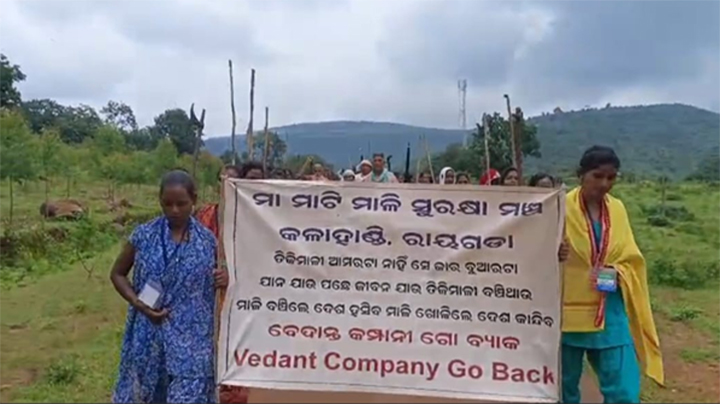
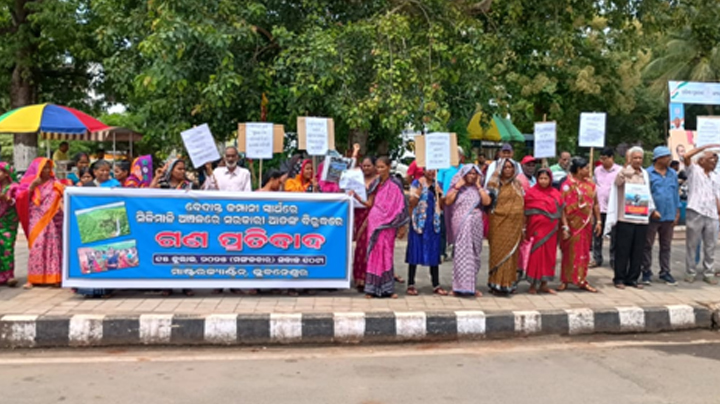
- On July 15, environmentalists, trade unionists, democratic rights activists, housing rights activists and many others organized a collective protest in Bhubaneswar in solidarity with the struggling people of Tijmali. They drew attention to the rising state repression in Raygada and Kalahandi and the arbitrary arrests of villagers opposed to bauxite mining; condemned the continuous spate of summons and prohibitory orders sent out to villagers in Schedule V area; decried the government’s violations of laws of the land like FRA and PESA; and urged the government to uphold the constitutional rights of the people by cancelling the lease given to Vedanta.
- On 18 July, 2025, the Odisha High Court quashed the order of the Raygada Collector that barred Dr Randall Sequeira from entering the district. In an order on June 5, the doctor had been listed along with 23 others when Medha Patkar was on her way to Tijmali on World Environment Day. Significantly, the Court held that blanket bans on protest activities are contrary to Constitutional values. The Court observed that the government should focus on dialogue rather than exclusion in a constitutional democracy. However, the court also spelt out a list of guidelines and restrictions to be observed for events and programmes held by organizations, including obtaining permissions from the administration.
- On 2 August, Narengi Dei Majhi of Sagabari was picked from the Raygada District Hospital by the Rayagada police who impersonated as doctors. She was attending to her daughter-in-law who had delivered a baby. Clearly, she was being taken into custody for being part of the delegation that met Rahul Gandhi the previous month. It is still bewildering how and why police came dressed as doctors to take Narengi Dei Majhi into custody.
- The first week of August, following the arrest of Narengi Dei, witnessed a series of repressive measures by the administration. It was a concerted attempt to stop the celebration of World Indigenous Day (August 9), known as Adivasi Dibas, in Odisha. First, summons were sent to a large number of villagers on probable breach of peace for organizing an event. The Office of the Sub-Collector (Raygada) served notices to leading activists from Kantamal, Kerpai, Bondel, Sagabari, and Bantej for their “alleged involvement in the antisocial activities of the locality which posed a threat to the peace and tranquillity in the locality.” Second, prohibitory orders were issued to two organizations, namely Ma Mati Mali Surakhya Manch and Niyamgiri Surakhya Samiti. Third, prohibitory orders were issued to seven individuals. Among them, the order mentioned pending criminal cases against Lingaraj Azad, Prafulla Samantara, Narendra Mohanty and Medha Patkar to underscore the dangers, apparently inherent, if the programme on August 9 was allowed to take place.
Instead of responding to people’s countless appeals and memoranda submitted to the local administration and all concerned government agencies, the administration is continuously criminalizing people of the region as well as all those who stand up in support for the constitutional rights of Adivasis and Dalits.
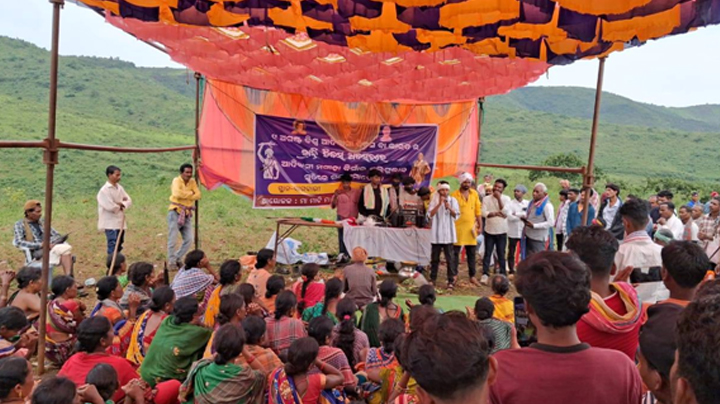
- August 9, World Indigenous Day, was observed not only with these strict warnings but also with drones flying over the area warning villagers not to step out of their houses. Yet, villagers made their way to the event at the protest site at Podbandha ghati. A big group from Talaampadar had to confront police personnel roughing them up. Despite police swarming over the area, over two thousand people attended the event. Laxman Majhi, of Kerpai village, presided over the meeting. As usual, there was an overwhelming presence of women. Erstwhile political leaders of the opposition parties also attended the event although these parties had initially in 2023 allied to support Vedanta’s mining plans.
- On August 25, the Forest Advisory Committee constituted by the Ministry of Environment, Forest and Climate Change deferred the decision of forest clearance through diversion of 708.2 hectares of forest land for Vedanta. The Advisory Committee directed the government and the company to provide clarification or information on the following issues:
a.The state government has provided relevant documents stating that the process under the Forest Rights Act has been completed in a fair and proper manner. However, the state government documents are silent on all the issues raised by the people through their claims and the petition filed in the Orissa High Court (fake, forced and arbitrary Gram Sabha). Notably, the High Court in its judgment had said that the government should address the issues raised by the people and the petitioners.
b. Out of the land earmarked for compensatory afforestation of the Vedanta Tijmali Bauxite Project, 8.02 hectares of land has already been earmarked for compensatory afforestation of the Dubna-Sakradihi Mining Project. But the government has not provided information on the current status of afforestation in this area.
c. According to the government, the forest area proposed for mining is highly vulnerable to soil erosion due to its steep slopes. Due to deforestation and mining, water will flow rapidly, soil will be eroded and streams will get buried. Further soil erosion will occur due to excavation of topsoil and blasting for mining. No plan has been presented to address the problem of soil erosion.
d. According to the information provided by the forest officials, most of the areas earmarked for the proposed compensatory afforestation are covered by slash-and-burn farming and village roads. Accordingly, the government was asked to ensure that the areas intended for conservation afforestation are suitable for planting trees and free from unauthorized entry and to provide a detailed report on each afforestation area. In this regard, the government has only mentioned the detailed plan for conservation afforestation. But the government has not provided the report that is supposed to be given to ensure that each area is free from all kinds of restrictions.
e. The government was asked to report that there is no violation of any authority. The government has not said anything in this regard.
f. It has been said that there is a presence of elephants in the proposed project area. Therefore, the opinion of the Elephant Project Division should be taken in this regard. (Source: Minutes of the Forest Advisory Committee meeting held on August 25)
This relief, however temporary, brought rejoice to the people of the region.
- August and September have been tough both at the court and on the ground as people are fighting at every level. On one hand, the litigation process for those incarcerated, namely Jaleswar Naik, has become tedious as fresh charges are being foisted. On the other, Vedanta attempted multiple times to begin its Peripheral Development work as part of its CSR activities. People have resisted the construction activities, stopped vehicles from entering the area, and stopped the setting up of street lights, all of which were claimed to be part of a Vedanta CSR project.
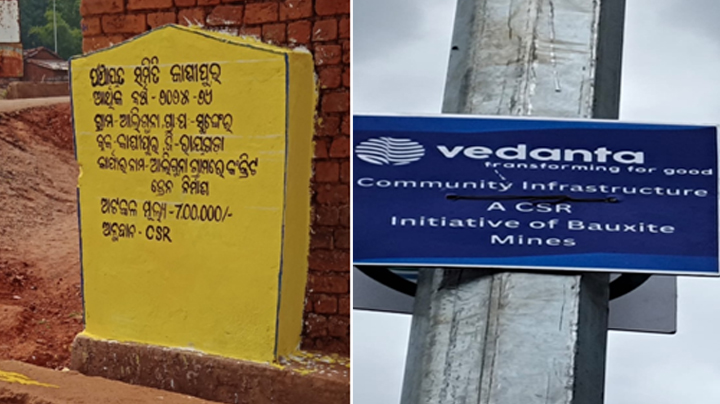
- Padman Naik, a leading activist and singer from Bantej village, was arrested on 13 October near Karlapat by Kalahandi Police. A public meeting had been called by Niyamgiri Surakhya Samiti, Khandualamali Stai Surakhya Samiti and Maa Mati Mali Surakhya Mancha in Lanjigarh. The district administration had passed an order on October 10 prohibiting the participation of Padman Naik along with 10 others in this event. Prohibiting village activists and leaders from attending their own programmes and events and arresting them for the same has become the modus operandi. The hundreds of fabricated charges that the administration of these two districts has accumulated over the last two years come handy for arrests.
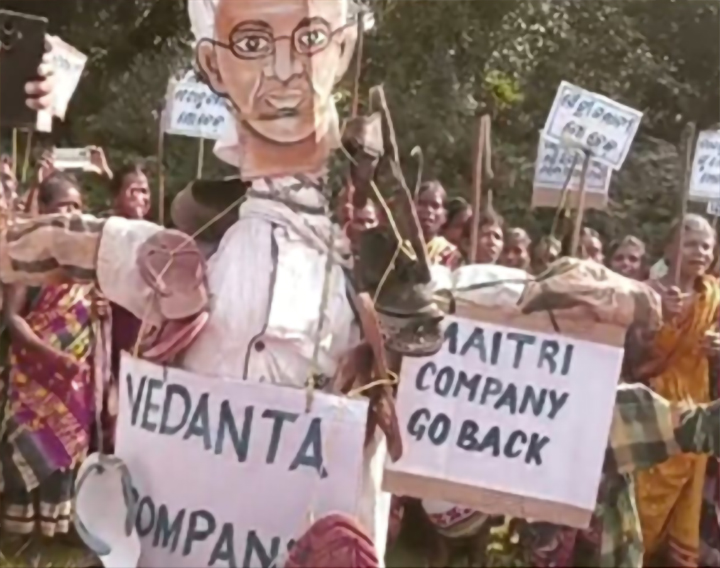
- On 17 October, a small meeting of Maa Mati Mali Surakhya Manch was planned to discuss the continuing police repression on the movement. What was intended as a small meeting turned out into a massive protest with close to 2000 people coming from villages in Raygada and Kalahandi to Serambai village at the foot of Majinghimali. The police cordoned of the two roads leading to Serambai to prevent people from coming to the meeting. Effigies of Vedanta, Adani and Mythri companies were garlanded with footwear. From 11 am onwards, many women and men shared their own stories of resistance to company agents. A lot of singing took place. A new version of Gaon Chadabo Nahin was sung by Reena Majhi of Talaampadar village. Many women expressed rage at being stopped on the way to the Lanjigarh event of October 12. Demands to release Narengi Dei Majhi, Padman Naik, Jaleswar Naik, Ramakant Naik and Sundarsingh Majhi rent the air. Many Boleros with police passed by the meeting twice but songs, slogans and axes rose on shoulders kept all at bay. Finally, there was joyful dancing with the burning of the effigies and people pledged to protect their land and hills and their supreme deity, Tij Raja.
________________
Update compiled by: Ranjana Padhi and Dr Randall Sequeira
Contact email ID: formountainsandforests@gmail.com