
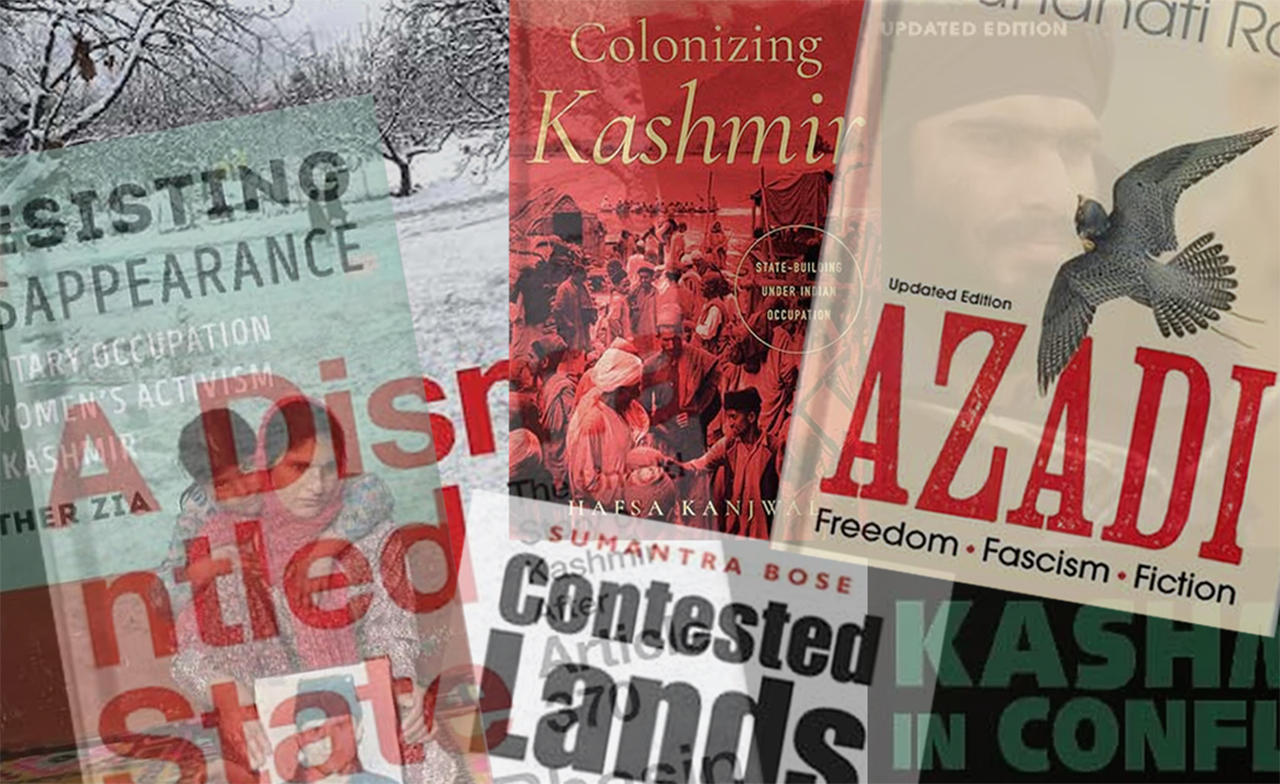
The ban on several books on Kashmir has drawn sharp criticism from various quarters, including academics, authors, activists, right organisations and political parties, who view it as an attack on freedom of speech and expression and as an authoritarian attempt to silence critical perspectives on Kashmir by the current union government.
Groundxero | Aug 9, 2025
On 5th August, 2025, Lieutenant Governor Manoj Sinha-led administration in Kashmir invoked Section 98 of the Bharatiya Nagarik Suraksha Sanhita to declare 25 books on Kashmir as propagating “false narrative and secessionism”. The order issued by the Jammu and Kashmir government’s home department declared these books “forfeited”.
As per the government notification, these 25 books by acclaimed public intellectuals, authors, academics, and journalists such as Arundhati Roy, Christopher Snedden, Sumantra Bose and A G Noorani, Anuradha Bhasin, Sugata Bose were “found to excite secessionism and endangering sovereignty and integrity of India, thereby, attracting the provisions of Sections 152, 196 & 197 of Bhartiya Nyaya Sanhita 2023.”
The ban order was issued exactly on the sixth anniversary of the abrogation of Article 370 by the BJP-led Union government in 2019, following which Jammu and Kashmir was bifurcated and demoted into two Union territories.
The home department order means that publishing houses will no longer be able to distribute or reprint these books again. Section 98 of [the] Bharatiya Nagarik Suraksha Sanhita 2023” empowers the government to seize books or other documents, and also issue search warrants for such documents.
There are already media reports of book stores across Kashmir being raided by police following the ban. In Srinagar city, many bookstores were raided with police looking for confiscating the banned publications. Police also conducted raids on bookstalls at Chinar book festival in Srinagar, which was inaugurated by the Lt Governor last week.
Similar search and forfeiture of banned books were done across several districts in Kashmir. The police said the “objective of the operation was to identify, seize, and forfeit any literature that propagates or systematically disseminates false narratives, promotes secessionist ideologies, or otherwise poses a threat to the Sovereignty and Unity of India”.
The ban has drawn sharp criticism from various quarters, including academics, authors, activists, right organisations and political parties, who view it as an attack on freedom of speech and expression and as an authoritarian attempt to silence critical perspectives on Kashmir by the current union government.
Coordination of Democratic Rights Organisation (CDRO) in a press statement said “Behind this authoritarian step lies the fascist’s desire to control every opinion through the choking of democratic voices.”
The authoritarian step has raised concerns about the suppression of academic and historical research on Kashmir and the potential chilling effect this move will have on future discourse that challenges state narratives of power and history in the region.
As well known Kashmiri journalist Anuradha Bhasin wrote in her X post, the government is “scared of words challenging… [its] lies!” Bhasin’s book ‘The Dismantled State: The Untold Story of Kashmir After 370’, which chronicles the untold story of Kashmir post-abrogation of article 370 is among the banned books. Her book is based on eyewitness accounts from a range of people with an aim to understand “what happened in the Kashmir Valley” after August 2019.
Referring to the list of banned books, Bhasin wrote in a Facebook post:
“They’re well researched & not one glorifies terrorism which this govt claims to have ended. Scared of words challenging your lies! I challenge the book banners (a ridiculous sign of a depraved mind) to prove a single word that glorifies terrorism. For those who value truth, read it and judge for yourself.”
Victoria Schofield, author of one of the 25 banned books, in an article published in The Wire wrote:
“My own book Kashmir in Conflict – does not, as is alleged of all the banned books, ‘glorify terrorism’ – it explains disaffection. It does not distort history, it provides an account through multiple voices of why the dispute arose, why it has not been resolved and why, to achieve peace and stability in the region, dialogue among the protagonists is essential.”
Piotr Balcerowicz (a professor of Indian philosophy, religions and history and currently teaching at the University of Warsaw), whose two works – Human Rights Violations in Kashmir (Routledge, 2022), and Law and Conflict Resolution in Kashmir (Routledge, 2022) – are among the banned ones, in an article in The Wire said, “nothing in my books or in other titles contained in the proscribed list I happen to know, could be even vaguely related ‘to the propagation of false narrative and secessionism in J&K’ or ‘to the excitement of secessionism and endangering sovereignty and integrity of India’”.
Former chief minister of Jammu and Kashmir and Peoples Democratic Party (PDP) president Mehbooba Mufti decried the ban and said banning books would not erase history.
Hurriyat chairman and the Kashmir’s chief cleric, Mirwaiz Umar Farooq, said “Banning books by scholars and reputed historians will not erase historical facts and the repertoire of lived memories of the people of Kashmir.” “It only exposes the insecurities and limited understanding of those behind such authoritarian actions,” he wrote on X.
Rashtriya Janata Dal MP Manoj Kumar Jha, pointed to an inherent fear of ideas, debate, and dissent among rulers. Reacting to the ban, he said, “Democracies thrive on the free exchange of thoughts, even those that are uncomfortable or critical of the ‘official truth.’ The moment we ban a book, it signals not the strength, but insecurity. It also exposes the government’s inability to engage with opposing viewpoints through dialogue.”
CPI(M) Politburo member from Kerala Subhashini Ali sarcastically wrote, “First they said terrorism would vanish after demonetisation, then after 370 revocation, now after banning of books!!”
The Politburo of the CPI (M) issued a statement terming the censorship as yet another “expression of authoritarianism and a brazen attack on the freedom of expression.” The party demanded immediate revocation of the ban on the books; restoration of Statehood for Jammu and Kashmir, along with full democratic rights without delay.
CDRO while condemning the banning of books on Kashmir said that these are brazen attempts to curb opinions which are critical of the present regime and prevent the public from learning multidimensional aspects of political discourses and becoming an informed, rational citizen.
It has demanded an immediate withdrawal of this anti-people notification. It has urged all democratic-minded people and, in particular, the authors, journalists and other media personalities, to stand united against the authoritarian notification and express public solidarity with the authors whose books have been banned.
CDRO has also pointed out that the bare fangs of fascism are becoming more conspicuous and ready to impose itself on the public, democratic institutions, and the population, and it is high time people stand united against all such onslaughts.
We conclude this report by quoting Piotr Balcerowicz, who reminded us in his article of the grim history of the Nazi Germany. Piotr wrote:
First, it was books that burnt throughout Nazi Germany, simply because they were considered by the political system to misguide the youth, radicalise the people, incite violence or impact the psyche of youth by promoting undesired ideas, or distort historical facts. A few years later, books were replaced with human beings in gas chambers.