
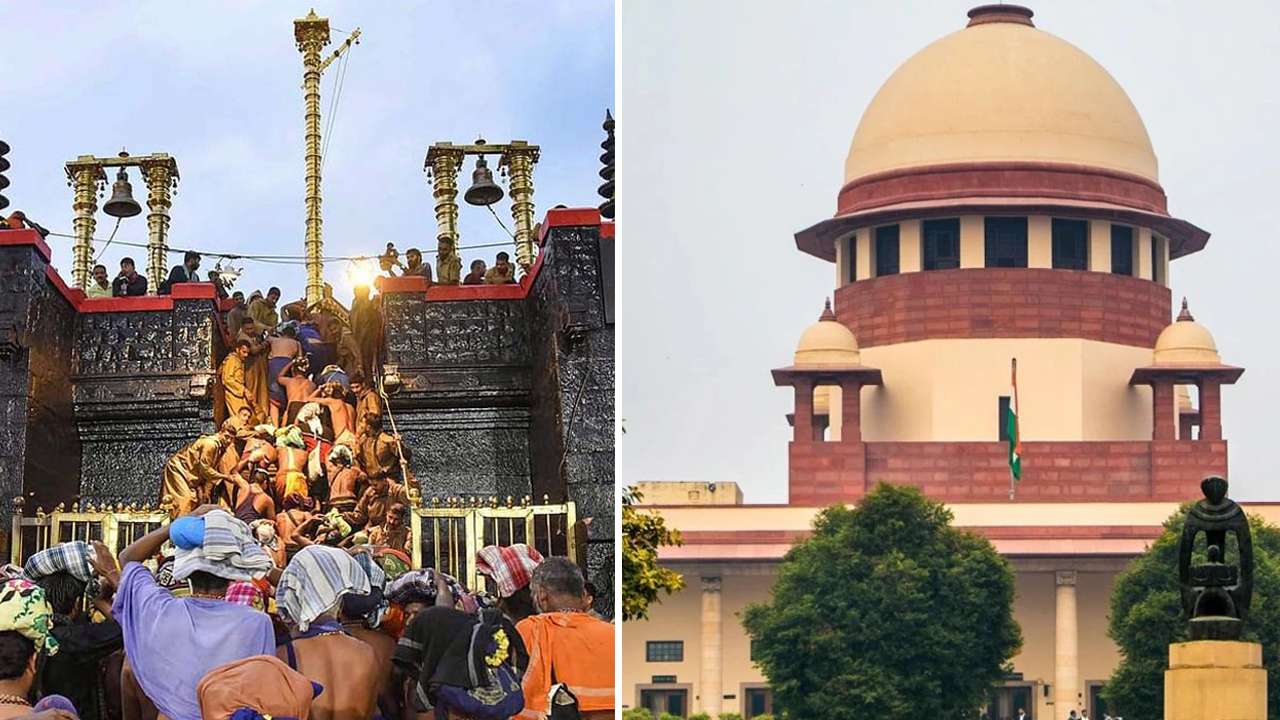
When the government’s top lawyer tells the Supreme Court that the 2018 Sabarimala verdict was “wrong in law,” he is not making a jurisprudential argument. He is making a political declaration — and women’s bodies are its currency.
Groundxero | April 15, 2026
by Tinku Khanna
When Solicitor General Tushar Mehta stood before the nine-judge Constitution Bench on 7 April 2026 and argued that the Supreme Court’s 2018 Sabarimala judgment was “wrongly decided” and must be declared “wrong in law,” he stripped away the usual procedural camouflage that surrounds such cases and stated the Modi government’s position with unusual directness: the State of India believes that menstruating women should not be allowed to enter the Sabarimala temple, and the court that said otherwise was mistaken.
The Solicitor General of India — the second-highest law officer of the Union, speaking in the name of the Government of India — appeared before the highest court in the land to argue, in effect, that a woman’s biology makes her an appropriate subject of exclusion from a public place of worship. He dressed this in the language of “denominational autonomy” and the deity’s “unique celibate nature.” But beneath the constitutional vocabulary, the argument is elemental and ancient: the menstruating female body is a problem, its presence is a contamination, and the State should protect the theology that says so.
Let us be precise about what Mehta actually argued. His submission rested on two claims. First, that, religious practices concerning a deity’s specific nature — in this case, Lord Ayyappa’s celibacy — should be insulated from judicial scrutiny under a doctrine of denominational autonomy, meaning that the faith community alone has the right to determine what its essential practices are. Second, that the 2018 judgment erred by applying constitutional morality to override what he characterised as the living faith of millions of devotees. The Union of India, he made clear, supports the review petitioners who want the 2018 verdict overturned.
Feminist analysis requires that we read these arguments not merely as jurisprudential positions but as political choices — choices made by a particular government, at a particular moment, in service of a particular ideological project.
A Case Eight Years in the Making: A Brief Timeline
The Sabarimala dispute did not begin in a courtroom. For decades, the Travancore Devaswom Board and the temple’s hereditary priesthood enforced a customary ban on the entry of women between the ages of ten and fifty — that is, women of menstruating age — into the hilltop shrine of Lord Ayyappa in Kerala’s Pathanamthitta district. The justification offered was theological: Ayyappa is a “naishtika brahmachari,” a permanently celibate deity, and the presence of women of reproductive age is held to disturb the sanctity of that celibacy. This custom was given legal sanction under Rule 3(b) of the Kerala Hindu Places of Public Worship (Authorisation of Entry) Rules, 1965, which permitted the exclusion of women from temples “at such time during which they are not by custom and usage allowed to enter.” What follows is the sequence of events that brought this practice before the highest courts in the land.
1991: The Kerala High Court upholds the ban, ruling that the restriction on women of menstruating age is a valid religious practice protected under Article 26 of the Constitution.
2006: The Indian Young Lawyers Association files a PIL (Public Interest Litigation) in the Supreme Court challenging the constitutionality of the exclusion, arguing that it violates the fundamental rights of women under Articles 14, 15, 17, 25, and 26.
28 September 2018: A five-judge Constitution Bench of the Supreme Court, by a majority of 4:1, strikes down the ban. Chief Justice Dipak Misra, along with Justices R.F. Nariman, A.M. Khanwilkar, and D.Y. Chandrachud, holds that the exclusion constitutes discrimination on grounds of sex and physiological features, and violates the constitutional guarantee of equality and dignity. Justice Indu Malhotra dissented, arguing that matters of religious faith and custom should not be subject to judicial scrutiny. The majority judgment holds that “devotion cannot be subjected to the rigidity of gender.”
October–December 2018: Multiple attempts by women to climb the hill are thwarted by large crowds of protesters, in scenes of considerable violence. The Kerala government, then led by the Left Democratic Front under Chief Minister Pinarayi Vijayan, deploys police to facilitate entry, and files an affidavit in the Supreme Court supporting the verdict. Several review petitions are filed by religious bodies, political organisations, and individuals seeking to overturn the judgment.
2 January 2019: Bindu Ammini and Kanaka Durga, accompanied by police protection, become the first women of menstruating age to enter the Sabarimala temple after the Supreme Court’s ruling. The event triggers further protests and considerable political controversy across Kerala.
22 January 2019: A five-judge bench, by a majority of 3:2, refers the review petitions and related matters to a larger bench of at least seven judges, citing the need to examine broader questions about the relationship between religious freedom and constitutional rights. The court does not stay the 2018 judgment. Justices Chandrachud and Nariman dissented, arguing that the review petitions should be dismissed outright.
2020–2025: The matter remains pending before a nine-judge Constitution Bench, alongside related questions including the validity of the practice of female genital mutilation in the Dawoodi Bohra community and the entry of Muslim women into mosques. Hearing dates are fixed and repeatedly deferred. The political salience of the Sabarimala issue fluctuates with election cycles, and successive state elections in Kerala.
A Movement Divided: Women’s Organisations and the Sabarimala Question
It would be a convenient simplification to say that women’s organisations, as a bloc, stood behind the 2018 verdict. The reality was considerably more fractured — and that fracture itself tells us something important about the Sabarimala question that the courtroom arguments tend to obscure. The dominant strand of organised feminist opinion in India did support the verdict unequivocally. The All India Democratic Women’s Association (AIDWA), the women’s wing of the CPI(M), was among the most vocal in welcoming the judgment, framing the ban as a form of sex discrimination rooted in menstrual impurity ideology. The National Federation of Indian Women, the Kerala Women’s Commission, and a number of independent feminist collectives and legal advocacy groups likewise argued that the exclusion was constitutionally untenable and that women’s right to worship on equal terms could not be subordinated to theological custom. Zakia Soman’s Bharatiya Muslim Mahila Andolan, working on the parallel question of Muslim women’s exclusion from mosques, drew explicit connections between the two struggles, arguing that the logic of bodily impurity — menstrual, moral, or otherwise — is the common idiom through which religious patriarchies deny women full participation in their own faiths.
But this consensus was complicated by two distinct counter-currents within the women’s movement itself. The first came from women devotees who organised under various platforms — most visibly the “Ready to Wait” campaign, which mobilised thousands of women, many of them Kerala housewives and practitioners of Ayyappa devotion, who argued that their choice not to enter Sabarimala during menstruating age was precisely that: a choice, rooted in faith and freely exercised. The campaign was later found to have received support from right-wing political networks, and its framing of “women’s choice” was rightly interrogated as a rhetorical convenience. Yet the women who participated in it were not all cynical actors. Many were genuine devotees who experienced the Supreme Court’s intervention not as liberation but as an imposition — a secular judiciary overriding the terms of their own religious life. Feminist movements have had to grapple honestly with this: the language of choice, even when deployed in support of patriarchal structures, cannot be dismissed without confronting the question of whose definition of freedom is being applied. The second counter-current came from within secular feminism itself. A strand of feminist scholars and activists — notably those working from Ambedkarite and anti-caste frameworks — raised the uncomfortable argument that the fixation on temple entry reproduced a Brahminical logic: that access to sacred space is the measure of dignity. These voices did not oppose the verdict on its merits, but cautioned against treating the right to enter a temple as the central horizon of women’s liberation in a society where Dalit women are still prevented from entering upper-caste temples, where the very concept of ritual purity is inseparable from caste, and where the primary violence facing poor and lower-caste women has little to do with whether they can climb a particular hill in Pathanamthitta. Taken together, these currents — the dominant feminist support for entry rights, the organised devotee resistance, and the internal anti-caste critique — remind us that the Sabarimala case is not a simple story of women versus religious patriarchy. It is a story in which women occupy every position in the debate, and in which the meaning of freedom, choice, and dignity remains genuinely contested. What is not contested, however, is the role of the State. Whatever position women’s organisations have taken on the substantive question, none of them — not even the most conservative — invited the Solicitor General of India to stand before the Supreme Court and declare a carefully reasoned constitutional verdict “wrong in law.” That move belongs to the BJP government alone.
The Convenient Theology
The first thing to notice about Mehta’s invocation of the deity’s celibacy is how selectively this argument is deployed. The BJP-led Union government, which Mehta represents, has not been notably shy about intervening in religious matters when such intervention serves its political interests. It oversaw the construction of the Ram Mandir at Ayodhya — a project that required the demolition of a mosque and a Supreme Court judgment of contested reasoning — without any hand-wringing about whether secular courts should adjudicate matters of faith. It has supported, through its political infrastructure, campaigns to “reclaim” temples, to alter the administration of mosques, and to legislate on the personal practices of Muslim men through the triple talaq law.
In other words, the Mehta doctrine — that religious practices should be protected from judicial scrutiny and decided by the faith community alone — is not a principled position on the relationship between law and religion. It is a position that is applied when exclusion benefits the government’s political coalition, and abandoned when intervention does the same. The principle is not “keep courts out of religion.” The principle is “protect practices that Hindu right-wing constituencies want protected, and intervene in practices of minority communities when politically useful.”
The hypocrisy is not incidental. It is the point. Denominational autonomy, as invoked here, is a weapon selectively aimed. And the body it is currently aimed at is the body of a woman between ten and fifty years of age, standing at the foot of a hill in Kerala, wanting to pray.
“Wrong in Law”: The Audacity of the Formulation
Mehta’s characterisation of the 2018 judgment as “wrong in law” is jurisprudentially aggressive in ways that deserve attention. The 2018 verdict was delivered by a five-judge Constitution Bench — the highest deliberative formation in the Supreme Court’s ordinary jurisdiction. It was a majority judgment, carefully reasoned, that engaged with Articles 14, 15, 17, 25 and 26 in detail. Chief Justice Dipak Misra, Justice D.Y. Chandrachud and Justice R.F. Nariman each wrote or concurred in opinions that drew on decades of constitutional jurisprudence.
To say this judgment was “wrongly decided” is not a modest claim. It is a claim that the reasoning of four Supreme Court judges was not merely debatable but fundamentally erroneous. And the ground on which Mehta makes this claim is not that the judges misread a statute or applied the wrong test — it is that they should not have applied constitutional morality to a religious practice at all. That constitutional values like equality and dignity should yield before faith-community autonomy when the two conflict.
From a feminist standpoint, this is not merely a jurisprudential argument. It is a demand that women’s fundamental rights be treated as negotiable in the face of religious authority. It says: your right to equality is subject to override if a sufficiently large or politically significant group of believers holds that your body is, at certain times, ritually incompatible with the sacred. It says: the Constitution’s promise of equal dignity is conditional. The condition is whether your exclusion serves a theology that the State has chosen, in this political moment, to protect.
This is not denominational autonomy. It is a state-sanctioned patriarchy wearing a constitutional disguise.
The Kerala Government’s U-Turn: A Study in Electoral Cynicism
Mehta’s position would be disturbing enough if it stood alone. What compounds it significantly is that the Kerala government — the Left Democratic Front administration, which in 2018 filed an affidavit in the Supreme Court supporting women’s unrestricted entry into Sabarimala, and which dispatched police to protect the women who attempted to enter — has now reportedly sought to be added on the side of the review petitioners.
The LDF’s 2018 position was not ideologically comfortable for it — the party faced enormous backlash from devotees, and the images of women being physically prevented from climbing the hill became a defining political crisis of that administration. But the party held its position, arguing that constitutional rights must prevail. To now reverse that position, and to align with the Travancore Devaswom Board and the Union Government in asking the court to undo the 2018 verdict, is a capitulation of remarkable completeness.
What drove it? Not a change in ideological conviction. The CPI(M) has not, as far as one can tell, developed a new theological view of Lord Ayyappa’s celibacy requirements. What has changed is the political calculus — specifically, the party’s assessment of whether defending women’s temple entry rights costs more votes among Hindu devotees than it gains among those who might support a progressive constitutional position. The answer, apparently, is that it does.
This is electoral cynicism of the straightforward kind, and it is worth naming it clearly. The women who attempted to climb the Sabarimala hill in 2018 — many of whom did so at considerable personal risk, facing mobs, abuse, and physical obstruction — were, in part, enabled by the Kerala government’s political commitment to the 2018 verdict. That commitment is now being withdrawn. The political party that carried a progressive position when it was legally required to do so is abandoning that position the moment it becomes politically expensive.
The feminist lesson here is one that has been learned and relearned across every context in which women’s rights have been made subordinate to electoral arithmetic: women’s bodies are among the first things that progressive parties may trade away when the trading becomes convenient.
Denominational Autonomy and the Question of Whose Autonomy
The Travancore Devaswom Board, which administers the Sabarimala temple, has urged the nine-judge bench to adopt a “community-centric” understanding of religion, arguing that courts should refrain from reinterpreting faith-based practices. This position, echoed by Mehta, sounds, superficially, like a plea for pluralism — for respecting the self-understanding of a religious community on its own terms.
But there is a question that this framing conspicuously evades: which members of the community? When we speak of “the Ayyappa devotee community” whose autonomy is to be protected, we are speaking of a community that includes both men and women. The exclusion is not the community’s position on itself — it is the community’s position on the bodies of a subset of its own members. The women who are excluded are also devotees. They also have faith. They also pray to Lord Ayyappa. The Travancore Devaswom Board’s own figures record that over 51 lakh devotees — men and women — visited Sabarimala in 2025-26. Women are not outsiders being admitted to a foreign rite. They are practitioners of the same faith being told that their bodies make them unfit for it during a third of their adult lives.
Denominational autonomy, in this framing, means the autonomy of the male-dominated institutional hierarchy of the faith to make decisions about women’s bodies. It is the autonomy of the Thanthri — the hereditary priest of the Thazhamon family — to affirm that the restriction is ancient and essential. It is not the autonomy of the menstruating woman who wants to climb the hill.
This is a fundamental flaw in the “community-centric” argument that feminist jurisprudence has long identified in analogous contexts globally. When the Catholic Church invokes its doctrinal autonomy to exclude women from ordination, the autonomy being protected is the autonomy of a male hierarchy over a practice that affects women. When orthodox Jewish communities invoke religious freedom to enforce niddah restrictions, the freedom being protected is a communal norm that circumscribes the lives of women who may or may not share the theology behind it. Community autonomy, as deployed in these cases, is almost always the autonomy of the institution over the individual — and the individual whose autonomy is being sacrificed is almost always a woman.
The Superstition Question: A Rare Moment of Judicial Courage
Against this backdrop, the Supreme Court’s own observation during the hearings — that it has the right and jurisdiction to determine what constitutes a superstitious practice in religion, even in the face of the Centre’s objection that secular judges cannot adjudicate matters of faith — is one of the more significant things to have come out of these proceedings so far.
The court was responding directly to Mehta’s framing, which implied that the category of “essential religious practice” is self-defining — that the faith community alone can determine what is central to its belief, and courts must defer. The bench’s pushback suggests that at least some of the nine judges are not prepared to accept that religious claims are constitutionally immune from scrutiny simply by virtue of being religious claims.
This matters enormously. If the court ultimately accepts Mehta’s position — that the essential religious practices doctrine means that any practice asserted by a faith community as central to its identity is beyond judicial review — the consequences extend far beyond Sabarimala. The Dawoodi Bohra practice of female genital mutilation, which is also before the nine-judge bench, would be similarly insulated. The exclusion of Muslim women from numerous mosque spaces would be similarly protected. Every patriarchal practice embedded in religious custom would acquire a constitutional immunity simply by being named “essential” by the men who administer those customs.
The court’s observation that it can identify superstition is not merely procedurally important. It is a statement — tentative, and far from a ruling — that constitutional morality is not infinitely deferential to religious authority. That there are practices which, regardless of theological framing, constitute discrimination and that the Constitution’s promise of equality does not dissolve at the temple gate.
What Mehta’s Position Actually Reveals
Strip away the constitutional vocabulary, the arguments about Article 25 and denominational autonomy and essential religious practices, and what Tushar Mehta’s position before the nine-judge bench reveals is this: the Indian State, under its current political leadership, has decided that the menstrual pollution logic embedded in the Sabarimala exclusion is a legitimate basis for restricting women’s constitutional rights.
It has made this decision not because it has developed a serious position on the relationship between religion and constitutional morality. It has made it because the political constituency that finds the exclusion theologically necessary is a constituency that the BJP requires, and because standing on the side of that constituency against the Supreme Court’s 2018 verdict is, in the current political climate, a profitable thing to do.
The government that banned triple talaq in the name of Muslim women’s dignity and equality— now stands before the Supreme Court arguing that Hindu women’s dignity and equality must yield to a theology of menstrual impurity.
Feminist movements in India have long understood that the State is not a neutral arbiter between tradition and rights. It is an actor with interests, alliances, and an ideological character that shifts with electoral conditions. The Sabarimala review hearings are a reminder.
The Solicitor General has told the court that the 2018 judgment was wrong in law. What he has actually told us is something simpler and more important: that in the India this government is building, the Constitution’s promise of equal dignity reaches only as far as the political cost of keeping it allows.
References
- “2018 Sabarimala Verdict Was Wrong: Centre Tells 9-Judge Bench in Supreme Court.” Law Curate, 7 April 2026.
- “Sabarimala Reference: Secular Courts Are Scholars of Law, Can’t Decide Religious Practices Due to Lack of Scholarly Competence: SG Tushar Mehta Concludes Arguments.” Verdictum, 8 April 2026. https://www.verdictum.in/court-updates/supreme-court/sabarimala-reference-secular-courts-are-scholars-of-law-decide-religious-practices-scholarly-competence-centre-concludes-arguments-tushar-mehta-1611623
- “Sabarimala Case: SC Says It Can Rule on What Superstition Is, Govt Opposes.” Business Standard, 8 April 2026.
- “Sabarimala Reference: Judicial Review over Superstitious Practices Not Barred, Says Supreme Court in Hearing.” Live Law, 8 April 2026.
- “Sabarimala Entry Case: Woman Can’t Be Treated as ‘Untouchable’ for 3 Days, Says SC Judge BV Nagarathna.” India TV News, 7 April 2026.
- Jovial, Nirmal. “Kerala Govt Shifts Stance on Sabarimala Women’s Entry ahead of Polls. Will the Move Work Electorally for the LDF?” The Week, 6 April 2026.
- “Ballot, Belief and Silent Campaign as Supreme Court Revisits Sabarimala Women’s Entry Issue.” The South First, 7 April 2026.
- “Why CPI(M) Changed Sabarimala Stance amid BJP Blitzkrieg: Thomas Isaac Interview.” The Federal, March 2026.
- “Kerala Govt Backs Review of Sabarimala Verdict ahead of Polls.” The News Minute, 7 April 2026.
- “Has the Kerala Government Taken a U-Turn Before Supreme Court?” Bar and Bench, 6 April 2026.
Tinku Khanna is a social activist and member of Groundxero Collective.
Also Read: The Systematic Consolidation of Savarna Fascism in India