
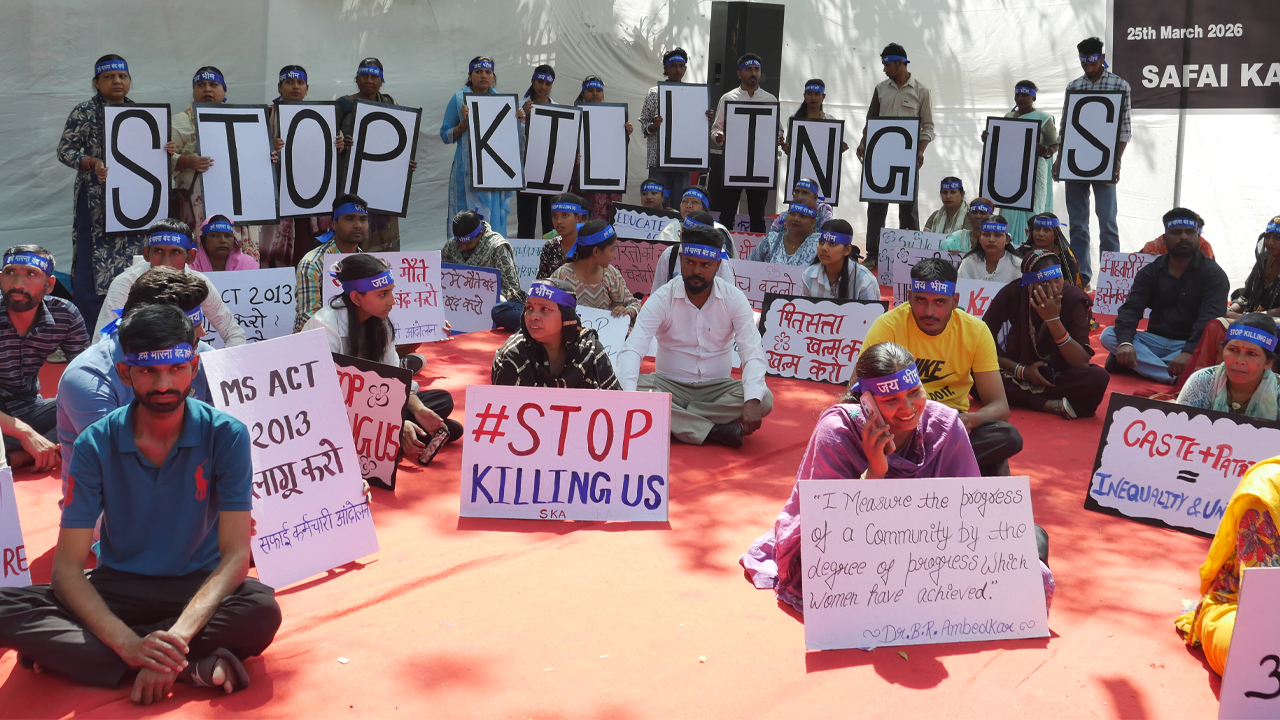
Despite official denial, sanitation workers and activists say caste-based sewer deaths in Modi’s Swachha Bharat continue unabated —“every 2–3 days, one Indian dies in a gutter.”
Mouli Sharma
Groundxero | 26 March, 2026 | New Delhi
“I joined [the movement] in 2015,” says Mangal, a 29-year-old from Delhi orphaned after his father drowned to death in a sewer and his mother succumbed to illnesses shortly after as the family couldn’t afford treatment. “I’d initially hoped that [protesting] might pressure the government to give some kind of compensation—I was an 18 year old with six younger brothers and sisters,” he recalls, somewhat shyly.
“The compensation never came, but I still show up,” he says, holding a placard in his hand reading ‘2026: 3 Months, 41 Deaths’. “I know now that the fight is bigger than that.”
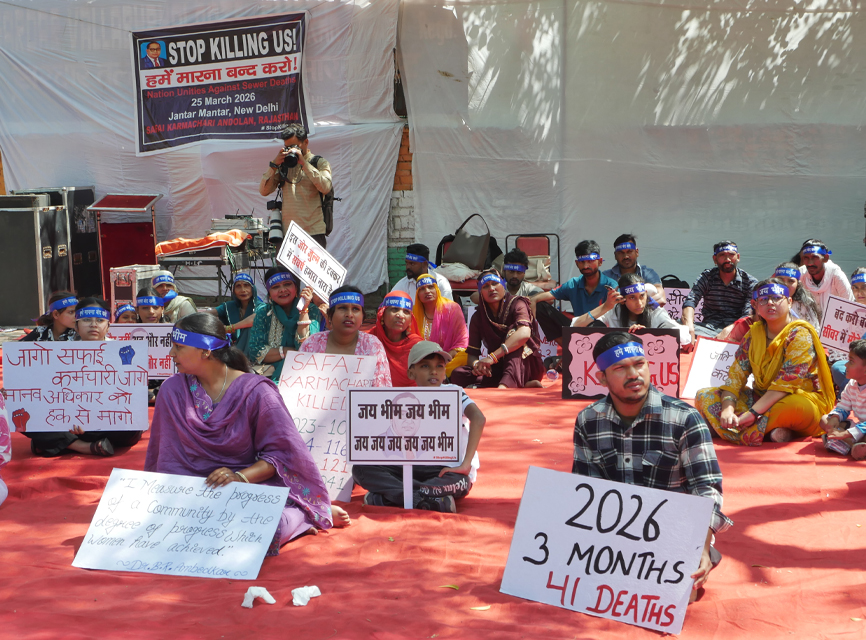
Photo: Mouli
Around 120 sanitation workers — current and former — along with their loved ones (who fear for them in life, and are left to mourn them in brutal, undignified death) gathered at Delhi’s Jantar Mantar protest site for a demonstration on Wedenesday ahead of an all-party meeting in the Indian Parliament to discuss the ongoing war in the Middle-East. Bhim-Blue silk cloths wrapped around their foreheads said the same words as did the banners hanging behind them, and also a formation of young men and women protestors holding alphabets — all spelled out a stark message: STOP KILLING US.
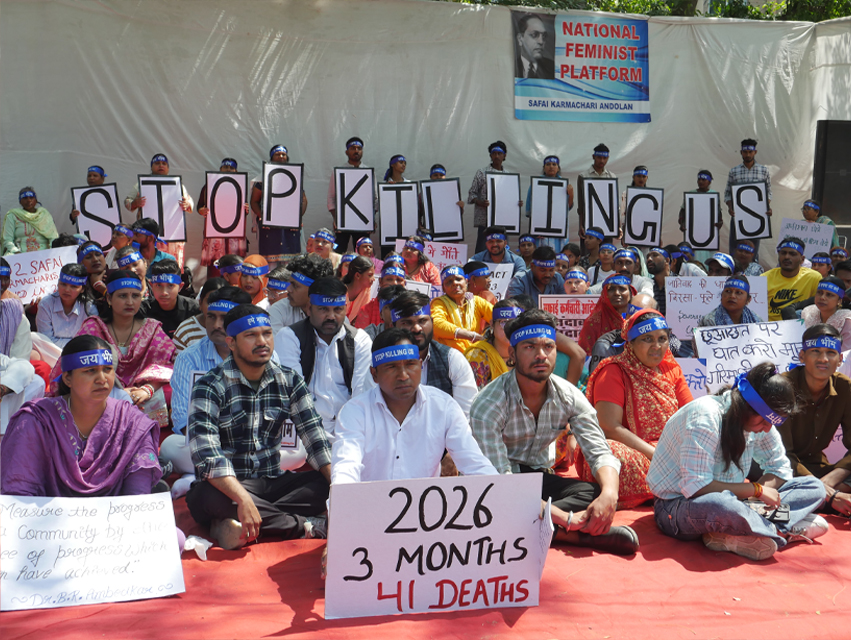
Photo: Firaaq
“Amidst claims of India’s development and its becoming the world’s third largest economy, is the reality of its people still dying in sewers and septic tanks today,” reads a press release by the Safai Karamchari Andolan (SKA). “Every 2-3 days, one Indian citizen is killed in a gutter. It is a matter of national shame that the government is silent on this.”
The Safai Karamchari Andolan (SKA), led by human rights and anti-caste activist Bezwada Wilson is a pan-India organised resistance movement that has been protesting state sponsored and abetted manual scavenging in India since 1993. Over three decades later, the unconstitutional, inhumane and outlawed practice of cleaning dry latrines and sewers by marginalised and impoverished Dalit men and women still persists in Modi’s ‘Swachha Bharat’.
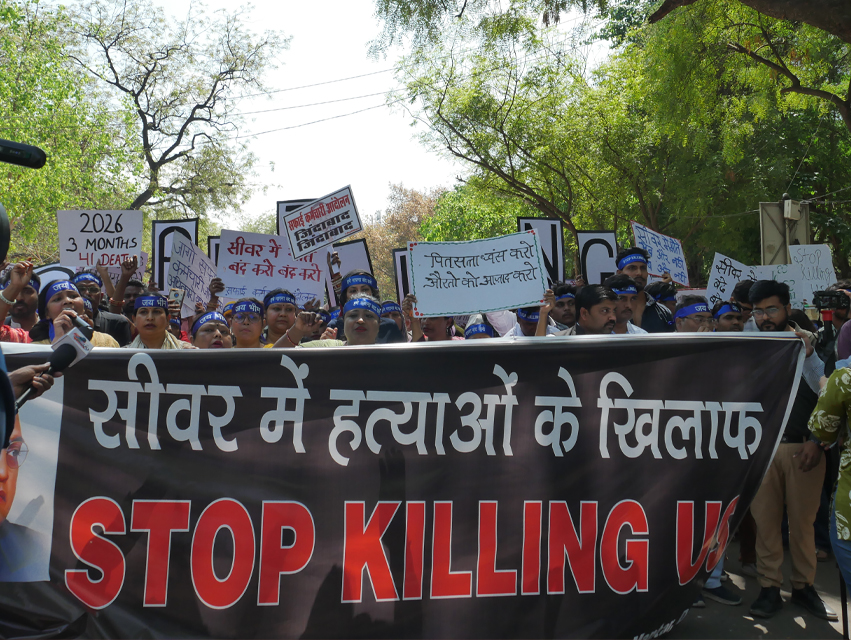
Photo: Firaaq
While many others at the protest, like Mangal, have lost their brothers, fathers and loved ones to the horrific fate of death in a sewer—many of whom have been involved with the SKA since as early as 2009, years before the Manual Scavenging Act of 2013 was even passed—still there are many, who are part of the struggle, not as a consequence of a tragedy but in anticipation of it.
Vishal from Ludhiana, who also lost his father when he was a child, and is now a father to a young daughter himself, is one of the few permanent employees enrolled by a private firm contracted by the Punjab government for sewage cleaning work. His salary, consequently, is significantly higher than those hired on precarious, contractual basis (Rs. 29,000 compared to Rs. 12,000 per month), but the work is the same.
Each day, Vishal manually lifts the metal lids of manhole covers we are used to walking over with passing anxiety. The noxious gases within sewers that often kill dalit men forced to clean them create a suction that makes these lids near impossible to remove. After this, he has to step into the gutter and wade through the muck by hand, collecting and excavating it for disposal: no safety gear, no gloves, and no mask.
‘Complaining’ to his employers and managers leads to further humiliation. “If I say on a particular day that I’m feeling unsafe and anxious”, the managers tells me, ‘you didn’t need any safety equipment when you joined, so why now?’” Vishal says. “I tell them that I didn’t know then”. They reply, ‘well if you know better now then leave.’”
“Every time you say a word, they remind you that it is your own fault that you are doing this job; I have a young daughter at home. I can’t leave this job,” Vishal tells GroundXero, and the other workers from Ludhiana accompanying him nod their heads in agreement. “They know this. That is why they say: ‘No one is keeping you here. If it smells bad, leave. If it feels dangerous, leave. Go home and live in safety. But if you want the money, do and finish the work,’” he adds. “Don’t talk, don’t whine. Just shut up and do your job.”
One person who did leave, and never looked back, is Usha Devi.
A 60-year-old from Roni, Uttar Pradesh, Usha Devi has three sons, two daughters-in-law, and a few grandchildren whose mention makes her smile. Roni in UP’s Jhansi district remains one of the countless regions in North-India’s Hindi speaking belt where many upper caste households continue to use dry latrines—those that have to be cleaned by hand, particularly by the Dalit women for pittances of compensation: the definitive act of ‘manual scavenging’.

Photo: Mouli
Usha Devi worked as a manual scavenger, cleaning dry latrines in upper-caste households, till she was 45 years old. In 2011, she learnt of a government scheme aiming to put an end to occupation of manual scavenging, the work that defines the most extreme ends of India’s horrifying brahminical caste hierarchy. A manual scavenger needs to fill a form declaring he/she will discontinue the work, and the government will provide financial support and rehabilitation package to aid a person doing so.
Usha Devi filled out the form, not once, but twice — first in 2011 and then again in 2017. The second time, SKA itself oversaw this process, ensuring that the bureaucratic formalities were met to completion. To this day, Usha Devi hasn’t received a single rupee of assistance from the government.
“After Usha Ji’s application, this was around 2017-18, we’d filed an RTI in Ghaziabad to figure out what happened,” says Mayank Jhanjhot, a 35-year-old activist and SKA’s convener in UP. “427 people had filled out the form for that scheme. Each of these sanitation workers appeared physically before the DM’s office and filled out declarations—I can attest to this myself as can their own Nodal officer at the time, but something very weird happened after that.”
“The government showed the figure of number of sanitation workers cleaning dry latrines—a woman’s work—as zero.”
This is far from the sole instance of the government’s figures failing to align with those of the people and researchers working on ground, i.e. reality. In fact, one of the main triggers for the demonstration on Wednesday, along with this being the one year anniversary of the SKA protest at Jantar Mantar last year on the 25th of March 2025 (on the same issue, met with the same silence), was a statement by the Ministry of Social Justice and Empowerment on the 18th of March 2026 submitted to the Rajya Sabha (read in Parliament the following day) claiming that there are ‘no manual scavengers found’. The same reply then goes on to list that 58,098 of them were anyhow identified in surveys conducted in 2013 and 2018.
Coming back to Usha Devi’s story, it is evermore ironic then, that even in 2018—when the ministry admits that there existed thousands of Manual Scavengers across the country (even if the numbers are far from accurate)—the response to Mayank’s RTI filed at Ghaziabad’s DM office spoke the exact same words as the SJ&E Ministry in parliament: ‘there are no manual scavengers found’.
“They claimed that after 2014, Modi ji put an end to the maila pratha (in Hindi, literally the ‘filthy practice’). Swachh Bharat Mission ensured the construction of toilets in all households, and that this woman,” referring to Usha Devi, “has not and cannot have cleaned dry latrines.”
“If you ask around the slum in which her home is, if you talk to the villagers, if you see the households around—everyone will be able to tell you what her caste is, what work she does, where she does it and for how long she has done it. The reality is there for everyone to see. But the government apparently is incapable!” Mayank tells me.
Despite never receiving cash compensation, Usha Devi never went back to the same work. And though she walks with a cane today (‘Not working is not good for the knees, you know?’ she jokes), like Mangal, she continues to show up at protests.
“I too lost a nephew to [this work],” she tells me, her smiling face turning sad for the first time in our conversation. “He was only 25; unmarried.” She informs me her sons are sanitation workers, too; when I ask her if she fears for their safety, she is scandalized.
“I never let them work in the sewers, Oh lord no!” she exclaims. “They work for the Nagar Nigam and a private company— waste collection.”
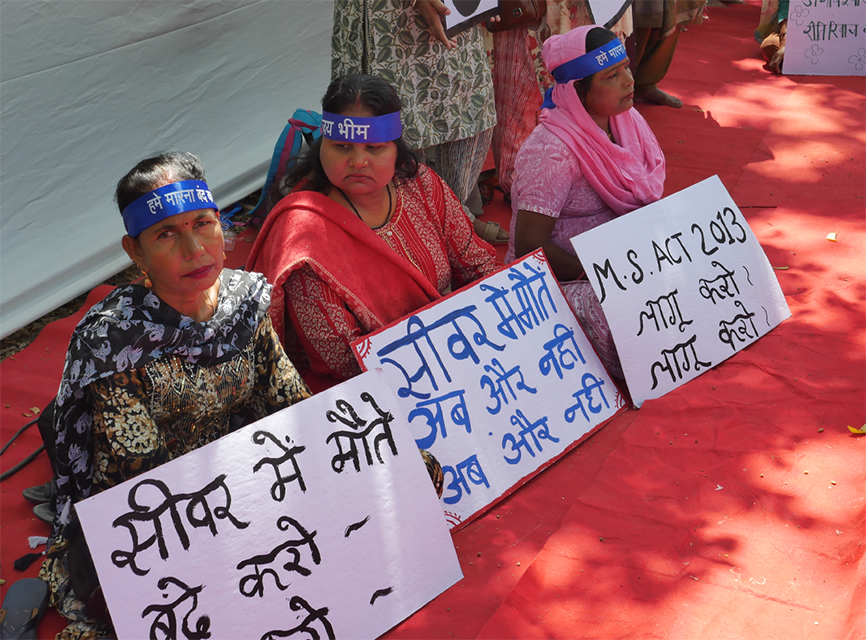
Photo: Mouli
In a memorandum to the Prime Minister, SKA condemned the government’s consistent apathy to the institutional killings of Dalits, who are employed through private contractors to clean sewers and septic tanks – a work that is claimed by the very same government as de-humanising and outlawed. SKA called out the SJ&E Ministry’s false claims of discontinuation of manual scavenging.
“On 19th March 2026 (sic), the Ministry of Social Justice and Empowerment once again made the shocking and callous claim that there are no deaths due to manual scavenging,” the letter said, referring to the PIB release mentioned previously.
The letter also highlighted the government’s pattern of data abuse and corruption in official statistics such as that seen in Usha Devi’s case.
“There is a glaring and unacceptable gap between the deaths that have occurred and the numbers reported to the parliament,” the letter said. “In 2023, SKA documented 102 deaths; the Minister reported only 65 to the Parliament. In 2024, we recorded 160 deaths, but the official figure dropped to 54. In 2025, SKA recorded 121 deaths, but the Ministry reduced the number to a mere 46. This year, in less than three months, 41 people have been killed in sewers and septic tanks.”
Ultimately, language of propriety and the provenance of consistently unreliable sources such as government data have paralysed the media and India’s consciousness when it comes caste annihilation; ‘sanitation work’ itself is merely a sanitized label—at the end of the day, the question is one of caste, and even a mere omission of this fact is a symptom of a nation’s continued affliction with the disease of Brahminism and Manuvad. SKA’s letter called what is the government’s explicit denial of the role of caste in the deaths of septic tank workers, as “a systematic erasure of Dalit lives.”
“The Minister’s statement that this is ‘occupation-based’ and not ‘caste-based’ is a deliberate attempt to deny social justice to a historically oppressed and excluded people of this country. These deaths are not accidents; they are the direct result of caste-based violence, sanctioned through neglect, denial, and inaction. Yet, the government has shown neither remorse nor urgency. Instead, our deaths are reduced to numbers, manipulated and minimized, to deny us our most fundamental right—the right to life.”
“This Prime Minister,” Wilson said in his address of the Bharatiya Janata Party’s incumbent leader of the government, Narendra Modi, “goes on camera and washes our feet. You’ll wash our feet?” he asked, words laced with contempt. “We want our rights, not this drama. The truth is that this the most casteist government that’s been in power in decades.”
Of course, the BJP’s entry has only made worse, a situation that was already abominable, and has been going on for ages, regardless of the ruling party. “Nothing has really changed in my opinion,” said Mayank. “Everything has gone downhill from 2014, but nothing structural has changed.”
In 2003, the same year that SKA filed a petition in the Supreme Court to acknowledge the continued existence of dry latrines and manual sewage cleaning work (a petition that took 11 years to receive response), researcher Mari Marcel Thekaekara authored a seminal work of India’s Manual Scavenging paradox: Endless Filth: The Saga of the Bhangis—on how something can exist and not exist at the same time.
“State governments deny that bhangis operate within their jurisdiction, but even the most casual observation will prove this false,” reads Henry Schwarz’s introduction to the text.
“After a large strike of safai karamchari’s in Haryana over back wages in 1996, during which 5,000 were jailed and police violence was fierce, a sweeper was quoted in the paper as saying, “Of these 400 sweepers, 100 are seconded to the houses of VIPs. You’ll find them at the houses of the Deputy Commissioner, the Superintendent of Police, tahsildar and others—doing their personal chores instead of the public’s work. Washing their clothes, sweeping their yards and houses. It’s the same in all towns.” It is unfortunate that this report of such outright corruption is not pursued for it is a compelling contemporary explanation for many seemingly ancient backwards practices,” Schwarz says.
Thekaekara’s own answer to the Schrodingerish problem, unsatisfactorily, has little to do with cats or quantum physics. “Public apathy and a propensity for expecting someone else to clean up behind us is part of the Hindu and Indian psyche,” she says, and 23 years later, both the psyche and the paradox remain, and Dalits are still dying in sewers.
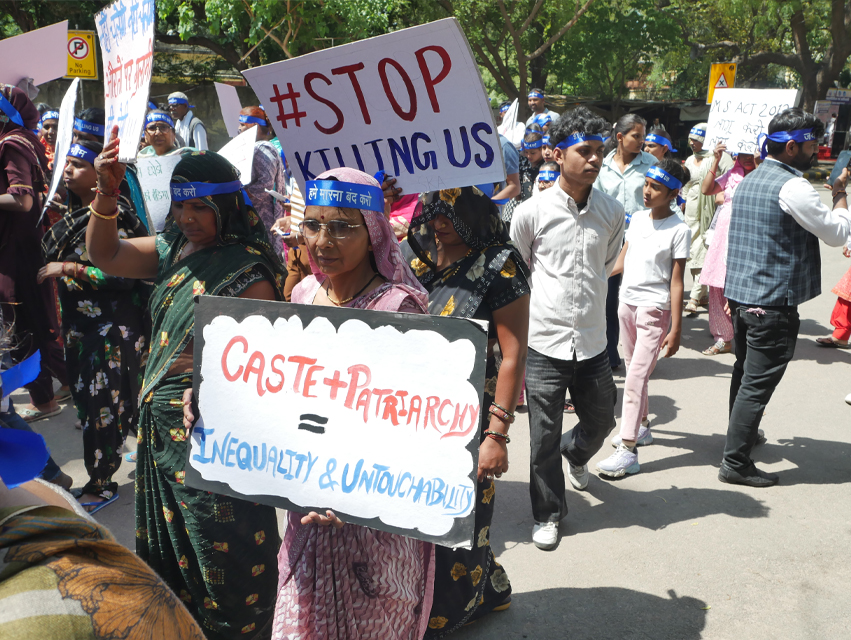
Photo: Firaaq
The current demands of the Safai Karamchari Andolan are simple: septic tank and sewer cleaning work by human beings needs to be immediately halted on an urgent basis. The government owes an apology and reparations; the Prohibition of Employment as Manual Scavengers and their Rehabilitation Act, 2013 (also known as the MS Act, 2013) needs to functionally implemented, and all individuals still engaged in this de-humanizing work need to be rehabilitated on a time bound plan.
But the chances of any of these demands being met is far from optimistic, when the government refuses to even acknowledge on paper that the wrongs that are to be rectified, exist.
One of the better known lines from one of George Orwell’s better known works, WWII era dystopian novel, 1984, here bears remembering: “The Party told you to reject the evidence of your eyes and ears. It was their final, most essential command.”
Mouli Sharma is an independent journalist from New Delhi. Her work has appeared in publications like Maktoob Media, GroundXero, The Observer Post, The Leaflet, Nivarana, The Polis Project, Article 14, Feminism in India, and been republished in SabrangIndia, NewsClick and Think Global Health.
Additional field-work by Firaaq, an independent journalist formerly stationed with the Hindi-language weekly, Nutan Charcha.