
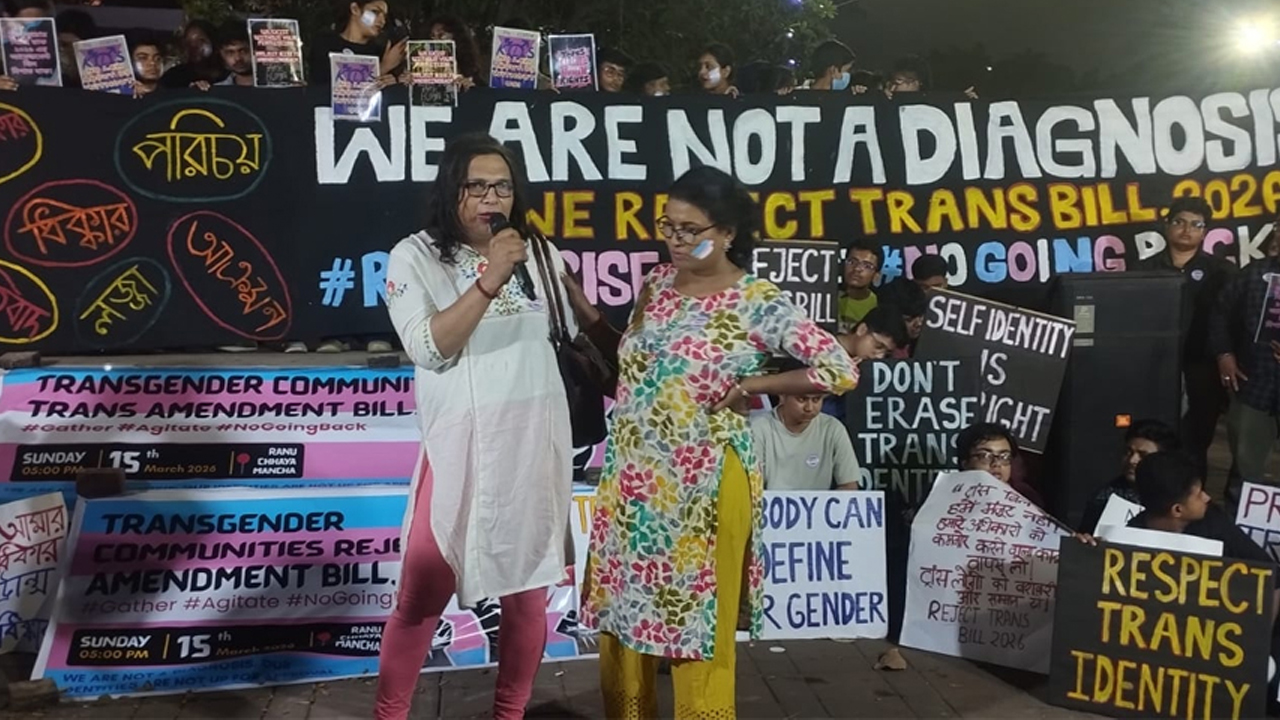
All-India Feminist Alliance and NAJAR warn the proposed Trans Amendment Bill undermines the right to self-identification and reverses gains made since the 2014 NALSA judgment.
Groundxero | 21 March 2026
Over 100 members of the All-India Feminist Alliance (ALIFA) and the National Alliance for Justice, Accountability and Rights (NAJAR) — pan-India platforms associated with the National Alliance of People’s Movements (NAPM) — have issued an open appeal to Members of Parliament (Lok Sabha and Rajya Sabha), expressing grave concern over the Transgender Persons (Protection of Rights) Amendment Bill, 2026, introduced in the Lok Sabha on 13 March 2026.
The signatories have urged MPs, both individually and collectively, to heed the growing opposition to what they describe as an unconstitutional Bill, and to ensure that it is immediately withdrawn and not passed by either House of Parliament. They have further stressed that no legislative changes should be undertaken without widespread and inclusive consultations with transgender, intersex, non-binary and genderqueer persons, as well as collectives and civil society organisations working with these communities.
The letter argues that the Bill violates constitutional guarantees and has been introduced without empirical backing or adequate consultation—not even with the National Council for Transgender Persons. It states that by narrowing the scope of the Transgender Persons (Protection of Rights) Act, 2019, the amendment introduces arbitrary and inhumane compliance requirements that could make access to fundamental rights and entitlements significantly more difficult. This, the signatories contend, would deepen vulnerability to medical, legal and social discrimination, humiliation and violence.
Citing the landmark National Legal Services Authority v. Union of India (2014) judgment, the letter reiterates that the right to self-identification of gender is a fundamental right protected under Articles 14, 19 and 21 of the Constitution. The Supreme Court had explicitly held that this right does not require medical or surgical procedures, certification, or state approval. While acknowledging the limitations of the 2019 Act, the signatories note that it nonetheless gave statutory recognition to this constitutional guarantee. In contrast, the Amendment Bill seeks to withdraw such recognition, thereby perpetuating harmful stigmas and reversing a decade of legal progress.
The signatories outline several specific objections. They argue that the Bill narrows the definition of “transgender person,” excluding trans men, trans women, non-binary and genderqueer persons who do not possess medical diagnoses or belong to specific socio-cultural groups. It removes the legal recognition of self-perceived gender identity, introduces medical gatekeeping through a proposed “authority” or medical board, and risks excluding the most marginalised individuals who lack access to bureaucratic and healthcare systems.
Further concerns include provisions that may criminalise transgender support systems and community networks, while failing to address longstanding gaps in the 2019 law—such as the absence of horizontal reservations, inadequate penalties for offences, and the exclusion of chosen families from legal recognition.
The letter underscores that transgender persons in India have relied on the existing legal framework for over a decade to secure identity documents, access services, and assert their rights. The proposed amendments, it argues, would dismantle these gains without evidence of systemic failure, setting a dangerous and discriminatory precedent.
Calling the Bill a threat to constitutional parity, bodily autonomy and equal citizenship, the signatories assert that it does not reflect the collective will of the people.
They have urged Parliament to:
- Immediately withdraw the Amendment Bill in its current form;
- Refer it to the Parliamentary Standing Committee on Social Justice and Empowerment for comprehensive review;
- Ensure wide-ranging consultations with transgender and gender-diverse communities and civil society;
- Reflect the diversity of transgender experiences across caste, region, religion, language, gender and sexuality;
- Consider existing legal shortcomings, including those highlighted in Jane Kaushik v. Union of India (2025), before any legislative revision.
The signatories emphasised that any review process must be evidence-based and participatory, and that legislative reform should aim to strengthen—rather than dilute—the rights recognised in the 2014 NALSA judgment.
The joint submission was made by ALIFA, a collective of feminist organisations and individuals, and NAJAR, a forum of progressive legal professionals. Many members identify as transgender, non-binary, genderqueer or intersex, while others have endorsed the appeal in solidarity.
Pdf of the open letter is attached below.
ALIFA-NAJAR Open Appeal to MPs – Withdraw Transgender Amendment Bill, 2026