
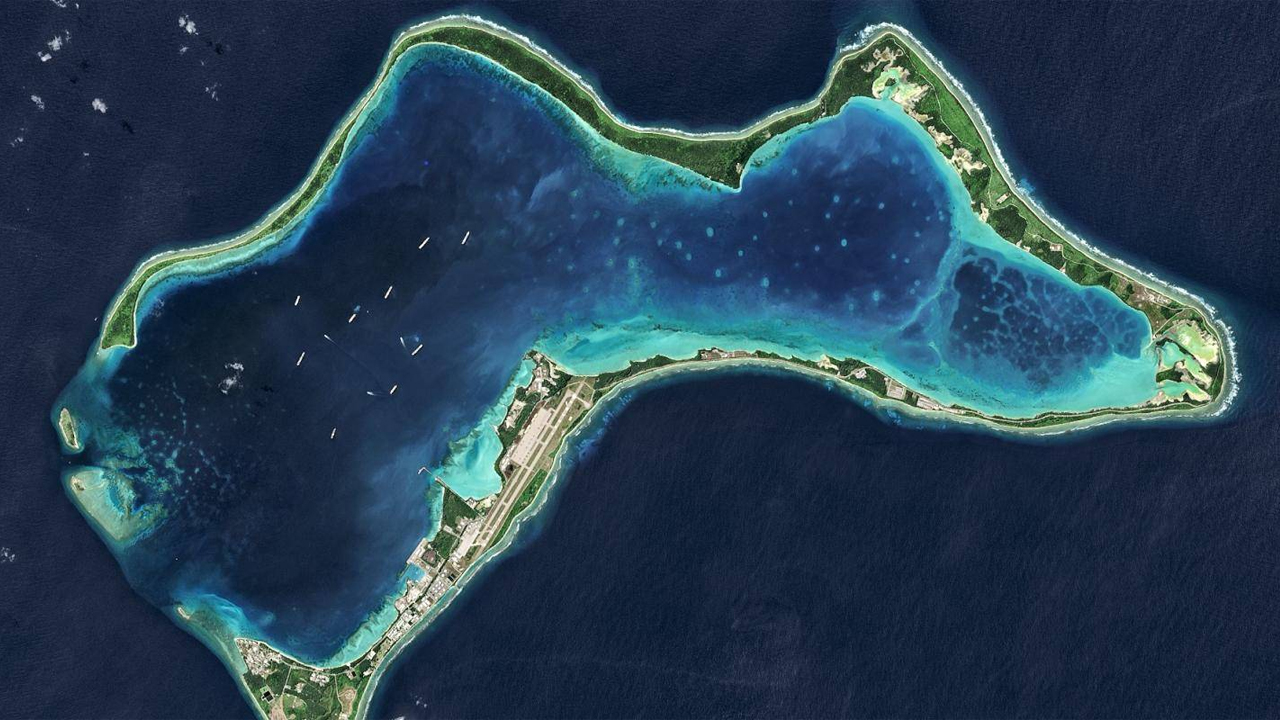
Donald Trump’s public criticism of UK government’s decision to transfer sovereignty of the Chagos Islands to Mauritius directly contradicting the U.S. State Department, have intensified diplomatic tensions, sharpened political divisions in the UK, and renewed global attention on Diego Garcia.
By Arkadeep Goswami
Groundxero | Feb 20, 2026
U.S. President Donald Trump has publicly criticised the United Kingdom’s plan to transfer sovereignty of the Chagos Islands to Mauritius, a decision that has dominated transatlantic diplomatic discussions this week. What makes the dispute especially extraordinary is its timing: Trump’s condemnation comes just one day after the U.S. Department of State announced its official support for the agreement.
In a post on his social media platform Truth Social, Trump warned UK Prime Minister Sir Keir Starmer not to “give away” the Chagos Islands, criticising the leaseback arrangement for the strategically vital Diego Garcia military base as a “big mistake.” He argued that such a move would weaken Western military capabilities in the Indian Ocean and could jeopardise responses to future geopolitical crises.
This episode reveals not only a sharp divergence within American foreign policy circles but also illustrates the contested politics of sovereignty, security, and historical justice surrounding the Chagos archipelago—issues that have simmered for decades.
The Chagos Islands: History and Strategic Importance
The Chagos Archipelago is a group of around 60 small islands in the central Indian Ocean, long administered by the UK as the British Indian Ocean Territory (BIOT). The largest island, Diego Garcia, hosts a joint UK–U.S. military base, which has been a critical node for Western military projection in the Middle East, Asia, and beyond.
The Chagos dispute is rooted in a colonial legacy. In the 1960s and 1970s, the UK forcibly removed the indigenous Chagossian people to make way for the military base—a move condemned by jurists and human rights groups as an egregious injustice. Most displaced Chagossians and their descendants now live in the UK, Mauritius, and the Seychelles, campaigning for the right to return.
Mauritius, which gained independence from the UK in 1968, has long claimed sovereignty over the archipelago, arguing that it was illegally excised from its territory before independence. Various United Nations and international court opinions have backed Mauritius’ claim, putting increasing pressure on London to settle the dispute.
Under the 2025 UK–Mauritius agreement, the UK will cede sovereignty of the Chagos Islands to Mauritius while securing a 99-year leaseback of Diego Garcia to retain military operations. London has agreed to pay Mauritius billions of pounds under this framework.
Trump’s Criticism: What Was Said and Why It Matters
In his recent social media post, Trump framed the UK’s plan as a strategic error, particularly given the military significance of Diego Garcia: “Prime Minister Starmer is losing control of this important island… This land should not be taken away from the UK.”
He warned that transferring sovereignty, even with a leaseback, would weaken the base’s strategic utility. Trump linked the issue directly to escalating tensions with Iran, suggesting that Diego Garcia might be needed for potential future military action and that losing strong, direct control could compromise allied defence.
His language was emphatic, labelling the deal a “big mistake” and urging Britain to retain full control: “DO NOT GIVE AWAY DIEGO GARCIA!”
Posting on Truth Social on Wednesday, Trump wrote: “I have been telling Prime Minister Keir Starmer of the United Kingdom that leases are no good when it comes to countries, and that he is making a big mistake by entering a 100-year lease…”
The U.S. president stressed that Diego Garcia was “strategically located in the Indian Ocean.”
“Prime Minister Starmer is losing control of this important island due to claims by entities never known of before,” he said.
“We will always be ready, willing, and able to fight for the U.K., but they have to remain strong in the face of wokeism and other problems put before them.”
Referring to ongoing U.S.–Iran talks on Tehran’s controversial nuclear programme, Trump added: “Should Iran decide not to make a deal, it may be necessary for the United States to use Diego Garcia… in order to eradicate a potential attack by a highly unstable and dangerous regime.”
Speaking to the BBC about Trump’s latest comments, White House Press Secretary Karoline Leavitt said: “The post should be taken as the policy of the Trump administration; it’s coming straight from the horse’s mouth.”
She added: “When you see it on Truth Social, you know it’s directly from President Trump—that’s the beauty of this president in his transparency and in relaying this administration’s policies.”
This rhetoric combines concerns about military preparedness with an appeal to traditional views of territorial sovereignty. Trump suggests that leases are unreliable, especially when future crises may require unfettered access.
Contradiction with the U.S. State Department and Diplomatic Fallout
The sharpest flashpoint in this story is the contradiction between Trump’s position and the official U.S. government stance. On Tuesday, the U.S. State Department publicly stated that the United States supports the UK–Mauritius agreement concerning the Chagos archipelago.
Yet 24 hours later, Trump’s social media post directly opposed that official endorsement. This contradiction has baffled British and international observers: how can the U.S. government back the deal one day and its most senior political figure condemn it the next?
Many commentators interpret Trump’s criticism not as formal State Department policy but as a reflection of his personal worldview and political strategy. His public foreign policy pronouncements increasingly diverge from diplomatic orthodoxy, highlighting profound tensions within U.S. foreign policy.
Domestic and International Reactions
In London, Trump’s intervention has added fuel to an already contentious political debate. Conservative politicians have seized on his remarks to attack Sir Keir Starmer’s government, with some labelling the deal a strategic blunder that weakens UK sovereignty and security.
Shadow Foreign Secretary Dame Priti Patel described Trump’s criticism as evidence that the British government should reconsider the agreement. Other opposition figures have echoed calls for a rethink, arguing that handing over sovereignty—even with a leaseback—undermines long-term strategic interests.
However, the UK Foreign Office has defended the deal, arguing that it is the only viable means of preserving a long-term Western military presence on Diego Garcia in light of international legal pressures.
Mauritius has welcomed the sovereignty transfer as a correction of historical wrongs, though negotiations over financial terms and resettlement rights remain ongoing. Some observers note that the leaseback ensures continuity of military cooperation while addressing longstanding demands for justice.
Strategic Implications: Geopolitics, Security, and Regional Balance
Military Strategy
Diego Garcia’s strategic importance cannot be overstated. It has served as a launching point for U.S. military operations in the Middle East and South Asia for decades. Its deepwater port and airfield enable force projection across a vast region.
Trump’s warnings hinge on the idea that any dilution of direct British control—even via a long lease—introduces uncertainty in times of crisis.
Trump also invoked broader geopolitical considerations, arguing that relinquishing sovereignty signals weakness to China and Russia, both of which have expanding interests in the Indian Ocean.
Diplomatic Credibility
Perhaps the most significant implication is diplomatic: the contradiction between U.S. institutional policy and Trump’s personal pronouncements raises questions about the coherence and reliability of American foreign policy.
Historical Justice and the Chagos Community
Amid these strategic debates lies a human dimension: the Chagossian people. Decades after their forced removal, many remain displaced, continuing to campaign for their right to return.
Critics argue that transferring sovereignty to Mauritius does not automatically guarantee restitution or resettlement. Human rights advocates have called for clearer safeguards and reparations within the agreement.
Conclusion: A Flashpoint with Far-Reaching Consequences
Donald Trump’s criticism of the UK’s Chagos Islands sovereignty transfer underscores how a remote territorial dispute can become a focal point for global debates on strategy, sovereignty, and justice.
His remarks, directly contradicting the U.S. State Department, have intensified diplomatic tensions, sharpened political divisions in the UK, and renewed global attention on Diego Garcia.
As the agreement moves forward, the Chagos archipelago stands as a test case for how global powers reconcile strategic imperatives with historical accountability.
Arkadeep Goswami is an activist and political commentator.