
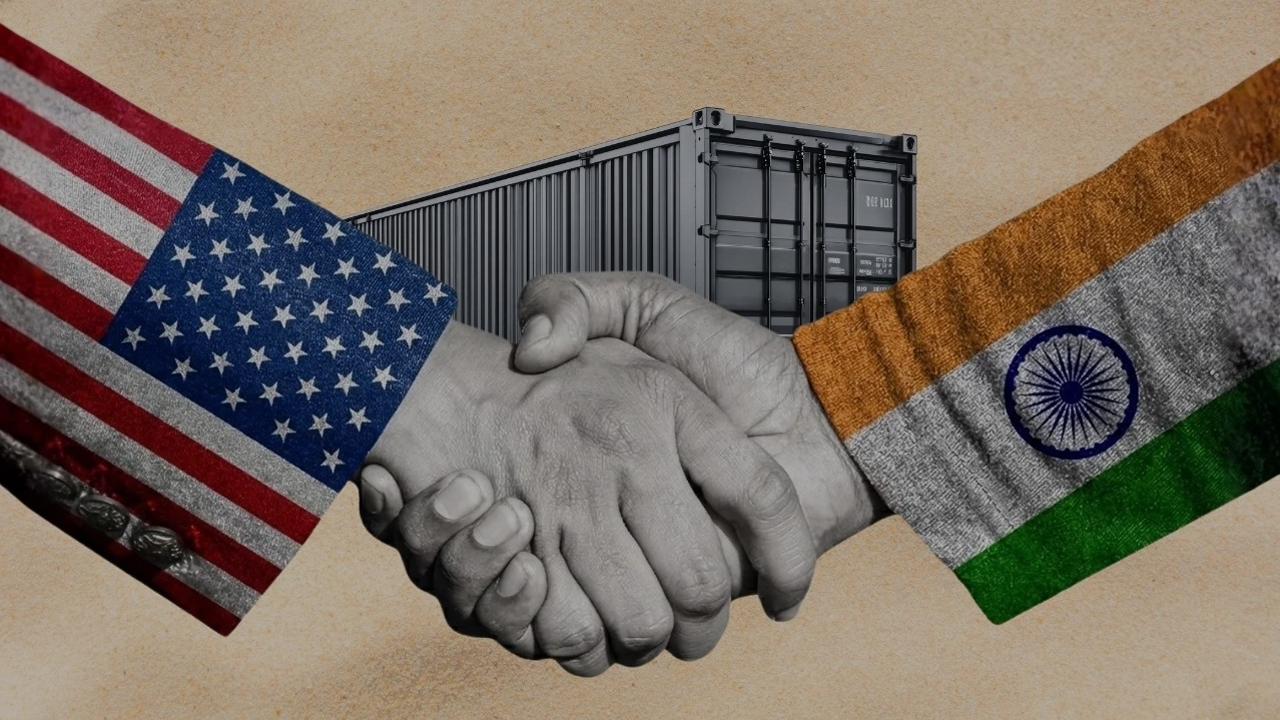
Warning of a repeat of the 2020–21 farmers’ movement, SKM said any inclusion of agricultural or dairy products in the India–US Trade Deal would provoke nationwide resistance.
Groundxero | Feb 5, 2026
The Samyukt Kisan Morcha (SKM), a pan-India platform of farmers’ unions, has launched a scathing attack on the Modi government over the proposed India–US trade deal, warning that the agreement represents a “total surrender before US imperialism” and poses an existential threat to Indian agriculture, rural livelihoods, and food sovereignty.
The sharp condemnation follows an announcement on social media by US President Donald Trump claiming that India has agreed to eliminate all tariffs and non-tariff barriers on American goods—including agricultural products—in exchange for a “reduced” tariff rate of 18 per cent imposed by the US.
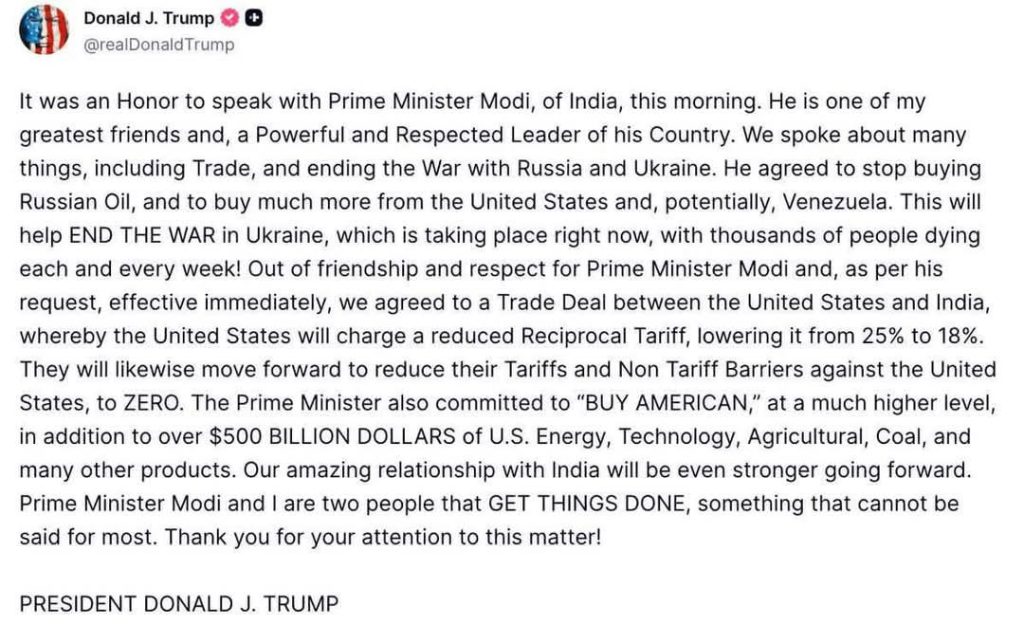
While the Indian government has yet to place, in the public domain, any official communication or detailed clarification, including when the new tariffs would come into effect, how the trade barriers would be reduced, and which US products India has committed to buying, Trump’s announcement and Prime Minister Narendra Modi’s response welcoming it leave no doubt as to the nature of the agreement.
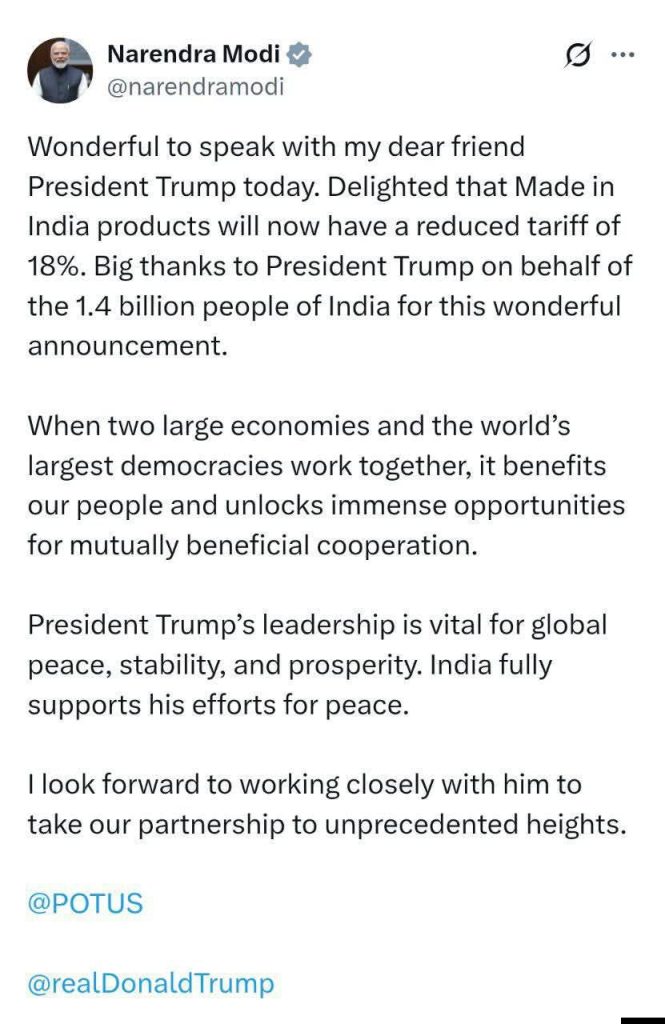
“Even as the government hides behind silence and ambiguity, Trump’s declaration and Modi’s welcome make the character of the deal unmistakably clear,” SKM said, describing the agreement as a blueprint for flooding Indian markets with heavily subsidised US farm produce.
‘Historic Betrayal of Farmers’
Calling the deal “nothing but capitulation in the face of Trump’s threats,” the All India Kisan Sabha (AIKS), a constituent of SKM, accused the Prime Minister of “shamelessly surrendering India’s national interests and rebranding it as a ‘mutually beneficial partnership’.”
The peasant organisation warned that the deal, coming on the heels of the India–EU Free Trade Agreement and ongoing negotiations with the UK, would constitute a “double whammy” for workers, peasants and small producers, accelerating deindustrialisation, unemployment, and agrarian distress.
According to SKM, crops that will be immediately impacted include soybean, maize, cotton and dairy—sectors already reeling under falling prices, import surges and withdrawal of state support. “The livelihood of crores of farmers will be jeopardised,” the organisation said.
Recalling Prime Minister Modi’s Independence Day speech on August 15, 2025—where he claimed he was willing to “personally pay a heavy price” to protect farmers—SKM accused him of backtracking under US pressure and allow free flow of US agricultural produces into Indian market. “Farmers will never forgive Modi for this historic betrayal,” it said.
US Agriculture to Gain, India’s Rural Economy to Bleed
SKM contrasted the structure of US and Indian agriculture to underline the asymmetry of the deal. The US has just 1.88 million farmers, while India has over 14.65 crore operational holdings as per the agricultural census of 2015, with nearly half the workforce and 65 per cent of the population dependent on agriculture and allied sectors.
Citing US Secretary of Agriculture Brooke Rollins, SKM noted that Washington has been explicit about the deal’s objectives: “export more American farm products to India’s massive market, raising US farm prices, pumping cash into rural America, and reducing a $1.3 billion agricultural trade deficit with India”.
“While Trump is protecting the rural economy of America, Modi is presiding over the dismantling of India’s,” SKM said, calling the agreement a transfer of crisis from the US farm sector to India’s already distressed countryside.
Commerce Minister’s Claims Rejected
Union Commerce Minister Mr. Piyush Goayal has boasted that “the trade deal finalised by India with the U.S. is the best among India’s neighbors and its competitors”. At the same time he said, the deal was in the “final stages of detailing” and as soon as the “deal is inked, full details will be shared”.
SKM said, “Without finalizing the details of the agreement why the Prime Minister of India was forced to announce the deal under the pressure of the US President exposes the sad plight of governance under the Modi Government, the absolute compromise on protecting the sovereignty of India and abject surrender to US Imperialism.”
SKM also sharply rebuffed Piyush Goyal’s claim that agriculture and dairy had been excluded from the deal, calling it “false, contradictory and aimed at misleading farmers.”
The organisation pointed out that Goyal has neither denied nor challenged the public statements made by US officials, raising serious questions about the government’s credibility. “If agriculture and dairy are excluded, why is the Prime Minister silent? Why does the US Agriculture Secretary claim the opposite?” SKM asked.
Warning of a repeat of the 2020–21 farmers’ movement, SKM said any inclusion of agricultural or dairy products would provoke nationwide resistance.
The farmer unions also cited recent policy decisions to underline what they called the government’s duplicity—particularly the lifting of the 11 per cent import duty on cotton in August 2025. The entire cotton area is the highest peasant suicide prone region of India. The elimination of import duty on cotton further eliminated the livelihood security of lakhs of cotton farmer households. Cotton imports from the US surged by over 95 per cent in a year, even as Indian cotton farmers were forced into distress sales far below the MSP recommended under the C2+50 per cent formula. Wheat and soya bean oil imports also surged during this period.
MSP, Procurement and Sovereignty at Stake
SKM warned that the US trade deal targets government procurement, minimum support prices and subsidies by branding them “trade distorting.” Such provisions, it argued, would strike at the heart of India’s food security system and federal rights, while helping the US resolve its crop glut and trade deficit.
The organisation also accused the Modi government of reneging on its written assurances to SKM in December 2021 on MSP@C2+50 per cent, guaranteed procurement, comprehensive loan waivers and halting electricity privatisation. For example, the MSP announced by the Commission for Agriculture Cost (CACP) for Kharif crops in the year 2025, the cotton price is Rs. 7710 (as per A2+FL) which is less by Rs. 2365 compared to Rs. 10075 the rate as per the rate of C2+50%. However, the Modi Government failed to even ensure the A2+FL price, and cotton farmers were forced to have distress sale in the range of Rs. 5500 to Rs. 6500 per quintal.
Call for Nationwide Agitation
Escalating its resistance, SKM has announced a village-level campaign from February 4 to 11, including mass meetings and effigy burning of Narendra Modi and Donald Trump. It has also called for massive participation in the all-India general strike on February 12 against what it termed the government’s “pro-imperialist, pro-corporate policies.”
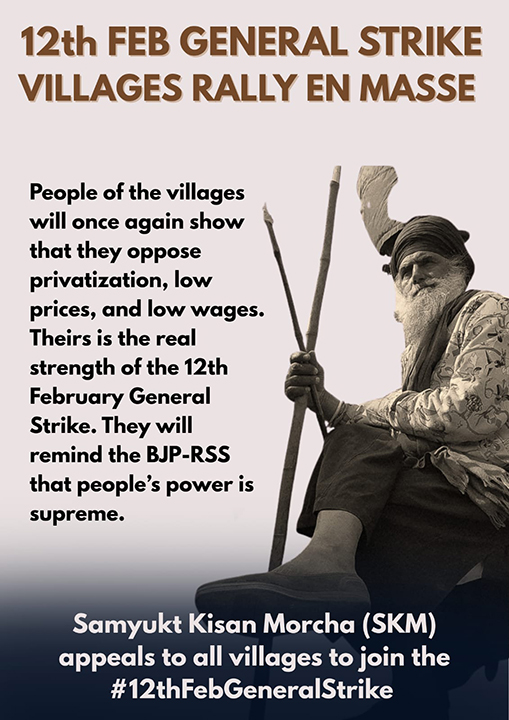
Demanding that the full texts of the India–US trade deal, the India–EU FTA and the India–UK FTA be placed before Parliament, SKM said all “anti-worker, anti-farmer and anti-people” trade agreements must be rescinded.
“What is being signed in closed rooms today will be resisted on the streets tomorrow,” SKM warned, signalling that the battle over India’s agrarian future is far from over.