
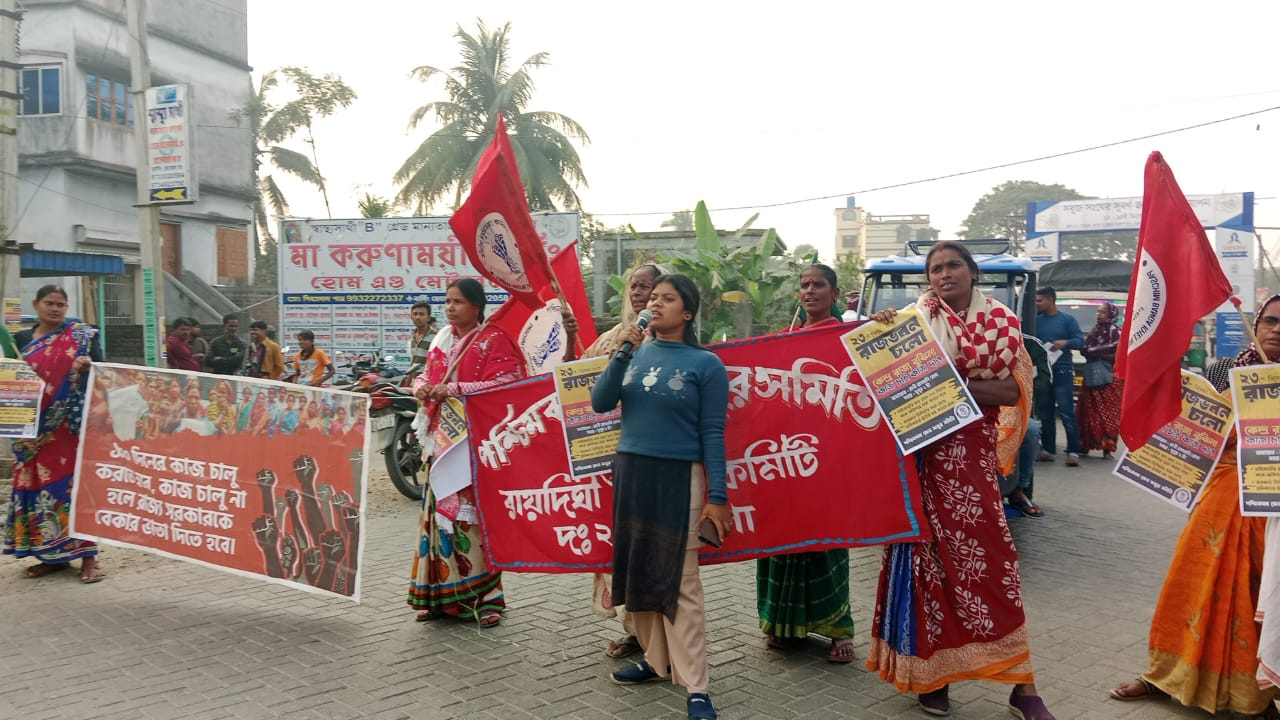
The Paschim Banga Khet Majoor Samity has issued a legal notice for contempt of court against both the State and Central Governments for failing to restart MGNREGA work in West Bengal.
Groundxero | December 12, 2025
On 10 December 2025, the Paschim Banga Khet Majoor Samity (PBKMS) issued a legal notice for contempt of court against both the West Bengal government and the Union government for failing to restart MGNREGA work despite clear directives from the Calcutta High Court and the Supreme Court. The continued non-implementation of the 100 Days’ Work Scheme, PBKMS argues, constitutes a blatant violation of binding judicial orders and an assault on the statutory rights of rural workers.
Despite clear directives from the Calcutta High Court and the Supreme Court, the West Bengal Chief Minister recently stated that she would not restart the NREGA scheme. The continued delay by both the State and Union governments in restarting work under the NREGA scheme amounts to nothing less than “contempt of court.”
On 7 November 2025, the Calcutta High Court directed the Government of India and the State Government to forthwith resume implementation of the 100 Days’ Work Scheme, in line with the earlier judgment of the High Court dated 18 June 2025 in WPA (P) No. 237/2023, filed by the Paschim Banga Khet Mazdoor Samity (PBKMS).
The High Court’s order followed the Supreme Court’s dismissal of the Union of India’s Special Leave Petition (SLP (C) No. 25528/2025) challenging the High Court’s directive on 27 October 2025. The dismissal made the earlier order of the Calcutta High Court final and binding. The High Court had, in June, directed the Union government to restart MGNREGA work in West Bengal from 1 August 2025, holding that MGNREGA cannot be put “in cold storage for eternity.”
The apex court’s decision and the High Court’s directive brought to an end a prolonged impasse that began in early 2021, when the Union government froze MGNREGA funds to the State citing “corruption and irregularities.” The freeze, however, effectively deprived nearly 1.5 crore rural workers of their statutory right to employment under the 100 Days’ Work Scheme.
For PBKMS, which had mobilised thousands of affidavits and field testimonies from workers across West Bengal, the verdict was a vindication of years of patient organising. “This was not just a legal process — it was a people’s movement expressed through the language of law,” a senior PBKMS organiser said about the SC verdict.
But despite the court’s order, work under the scheme is yet to start in West Bengal. According to media reports, on Tuesday, 9 December 2025, while addressing a public meeting at Cooch Behar, Chief Minister Mamata Banerjee categorically stated that she would not accept the conditions imposed by the Central Government for restarting work under the 100 Days’ Employment Scheme. During the same meeting, she mentioned certain conditions allegedly imposed by the Union Government.
The question that naturally arises is: what exactly are those conditions? From the statements made at Cooch Behar, the following points emerge:
- Accumulated dues under the 100 Days’ Scheme are to be paid in the next quarterly budget. In this regard, the Chief Minister stated that due to preparations for the upcoming elections, the State government has no time to deal with this matter.
- Training is to be provided under the 100 Days’ Scheme. Regarding this as well, the Chief Minister stated that the State government does not have time for such training.
Paschim Banga Khet Majoor Samity and the rural working-class people of the State are deeply concerned by the attitude of the Chief Minister with regard to restarting the scheme. Perhaps the Chief Minister has forgotten that due to corruption by State officials and elected representatives of Panchayats, the Union government, citing Section 27 of the Mahatma Gandhi National Rural Employment Guarantee Act, 2007, found a pretext to keep the scheme suspended for the last four years.
The Chief Minister may theatrically tear apart the list of conditions before the media, but can she prove that no corruption was committed by her government officials and Panchayat representatives during the earlier implementation of the 100 Days’ Scheme, PBKMS asked?
PBKMS alleged that these excuses are being used to further delay the restarting of work. As per court directions, the Union government can impose conditions to ensure that the scheme is corruption-free. The Union government can also ask for quarterly budgets. PBKMS asked: what, then, is the reason for the State government’s reluctance to submit those budgets?
The Chief Minister’s statement clearly proves that the State government does not actually want to restart the 100 Days’ Scheme immediately. It appears to have no concern that rural poor people of the State are being forced to migrate outside West Bengal in search of work.
The Chief Minister further stated that instead of the 100 Days’ Scheme, work would be provided to workers under the ‘Karmashree’ scheme. She also claimed that the State government is currently providing 75 days of work per year.
PBKMS claimed that not a single member of the Samity has received work under the ‘Karmashree’ scheme to date, despite 2,728 workers submitting applications in 11 blocks across 5 districts. In most cases, PBKMS alleged that Panchayat and Block offices refused to accept the applications and instead turned the applicants away.
The Samity said the scheme appears to be nothing more than a paper project meant to show that funds are being spent, not a genuine programme to provide employment to poor people.
On the occasion of Human Rights Day, 10 December 2025, the joint platform of various Khet Majoor organisations, ‘NREGA Sangharsha Mancha, West Bengal’, along with Paschim Banga Khet Majoor Samity, held road blockades across different districts of the State, demanding the right to work. The protestors categorically opposed the excuses being advanced by the State government and the apathy of the Union Government, and demanded the immediate restarting of work under the 100 Days’ Employment Scheme.