
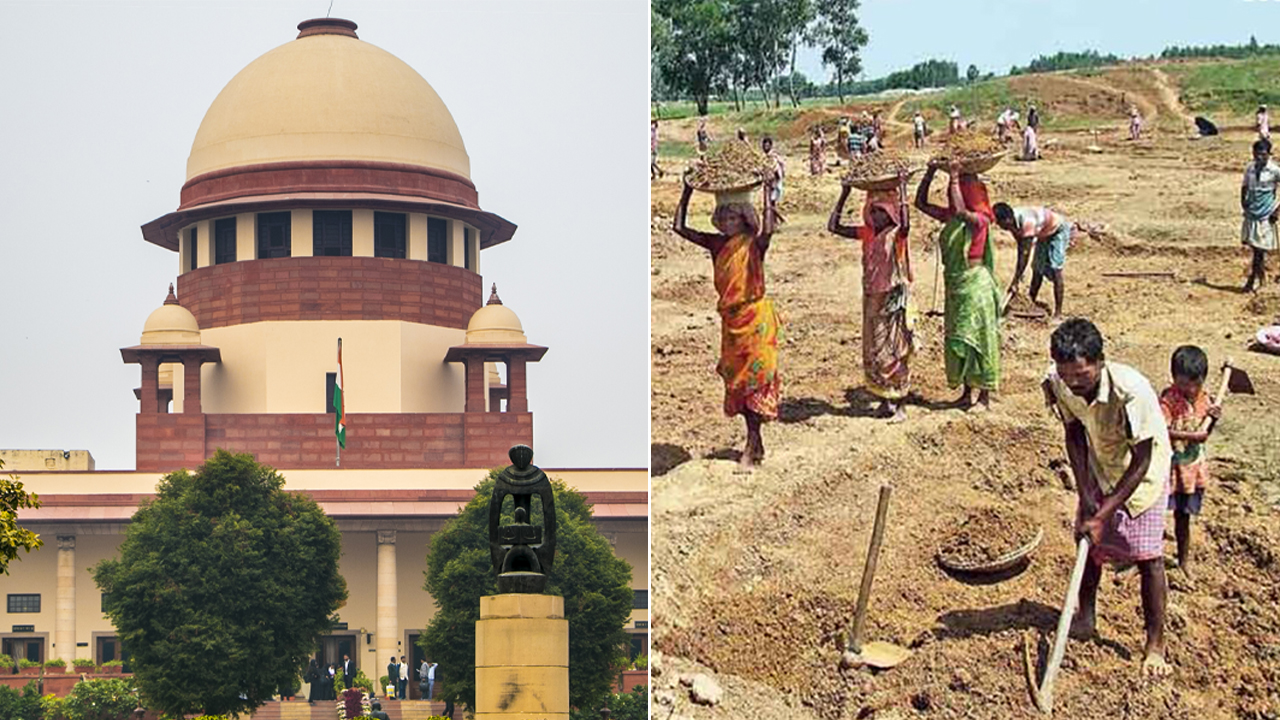
The Supreme Court’s judgment may serve as a precedent for ensuring that social-welfare rights are not held hostage to political disputes.
Groundxero | Nov 4, 2025
After four long years of waiting, West Bengal’s rural workers have won a battle fought not only in the courts but also in the fields and streets. On October 27, 2025, the Supreme Court of India dismissed the Special Leave Petition (SLP (C) No. 25528/2025) filed by the Government of India, thereby upholding the Calcutta High Court’s 2023 judgment directing the Union Government to resume work under the Mahatma Gandhi National Rural Employment Guarantee Act (MGNREGA) in West Bengal from August 1, 2025.
The apex court’s decision brings to an end a prolonged impasse that began in early 2021, when the Union Government froze MGNREGA funds to the state citing “corruption and irregularities.” The freeze, however, effectively deprived nearly 1.5 crore rural workers of their statutory right to employment under the 100 Days Work Scheme.
For the Paschim Banga Khet Majoor Samity (PBKMS) — a grassroots labour collective that led the legal battle — the verdict marks not just a legal milestone, but a moral one. “This is a victory of dignity, labour, and collective struggle,” PBKMS declared in a statement shortly after the judgment. “No matter how many obstacles arise, workers will win what is rightfully theirs,” said PBKMS.
The Legal Journey: From Silence to Supreme Court
The case that culminated in the final verdict in the Supreme Court began as WPA(P) No. 237/2023, filed by PBKMS before the Calcutta High Court. The petition challenged the Union Government’s continued suspension of MGNREGA work and non-payment of wages in West Bengal, calling it a violation of Section 3 of the MGNREGA Act, which guarantees at least 100 days of wage employment per year to every rural household.
In May 2025, the Calcutta High Court ruled in favour of PBKMS, directing the Union Ministry of Rural Development to resume the scheme in the state from August 1, 2025 and to clear pending wage liabilities. The judgment emphasised that “corruption allegations cannot be grounds for collective punishment of workers”, and that accountability measures should not come at the cost of basic entitlements.
However, neither the Union nor the State Government complied with the directive. Instead, the Union Government approached the Supreme Court, filing the Special Leave Petition and repeatedly seeking adjournments over procedural issues. This effectively delayed the implementation of the High Court’s order by several months.
On October 27, the bench of Justice Vikram Nath and Justice Sandeep Mehta dismissed the Union Government’s appeal, upholding the Calcutta High Court’s decision. The Union Government was represented by Solicitor General Tushar Mehta, while PBKMS was represented by Senior Advocate S. Muralidhar, with Advocate-on-Record Prasanna S. and Purbayan Chakraborty.
For PBKMS, which had mobilised thousands of affidavits and field testimonies from workers across West Bengal, the verdict was a vindication of years of patient organising.
“This was not just a legal process — it was a people’s movement expressed through the language of law,” said a senior PBKMS organiser. “Workers from across districts stood up and said, ‘we will not be erased,’” he said.
The Fund Freeze, Unpaid Wages and Its Fallout
MGNREGA — India’s flagship employment guarantee scheme — was effectively hamstrung in West Bengal in March 2022 when the Union Government took recourse to Section 27 of the Act. About 6.8 crores or about 60% of the West Bengal population uses NREGA as a source of income or as supplementary income.
Anuradha Talwar, associated with PBKMS, in an article in Groundxero in June 2023 wrote:
To date, wages to the extent of Rs 2800 crores remain unpaid to these workers. Some wages are pending for two years since mid-2021. The last Fund Transfer Order (FTO) was paid by the Government of India on 16th December 2021 and since then no wages have been paid by the Government of India. To make matters worse, no Labour Budget has been sanctioned for 2023-24 for West Bengal. As a result, almost all NREGA work has been stopped since mid-2022. It is almost as if the entire rural working population of West Bengal has been labelled “thief”, and has been excluded from the program, while the rest of the country enjoys its fruits.
She pointed out how the suspension of payments had an acute humanitarian impact. The article records:
- At least four suicides due to economic distress of non-payment.
- Vulnerable groups like women, especially single women, and SC/ST families were disproportionately affected.
- Distress migration surged. In one extreme case a fireworks factory explosion in Purba Midnapore was traced to workers previously employed under MGNREGA.
The article further critiques the technological oversight systems introduced: real-time mobile monitoring, Aadhaar-based payment systems, connectivity demands — all of which compounded delays, rather than reduced corruption.
“Genuine workers cannot be penalised for the corruption of officials,” the article states, pointing out that Section 27 could not be used as a blunt instrument of punishment.
In short: the legal freeze, non-payment of wages, and halt of worksites pushed thousands of rural households to the brink.
A Political Blame Game Rekindled
Barely hours after the Supreme Court’s dismissal of the Union Government’s appeal, a political controversy erupted in West Bengal. Several senior leaders of the ruling Trinamool Congress (TMC), including General Secretary Abhishek Banerjee, took to social-media claiming that the judgment was a result of the TMC’s “tireless struggle” for workers’ rights.
In a swift rebuttal, PBKMS issued a strongly-worded statement calling the TMC’s claim “false propaganda and legal ignorance.”
“How can the ruling party whose corruption led to the suspension of MGNREGA now claim credit for its resumption?” the statement asked. “The State Government was a respondent in the case, not a petitioner. It neither filed nor supported the litigation that brought this relief to workers,” noted the statement.
PBKMS also pointed out that the same TMC government had denied permission for a peaceful dharna by the workers in Kolkata earlier this year, when labour organisations sought to protest the continued suspension of MNREGA work.
The whole episode witnessed a political blame-game: the BJP-led Union Government accuses the TMC-led State Government of mismanagement and corruption in the implementation of the scheme, while the State likens freeze of fund to political vendetta. But for workers, the result was the same – four years of lost wages, stalled works, rising loans and increasing indebtedness.
Union and State Governments on the Defensive
With the Supreme Court’s decision behind them, both governments now face uncomfortable questions.
The Union Government, which has for years defended the fund freeze, must now comply with the apex court’s direction to resume the scheme and clear pending wages. Ministry officials have so far refrained from public comment, saying only that they are “examining the order.”
For the State Government, the judgment is a stark indicator of its own administrative lapses. Despite repeated High Court directives, the State’s Rural Development Department failed to process unemployment-allowance applications, and many block-offices continued to reject workers’ job-cards.
A senior bureaucrat, speaking on condition of anonymity, admitted that “implementation systems were broken” and said the state now faces “a mammoth task of restarting work, verifying job lists and coordinating with the Centre.”
Political analysts view the verdict as a blow to both the BJP-led Centre and the TMC-led State. “This is one of those cases where the grassroots truly led the narrative,” said Dr Anuradha Sen, a social policy researcher at the Indian Institute of Management, Kolkata. She added, “PBKMS’s persistence forced both governments to confront their negligence. It restores the idea of MGNREGA as a legal right, not a political favour.”
Voices from the Ground
In districts like Birbhum, Purba Medinipur and Malda, where MGNREGA works had been shut since 2021-22, news of the verdict was met with cautious optimism.
“We don’t know when work will actually start,” said Mita Kisku, a landless worker from Bolpur, “but at least now we have some hope. For years we went to the block office, and they would say there is no order from Delhi.”
For many, the hardship extended beyond the loss of income: “When the work stopped, people borrowed money just to eat,” said Kamal Sarkar, a PBKMS activist from Bankura. “Some migrated to other states. Some died waiting for wages that never came,” he added.
A Long Road Ahead
While the Supreme Court’s order clears the legal hurdle, implementation remains the formidable challenge. Resuming MGNREGA operations after four years will require rebuilding administrative capacity, re-activating job cards, clearing massive back-logs of unpaid wages (Rs 2,800 crore), and restoring workers’ confidence.
PBKMS has already announced plans to monitor compliance at the block level and assist workers in filing fresh job- and unemployment-allowance applications. The organisation has also demanded that both the Union and State Government Issue a joint action plan ensuring that the scheme resumes without discrimination or delay.
“Workers’ rights are not charity — they are law,” and “The Right to Work is the cornerstone of rural dignity, and we will defend it in the fields, on the streets and in the courts,” said PBKMS.
As India grapples with rural distress, the verdict could have implications beyond West Bengal. The case reaffirms that central sanctions under MGNREGA cannot override statutory entitlements — and that the Right to Work has constitutional backing under Article 21. This judgment may serve as a precedent for ensuring that social-welfare rights are not held hostage to political disputes.