
Has the defeat of the Naxal movement translated into victory for Indian farmers? For workers? For Adivasi women? No. This is a victory for capitalists; it is a victory for those who impoverish India by plundering its water, forests, and land.
By Himanshu Kumar
Groundxero | Oct 17, 2025
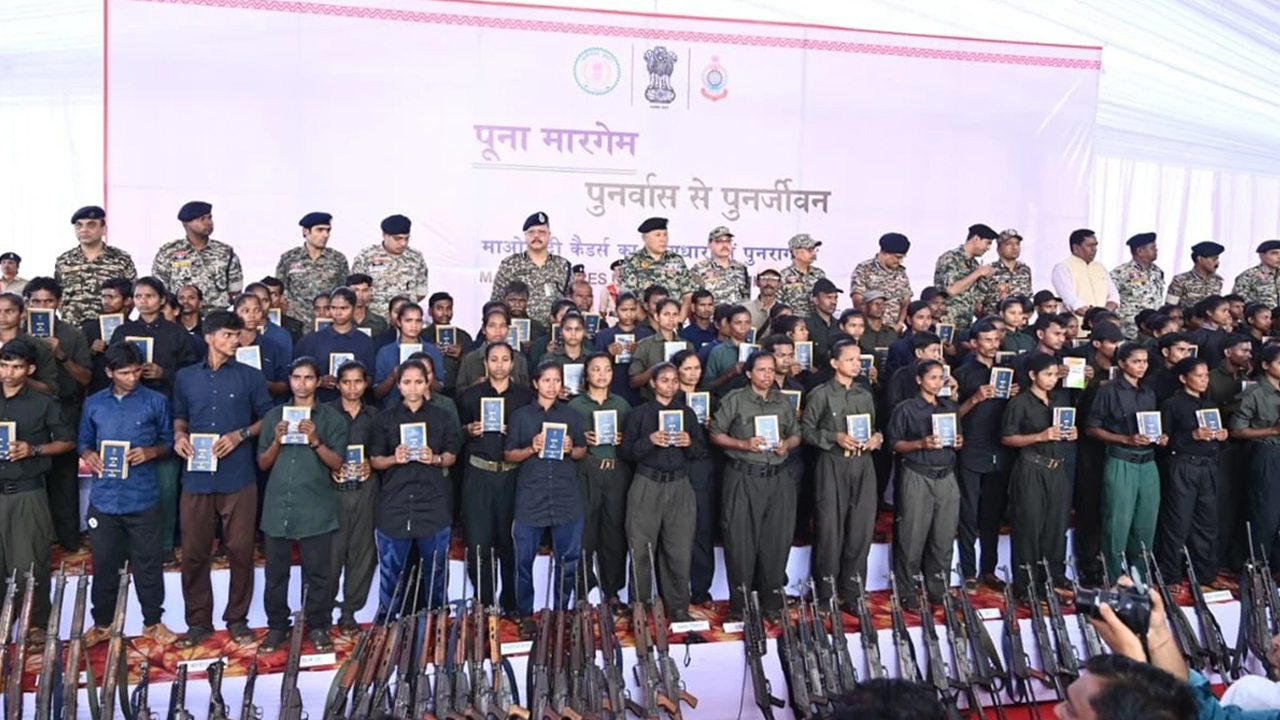
Today, in the pink cold of October, two hundred and fifty Naxal fighters in Bastar handed over their weapons to political leaders and to the police. Two days ago a senior Naxal leader, Venugopal, handed his gun into the hands of the Chief Minister of Maharashtra. In return, Chief Minister Fadnavis handed a copy of the Constitution to the Naxal leader. I felt that Chief Minister Fadnavis needed the Constitution more than the Naxal leader — because just a few months earlier Fadnavis became Chief Minister after winning a fraudulent election. When people in a village of his state Maharashtra, Malshiras, refused to accept the results from the corrupt EVM machine and declared they would hold voting by ballot papers themselves, this Chief Minister deployed the police there, imposed a curfew, and had cases registered against the villagers.
Many years ago, during a discussion with a Naxal leader in Bastar, he asked about violence versus nonviolence in the people’s struggles: “You fight nonviolently — what have you achieved? What has Medha Patkar achieved? The Narmada dam was built, people were displaced.” Irritated and frustrated, I responded, “What have you achieved by fighting with guns?” Anyway, we stayed together the whole night, ate together, and parted in the morning with affection.
I think in that debate both of us were only expressing our frustration, and that is why we tried to prove the other one wrong. The reality is that struggles for social change begin in search of big goals and ideals. After a long process that often involves sacrifices across generations, we reach a certain point. Often we don’t get the exact goal we envisioned, but the process of struggle brings many positive changes in society.
For example, even though the Narmada Bachao movement could not stop the dam from being built, it started a global process of rethinking big dams. Because of that, successful movements have allowed some rivers to flow freely and many large dams have been broken to save aquatic life.
Similarly, because of the Naxal movement, repression of women, Dalits and Adivasis by landlords diminished somewhat, governments were compelled to consider land-reform measures, and the rates for tendu leaves and wages increased.
It is also important for the new generation to understand who the Naxals are and why they took up arms. Are the Naxals traitors to the country as the government tells us? No — they are not traitors at all. Some among us fight against the injustice that pervades society. But some become so disturbed and restless because of that injustice that to end it they take the oppressor’s weapons and confront the oppressor’s brutality. So you could say that Naxals are more patriotic than us because they are ready to give their lives for the people of this country.
Look at India’s condition: eighty percent of Dalits in the country are landless; therefore they are poor. This is called socio-economics — being poor because of one’s caste. Because of this poverty, Dalits become targets of oppression and exploitation. Even today in India twelve Dalit women are raped every day. If these conditions do not make anyone uneasy, then we must ask whether they have any concern for this society at all. The landlessness, poverty, and resultant weakness of Dalits in India’s political system, capitalist exploitation of workers, patriarchal repression and unequal status of women — all these gave rise to many political movements. Gandhians, leftists and Ambedkarites all carried their movements forward.
Many people in society experienced that when they tried to change society against oppression, those who oppress — the powerful — had weapons, goons, police, and the state; and with their help they attacked those trying to change society, killed them, and jailed them. So if we have to fight these armed oppressors, then we too should have weapons.
Every political party in India has large numbers of weapons. The RSS and the BJP have the most weapons. So it is not factually correct to label only the Naxal party as the armed one.
The movement came to be called the Naxal movement after the 1967 Naxalbari village revolt in West Bengal, when peasants rose up against landlords. But in the Telangana region, peasant movements had begun even before independence. Along with that, Bengal’s Tebhaga movement was also a powerful peasant struggle against landlord exploitation.
After the hangings of Gandhi’s assassin Godse and Nana Apeete, in independent India, two Dalit peasants from Andhra Pradesh, Kishegouda and Siddaramayya, were sentenced to death because they killed a landlord and redistributed his land to the landless. That means Dalit peasants posed a major challenge to the Indian State. Professor Jagmohan, Bhagat Singh’s nephew, assesses that to separate Dalits from this movement, the Congress, in 1971, first began installing statues of Dr. B.R. Ambedkar, pointing a finger toward Parliament with the Constitution on his chest — to signal to Dalits: don’t fight the state; come this way.
After that, because a large number of Adivasis joined the Naxal movement, it began to be seen as primarily an Adivasi movement. However, in Bihar, the Naxal movement did excellent work securing land for Dalits. Many Dalit comrades later sacrificed themselves in the movement.
After globalization, liberalization, and privatization in 1991, corporate capital began attempting to seize minerals in tribal areas of India, and these areas were filled with security forces. The Naxal movement then stepped up the fight, joining the tribals to protect their water, forests, and land. Eventually the government decided to talk to them, and in 2004 negotiations began between the Andhra Pradesh government, the People’s War Group, and Janashakti. But after the government refused to accept the demand to redistribute landlords’ lands to the landless, the talks broke down. During this time the People’s War Group, Party Unity and MCC merged and formed the CPI (Maoist). One year later, in the name of wiping out the Maoists, the BJP government in Chhattisgarh launched an armed operation called Salwa Judum in 2005. In this campaign, tribal villages were burnt by the state, mass rapes of tribal women occurred, and tribals were murdered. In 2011 the Supreme Court declared Salwa Judum unconstitutional, but this repression continues.
With my colleagues, I was doing constructive Gandhian work in Bastar on education, health, environment, and employment with government cooperation. When I raised my voice against this brutal human-rights repression of tribals, the BJP government attempted to assassinate me; in 2009 bulldozers razed our sixteen-acre Gandhian ashram and I was expelled from Chhattisgarh.
At present, the BJP is in power at the centre and in Chhattisgarh. The BJP is unabashedly a pro-capitalist party. To clear the way for capitalists to loot and sell the water, forests and land in tribal areas and to crush opposition, BJP the union home minister Amit Shah has announced the complete eradication of Naxals in Bastar by March 31, 2026. In the last two years nearly two thousand tribals — children, women and Naxal cadres have been killed by the security forces.
To stop this bloodshed, many Naxal leaders and fighters have now announced they will lay down arms and work on people’s issues through nonviolent political processes, and this process is ongoing. However, many in the Maoist party still do not agree to give up arms and say they will continue to fight to the death.
Today on the Bastar Talkies YouTube channel, in a conversation with journalist Vikas Tiwari, Naxal leader Rupesh said that they intend to lay down arms and work on people’s issues.
The question is: is this possible? Can one do politics in India in opposition to the government? If Amit Shah hands over Bastar land to Adani and these unarmed Naxal leaders democratically organize the Adivasis in protest, will Amit Shah tolerate it? While the BJP openly declares an India without Opposition, will it allow unarmed activists of Naxal ideology to work in Bastar? When the government banned the Adivasi youth’s unarmed organization, the Mulvasi Bachao Manch, its order said the organization was being banned because it criticizes and opposes the government.
A government that for years has imprisoned journalists, lawyers, writers and professors, who criticize the BJP by calling them “urban Naxals”, should not give any hope to Naxal leaders laying down arms, that this government will permit them to work among the people.
So the question is: if such a powerful movement that challenged plunder of natural resources and exploitation of the poor loses, who actually wins? The BJP government will say democracy has won. But who can call this a victory of a government that itself was formed through stolen votes and unlawfully — who can call this a victory for democracy? Has the defeat of the Naxal movement translated into victory for Indian farmers? For workers? For Adivasi women? No — this is a victory for capitalists and for looting; it is a victory for those who will impoverish India by plundering its water, forests, and land. It is a victory for forces that murder democracy; it is a victory for powers that protect rapists.
If a powerful movement that challenged state plunder is defeated, the natural consequence will be increased plunder, repression, and suffering. And the result will be intensified anger, resistance, struggle, and fighting. In India there are many sections who must and need to fight: Dalits, Adivasis, workers, women, unemployed youth, students — they will fight, or else they will perish.
Therefore, neither will the struggle end nor will the path to taking up arms again be closed. No one’s victory is final, and no one’s defeat is final.
Saint Vinoba said there are three ways to change society: law, compassion, or killing. Vinoba said if the law does not give justice and society’s compassion does not awaken, the oppressed will choose the path of killing. That is why I work to awaken compassion in people so that society can be saved from going down the path of killing.
I have stayed close to Vinoba and for a long time I have walked the country spreading Vinoba’s ideas; therefore I too want to awaken the compassion of the people so as to prevent society from taking the path of killing.
_______________
Himanshu Kumar is a well-known Gandhian and human rights activist.
The views expressed in this article belong to the author and do not necessarily reflect the opinion of Groundxero editorial team.