
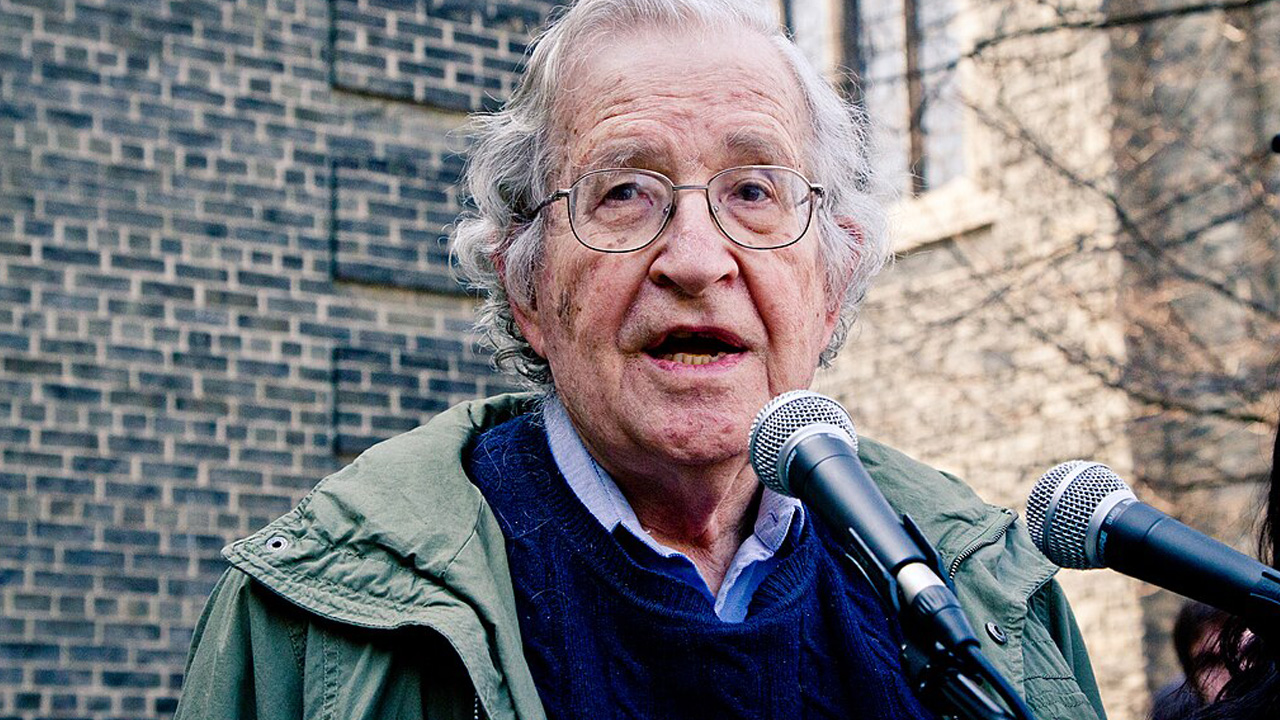
Chomsky stands as a model of putting a progressive face on collaboration with state power.
Shyamoli Jana
It is hard to come up with a name other than Noam Chomsky who has been praised as much for his ‘anti-establishment’ stances – by establishment outlets themselves. A superstar academic who, along with a fellow academic, literally wrote the book on how the media shapes perception. His incisive comments are oft-quoted, and justifiably so. However, in the next few paragraphs, I will argue that the Chomsky’s path of politics offers no way out of the political quagmire that we are in. In fact, more than that, Chomsky is, at the end of the day, a status quo-ist.
Even though the title suggests otherwise, the purpose of this article is less about criticising Chomsky than illustrating certain tendencies that many on the Left confuse as Leftism, and Chomsky is an excellent vehicle for that. This article is going to be as much about Chomsky as about Chomsky’s fandom, many of whose love for Chomsky comes from the fact that Chomsky stands as a model of putting a progressive face on collaboration with state power.
It is not too hard to notice the following tendencies in Chomsky, and often in his disciples: a remarkable revulsion towards any and all meaningful resistance against imperialism and the current global capitalist order, and a distaste for societies that managed to install some form of socialism instead of capitalism through a revolution.
Let’s take one of them at a time.
Revulsion towards any and all meaningful resistance against imperialism and the current global order:
One of Chomsky’s earliest activist roles was during the anti-Vietnam war protests. Masses of students at universities were up in protest, streets were filled with people, and in Vietnam, army rank-and-file were so disgruntled that fragging – i.e., throwing a live grenade inside the tent of a superior officer – was not a very rare occurrence, with around 800 documented cases during the course of the war. Chomsky supported the protests, but only up to a point.
At that time, at MIT, calls for severing ties with the military-industrial complex were growing. Chomsky, who was employed at a military lab at MIT between 1963 and 1965, claimed that it was impossible to do so. The position he espoused then is similar to this quote from his essay On Resistance:
“Many possibilities come to mind: a general strike, university strikes, attempts to hamper war production and supply, and so on. Personally, I feel that disruptive acts of this sort would be justified were they likely to be effective in averting an imminent tragedy. I am skeptical, however, about their possible effectiveness. At the moment, I cannot imagine a broad base for such action, in the white community at least, outside the universities. Forcible repression would not, therefore, prove very difficult. My guess is that such actions would, furthermore, primarily involve students and younger faculty from the humanities and the theological schools as well as some scientists. The professional schools, engineers, specialists in the technology of manipulation and control (much of the social sciences) would probably remain relatively uninvolved. Therefore the long-range threat, whatever it proved to be, would be to American humanistic and scientific culture.”
It is incredible that someone who is known for being a stringent critic of American foreign policy would be opposed to the attempt to disrupt war research, calling it a threat to “American humanistic and scientific culture”, whatever that is. Another quote from Chomsky himself provides a pithy summary of his position: “Nothing should be done to impede people from teaching and doing their research even if at that very moment it was being used to massacre and destroy.”
Chris Knight writes:
“Still more puzzling was Chomsky’s attitude when Walt Rostow visited MIT in 1969. Rostow was one of those prominent intellectuals whom Chomsky had so eloquently denounced in his ‘Responsibility of Intellectuals’ article. As an adviser to both President John Kennedy and President Lyndon Johnson, Rostow had been one of the main architects of the war in Vietnam. In particular he was the strategist responsible for the carpet bombing of North Vietnam.
Against this background, it was hardly surprising that when Rostow arrived at MIT, his lecture was disrupted by students furious at his presence on their campus. Far from associating himself with such student rage, however, when Chomsky heard that Rostow was hoping to return to his former job at MIT, he actually welcomed the prospect. Then, when he heard that the university was poised to reject Rostow’s job application for fear of more student disruption, Chomsky went to Howard Johnson and threatened to lead MIT’s anti-war students to “protest publicly” —not against—but in favor of Rostow being allowed back to the university.
Rostow wasn’t the only powerful militarist at MIT to receive support from Chomsky. Twenty years later, Chomsky was, as he says, ‘one of the very few people on the faculty’ who supported John Deutch’s bid to become university President… Fearing that the university was about to become even “more militaristic,” MIT’s radicals—with the notable exception of Chomsky—joined others on the faculty to successfully block Deutch’s appointment. Then, later, when President Clinton made Deutch No.2 at the Pentagon and, in 1995, Director of the CIA, student activists demanded that MIT cut all ties with him. Chomsky once again disagreed… Of course, the most remarkable thing about all this is that, throughout this entire period, Chomsky was churning out dozens of brilliantly argued articles and books denouncing the CIA and the US military as criminals, their hands dripping in blood.”
So, disrupting the production of the war machine was out of the question. Then how is one to resist it? The most radical proposal Chomsky had to offer was draft resistance. Draft resistance was already common at the time as a tactic, but many did not do it openly, for obvious reasons. After Chomsky’s On Resistance was published, there was a brilliant reply to it by someone who went by the moniker William X:
“I write in response to Noam Chomsky’s troubled article, “On Resistance.” I write as one who has engaged in the particular form of draft resistance Professor Chomsky supports — it takes its organized form today in the non-cooperative tactics of “The Resistance.” I also write as one who has subsequently rejected this form of resistance…
The first is that the most effective anti-war activities are those which are the most disruptive, the most costly, those which most undermine the authority of the government domestically and in its war policy. In this light the ghetto rebellions must be seen as one of the activities which most affect the war — and therefore those elements of the white middle class opposed to the war must work to protect participants (whether or not they agree with the aims or means of those involved, I would say). The anti-war and anti-draft demonstrations are also in this category: the Pentagon was not taken, the New York and Oakland induction centers weren’t shut down — but the Washington demonstration cost the government over one million dollars, in New York on one day 4,000 police were deployed to hold 700 demonstrators, and the Oakland demonstration cost over $100,000 and caused the city to seriously consider applying for federal aid. Moreover, the attitude developed and the tactics following from it, the tactics of harassment and disruption, are those which will continue to escalate the cost. To all this should be added the immeasurable effect of the demonstrations on draft-age men who see them, and see that the war mechanism ultimately is upheld by troops and police, that many others “won’t go,” that the government’s authority can be questioned.
Because the above is so, the kind of specific draft resistance Chomsky and “The Resistance” advocate is the least effective — it causes men to volunteer for prison. I agree with these people that the idea of prison should not be allowed to stop anti-war activity, that we should not be afraid of prison, and that prison can be survived by most, however uncomfortable (I did two stretches before getting out of the Chicago ghetto at 22). But anyone who volunteers for prison is saying he has nothing to do on the outside; you don’t see black community organizers burning draft cards, and you don’t see the militant white organizers of anti-draft demonstrations doing it much either. These people have something to stay out for, they have a community they are responsible to, they understand the effectiveness of their tactics…
I am not the only one doing this; I have met others, both black and white. I think we would agree that Chomsky’s notion of the alternatives — the military, prison, or exile — is too limited, constrained by lack of experience and by lack of a full comprehension of what is to be done. Our attitude is, prison or exile, yes, before the military — but the cost of trying to catch us will be theirs. We have work to do, or simply lives to live, and don’t intend to make their job easier or our lives more miserable (in fact “underground” life is not that difficult to maintain so long as we avoid accidental arrest).”
One has to remember — all of this was happening at the time of the Vietnam war, when resistance to it mattered the most. At that hour of upheaval, Chomsky’s stance was more moderate than an average anti-war student protester at campus. It was his choice to publicly oppose student protesters and defend the appointment of an advisor to the President at the university, or oppose posing any hindrance to military research being conducted in the midst of a war. This is where his likeness with his fandom becomes the most apparent; Chomsky could have kept quiet if he was worried about being hounded out of the academia — a fate that befell some of his contemporaries — but he chose to speak against those who were being disruptive as if he held a higher moral position over them, as if letting the military continue their slaughter unimpeded was the ethical position to take. This position of Chomsky’s comes as a soothing balm to his many fans in the academia and the media, who can rationalise their own cowardice and status-seeking as a moral and sensible position using his example, while looking down on those whose actions stand in contrast to their spinelessness.
This is far from the last time Chomsky wanted a movement to be toothless when it started to be disruptive. When in 2014, the BDS movement was growing at universities against the Israeli occupation of Palestine, Chomsky described the call for boycotts “ambiguous” and the insistence on the demand for the right to return for Palestinian refugees “a virtual guarantee of failure”. Then what are Palestinians to do in the face of extinction by Israel? Chomsky’s suggestion: educate the public. But at which point can one take action, try some pressure tactics? Why can’t the BDS movement itself be seen as educational? Chomsky, who stated that he would not use “inflammatory” words like apartheid to describe Israel’s treatment of Palestinians, offers no answers except reams of criticism of the tactics adopted. Jeffrey Blankfort wrote:
“A more disturbing exchange occurred later in the interview when Chomsky was asked if sanctions should be applied against Israel as they were against South Africa.
He responded: “In fact, I’ve been strongly against it in the case of Israel. For a number of reasons. For one thing, even in the case of South Africa, I think sanctions are a very questionable tactic. In the case of South Africa, I think they were [ultimately] legitimate because it was clear that the large majority of the population of South Africa was in favor of it. Sanctions hurt the population. You don’t impose them unless the population is asking for them. That’s the moral issue. So, the first point in the case of Israel is that: Is the population asking for it? Well, obviously not”.
“So; calling for sanctions here, when the majority of the population doesn’t understand what you are doing, is tactically absurd-even if it were morally correct, which I don’t think it is. The country against which the sanctions are being imposed is not calling for it”.
The interviewer, Lee, understandably puzzled by that answer, then asked him, “Palestinians aren’t calling for sanctions?”
Chomsky: “Well, the sanctions wouldn’t be imposed against the Palestinians, they would be imposed against Israel.”
Lee: “Right… [And] Israelis aren’t calling for sanctions!”
That response also disturbed Palestinian political analyst Omar Barghouti, who, while tactfully acknowledging Chomsky as “a distinguished supporter of the Palestinian cause,” addressed the issue squarely:“Of all the anti-boycott arguments, this one reflects either surprising naiveté or deliberate intellectual dishonesty. Are we to judge whether to apply sanctions on a colonial power based on the opinion of the majority in the oppressors community? Does the oppressed community count at all?”
For Chomsky, apparently not. But there were more absurdities to come:”Furthermore, there is no need for it. We ought to call for sanctions against the United States! If the US were to stop its massive support for this, it’s over. So, you don’t have to have sanctions on Israel. It’s like putting sanctions on Poland under the Russians because of what the Poles are doing. It doesn’t make sense. Here, we’re the Russians”.
First, what does Chomsky mean by saying “there is no need of it?” He was certainly aware, at the time of the interview that Israel, with its construction of a 25-foot high wall and fence, appropriately described by its critics as the “Apartheid Wall” was accelerating the confiscation of yet more Palestinian land and continuing the ethnic cleansing that began well before 1947 and there was nothing other than the weight of public opinion that might stop it.
Second, while there would be considerable support for sanctions against the US, if such were possible, would this not violate Chomsky’s own standard for applying them? Had he not moments before, said that the majority of the people must support them? He apparently has a different standard for Israelis than he does for Americans. And what the Palestinians may wish doesn’t count.
Then, having just told the interviewer that he did not like making comparisons, what can one make of his placing the relationship that existed between Poland and the former Soviet Union (Russia, in his lexicon) in the same category as that existing between Israel and the United States? He was referring to the implementation of sanctions by the Reagan administration against Poland in 1981 after the East Bloc nation had instituted martial law in response to the rise of the Solidarnosc movement. What role the Soviet Union had in that has been debated, but it should be obvious that there is no serious basis for such a comparison.”
This is incredible if you take Chomsky to be a radical leftist, but quite expected if you look at his past work. He critiques the system, but denounces any attempt to change or resist the system. It would not be a stretch to imagine that this is why the mainstream loves to hold him up as the ultimate conscientious anti-establishment leftist, because the amount of anti-establishment in him is within acceptable limits for the establishment. This is why others who offer similar or better critique of the system than Chomsky do not enjoy his popularity in the mainstream media, instead, they are treated as invisible, mostly finding space in small, lefty publications. Chomsky himself is an excellent example of his own comment to Andrew Marr, if we grant that he’s sincere in his espoused beliefs : “I’m not saying you’re self-censoring. I’m sure you believe everything you say. But what I’m saying is if you believed something different, you wouldn’t be sitting where you’re sitting.”
Distaste for societies that managed to install some form of socialism instead of capitalism through a revolution:
Michael Parenti is a contemporary of Noam Chomsky, who, unlike Chomsky, was blackballed from the Academia due to his activism during the Vietnam war. He authored the book Inventing Reality on how the media distorts the truth, two years before Chomsky and Hermann wrote their famous book Manufacturing Consent. In an essay titled Another View of Chomsky, he wrote:
“In Z Magazine (October 1995), four years after the Soviet Union had been overthrown, Chomsky warns us of “left intellectuals” who try to “rise to power on the backs of mass popular movements” and “then beat the people into submission….You start off as basically a Leninist who is going to be part of the Red bureaucracy. You see later that power doesn’t lie that way, and you very quickly become an ideologist of the Right…. We’re seeing it right now in the Soviet Union [sic]. The same guys who were communist thugs two years back, are now running banks and [are] enthusiastic free marketeers and praising America.”
In its choice of words and ahistorical crudity, this statement is rather breathtaking. The Leninist “communist thugs” did not “very quickly” switch to the right after rising to power. For more than seventy years, they struggled in the face of momentous Western capitalist and Nazi onslaughts to keep the Soviet system alive. To be sure, in the USSR’s waning days, many like Boris Yeltsin crossed over to capitalism’s ranks, but other Reds continued to resist free-market incursions at great cost to themselves, many meeting their deaths during Yeltsin’s violent repression of the Russian parliament in 1993.
In the same Perception interview cited above, Chomsky offers another embarrassingly ill-informed comment about Leninism: “Western and also Third World intellectuals were attracted to the Bolshevik counterrevolution [sic] because Leninism is, after all, a doctrine that says that the radical intelligentsia have a right to take state power and to run their countries by force, and that is an idea which is rather appealing to intellectuals.” Here Chomsky fashions a cartoon image of ruthless intellectuals to go along with his cartoon image of ruthless Leninists. They do not want the power to end hunger, they merely hunger for power.
In his book Powers and Prospects (1996, 83), Chomsky begins to sound like Ronald Reagan when he announces that Communism “was a monstrosity,” and “the collapse of tyranny” in Eastern Europe and Russia is “an occasion for rejoicing for anyone who values freedom and human dignity.” Tell that to the hungry pensioners and child prostitutes in Gorky Park. I treasure freedom and human dignity as much as anyone, yet I find no occasion for rejoicing. The post-Communist societies do not represent a net gain for such values. If anything, what we are witnessing is a colossal victory for gangster capitalism in the former Soviet Union, the strengthening of the most retrograde forms of global capitalism and economic inequality around the world, a heartless and unrestrained increase in imperialistic aggression, and a serious setback for revolutionary liberation struggles everywhere.”
The Soviets were evil according to Chomsky, and the fall of the USSR was “an occasion for rejoicing”. What about the policies of the USSR that managed to lift so many of its citizens out of abject poverty? What about other countries, like Cuba or China, that too pulled a massive number of their people out of poverty? Surely an anarchist like Chomsky understands the coercive power of the threat of going hungry, homeless, and without healthcare, and the empowerment that comes from security guarantees on these aspects of life? Surely, the liberation of women from the shackles of servitude within the family system, or strides in eliminating religious and racist bigotry in a society are worth discussing while rejoicing in the fall of that society? Surprisingly, not much can be found about that in Chomsky’s writings. Parenti writes:
“What we used to say about the Trotskyites can apply to the Chomskyites: they support every revolution except those that succeed. (Cuba might be the exception. Chomsky usually leaves that country unmentioned in his sideswipes at existing or once-existing Communist countries.) Most often, organized working- class struggles and vanguard parties are written off by many on the left (including Chomsky) as “Stalinist,” a favorite, obsessional pejorative made all the more useful by remaining forever undefined; or “Leninist,” which is Chomsky’s code word for Communist governments and movements that have actually gained state power and fought against the west to stay in power. Through all this label-slinging, no recognition is given to the horrendous battering such countries and movements endure from the Western imperialists. No thought is given to the enormously distorting impact of capitalist counterrevolutionary power upon the development of existing and once-existing Communist governments, nor the evils of international capitalism that the Communists and their allies were able to hold back, evils that are becoming more and more apparent to us today.
Bereft of a dialectical grasp of class power and class struggle, Chomsky and others have no critical defense against the ideological anti-Communism that inundates the Western world, especially the United States. This is why, when talking about the corporations, Chomsky can sound as good as Ralph Nader, and when talking about existing Communist movements and society, he can sound as bad as any right-wing pundit. In sum, I cannot join McChesney in heaping unqualified praise upon Noam Chomsky’s views. When Chomsky departs from his well-paved road of anticorporate exposé and holds forth on Communism and Leninism, he shoots from the hip with disappointingly facile and sometimes incomprehensible pronunciamentos. We should expect something better from our “leading icon of the Left.””
To clarify, I am not suggesting that the USSR was free of flaws, or that the Chinese system should be a model for socialists everywhere. But these are socioeconomic systems that managed, without imperialistic extraction from colonies and neo-colonies around the world, to improve the conditions of life for the majority of their population, which is much more than what the capitalist economies have ever offered. Dismissing these societies using descriptions that border on caricature is unserious, to say the very least. In contrast, Chomsky is quite charitable towards American society. In December 1967, Chomsky claimed that people in the USA “live under conditions of almost unparalleled freedom.” A few months later, Martin Luther King Jr. was shot dead. The next year, Fred Hampton, a prominent Black Panther Party activist and a revolutionary socialist, was killed in a police raid. A few years earlier in 1965, Malcolm X was shot dead. FBI surveillance on black activists was stifling. To quote from an excellent article titled Noam Chomsky and the Compatible Left, from which much of this article is borrowed:
“At this point, the murders of civil rights activists like Medgar Evers were well known, especially in radical circles. As early as 1958, four months after Malcolm X was designated Elijah Muhammad’s successor, a mole in the Nation of Islam named John Ali passed the plans for Malcolm X’s Queens apartment to the FBI. The NYPD invaded X’s home and fired into his office, though they missed killing him. His food was poisoned in Cairo in 1964 (X claimed that the waiter was a white man whom he’d seen in New York), and he was successfully assassinated in 1965. X had been denied entry into France a few weeks before his death despite having entered the country successfully within the previous year, and one African diplomat told journalist Eric Norden that it was because the French government knew his assassination was imminent and didn’t want it to happen on their soil. “The United States is beginning to murder its own citizens,” the diplomat said.
Hundreds of prominent artists, including Ernest Hemingway, Pearl S. Buck, George Bernard Shaw, and Sinclair Lewis, were monitored by the FBI (they usually incurred Hoover’s ire for their opposition to fascism in the ‘30s and ‘40s). David J. Garrow says “well before 1950 most Americans in public life realized that the FBI’s enemies list was one that no self-concerned person wanted to be chosen for.” Richard Wright, the first bestselling black American author, was on the list, and when his best friend Ollie Harrington ribbed him about his “paranoia,” Wright said that “any black man who is not paranoid is in serious shape. He should be in an asylum and kept under watch.” It was common practice for prominent activists, particularly black ones, to have their passports revoked, and Wright was investigated by HUAC and had his passport revoked twice. He sought refuge in France, where he was monitored by America’s secret police. One author writes that state intimidation was prevalent enough among the 30,000 Americans in Paris that they “espoused different views in public and in private. If they read left-wing newspapers, they did so in the privacy of their homes.” Wright told French media about his surveillance and American racism before dying of a heart attack at 52 despite being in decent health and not suffering heart trouble (Ollie Harrington and Wright’s daughter, Julia, believe it was an assassination). Wright died the year before Paul Robeson was MK-ULTRA’d in Moscow. Robeson’s passport had been confiscated, too. A Supreme Court ruling returned it to him, but when he chose to continue his activism, the CIA poisoned him. The core of the Black Panther Party convened in 1966 and police harassment was routine by the next year. In October 1967, Huey Newton was involved in a shootout with Oakland police for which he was tried for murder. He claimed that it was a police assassination attempt on his life, a claim that was supported by the later release of a CIA hit list with his name on it.
Operation CHAOS began in August 1967; it would eventually have computerized files on 300,000 dissidents. One Puerto Rican activist involved in the anti-war and independence movements described the typical treatment meted out to people like him: “The FBI and the CIA started to visit my neighborhood, the boarding house where I live and the one where I had lived, the places I often go to, the place where I used to work.” “The fear of surveillance being as effective as surveillance itself,” writes Doug Valentine, “the result was that many Americans refrained from writing letters to their representatives or otherwise participating in the democratic process, knowing that to do so was to risk wiretaps on their phones, FBI agents’ reading their mail, being blackmailed for past indiscretions, made victims of vicious rumor campaigns, losing their jobs, or worse.” Covert actions against radicals were so widespread that even Joseph Califano, President Johnson’s top aide and the man responsible for coordinating the White House’s response to domestic unrest, was shocked at how many conspiracies were carried out.”
Does this sound like “unparalleled freedom”? Or does it sound like the exact sort of a surveillance society that anti-USSR pundits describe the USSR to be? In Chomsky’s 1967 world, the domestic policy of the USSR is authoritarian, whereas citizens of the United States enjoy “unparalleled freedom”, even though until 1965, equal voting rights for Black people did not exist, Civil Rights Act was passed only in 1964 and there were remnants of Jim Crow, and Equal Credits Opportunity allowing women to open a bank account without their husbands’ signatures did not exist. Since the collapse of the USSR is a win for freedom and dignity for Chomsky, it is perhaps not much of a shocker that this is what freedom and dignity look like to him.
Conclusion
Irrespective of how much Chomsky’s fandom wishes to describe him as some sort of a silenced, marginalised, conscientious critic, Chomsky was and has always been mainstream. As Parenti says, as soon as one starts looking at Chomsky through the lens of class struggle and empowerment of the masses, the image of the ‘radical leftist’ falls apart, and in its place emerges an academic who has always been comfortable around the powerful, and uncomfortable with movements that challenge the powerful. It has been recently revealed that Chomsky was an acquaintance of Jeffrey Epstein who Chomsky claimed helped him with his finances. Before his death in FBI custody under suspicious circumstances, Jeffrey Epstein was involved in sex trafficking of minors and blackmailing rich and powerful people, and there is credible speculation about his involvement with the Israeli spy agency Mossad. Epstein met Chomsky multiple times, once with Israeli ex-Prime Minister Ehud Barak, another time with the famous director Woody Allen who is married to the adoptive daughter of his ex-wife, and whose ludicrous attempt to ‘intellectually humiliate’ then a 17-year-old model Twiggy is on the internet for everyone to see. Ehud Barak was the Defence Minister of Israel at the time of Operation Cast Lead, a massacre of Palestinians in Gaza that took around 1400 lives, including over 300 children, according to Amnesty International. Norman Finkelstein said about Operation Cast Lead in an interview:
“The Big Lie about Gaza is that it’s an aggressor, that Gaza is aggressing against Israel, and Israel is reacting in self-defense. It’s a double lie. The first lie is, most of the Israeli attacks on Gaza don’t even have anything to do with Gaza. So, if you take Operation Cast Lead, in 2008, ’09, why did Israel attack Gaza? Not because of Gaza. Not because of anything Gaza did. The Israelis were very honest. This is revenge for Lebanon. In 2006, Israel suffered a major defeat in Lebanon against Hezbollah, the Party of God. And then Israelis began to panic. They’re losing what they call their deterrence capacity. And their deterrence capacity simply means—it’s a fancy, technical term for the Arabs’ fear of us. And they worried because the Arabs no longer fear them after this—you know, not a ragtag guerrilla army, but it’s not a big thing, either. It’s about 6,000 fighters, the Hezbollah—at the time, it was 6,000 fighters. And they effectively inflicted a defeat on the Israeli invaders of Lebanon. And so they were looking for somewhere where they could restore what they call their deterrence capacity. They didn’t want to tangle again with the Party of God, with the Hezbollah, so they targeted Gaza. Had nothing to do with Gaza.”
Why do these big, powerful criminals hang out with Chomsky? Can one imagine such a hangout involving a regular campus Leftist? No. If anything, dissidents everywhere get shunned from elite and powerful circles, not invited into those, precisely because if they see something off, they might raise a stink. The only ones allowed in are those that are guaranteed to play ball. And Chomsky, we can be sure, plays ball.
For many of us, Chomsky provided an articulate critique of American imperialism, without which it would have been impossible to build up his image. Someone who is dissatisfied with the existing society and who questions versions of events from political figures would easily be led to Chomsky, whose writings can, at an early stage of one’s political development, indeed be a source of strength. His comments about how political ideas can be simply stated and imbibed should be a lesson to many academics who posture as progressives and write indecipherable, verbose nonsense. However, one must also move on from Chomsky if one wishes to build a better society, or even understand the present society better, because Chomsky never strays too far from the mainstream. Chomsky’s fans would often point to things like how Chomsky responds to almost every email regardless of whom it is from, as if that is a certificate of anything other than their own sycophancy where they’re thrilled to have a reply from a celebrity academic to their own possibly inane email. Meaningful political action does not come from a fandom of inaction and pointless gestures, but the willingness to wrestle power from the powerful who are actively making our lives miserable with their policies and actions.
________________
The author is a social activist based in Kolkata.
(The views expressed in this article belong to the author.)