
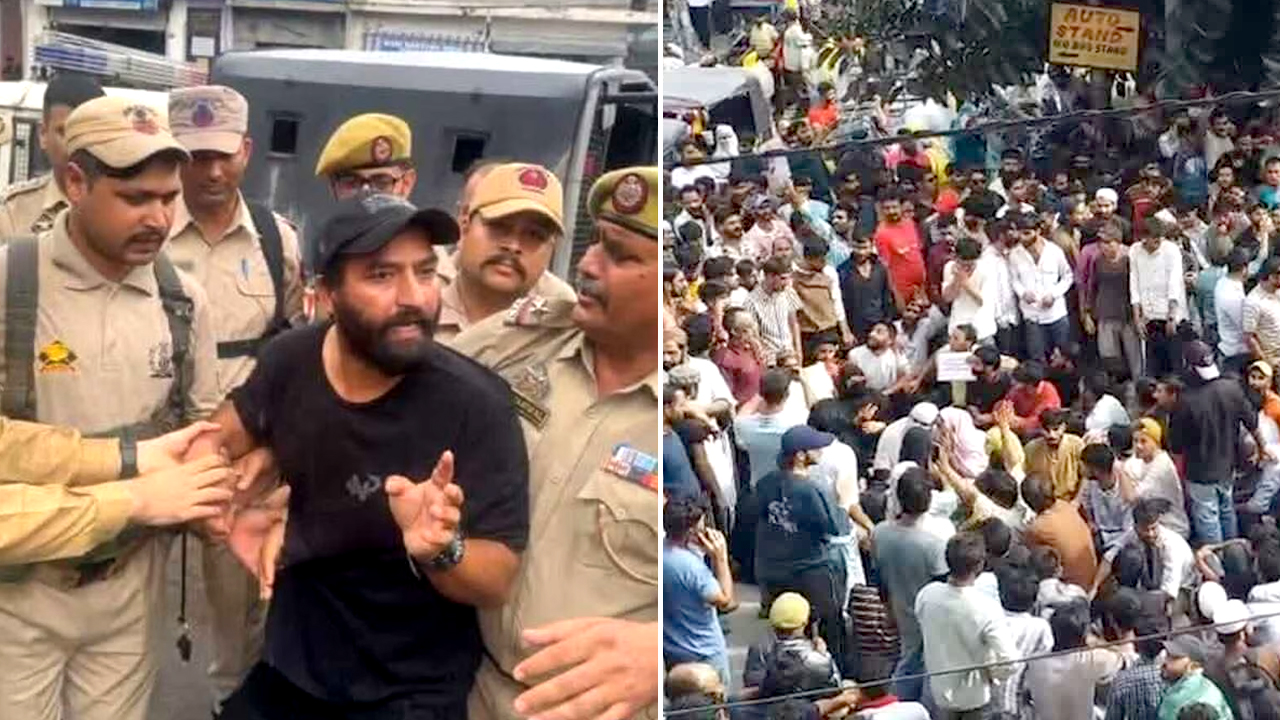
The selective targeting of public representatives, particularly from marginalized backgrounds, under sweeping security laws like the PSA casts a long shadow over the claims of “normalcy” and democratic restoration in the region.
By Ishtiaq Hussain
Groundxero | Sep 9, 2025
The already fragile democratic system in Jammu and Kashmir, deeply embedded within centrally controlled frameworks, has witnessed yet another alarming deterioration with the arrest of an elected representative under the draconian Public Safety Act (PSA). The legislator, a Member of the Legislative Assembly (MLA), Mehraj Malik from the Doda constituency in the Chenab Valley region, represents a constituency of an area historically marred by systematic neglect, developmental disparity, and entrenched corruption.
The arrest stems from a controversy regarding the relocation of a health centre in a remote village of Doda. The MLA had objected to what he termed the unilateral override of his recommendation by the District Development Commissioner (DDC), who allegedly favoured the stance of a local social activist over that of an elected representative. Acting on public demand, the MLA facilitated the relocation of the health centre to a more central location within the village. In response, the administration filed an FIR against the MLA and others, accusing them of theft.
Following this, the MLA held a live telecast on his social media, where he verbally lashed out at the DDC, using language widely condemned across the political and social spectrum. However, this outburst seems to have triggered what appears to be a politically motivated vendetta, culminating in his arrest under the PSA—an irony that underscores the deep democratic deficit in the region, where liberty, justice, and civil rights are often casualties of political manoeuvring.
Understanding this episode requires an understanding of the complex political structures that have evolved since Jammu and Kashmir’s reorganization into a Union Territory. The administrative setup has often been accused of using law and order mechanisms to suppress dissent and marginalize opposition voices by the state government and other political outfits. In this context, the arrest reflects a larger trend of bureaucratic dominance over democratic institutions and sets a very undemocratic precedent.
It is also important to consider the unique socio-political profile of the arrested MLA. He is the sole Muslim legislator from a region in the Jammu Division where Muslims constitute approximately 60% of the total population. His electoral victory was particularly remarkable given his modest economic background and campaign run largely on public goodwill rather than financial or political patronage. His emergence was viewed as a challenge to entrenched interests—ranging from dynastic political families to powerful political-business nexuses and communal forces prevalent and dominating the region.
Moreover, the MLA actively exposed high-level corruption in the Union Territory, including misgovernance that occurred over previous decades in the last session of state assembly. This earned him significant public support, especially among the youth, who saw in him a symbol of democratic renewal and grassroots empowerment. However, his inexperience in governance and lack of seasoned advisors may have made him vulnerable to conspiracy from the political, business and communal groups.
Coming from the historically marginalized Chenab Valley and representing an underprivileged community, the MLA perhaps overestimated the system’s openness to reform and underestimated the resilience of established power structures. His frustration over being sidelined led to periodic emotional and, at times, abusive outbursts—one of which has now resulted in his incarceration under a law typically reserved for threats to national security.
This development raises critical questions about the democratic ethos in Jammu and Kashmir. Will mainstream political parties transcend partisan interests and challenge this growing bureaucratic autocracy? Or will they remain confined to symbolic protests on social media, content with their privileges and passiveness in the face of shrinking democratic space?
The selective targeting of public representatives, particularly from marginalized backgrounds, under sweeping security laws like the PSA casts a long shadow over the claims of “normalcy” and democratic restoration in the region. After a six-year delay in holding elections, the incarceration of an elected MLA undermines public faith in democratic processes and raises legitimate concerns about the trajectory of governance in Jammu and Kashmir. The arrest is not just an isolated incident but a reflection of the larger crisis of democracy in the Union Territory, where elected voices are being silenced, bureaucrats override mandates, and governance increasingly veers toward autocratic control. If unchallenged, such trends may irreparably damage the political future of a region already grappling with alienation and distrust.
________________
Dr. Ishtiaq Hussain is currently serving as an assistant professor at the Department of History, Aliah University, Kolkata. Email:ishtiaqzargar01@gmail.com
Feature Image: (Left) Mehraj Malik, AAP MLA from the Doda constituency, being arrest by the police. (Right) Doda erupts in protest against his arrest.