
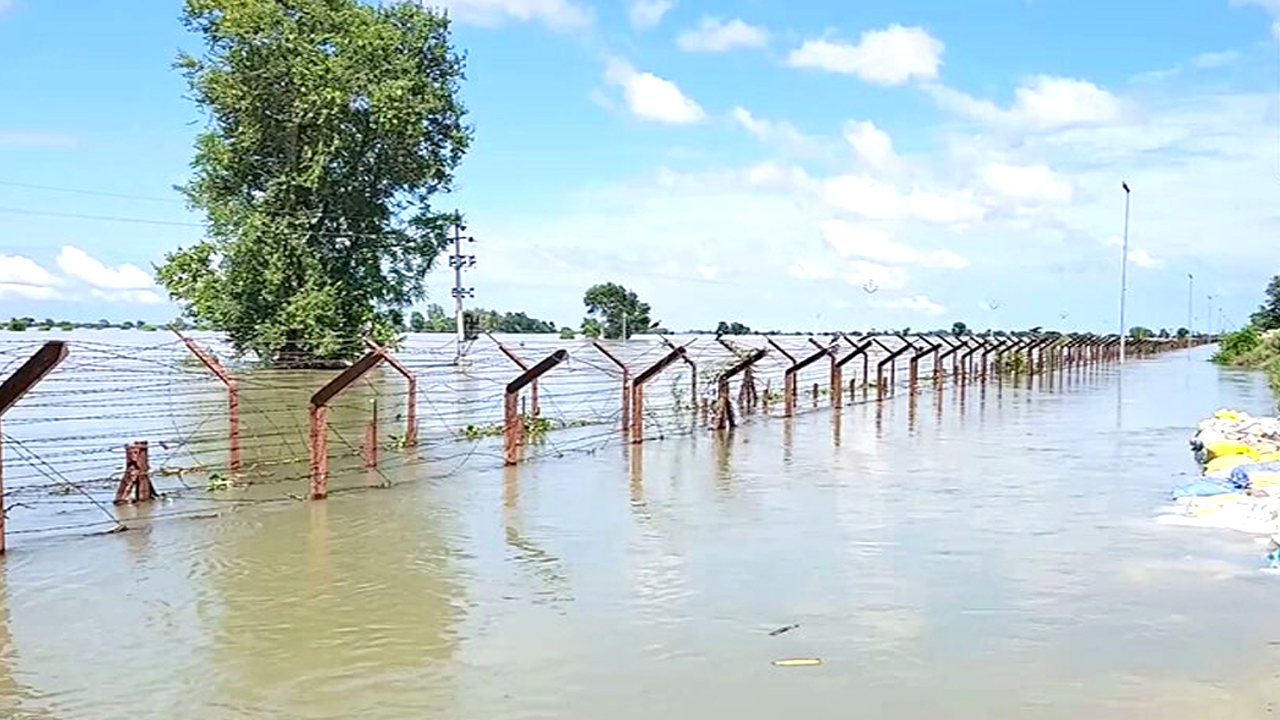
In those hours, religion, politics, and borders faded. What remained was a quiet, unwavering solidarity with the land and those who live by it.
By Jaspreet Kaur
Groundxero | Sep 8, 2025
A couple of weeks ago, when the Ravi River overflowed and unleashed devastation, the pain was felt equally on both sides of the border. The floodwaters didn’t recognize boundaries; they surged through Eastern and Western Punjab with the same force. Videos circulating online showed people from across the border helping repair broken embankments with whatever they could hold on to. The water paid no heed to man-made divisions or barbed wire; it flowed freely, washing away fragments of the symbols that separate the two nations.
In those moments, people from both sides of the border, formed human chains to slow the torrent—not as citizens of different nations, but as fellow humans. What remained was a shared commitment to life and land.
A Conversation That Lingered
This scene brought back a conversation from a few months ago in Bombay, over dinner with a batchmate friend and his journalist friend. About fifteen or twenty minutes into our meal, a comment surfaced: “Punjabis have more affiliation to the people across the border.” I looked up from my soup, puzzled. “Isn’t it?” he added, sensing my confusion at what felt like both a statement and a question.
It wasn’t the first time I’d heard this sentiment. The idea of “affiliation to the other side” surfaces often—sometimes subtly, sometimes overtly—in conversations across India. It’s rarely hostile, but it carries an undercurrent I’ve never quite been able to name. It leaves me uneasy.
Living outside Punjab, I’ve heard variations of this comment many times. Most often, I let them pass. But some linger. My usual response is humor – a way to deflect. Yet there have been moments when I’ve pushed back. In spaces that claim to be “apolitical,” any attempt to explain is seen as “too political.” Silence is mistaken for agreement. Anger is labeled intolerance. Humor became my shield.
But that evening, I didn’t want to be witty. I wanted to understand the intent behind the question. Journalists observe society; their perspectives shape public discourse.
He shared that during his years in Delhi; he noticed how often Pakistan came up in everyday conversations among Punjabis. In response, I asked him to imagine being told one day, without warning— he had just a few hours to leave his family home and never return. The next destination could be anywhere—from a few kilometers to a few hundred—and there would be no allocated place to go. The path to this unknown destination would lie under the shadow of death and destruction. And from that moment on, everything that once defined home would be lost. The tangible—land, house, money, photographs, clothes, cattle, crops—and the intangible—smells, sounds, voices—would all become inaccessible. Would he, then, stop speaking about it?
Amritsar is just 30 miles from Lahore. The shared food, language, music, and memories don’t end at a barbed wire fence. They are experiences passed down through generations.
Both men listened patiently. I hoped the conversation wouldn’t spiral into discomfort or disrespect. My host had been gracious, enriching my understanding of Maharashtra’s history and culture. In today’s fragile world, these conversations are never easy.
The Question That Wouldn’t Go Away
That night, the exchange stayed with me. The question of “affiliation” lingered. I felt I hadn’t explained it well enough. Why does this sentiment arise so consistently when someone says they’re from Punjab? Whether it’s a stranger or a friend, some versions of it surfaces uninvited.
The next day, I asked my friend earnestly: What must the people of Punjab do to prove their loyalty to the nation?
There’s abundant historical evidence of Punjab’s contribution to the freedom struggle and nation-building. So why the doubt? If Maharashtra reveres Chhatrapati Shivaji Maharaj, why can’t Punjab revere Maharaja Ranjit Singh and his kingdom? How can we forget the birth and resting place of Baba Nanak?
He listened intently. At one point, he said, “You’re right. I never realized how close Amritsar and Lahore are. Maybe we’ve failed to acknowledge the social and cultural loss.” His response gave me hope, not all questions come from suspicion; some are asked to gain deeper understanding .
Months have passed since that evening, but I still revisit my response. There’s something about the idea of affiliation I’m still trying to grasp. Perhaps I never will.
To understand it a little better, one must go further back—beyond Partition, beyond borders. This land, now divided, was once home to the Indus Valley Civilization, one of the world’s oldest civilizations. Its cities—Harappa, Mohenjo-daro, Rakhigarhi—spanned across Punjab, Sindh, Haryana and parts of Gujrat. India derives its name from river Indus, ironically now a part of the “other side” and three major rivers of eastern Punjab fall into the Indus basin which meets Arabian Sea in Sind Pakistan. Long before nation-states existed, people here lived, traded, and worshipped together.
Affiliation, then, is not a deviation —it’s a remembrance of a time when the land was whole and maybe the soil itself carries the memory?
When Borders Blurred Again
When the central government delayed releasing excess dam water into feeder canals of neighboring Haryana and Rajasthan, and those states refused to accept the floodwaters, the “other side”—already drowning—did not protest the opening of the Harike floodgates (Dam at the confluence of Satluj and Beas). Instead, they made arrangements to protect the Gurudwara at Kartarpur Sahib, rescuing pilgrims and evacuating their own people.
In those hours, religion, politics, and borders faded. What remained was a quiet, unwavering solidarity with the land and those who live by it.
12 days of devastation followed, with forecasts predicting worse to come. No emergency is declared. No flood relief package announced. The national media remained silent. No national disaster relief organizations arrived. It seemed the only ones who truly understood the depth of this suffering were those across the border, those who shared the floodwaters and the pain.
Beyond Language and Culture
Affiliation may be not just about shared language or culture. It’s about shared disasters, shared grief, and the memories that continue to shape identity. The wound of Partition hasn’t healed—not because people haven’t tried, but because new scars keep forming.
India was built on principles of non-violence and brotherhood. Perhaps it’s time we revisit those ideals—not just in policy, but in perception.
Affiliation doesn’t mean disloyalty. Sometimes, it simply means remembering what was once whole.
And perhaps it’s time to ask: When will larger India give Punjab what it truly deserves? When will those who question or dismiss begin to show affection towards a state that has fed them for six decades, stood guard at the borders, and participated in nation-building with unmatched resilience? When will acknowledgment replace suspicion? When will East Punjab feel seen and heard in its own country?
________________
Jaspreet Kaur lives in Noida. She is at present pursuing Gerontology to work for senior citizens.

It brings out my tears and I tried to appreciate the spirit of Punjabiyat
. It is not forgotten, despite 1947. 1984 and beyond. I congratulate the author for writing of what I have seen in 1982 and my on lif-long Punjward journeys.