
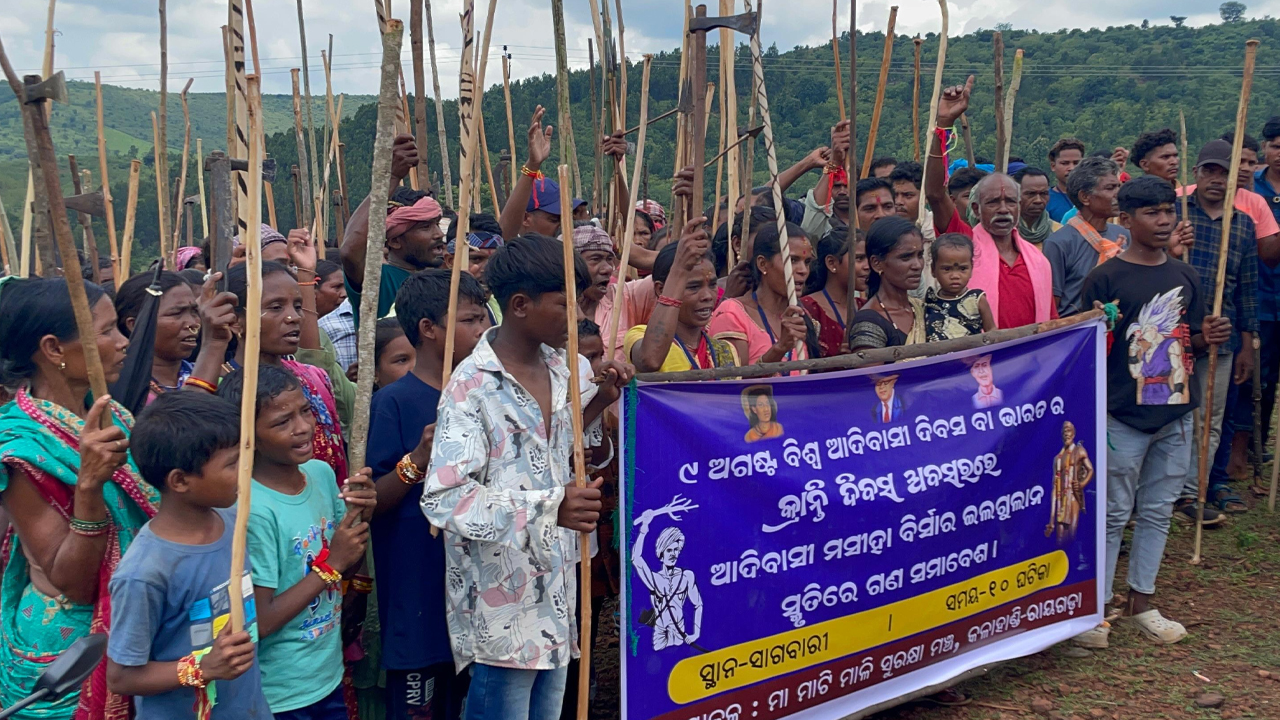
Beyond spectacles of formulaic festivities, Tij Raja’s children have taught me that the will to resist oppression and fight for one’s rights is more contagious than the fear invoked by the oppressor.
Srijan Dutta
Groundxero | Sep 3, 2025
A week before India’s 79th Independence Day, this year’s 9 August marked the 30th anniversary of the International Day of the World’s Indigenous Peoples, enlivened by celebrations across the globe. It was a day of celebration for the Maa Mati Mali Suraksha Manch, an anti-mining community organisation comprising Kui-speaking Adivasis and Dalits living in the villages nestled in the hillscape of Tijmali, located in southern Odisha, venerated as the sacred abode of Tij Raja. The Tijmali hillscape (referred to as ‘Sijimali’ in government records), which spans across Rayagada and Kalahandi districts, has been the epicentre of peoples’ movement since 2023 due to a proposed bauxite mining project covering an area of 1,549 hectares, including 699 hectares of forest land. The parties to the ongoing political conflict are the combined forces of the current BJP government in Odisha and the mine project lessee, the multinational mining conglomerate Vedanta Limited, on the one hand, and the Adivasis and Dalits inhabiting the project area, on the other.
Co-Option
On 8 August, en route to the programme venue, I met Kartik Naik, one of the key activists of the Manch, the community organisation leading the movement against the bauxite mining project in the Tijmali hills. Naik, who was arrested for his anti-mining activism on 19 September last year by Kashipur police and released after being incarcerated for seven months on 30 March this year, shared insights into how co-option and coercion constitute the modus operandi of neutralising the anti-mining movements in Odisha.
The mining companies initially attempt to market distant dreams of community development in terms of tangible construction initiatives related to education, healthcare, and the overall improvement of living standards in the project-affected villages. When big talk alone fails to secure the trust and consent of the local people in favour of the mining project, middlemen, third-party contractors colloquially dubbed as ‘company dalals’ step down in the mud to break the deal on behalf of the original company to whom the mining project has been leased out. The third-party contractor scouts the villages falling within the project area, gathers information on the dissenters, and purchases the loyalties of passive or weak-willed locals for raising a Trojan band of dalals who can sabotage the movement from inside. Mythri Infrastructure and Mining, a contractor based in Visakhapatnam, has been fulfilling this role for Vedanta Limited. Mining bauxite from the Tijmali hills is not a novel prospect; the history of anti-mining protests in the region dates back to the early-90s when prospecting leases for the Tijmali and Kutrumali bauxite blocks were handed out to Larsen & Toubro. However, faced with popular resistance, both projects remained a non-starter for L&T, and the PL licenses reached expiry. The two bauxite blocks were re-auctioned. While Vedanta emerged as the preferred bidder in Tijmali’s case, the Adani group bagged the ML (mining lease) for Kutrumali. Initially, Mythri surfaced as a compassionate regional mining company claiming to cater to the concerns and needs of the local populace in Tijmali. But the Tijmali locals soon realised that Mythri (colloquial for ‘friendship’) “serves as a true friend of the big mining giant Vedanta and is an enemy of the people”.
Coercion
The manoeuvre of co-option is only the first-line strategy. If it fails, the corporate-state nexus resorts to the manoeuvre of coercion. The Indian government’s regulatory laws on development projects direct industrial mining companies to obtain environmental clearances before starting operations. The due process for obtaining EIA clearance certificates from the competent authorities necessitates the hosting of public hearings involving representatives of communities residing within the project-affected area. These hearings must be highly publicised, accessible, and peaceful, inviting queries and concerns from probable project-affected citizens, cultivating a relationship based on trust, transparency, and accountability among the parties involved. However, images and memories of the two public hearings held in mid-October 2023, amidst heavy deployment of police and paramilitary forces, inside barricaded venues adorned with barbed wire, tell us otherwise. While the state authorities declared the hearings a success, the locals contradict the claim. They dismiss these hearings as a farce and call it “a vile attempt at manipulating public opinion”. The concerns and complaints expressed by the protesting locals have been documented in the proceedings of the two public hearings. They elaborate on the various aspects of the mining-induced devastation that would impact the Tijmali hills. Yet, every single public submission that is critical of the project has been refuted as lacking “cogent evidence” or “scientific information” in support of the protestors’ claims. On a similar note, an in-depth study into the multifaceted impacts of the mining project was published by the Human Rights Lawyering Clinic at NLSIU Bangalore titled Under the Surface: Human Rights and Environmental Implications of the proposed Sijimali Bauxite Mine Project in Odisha in April 2024. The language of patronising benevolence spoken today is something the state-corporate nexus of today’s India has inherited from the colonial masters of the past. The idea is clear— the poor, illiterate Adivasi or rural compatriot is far from knowing about one’s welfare better and must be guided duly before the “urban naxals” brainwash them.
In the weeks following the hearings, the state administration unleashed a police crackdown on protestors, and the situation escalated to midnight raids, arbitrary arrests, custodial torture, and imposition of stringent bail conditions upon release. The latter in the series of coercive methods used to repress the Tijmali movement is especially true in the case of Kartik Naik. Even if bail conditions infringing on one’s right to mobility are not outrightly stated on paper, apprehensions regarding future charges cannot be completely overruled. Under the current regime, precedents emphasising how activists may be booked based on mere association are available in abundance. I bade farewell to Naik and hiked uphill towards the celebration and protest site.
With the Shagabari village on the left, a dirt road on the right proceeds uphill to Podbandha Ghati. In the local tongue, the name refers to an elevated flat hilltop used as a grazing site for cattle, surrounded by taller hills. At the top of the ghati, people from the neighbouring villages have been camping on a relay basis for the past several weeks. They have been watching over the dirt track, ready to intercept Mythri officials, the police, and government representatives, because it is this very path that has been chosen as the ‘approach road’ for the proposed bauxite mine. The tricolour waves above the modest makeshift tent built with bamboo and tarpaulin sheets. It adds a sense of boldness to the campsite— bold enough to reiterate the most burning question that must be asked in today’s India. To whom does the country belong?
The situation was already tense when I reached the camp in the afternoon. The Rayagada Collector and District Magistrate’s office had sent a prohibitory order under Section 163 of the BNSS outlawing Adivasi Divas celebrations at the camp site. The order, as the authorities stated, was issued “in the interest of maintenance of public order and tranquillity”. It further went on to profess a possible “naxal attack on the congregation” at Tijmali. According to the order, the host organisation was “actively planning to organise a congregation of people” and the event was “a protest under the guise of celebration”, and “a clear attempt to incite anti-mining sentiments”.
Determination
A quick meeting among the protesters at the camp site gave out a resolute verdict in the evening: “The prohibitory order issued by the Rayagada Collectorate concerning the celebration of Adivasi Divas is something unprecedented for us. Tijmali is part of a Scheduled Area. Here, the Gram Sabha is the primary directive authority. Why should we bother about seeking permission from the Collector’s Office? Even the Supreme Court cannot directly overturn the Gram Sabha’s mandate unless and until the latter’s decisions go against the Constitution. So, if the Gram Sabhas have no objection to organising a programme on Adivasi Divas, why should we step back?”
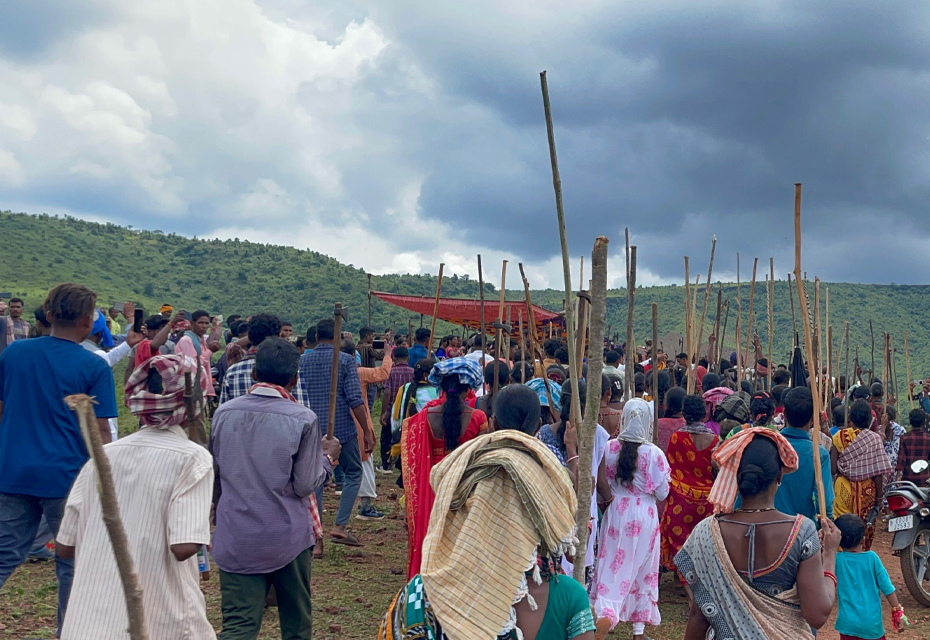
Enthusiastic participants flood the campsite
Preparations for the next day’s programme continued through the night. The next morning, the Adivasi Divas celebrations began by paying ritual homage to Tij Raja. Following that, rallies both big and small came from all directions traversing the hills. By noon, a gathering of more than a couple of thousand people had gathered at the programme venue. The majority of the participants were Adivasi women. Before settling to listen to what the designated speakers had to say, the participants danced and marched in and around the venue with their traditional weapons in their hands. They shouted slogans in unison, opposing the mining project, upholding the Right to Life of Adivasis and Dalits, and drawing inspiration from historic peoples’ struggles led by Birsa Munda, Laxman Naik, Rindo Majhi and others.
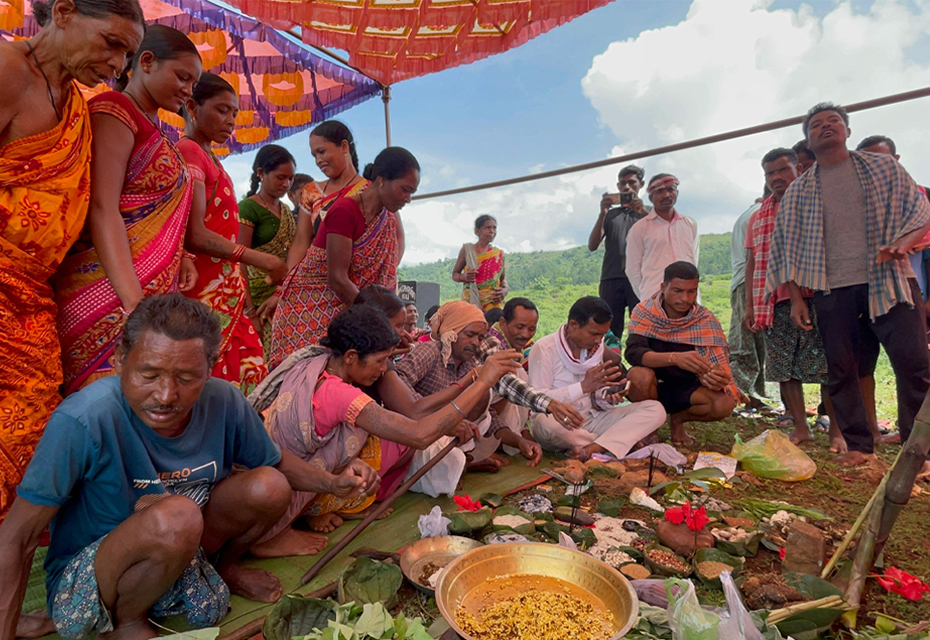
Padman Naik of Banteji village, who had previously acquired a reputation as a singer for people’s rights for his song protesting the mine project sung at one of the two public hearings held in 2023, inaugurated the programme by singing a song. His performance was centred on the idea: “We are all worms on the face of Mother Earth / We are all branches of the same tree / No one is different from one another / Let us come together and fight for Mother Earth / Let us not allow the company to enter.”
Earlier, on World Environment Day, the participation of 25 activists including Medha Patkar in a celebration programme under the banner of Maa Mati Mali Suraksha Manch was criminalised under a similar order. The current order names seven activists whom the state authorities view as a threat. The name of Lingaraj Azad, a veteran Dalit activist with the Samajwadi Jan Parishad, fell among the seven activists named this time. However, an undaunted Azad held the microphone and addressed the gathering.
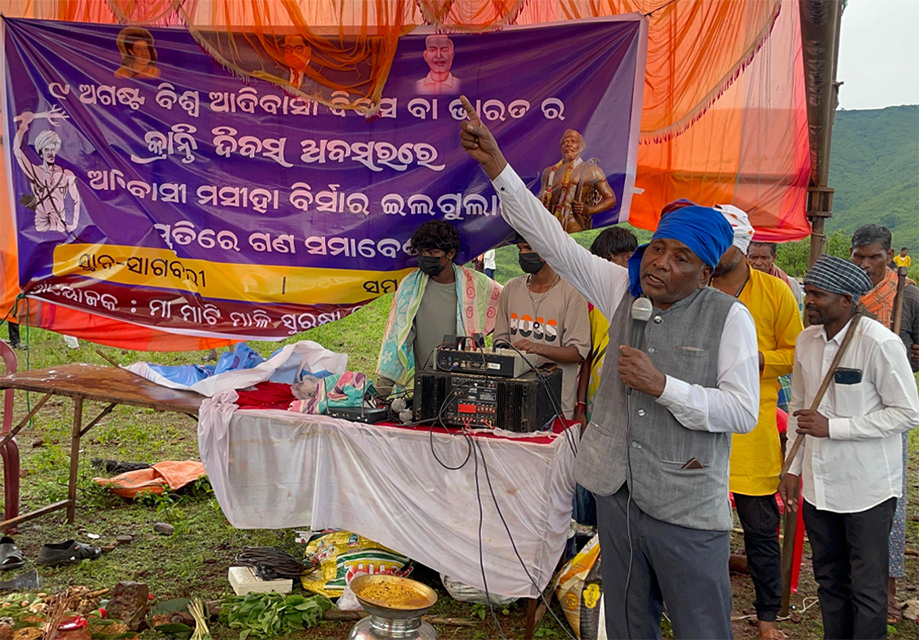
Dalit activist Lingaraj Azad addresses the gathering
Azad’s speech revealed an appalling instance of administrative highhandedness. “The Rayagada Collector is functioning as a stooge of the mining companies. Hence, it has been issuing notices against protestors. On top of that, the judiciary is also being led to act against the people. Those arrested earlier on false grounds are being released under bail conditions previously unheard of. They are forcing protestors from Dalit backgrounds to sweep the floor and even clean toilets at the investigating police station.” said Azad. Kumeswar Naik and Hiramal Naik, both belonging to Scheduled Castes, are activists associated with the Maa Mati Mali Suraksha Manch. Following their participation in a protest demonstration organised in front of Kashipur Police Station on 19 August 2024, they were both arrested by the Kashipur police. The case registered against them alleges that both the men, as part of a crowd of “200 villagers [had] gathered with deadly weapons in front of the Kashipur Police Station” and vandalised the station premises. In fact, the demonstrators had gathered in front of the Station to protest against the arrest of Kartik Naik. While Kumeswar was granted bail by the Orissa High Court on 9 May this year, Hiramal obtained a bail order from the District and Sessions Court in Rayagada on the 6th of the next month. The High Court granted bail to Kumeswar with the following as one of the conditions: “The Petitioner shall clean the premises of the Kashipur Police Station in the morning hour (between 6:00 A.M. to 9:00 A.M.) for two months from the date of his actual release in the aforesaid case. The I.I.C. of the Kashipur Police Station shall provide the cleaning articles like broom, phenyl and other items to the Petitioner so that he can clean the said premises.” Taking precedence from the High Court order, the District and Sessions Court also imposed the same bail condition on Hiramal. The Supreme Court often stresses on the principle of proportionality as a key tenet of the retributive justice system. Plenty of legal precedents also emphasise on the right of the accused to be presumed innocent. So, how can a pre-trial ruling punish the accused before one is found guilty after trial? Our learned judges know it better. On a different note, the last time I checked, the begar system or forced labour has been abolished long ago in our country. Even prisoners have a right to be paid wages for their work in prison under Article 23 of the Indian Constitution, which criminalises forced labour. A night before the programme, while interacting casually with the locals, a certain remark had caught my attention. Someone commented that Brahminism is the biggest corporate enterprise among all the companies trying to infringe on the rights of Adivasis and Dalits; does this bail condition meted out to Kumeswar and Hiramal not reinforce caste discrimination?
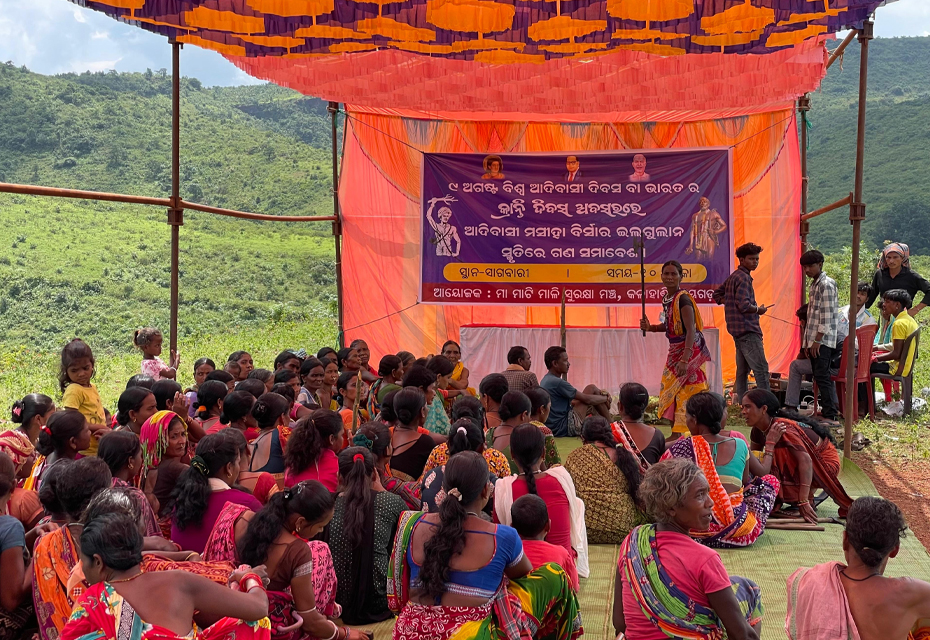
The program was brought to life by the vibrant energy of women, who comprised most of the participants.
Collaboration
One might think that political co-option, in the context of mass movements, only runs through the explicit purchase of loyalties. But there is a whole other dimension to the tactic of co-option. Our shrewd parliamentarians, often capitalising on their community identity, raise self-serving rhetorical questions to allure the people. Azad was succeeded by a long list of speakers. Apart from two, all of them belonged to the Samajwadi Jan Parishad and the Maa Mati Mali Suraksha Manch. I noticed that the presence of the two exceptions had caused the people in the crowd to have their eyebrows raised or frown. The two gentlemen were Bibhishan Majhi and Jayaram Pangi.
The organisers told me that both of them were self-invited guests. To my surprise, both the gentlemen were given a chance to speak at the programme. Further interaction with the crowd helped me understand the skepticism in the air better. In the mid-90s, massive anti-mining protests had erupted in Kashipur block against the establishment of the Baphlimali bauxite mine project by Utkal Alumina International Limited. Bibhishan Majhi had initially participated in the movement as a young and promising Adivasi activist. But later on, he joined the BJD and was elected the MLA from Laxmipur Constituency in Koraput district. After elections, he took a 180-degree turn and emerged as one of the strongest pro-mining advocates in Odisha’s politics at that time. From a defender of Jal-Jangal-Zameen and the Right to Life of Adivasis, he became the flag-bearer of the All Party Committee that was formed to administratively suppress the movement. Jayaram Pangi is a four-time former MLA from Pottangi Constituency in Koraput district and also a former MP from the Koraput Lok Sabha seat. The locals told me that Pangi currently possesses the reputation of an opportunist given his tendency to frequently shift allegiances. He was a BJD MP from Koraput Constituency from 2009 to 2014. He quit BJD and joined the BJP in 2017. He had contested in the 2019 Lok Sabha elections on a BJP ticket but lost to INC candidate Saptagiri Sankar Ulaka. Two years after facing defeat, Pangi left the BJP and quite surprisingly joined BRS in Telangana. Again, in 2023, he quit BRS and joined the INC. Now, Pangi seems to have a justification for his tendency to hop among parties. In his address to the gathering, Pangi raised the slogan “Age Mati, Phir Party” (The land comes before the party). He even condemned the Rayagada administration’s prohibition order on the Adivasi Divas celebration in Tijmali. In his speech, he proposed a one-time solution to the ordeals of the Adivasis and Dalits in Odisha— a separate state constituting the former undivided districts of Kalahandi, Bolangir and Koraput. He urged that Odisha’s wretched ST and SC communities should unite under this demand as it is their only road to liberation.
The idea, no matter how radical it may sound, seemed to cause no reaction from the audience. To be clearer, before handing over the microphone to Pangi, Lingaraj Azad had ended his speech with a cautionary note. He said: “Today, a section of the Adivasis and Dalits have started to collaborate with the ruling classes. Our President Draupadi Murmu is an Adivasi. We also have an Adivasi Chief Minister. But has our situation improved?”
Realisation
After the programme was over, I came down from the hilltop and spent the night at Kantamal village. There, I had the opportunity to interact with Subha Singh Majhi, the president of Maa Mati Suraksha Manch. He detailed how the state authorities have been working together with the big mining companies against the interests of Adivasis and Dalits. In Subha’s own words: “Our Chief Minister Mohan Charan Majhi is an Adivasi. But, the police and Mythri men are working together against the people. It is the company goons who are assaulting us. Instead of taking action against them, the police are framing innocent villagers in fabricated cases. On 2 August 2025, a woman protester named Naring Dei Majhi had gone to the hospital to seek treatment. But she was picked by the police from there and put in jail. Our fight is a struggle to save Tij Raja, our malis, land, culture, and way of life.”
On my way to Kantamal, I noticed a couple of houses here and there with solar panels installed on their roofs. I was told that the Mythri company men were installing them under some ostensible CSR (corporate social responsibility) scheme. I wanted to know what villagers at Kantamal thought of CSR initiatives. The view they shared was brief and can be summarised into a single slogan: “Give with one hand and take away more with the other!” The question they threw back at me was even more simple yet hard-hitting: “Why should development be conditional?”
It is no secret that the rationale of development adopted by regimes like ours is actually the rationale of capital. To think that the protagonists of this story are naïve enough to not understand this truth would be nothing but belittling them. They remind us that communities fighting to protect their autonomy are not socio-economically uniform. Thus, political solidarities fuelling peoples’ movements are primarily forged along the lines of shared class interests, rather than community identity. Most importantly, beyond spectacles of formulaic festivities, Tij Raja’s children have taught me that the will to resist oppression and fight for one’s rights is more contagious than the fear invoked by the oppressor.
________________
Srijan Dutta is an activist and researcher.