
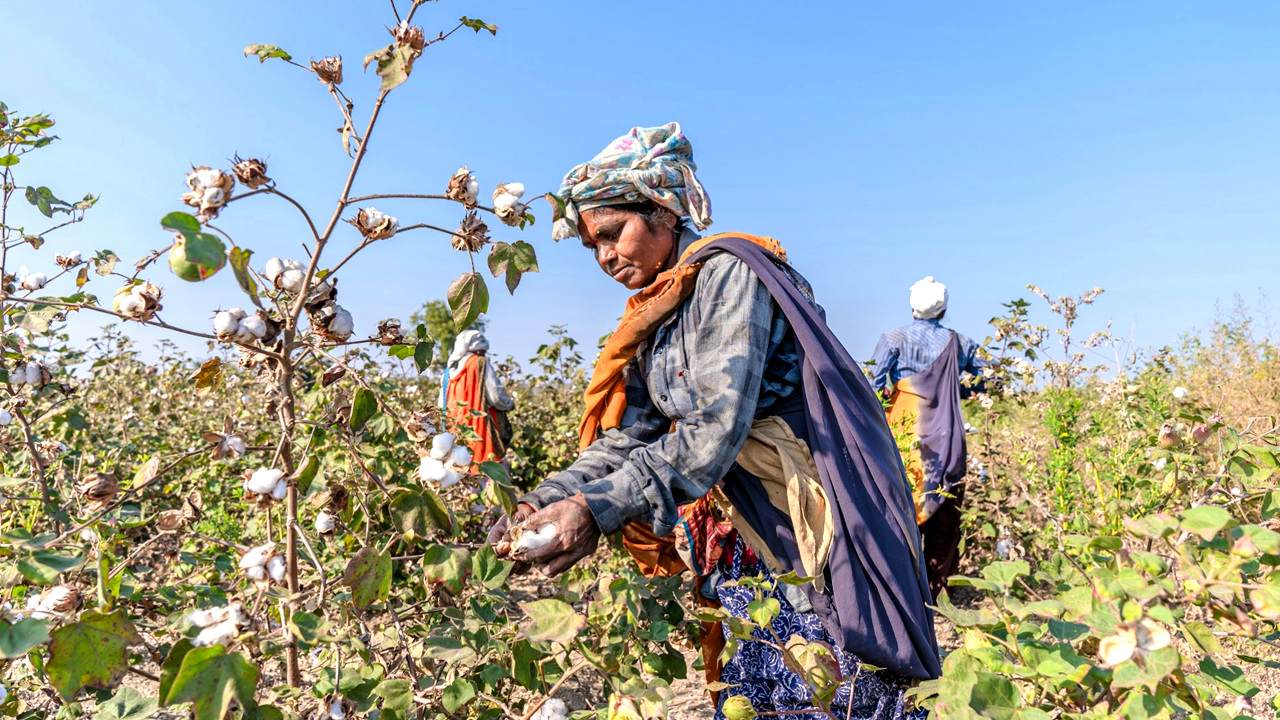
Farmer’s access to markets, price fluctuations, and government support policies, such as Minimum Support Price (MSP) operations, play a vital role in cotton production and farmers’ income. Analyses by SKM indicate that a farmer cultivating cotton on one acre of land in India likely suffered potential loss of Rs.31500 in the year 2024-25 due to the Minimum Support Price (MSP) not being fixed at the C2+50% level as was recoomended by the Swaminathan Commission.
Groundxero | Aug 25, 2025
The Union Finance Ministry has notified the elimination of 11 per cent duty on the cotton imports with immediate effect on 19th August 2025 and it will remain in force up to September 30. The government said that the “elimination of import duty on cotton as well as Agriculture Infrastructure Development Cess (AIDC) is necessary in the public interest”.
Samyukt Kisan Morcha (SKM) has convened a Press Conference today (August 25, 2025) at the Press Club of India, New Delhi on this issue. Senior SKM leaders Rakesh Tikait, Hannan Mollah, Rajan Kshirasagar, Prem Singh Gehlavat and P Krishnaprasad addressed the press conference.
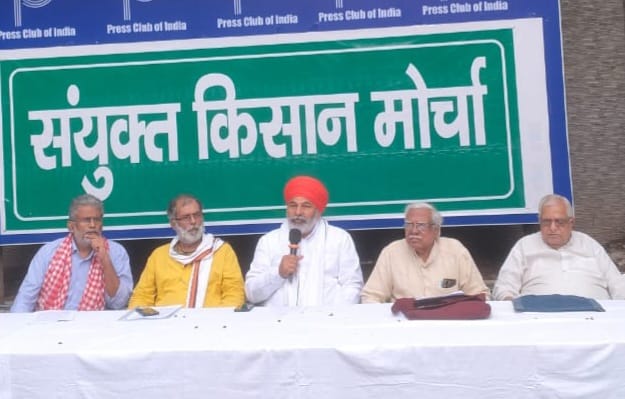
SKM said that it is ironic that an anti-farmer decision to scrap the 11% import duty on raw cotton by the Union Government was followed by Prime Minister Modi’s Independence Day speech in which he said that he is “standing like a wall against any adverse policy that could impact Indian farmers, fisherfolk and cattle keepers” and “India will never compromise the interests of Indian farmers, fisherfolk and cattle keepers”.
SKM alleged that Modi’s consistent pro-imperialist policies couldn’t ensure the protection of India’s interests in the tariff war initiated by Trump. It said that to manage the situation post US declaration of 50% tariff on India’s textile exports, Narendra Modi has decided to punish Indian cotton farmers who are the weakest links in the global supply chain.
SKM said that this decision will result in a reduction in the price of imported cotton which, in turn, will push prices of domestic cotton downwards. It said that the small cotton producers in India cannot compete with large, industrial-scale cotton farmers of the United States who have historically received massive government subsidies. SKM alleged that the duplicity of US lobbying with the Indian government to reduce state support to the Indian cotton farmers is well documented. It pointed out that as per estimates, government subsidies in the US are as high as 12 per cent of the total value of production of cotton, while in India, government support to cotton farmers is about 2.37 per cent of the value of production. SKM said that this massive disparity is at the core of the advantage the US cotton farmers have over cotton producers in developing countries like India.
SKM said that the immediate impact of this decision will be particularly severe as farmers in most cotton-growing areas have already sown their crops almost two months back and have incurred significant costs in anticipation of getting remunerative prices for their produce. Pointing out that cotton-growing regions of India are notorious for agrarian distress and death by suicides by farmers, SKM said that the latest policy decision of eliminating import duty on cotton will further push cotton farmers into indebtedness and aggravate the economic distress of 60 lakhs cotton farmer households.
SKM said that the US government is putting pressure on India to similarly open Indian markets to other farm products from the US. It said that unless farmers make it clear to the Indian government that such anti-farmer decisions will not be tolerated, it is likely that the Modi government will succumb to the US pressure and take such decisions for other crops as well. So, SKM has called upon all farmers to come together and launch an intense agitation to force the government to reverse this decision.
The Issue of MSP for cotton farmers
At the Press Conference, SKM provide detailed condition of the cotton farmers in the country, explaining how the union government’s policy of not implementing Swaminathan Commission’s recommendation of fixing the Minimum Support Price (MSP) at C2+50% level (50% profit over the comprehensive cost of production, including imputed value of family labor, rental value of owned land, and interest on fixed capital), is pushing cotton farmers into indebtedness, and in many cases leading to their suicides. The annexure attached to the press release in this regard is published below.
Annexure
In India, the area under cotton cultivation is around 120.55 lakh hectares, which represents about 36% of the world’s total cotton area. The country is the world’s largest in terms of cotton acreage. Among the states, Maharashtra has the largest area dedicated to cotton cultivation, followed by Gujarat and Telangana. Approximately 67% of India’s cotton cultivation relies on rain-fed areas.
India, China, the United States, Pakistan and Brazil are the key producers of cotton. World cotton production is projected to grow by 0.9% per year, increasing from 119 million bales in 2014-15 to around 133 million bales in 2024-25. China is projected to account for 23% of world production by 2024-25. The United States is projected to account for 13% of world production by 2024-25. During the last 11 years, the cotton production in India has declined by around 10 lakh metric tonne. 2014-15: 6.56 MMT (386 lakh bales), 2017-18: 6.29 MMT (370 lakh bales), 2021-22 (P): 5.36 MMT (315.43 lakh bales), 2023-24 (P): 5.50 MMT (323.11 lakh bales) [(P) indicates Provisional Data.]
Farmer’s access to markets, price fluctuations, and government support policies, such as Minimum Support Price (MSP) operations, play a vital role in cotton production and farmers’ income. Based on CACP calculations for the Kharif Marketing Season (KMS) 2024-25: Projected C2 cost of production: ₹6,230 per quintal. Reports and analyses indicate that cotton farmers in India likely suffered losses in the 2024-25 season due to the Minimum Support Price (MSP) not being fixed at the C2+50% level (50% profit over the comprehensive cost of production, including imputed value of family labor, rental value of owned land, and interest on fixed capital), as recommended by the Swaminathan Commission.
Here’s a breakdown of the potential losses: Difference between MSP and C2+50% benchmark: The CACP projected C2 cost for medium staple cotton for KMS 2024-25 is ₹6230 per quintal. The MSP fixed for medium staple cotton was ₹7121 per quintal. The C2+50% price, according to calculations, should be around ₹10,075 per quintal. This implies a potential loss of approximately ₹2365 per quintal for farmers (₹10,075 – ₹7710 = ₹2365). In 2024-25 estimated production of 5.21 million tonnes (52.1 lakh metric tonnes) and the potential loss = 52,100,000 quintals x ₹2365/quintal = ₹123,285,000,000 (approx. ₹123.28 billion)
This calculation highlights the significant financial impact that the gap between MSP and the C2+50% recommended price can have on Indian cotton farmers. This is a theoretical loss based on the difference between the MSP and the C2+50% recommended price. Not all cotton is sold at the MSP, and actual market prices vary. The effectiveness of the current MSP based on A2+FL is further hindered by limited procurement and a gap between announced MSP and realized prices for farmers, particularly when market prices are lower than MSP. On an average the open market price is in the range of Rs.5500 to Rs. 6500 and accordingly the loss suffered could be estimated at Rs 18850 crore for the year 2024-25 alone.
Based on this estimate the loss suffered by one acre cotton farmer in the year 2024-25 is Rs.31500. The Prime Minister boasts on the PM Kisan Nidhi of Rs.6000 per year to one farmer. If the Union Government implements MSP@C2+50%, then cotton farmers could save Rs 25000 even after donating Rs. 6000 to the Prime Minister’s fund.
Factors like yield, farmer input costs, and access to MSP procurement also influence overall farmer profitability. Additional factors contributing to potential losses includes fluctuations in production due to biotic and non-biotic stresses (pest attacks, erratic rainfall, etc.) impacting farmer profitability. While the government claims to be setting MSPs at least 50% above the cost of production (A2+FL), this calculation may not fully account for all input costs, potentially affecting farmers’ profitability.
The peasant suicide due to indebtedness has become a common feature after the implementation of the neoliberal reforms affecting agriculture since 1991. So far more than 4.5 lakh farmers have committed suicide as per the government data. Now the government consciously abdicates from the responsibility of maintaining such data. Under the Modi Government 31 farmers are committing suicide daily. But in the last 11 years, the Modi Government has not provided any loan waiver scheme for the farmers while the corporate debt to the tune of Rs. 16.11 lakh crore has been written off.
479 farmer suicides were reported in Maharashtra in just two months of March and April 2025, Relief and Rehabilitation Minister Makarand Jadhav informed the state Legislative Assembly on 4th July 2025. The Minister had said that 250 suicides occurred in the Marathwada and Vidarbha regions in March 2025. In April 2025, the state recorded 229 cases of farmer suicides. The state government provides Rs 1 lakh as assistance to the legal heirs of farmers who die by suicide. After a suicide is reported, the family is visited by a district level officer. The necessary inquiry is conducted by a committee and after the complete proposal is made by the district level committee, the eligible and ineligible decision is taken, and immediate assistance is provided,” he said in a written reply.
SKM has strongly demanded the Union Government and all the State Governments to immediately enhance this compensation to Rs. 25 lakh with retrospective effect from 2014.
Future Plan of Action
At the Press Conference, SKM also announced the future protest actions by the cotton farmers.
- The cotton farmers will burn the copies of the notification and hold protest meetings in villages on 1, 2, 3 September 2025.
- Village Gram Sabhas will be convened and they will adopt a resolution urging the Prime Minister Narendra Modi to repeal the 19th August notification to scrap 11% import duty on cotton and immediately declare Rs.10075/ quintal as MSP@C2+50% for raw cotton. The resolution will be sent to the Prime Minister.
- A signature campaign and house to house leaflet distribution will be conducted in support of the memorandum to the President of the respective local body before 10.09.2025.
- If the Prime Minister doesn’t take immediate decision on the demand then cotton farmers will convene Mandal Mahapanchayat and organize a protest march to the respective Members of Parliament.
- State Coordination Committees of SKM in the 11 cotton growing states will immediately convene meetings and conventions of cotton farmers to discuss and decide future plans of struggle.
- In the context of widespread suicides among cotton farmers a delegation of SKM will visit Vidharbha in Maharashtra on 17 and 18 September 2025.