
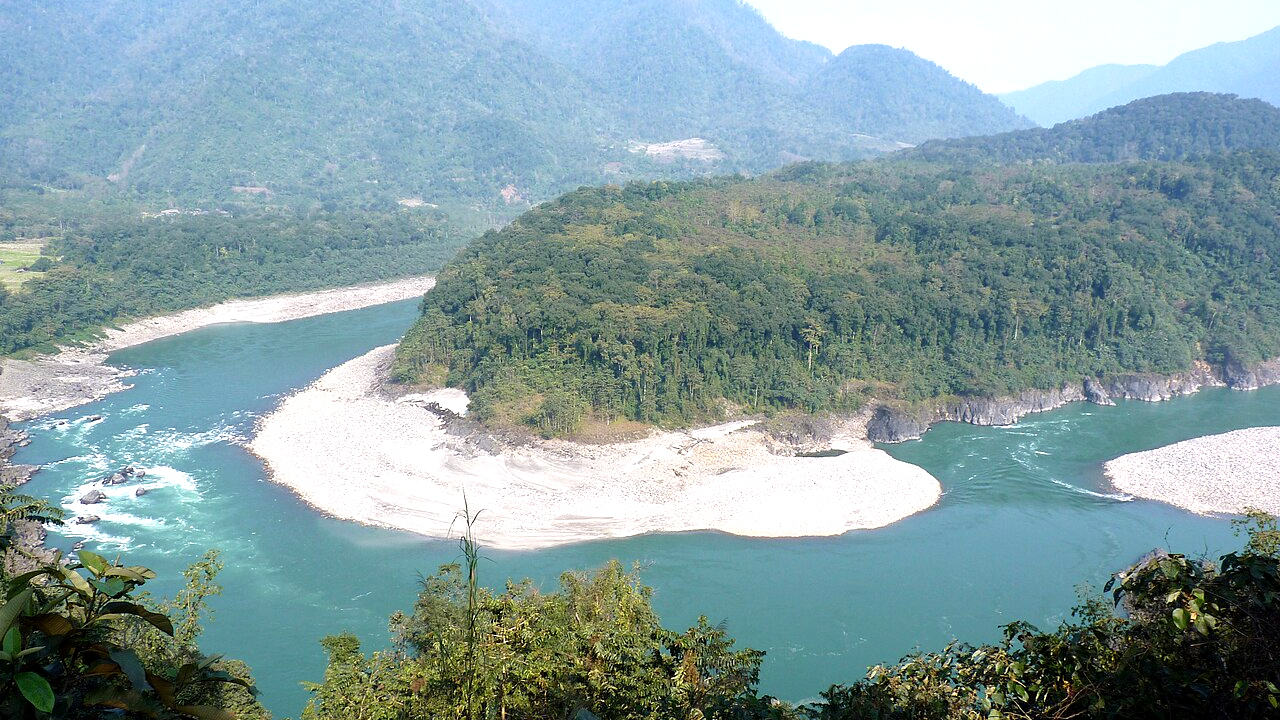
The recommendation for in-principle forest clearance for the 1,000-MW Naying Hydroelectric Project in Arunachal Pradesh comes amid escalating protests against large dam projects in the Siang river basin. With 470.8 hectares of forest land set to be diverted, compensatory afforestation proposed 1,700 kilometres away in Madhya Pradesh, and landowners rejecting NEEPCO’s compensation offer, the Naying project on the Siyom River raises serious questions about ecological destruction, and the social cost of hydropower expansion in a region where indigenous communities are increasingly resisting such projects that threaten their forests, rivers and ancestral lands.
Groundxero Desk
Amid growing opposition and resistance to the proposed 11,200-MW Siang Upper Multipurpose Project (SUMP) in Arunachal Pradesh, another major hydroelectric project in the Siang river basin has moved closer to implementation. On October 23, 2026, the Forest Advisory Committee (FAC) of the Union Ministry of Environment, Forest and Climate Change recommended in-principle forest clearance for the 1,000-MW Naying Hydroelectric Project on the Siyom River (Yomgo River), a major tributary of the Siang.
The FAC recommendation permits the diversion of 470.8 hectares of unclassed forest land for the project, which will require the felling of approximately 1,04,036 trees. The FAC has categorised the project area as a “high conservation value zone”. The clearance comes despite persistent objections from project-affected communities, unresolved disputes over land compensation and allegations of procedural irregularities in the environmental clearance process.
The Naying project, being developed by the North Eastern Electric Power Corporation (NEEPCO), is a run-of-the-river scheme with peaking power generation capability. Proposed on the Siyom (Yomgo) River, a right-bank tributary of the Brahmaputra, the project extends across parts of Shi-Yomi and Siang districts, both bordering China. With an estimated investment of Rs 11,835 crore, it involves the construction of a 108-metre-high concrete gravity dam over an area of approximately 470 hectares.
The project was conceived more than a decade ago and received the Central Electricity Authority’s concurrence in 2013. Its progress remained stalled for years because of environmental and social concerns, particularly the large-scale diversion of forest land. The Union Environment Ministry’s Expert Appraisal Committee recommended environmental clearance in June 2026, and the project received conditional environmental clearance in July. The conditions included safeguards relating to compensatory afforestation, wildlife conservation, air and noise pollution monitoring, and waste management. A mandatory public hearing was subsequently held at Yapik village in Shi-Yomi district.
Construction is expected to begin around 2028, with commissioning targeted for 2032.
Landowners reject NEEPCO’s compensation offer
The successive clearance procedures of the project have intensified opposition among affected landowners. Twelve villages are expected to be affected, and grievances over compensation have developed into a major source of conflict between local communities and NEEPCO.
The dispute reached a deadlock in September 2026, when NEEPCO proposed compensation of just Rs 130 per square metre for land and forest resources during an administrative meeting in Yapik village. The Naying Hydroelectric Project Land Owner Welfare Committee (NHEPLOWC), led by its chairman, Taya Yabu, rejected the offer, describing it as a gross undervaluation of ancestral land.
The landowners pointed out that compensation rates for comparable infrastructure projects in other districts of Arunachal Pradesh ranged between Rs 3,000 and Rs 5,000 per square metre. They demanded that the same standard be applied to the Naying project.
On September 23, landowners from seven affected villages met at Yapik and formally decided to suspend all cooperation with NEEPCO until their demands concerning compensation and land rights were addressed.
The nine-point memorandum submitted by the Land Owner Welfare Committee also raised objections to unauthorised tree cutting and clear-felling within designated local forest areas without the required final clearances and compliance procedures.
Questions over the environmental public hearing
The landowners’ opposition is not confined to monetary compensation. They have also raised serious questions about the transparency and legality of the environmental clearance process.
During the mandatory public hearing, affected landowners submitted a memorandum detailing their objections and concerns relating to the environment and local livelihoods. However, the welfare committee alleges that the Arunachal Pradesh State Pollution Control Board (APSPCB) failed to provide a formal action-taken report or respond to the objections submitted by the community.
The committee has further alleged that the official minutes and records of the public hearing were withheld from the public. This, it argues, prevented project-affected families from verifying whether their objections and concerns had been properly recorded before the government proceeded with subsequent declarations and land acquisition notices.
Following these alleged procedural violations, local landowners convened meetings in Yapik village and adopted resolutions warning of peaceful protests and total non-cooperation if the state government failed to arrange a formal hearing to address their grievances in a transparent manner.
The refusal of seven villages to cooperate with NEEPCO represents a significant challenge to the project’s implementation. It also raises a fundamental question: can a project claiming to serve the public interest proceed legitimately when the people whose land and forests it will consume are contesting the terms of acquisition and the very procedures through which it has secured approval?
A forest lost here, trees to be planted 1,700 kilometres away
One of the most troubling aspects of the Naying project is the nature of its proposed compensatory afforestation.
Under the compensatory afforestation framework, project developers are required to arrange tree planting on an equivalent or, in this case, double the area of forest land diverted for non-forest purposes. Accordingly, NEEPCO must undertake compensatory afforestation over 942 hectares.
However, the planting is not proposed in the Siyom river basin or even in Arunachal Pradesh. According to the project’s environmental assessment, the compensatory afforestation is to be carried out on degraded forest land spread across 18 districts of Madhya Pradesh, approximately 1,700 kilometres away from the project site.
The FAC has stipulated that the 942 hectares must constitute a single contiguous patch rather than being divided into smaller, scattered plots.
This arrangement exposes a fundamental flaw in the compensatory afforestation model. A natural forest is not simply a collection of trees that can be replaced by planting saplings somewhere else. It is a complex ecological system shaped by its geography, soil, water, climate, biodiversity and the relationship between local communities and their surroundings.
The forests of Arunachal Pradesh, particularly those classified as having high conservation value, sustain distinctive ecosystems and provide habitats for diverse wildlife. Planting trees in a different geographical and ecological region cannot recreate the biodiversity, ecological functions or livelihood relationships of the forests being destroyed.
The problem is further compounded by the lack of transparency and accountability in the implementation of compensatory afforestation programmes. Studies and audits have repeatedly raised concerns about the survival of planted saplings, the use of limited varieties of fast-growing species, inadequate monitoring and the exclusion of local communities from long-term maintenance.
A comprehensive Comptroller and Auditor General (CAG) audit report examining nationwide greening and afforestation initiatives highlighted severe implementation failures. The audit reportedly found that forest-cover expansion fell substantially short of targets. The cited figures indicate that forest cover increased by only 0.03 million hectares against a target of 1.4 million hectares over a decade, while 70 per cent of sampled afforestation sites showed no noticeable improvement in greening.
Such shortcomings make it difficult to accept compensatory afforestation as an adequate ecological response to the destruction of an existing natural forest.
In the case of Naying, the contradiction is particularly stark: more than one lakh trees are to be felled in a high conservation value forest zone in Arunachal Pradesh, while the legally mandated afforestation is to take place thousands of kilometres away in another state, in a completely different ecological landscape.
Naying and the larger battle over the Siang river basin
The Naying Hydroelectric Project is not an isolated case. It is one of at least four hydroelectric projects planned in the Siang river basin, with the proposed 11,200-MW Siang Upper Multipurpose Project being the largest and the most contentious.
The cumulative impact of these projects on the river system, forests, biodiversity and indigenous communities remains a major concern. The local opposition to the Upper Siang (SUMP) project has already developed into a statewide wider people’s movement involving the indigenous Adi community, residents of villages along the river, student and youth organisations, cultural activists and the larger civil society. Communities fear that the massive project could submerge dozens of ancestral villages and irreversibly alter their relationship with the river and surrounding forests.
In late October and early November 2026, protests against the Upper Siang project escalated, resulting in demonstrations and strikes, the state responded by use of force to suppress the protests, anti-dam activists were detained in Itanagar and New Delhi, and the deployment of central paramilitary forces, including the Indo-Tibetan Border Police (ITBP) and the Rapid Action Force (RAF). The use of the draconian Unlawful Activities (Prevention) Act against anti-dam activists has further intensified people’s anger and intensified the opposition to the project.
The growing resistance to both the Naying and Upper Siang projects reflects a deeper conflict between the state and the indigenous communities over the future of Arunachal Pradesh’s rivers, forests and ancestral lands.
For the people living in these river valleys, land and forests are not merely economic assets to be acquired through compensation packages. They are integral to their livelihoods, cultural identities, community life and relationship with their ancestral lands.
The Naying project has already exposed the design of an environmental clearance process that move forwards even as affected communities contest compensation, question the transparency of public hearings and refuse cooperation.
The key issue is therefore not simply whether NEEPCO will meet the official conditions attached to the project’s clearances. It is whether the destruction of a high conservation value forest and the disruption of lives of the indigenous communities can be justified in the name of expanding electricity generation and national security, while the indigenous communities who bear the environmental and social costs have no meaningful say in determining the future of their ancestral land, forests and rivers.