
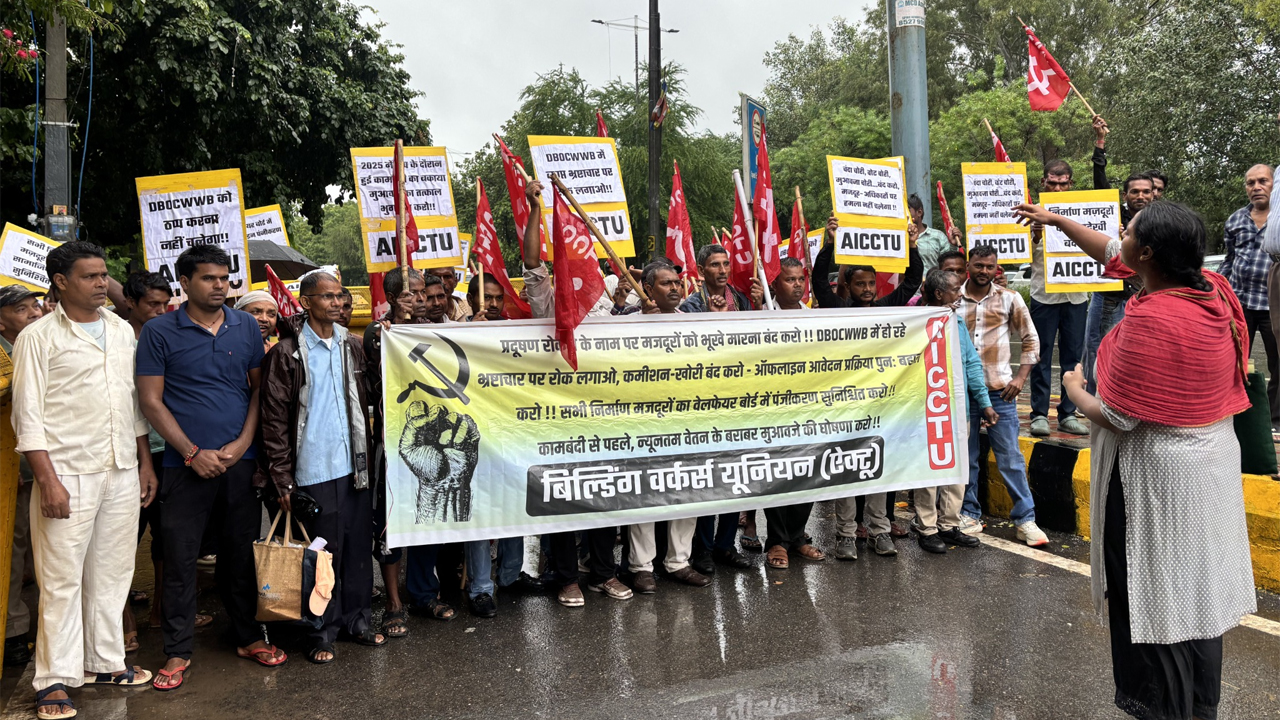
The ‘annual ban’ on construction work through the winter seasons in Delhi that has become tradition over the last half a decade due to an acute air pollution crisis in the city, has this year, become a starvation sentence.
by Mouli Sharma
15 October 2026, New Delhi: The rain falls in sheets on Thursday morning, ice cold and sudden like it can only get during mid-October weeks as Autumn bleeds into Winter. The wide, planned roads of Delhi’s Civil Lines region don’t flood quite so much as Shankar Road and its tributaries (or, god forbid, Gurgaon) but it’s enough to drench the lower halves of even the umbrella havers stuck underneath foot-over bridges and bus stops.
Needless to say, the roads are abandoned. At the T-Point facing the DRDO office, a lone rickshaw puller stops abruptly, shivering as he holds the thin gamchha protecting his head tighter over him and runs to the shelter of the bridge. I stand there, too. Water has been steadily gathering at the top, and has now begun flooding down the stairs, soaking his sandalled feet and into my socks and shoes. When the rain slows, for a minute, I make to leave, aiming for the bus stop 50 metres away in case it starts up again.
The rickshaw puller warns me not to do that. I tell him I have somewhere to be. He asks me where I’m trying to go. I tell him there’s a protest today at Vikas Bhawan.
“Look at the weather. No one’s protesting in the middle of this. Only a lunatic would be out there today.”
He is, of course, wrong.
***
At Thursday noon, nearly 50 construction workers led a march from Vikas Bhawan to the Sushruta Trauma Centre, led by the AICCTU’s Building Workers’ Union, many of them travelling from faraway districts like Burari and Okhla. This was ahead of an announcement by the Delhi government that construction work in the city would be banned for a period of three months between November and January, ostensibly due to air pollution concerns, except the Supreme Court’s directions that such a blanket ban on work must be accompanied by the provision of minimum wages to aggrieved workers are not only nowhere close to being fulfilled, but are in fact being violated for a consecutive season since the Rekha Gupta led BJP came to power in 2025.
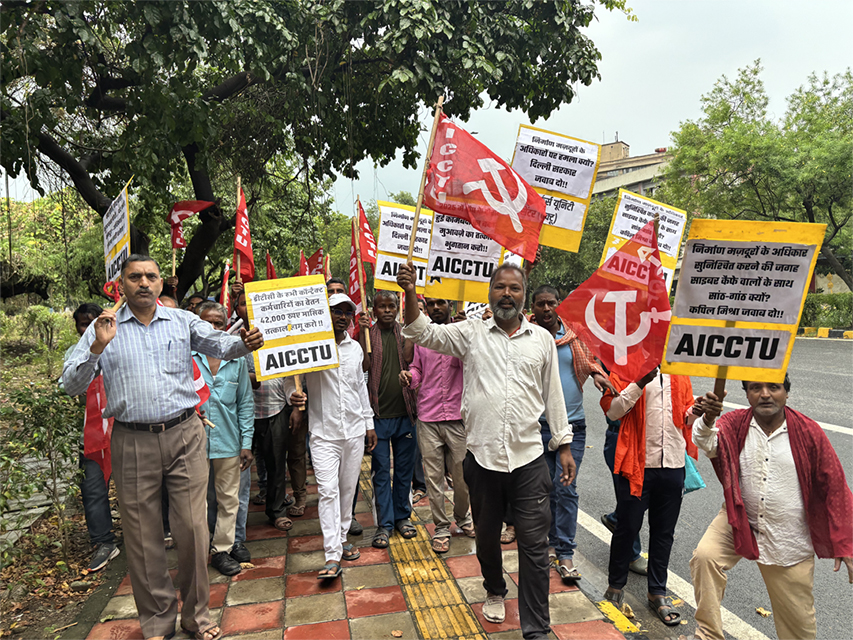
“The Welfare board website has been down for nearly four months now,” said Ranjan Kuswaha, a mason and secretary of the local Burari unit of the Building Workers’ Union. “They said they were making a new one. And now that they have, they’ve already announced a seasonal ban less than two weeks away, beginning on November 1st and ending on January 31st. And till now this website is taking neither new registrations nor renewals. How on earth is the worker supposed to survive?”
Kushwaha further highlighted the plight of the migrant worker, so many of whom come to Delhi to work contractually on the many building and developmental projects undertaken here annually, who will now be left destitute.
Advocate Surya Prakash Union said that a majority of the workers associated with the BWU hail from Supaul and Saharsa, two of Bihar’s poorest districts.
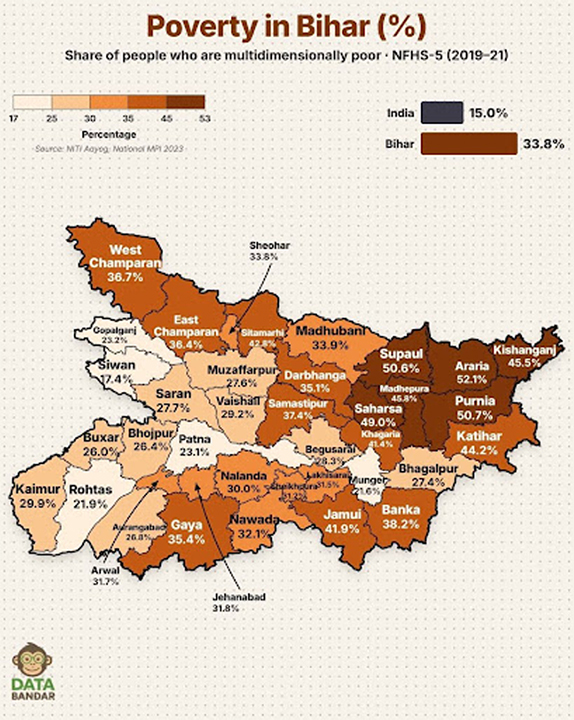
“Most of our workers come from the poorest regions,” Surya Prakash, AICCTU; Infographic via BWU.
“We demand that this website be fixed at the earliest, and that registrations and renewals be completed as soon as possible and the workers be provided their labour cards,” Kuswaha said.
There is also the matter of alleged gross corruption within this “welfare board” itself—the Delhi Building and Other Construction Workers Welfare Board (DBoCWWB), an organisation founded in 2002 in reference to the 1996 BoCW Act, which is apparently as much of a handful as it as a mouthful, according to the workers whose welfare it proclaims to oversee.
“On paper, the welfare framework for Delhi’s construction workers promises them wide-ranging support in almost all spheres of life: from maternity care, pension, housing, healthcare, education and even free daily commute on govt buses,” wrote Ishita Jairath for the Times of India in her scathing January 2026 report, Hands That Build Delhi Brick By Brick Out Of Welfare Framework.
The ground reality, however, was that the intended beneficiaries she asked about the schemes meant for them had nothing more than a “blank look”.
“Bitto, a marble and tile worker from Mangolpuri, didn’t know his children are eligible for education assistance,” Jairath wrote. “Preeti, a construction worker and mother of two who received a subsistence allowance during the recent GRAP-enforced restrictions, asked, “Yeh kya hota hai?””
The harsh reality is, despite the city employing over 2.7 registered construction workers, the DBoCWWB has repeatedly come under fire over the 24 years since its foundation due to its failure to bridge the gap between statutory safeguards, provisions, and entitlements to their actual beneficiaries. And come the BJP era, it along with employers have been granted even more impunity than before, as the legislation that mandated the board’s creation, has itself been axed.
The 1996 Building and Other Construction Workers, Act, was one of 29 labour statutes that were subsumed and consequently repealed by four controversial parliamentary acts passed between 2019 and 2020, infamously known now as the “New Labour Codes”: The Code on Wages, 2019, the Industrial Relations Code, 2020, the Code on Social Security, 2020 and the Occupational Safety, Health and Working Conditions Code, 2020.
The third and fourth of these repeal the provisions within the 1996 Act. The first, CoSS (2020), allows employers to “self assess” their own cess liabilities—cesses that are meant to finance the minimum subsistence wages owed to workers in a situation like a blanket ban due to GRAP III/IV restrictions.
“Employers can now self-assess liabilities in respect to Building and Other Construction Work, previously assessed by the notified Government authority,” the Labour Ministry said on the subject through a PIB release in 2025. “It reduces procedural delays and official intervention.”
The fourth decriminalises the labour offences listed in the repealed Act(s) (12 others along the BoCW, 1996) and replaces them with civil penalties, allowing employers to get away with violating ostensible safeguards with monetary fines, increasing the thresholds for employers’ compliance, and enabling abuse in a myriad other ways, hollowing out pre-existing laws.
As things stand, the current laws are being flagrantly violated by both the employers they are meant for and the constitutional bodies that are meant to enforce them, and the laws that once would have enabled stringent action and criminal proceedings against said violators have been nixed despite unilateral uproar against them from labour rights organisations, workers’ unions, economists, and political analysts at large.
This is the context that allows Rekha Gupta to announce in August a 42 day ban on construction work in the capital despite 2.6 lakh registered workers not still waiting on the minimum wage compensation due to them from last year, which she has now extended to a 90 day ban while the website meant to register and entitle them to reparations—after an arduous and alienating bureaucratic process that requires mobile-Aadhaar linkages and documents that a significant number of migrant workers don’t possess, mind you—and doesn’t even work.
***
As Jairath wrote, though, even when those safeguards did exist, a vast majority of workers within the capital were not aware of them, and unlike the prohibitions in Central Delhi due to the ongoing SIR protests, in which the State has spared no expense in making people aware of their authority to violate citizens’ constitutional freedoms, no similar mass notification or awareness drive seeks to bring workers into the know of all they can and should be doing to safeguard them.
“How is it that these kinds of things can be allowed to escape people’s notice?” JNU SFI President Nadia said later the same day, at a protest commemorating the forced disappearance of the missing JNU student Najeeb alongside 12 days of an indefinite hunger strike by the University’s student union against what appears to be a crackdown on campus politics and democracy in its entirety.
Neha Bora had just left after delivering her own speech on the enduring legacy of JNU as India’s conscience and spirit of dissent, as had MP John Brittas. Both took much of the crowd with them, but much to the chagrin of the security personnel tasked with ‘observing’ such protests within the campus, the program went on. These security personnel, for those who don’t know, are also contract workers, employed through private security firms like A.E. Securitas, who are so aware of their own impunity in a labour dispute that they did not even show up to a recent meeting with a labour conciliator about wage theft and worker endangerment. As Nadia went on, I could see some of them zoning back in.
“You need to fill out a form by such and such date, or you aren’t going to be able to vote anymore. How is it that a right like Universal Adult Franchise, or something equally basic,” say, three months of minimum wage, “can possibly be made subject to being lost by accident or negligence. If you walk down central Delhi right now, you will know you can’t be there. Why isn’t the same done for these bureaucratic processes? We know the answer. It’s not incompetence. It’s very intentional,” she said.
At the protest, no worker knows the ins and outs of what the government owes them, or even the ballpark of all the things that have been stolen from them. The New Codes mentioned above have expanded the previous statutes for 40-hour workweeks for 48-hour workweeks, but the ordinary day’s work has still been capped out at 8 hours as per the landmark ILO treaty. Every hour past that constitutes overtime, which requires both the workers’ consent as well as double-pay from the employer.
None of that is real. These are fairytales that when relayed to the BWU workers on ground accomplish little more than making them laugh.
“I work 12 hours a day at the least,” says Rampyari, a 26-year-old mason tender. Everyone around her agrees.
“Somedays I start working at 7 in the morning and work till 8 or 9 at night,” says 35-year-old Arun Kumar Yadav, a mason. None of them has ever received overtime. They are paid by the day, and the hours are not negotiable.
Further, women are paid exorbitantly less than the men. While Rampyari makes Rs. 500 per 12 hour shift, Arun Kumar makes Rs. 700 or even Rs. 800, making their monthly earnings miles apart. The workers tell this reporter that this is because masons are seen as more skillful than mason tenders (centering masons like Ranjan are seen as even more skillful), and the women tend to get assigned the lowest paying jobs despite the differences in the skill requirements of the roles being negligible in their practical experiences.
“It’s all the same process,” Arun Kumar confesses. “One person mixes the masala, another applies it and lines the bricks, another checks the centering of the wall. All of us can do all of it, if it comes down to it.”
Obviously, the rates are unlawful. The New Codes have weakened the pre-existing regulations around wages just as they have all others, with the Cosen on Wages, 2019 having replaced the Minimum Wages Act, 1948, and placed wage notification processes entirely in the hands of individual states’ and the formula for their assessment within the discretion of individual actors. The recent labour upheaval throughout the North Indian industrial belt saw the governments of Haryana and UP both being compelled to renew wages after decade long delays, but despite the acknowledgement of extended failures, the updated wages followed no transparent declaration of methodology, and fell far short of the recommendations made by researchers under the landmark Reptakos judgment. A detailed analysis of the embedded corruption and irregularities within the new wage codes as well as outstanding delays in the wage renewal process can be read here.
Recently though, the phenomenon went from intra-state to national, with the Karnataka High Court directing the Union Government itself to renew central minimum wages the way UP and Haryana had been forced to after tens of thousands of workers took to the streets.
“The Union government had last revised minimum wages in the year 2017 and despite the statutory mandate to do it within the year 2022, the Union government kept delaying the same,” said AICCTU, who repeatedly moved court on the subject and recently found victory in September earlier this year, when the Union of India, through the Ministry of Labour and Employment was directed to complete the process of revision of minimum wages and to issue the necessary notification within five months from the date of the order, i.e. 16 September 2026.
The minimum wage as directed to be calculated according to the previously mentioned landmark Reptakos Judgment (which laid provisions for a five-part calculation of the bare minimum subsistence amount necessary for a worker and their family’s survival) would sit at around Rs. 40,410.
Given the five month deadline, the construction workers’ season of starvation will long since have passed, but a requirement for the payment of backwages and arrears from 2022 onwards means that the rates being paid to workers like Rampyari, Anil Kumar and Lal Shah can be qualified as legally exploitative.
The gender disparity on the other hand, the law is not so vocal about.
***
The youngest protester this reporter had the pleasure of meeting on the 15th was Shyam Babu, asleep in his mother Rita Devi’s arms under a banner (“Stop starving workers in the name of stopping pollution!”) repurposed as a small shelter from the rain. He was six years old, and fast asleep.
Shyam looks small for his age; very small. Rita, 30, tells me his health has been delicate since he was born, and his muscles never quite developed since.
“There’s something wrong with his bones. His arms won’t lift up properly. We don’t really know what to do.”
Under the current wage administration system, the consumption units assigned to an adult male minimum wage earner are one whole of the calculations made based on daily calorie consumption of the average adult Indian by Dr. Wallace Akroyd, the first director of the Department of Nutrition at the Food and Agricultural Organisation, in 1948. Come 2026, minimum wage provides for only 0.8 of this whole unit to adult women, and only 0.3 for a child.
AICCTU called out this bias in a press note announcing the 16 September Karnataka High Court Order, and seeks to move court for an increase in consumption units (also including a demand for two full additional units for senior citizens).
“Assigning only 0.8 consumption units to women is not only arbitrary but also inherently discriminatory, as it undervalues their nutritional requirements and perpetuates gender bias,” the note said. “Hence, an adult woman must be assigned 1.0 consumption unit, equal to their male counterparts. Similarly, providing only 0.6 consumption units for children grossly underestimates the nutritional needs of growing children in vulnerable age groups. In view of growing malnutrition, it is necessary that each child should be allocated at least 0.8 consumption units.”
But down on the ground, not a single worker fighting for her right to survive is aware that 20% of her food is being taxed away at the source by virtue of her assigned sex.
“The person who cooks always gives less to herself to begin with,” Rampyari says. “A woman would go hungry before letting her family want.”
Ruminating upon the health problems running throughout her family, though, she wonders if she’s been handed the short end of the stick from the start.
“My brother-in-law is also mentally ill,” she says. “Treatment in government hospitals is a nightmare.”
Such conversations reveal more and more holes within the ostentatious framework of India’s labour law (now its new labour law): the third and fourth new labour codes formally entitle professionals to free annual health check ups, employee-state insurance and other health and maternity benefits. But till date, only one ESIC hospital stands functional in Delhi, in Basai Darapur, and even there, insured treatment is capped at 21,000 rupees.
And anyway, there’s only so much health insurance can do when a child grows up on 30% of an average person’s nutritional requirements and the mother who births them survives on 80% of the same.
“Food is everything,” Arun Kumar says.
“What else is there?”
***
By 2 o’clock, the crowd begins to dissipate. There’s a brief bout of drama near the tail end of the hour: a politician from a rival party, the Indian Inclusive Party, based in Bihar where most of the BWU’s workers hail from, which focuses on Pan caste politics, arrives to speak to the workers, leading to a brief tiff between him and a CPI-ML Liberation leader.
“I am simply talking to members of my caste,” he said.
“Why are you bringing up caste?” Asked CPI-ML’s Ajay Pal. “Why can’t you look beyond caste in this day and age?”
While the man left soon after, those speaking to him said in his defence. “He means no harm. We hail from the same place, that is why he was speaking to us.”
A significant proportion of the population that migrates to Delhi for construction based contractual work from Bihar, Odisha, Jharkhand, and even West Bengal hails from the Pan community, a Scheduled Caste in all four states. The IIP’s symbol itself, for what it’s worth, is a brick trowel.
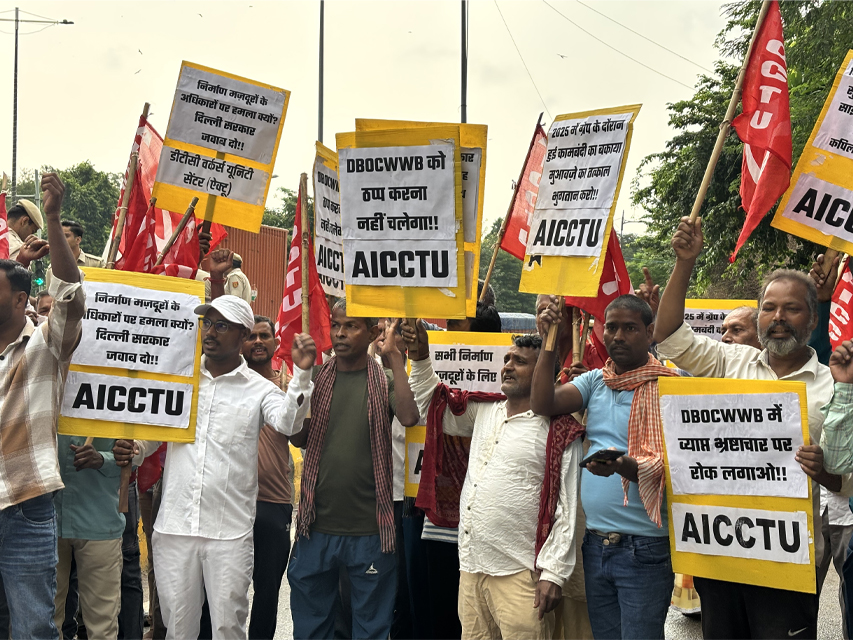
“They’re all politicians at the end of the day,” a worker said.
Red Mic’s Niraj Pandey, who works at the intersection of gender, caste, class and land issues, asked why the workers could not unionise themselves. Simply put, the answer is not so simple: In 2022, the grant of union membership to a contract labourer in Manesar’s Bellsonica Auto Components Private Limited was declared “illegal” by the State’s labour commissioner, under whose protection the management then demanded not only the cancellation of the workers’ membership, but a dissolution of the union itself.
Till date, contract workers across organised and unorganised sectors stand dependent on central trade unions like the Liberation’s AICCTU or other kinds of political backing to generate any sort of bargaining power with the state. With the further weakening of labour laws since the institution of the new codes, their employment and existence has become more precarious than ever, and such relations hardly remain a choice.
At any rate, Delhi’s building workers plan to continue their battle for this season’s survival till the ban takes over, questioning why they must bear the brunt of the country’s pollution crisis while factory and vehicle owners continue to contribute the lion’s share of pollutants to the city’s air. The next strike is set to take place on 1 November 2026 again at Vikas Bhawan, Civil Lines.
Mouli Sharma is a journalist based in New Delhi. She currently writes for GroundXero, and her work has appeared in various publications.
All Images are by photographer and filmmaker Vivek. He was the DOP for the documentary, Sanitised Republic, which has been heavily censored and banned from screening by the Indian Censor board.

Thank you, Mouli, for bringing these workers’ struggles to light, particularly the gap between statutory rights and their actual material conditions. The account of Rampiyari and the discussion around nutritional consumption units were especially revealing.
A few questions came to my mind while reading, regarding the political dimensions of the struggle.
1. You rightly point out that precarious contract workers remain “dependent” on established central trade unions and political backing for bargaining power. But does this dependence also risk limiting the development of independent working-class organisation? To what extent are workers themselves determining the political direction of these struggles, beyond the immediate demands articulated by union leadership?
2. The article demonstrates how even existing labour protections remain inaccessible or unenforced. But given the structural relationship between the state and capital, how far can legal victories and demands for better implementation take the movement? Is there any discussion among the workers about moving beyond defensive struggles for compensation towards a broader political challenge to the conditions producing their exploitation?
3. Finally, the worker’s remark, “They’re all politicians at the end of the day,” stayed with me. Did you get a sense of whether this reflects a wider disillusionment with established political organisations, including those claiming to represent the working class, as well as Dalit political parties and representative organisations? And could that disillusionment become the starting point for an independent political consciousness rather than simply withdrawal from politics?
I ask these questions in the spirit of revolutionary Marxist solidarity, not to diminish the importance of the immediate struggle or the organisational work being undertaken. The distinction between fighting for survival within the existing system and developing the political capacity to transform that system seems particularly important here.
Thank you again, for documenting a struggle that otherwise receives so little attention!