
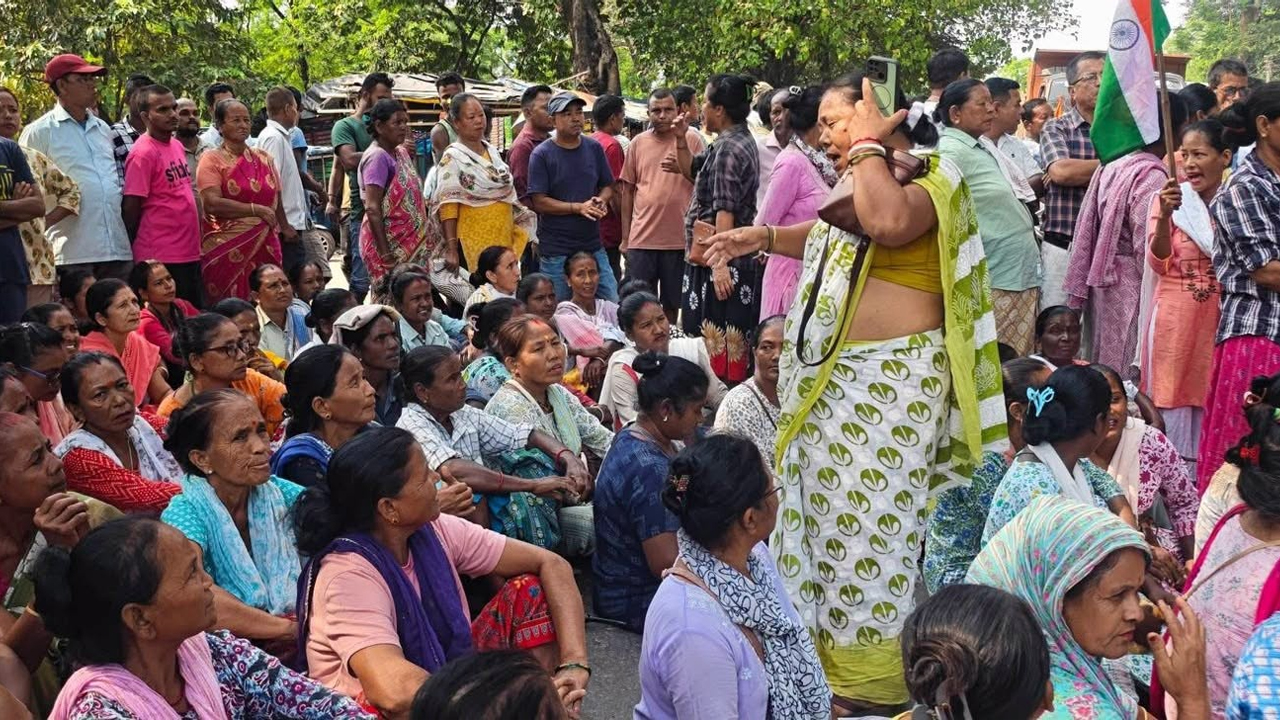
More than a hundred tea estates in North Bengal reportedly missed the 5 October deadline for payment of the 20% annual bonus. Thousands of workers across Merico-Sammelan gardens in the Dooars are protesting unpaid bonuses, outstanding wages and provident fund dues, even as the state government’s assurances and meetings yield little.
Groundxero | 16 October 2026
On the morning of Shashthi, as people across Kolkata throng Durga Puja pandals, women tea garden workers in North Bengal are taking to the streets to fight for a bonus that should already have been in their bank accounts. Workers, led by women workers from Hantapara, Gayerdanga and Dumkipara tea estates marched towards Madarihat to demand payment of their bonus. Workers at Birpara are preparing similar protests, while others staged demonstrations outside factory gates and approached the police.
Their immediate demand is straightforward: payment of the full 20% annual bonus. But the protests expose a much wider crisis of unpaid wages, withheld provident fund contributions, unpaid gratuity, and the continuing impunity enjoyed by tea garden owners.
At the centre of the current confrontation is the Merico Agro Industries and Sammelan Tea & Beverages group, which controls 12–13 tea estates employing nearly 10,000 workers, the vast majority of them women. The management has sought to persuade workers to accept a bonus of just 10%. The workers, led by the Paschim Banga Cha Majdur Samiti (PBCMS), have refused to settle for half of what they are demanding.
The West Bengal government had set 5 October as the deadline for payment of a 20% bonus to tea garden workers. Yet, according to available reports, only 170 of the Dooars’ 285 tea gardens had paid bonuses by 10 October. More than a hundred estates had reportedly failed to pay workers even a single rupee.
The failure is particularly revealing because the change of government in West Bengal was accompanied by the BJP’s promise of a new political and administrative dispensation. For tea garden workers, however, the much-publicised ‘double engine’ government appears to be running along the same tracks as its predecessor: false assurances for workers, impunity for defaulting employers, and little effective action to compel payment.
Last year, the Trinamool Congress government had also advised employers to pay a 20% bonus. This year, the BJP government issued a similar directive, setting a deadline of 5 October. But an advisory, however emphatically worded, is no substitute for enforcement. Employers continue to delay and withheld payments while workers lose wages, spend days in demonstrations and struggle to meet their basic needs.
Pay slips issued but no payment made
The confrontation at Bagrakote Tea Garden illustrates the gap between management promises and workers’ actual experience. After the bonus remained unpaid, workers went on strike and blocked the Siliguri–Dooars national highway at Meena More. Following the mobilisation, the management issued a notice promising payment of the 20% bonus by 13–14 October.
Both dates passed without the promised payment.
On the night of 14 October, owner Surajit Bakshi telephoned PBCMS leaders and reportedly asked them to persuade workers to accept a 10% bonus, saying that this was all he had managed to arrange. The union refused to endorse the proposal, maintaining the workers’ demand for the full bonus.
On 15 October, garden managers distributed pay slips promising a 20% bonus. Workers waited for the money to arrive in their bank accounts. Managers waited for funds to become available. Police stood guard over the managers, while rumours circulated among workers that payments had been made in neighbouring areas.
By 10 pm, according to PBCMS, not one of the approximately 10,000 workers employed across the Merico-Sammelan group’s gardens had received any money.
The episode captures the absurdity of a system in which paperwork and promises can be produced on schedule, but the payment of workers’ dues remains indefinitely negotiable. The workers are expected to trust pay slips, wait through successive deadlines and accept management’s financial difficulties as an excuse. Their own financial difficulties, and their rightful dues, meanwhile, receive little consideration.
Labour department calls meetings without accountability
The labour department’s handling of the dispute has added to workers’ frustration. According to PBCMS, one meeting was cancelled on the grounds that management representatives were busy arranging bonus payments. No payment followed. At another meeting, union representatives reportedly waited for six hours without any meaningful discussion. The proceedings eventually deteriorated into shouting and the breaking of chairs, with BJP-affiliated union leaders allegedly abusing their own MLA, Puna Bhengra.
For workers already waiting for their dues, such meetings mean another day lost without a resolution. The spectacle of official consultations cannot conceal the absence of effective intervention.
The crisis is not confined to the annual bonus. PBCMS alleges that almost all the Merico-Sammelan gardens owe workers three to four fortnights’ wages, last year’s leave allowance and 10% of last year’s unpaid bonus. The union also alleges that provident fund (PF) contributions deducted from workers’ salaries have not been deposited into the Employees’ Provident Fund Organisation (EPFO) accounts since June 2023—an action unions label as criminal breach of trust. Retired workers are reportedly dying without receiving their gratuity.
Meanwhile, factories have shut, gardens have deteriorated and green leaves are reportedly being sold through brokers. The conditions raise serious questions about the management of these estates, the protection of workers’ livelihoods and the government’s willingness to hold employers accountable.
Workers suffer for the owners’ impunity
Workers are mobilising across the Dooars and North Bengal, with protests reported at Dumkipara, Lankapara, Hantapara, Nagaisuri, Garganda and other gardens associated with the group. Women workers have been at the forefront of the mobilisation, marching towards Madarihat and organising demonstrations at factory gates. Workers in Birpara have also been preparing to join the protests.
Their determination exposes the unequal balance of power in the tea industry. Workers whose labour sustains the plantations must organise, march and confront the authorities to secure payments that are already due to them. Employers, by contrast, appear able to delay and even withheld payment even after announcing deadlines and issuing written assurances.
The reports of prolonged non-deposit of provident fund contributions are particularly grave. The government must also address the reported non-payment of wages and gratuity. Issuing advisories and convening meetings will not resolve the crisis unless the authorities ensure that employers meet their obligations and face consequences for violations. The failure to secure payment by the announced deadline demands an explanation of what enforcement measures, if any, have been taken.
PBCMS has demanded immediate payment of the full 20% bonus, all outstanding wages, leave allowance and gratuity, the deposit of every rupee deducted towards provident fund contributions, and legal action against those responsible for violations.
These are not extravagant demands. They concern workers’ earnings, statutory entitlements and economic security. The government must move beyond assurances and take effective steps to ensure that workers receive what is owed to them.
As people in Kolkata sip tea between visits to Durga Puja pandals, the workers who produce that tea are fighting to obtain their own unpaid dues. The contrast is stark: the festive economy depends on workers’ labour, yet thousands of them face the prospect of celebrating the festival season without money that should already have been paid.
The Government has changed but the ‘Acche Din’ of tea garden owners appears remarkably secure. The BJP’s ‘double engine’ government now faces a simple test: will it enforce workers’ rights, or will it let garden owners to continue with their illegal exploitative labour practices, while its engines runs smoothly — in the service of employers!
Workers cannot pay their bills with government advisories, feed their families with pay slips or retire on false promises. Unless the workers’ united struggle force authorities to compel employers to pay, the change of government will mean little to the thousands of women and men whose labour sustains North Bengal’s tea gardens, and its economy.