
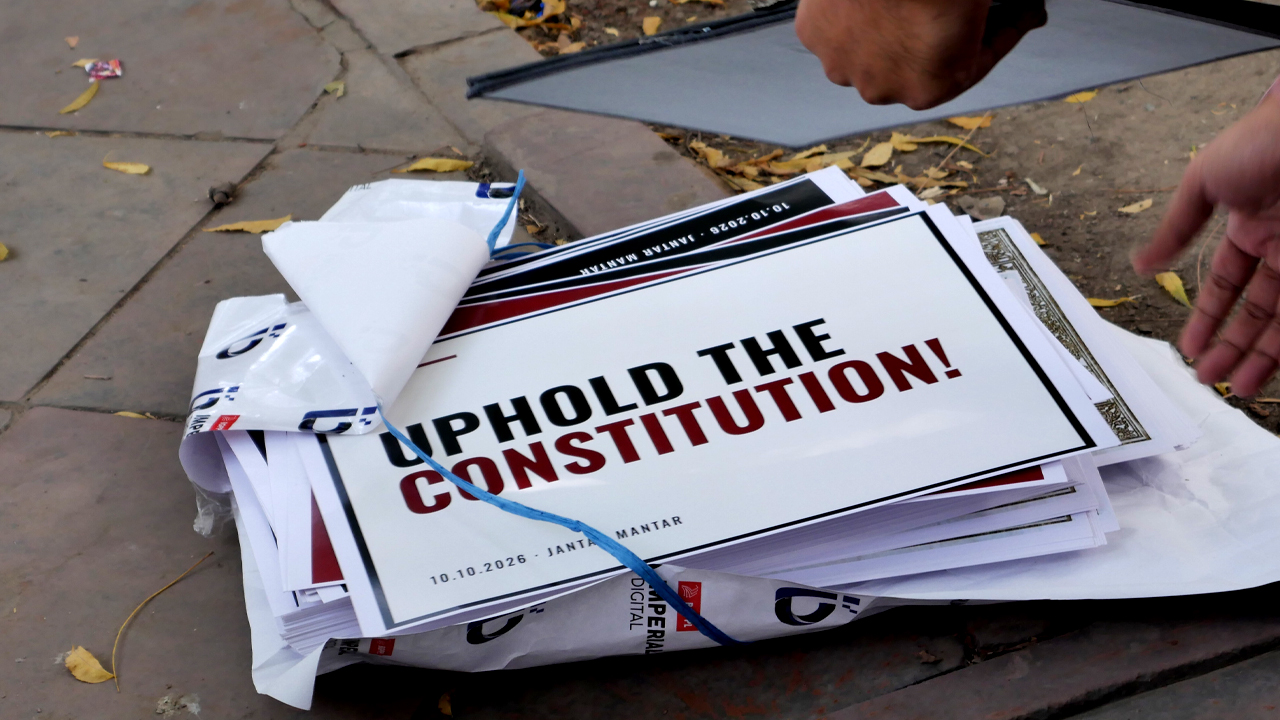
Delhi’s makeshift ‘detention centres’, community spaces like stadiums and public event halls repurposed as mass holding cells for thousands of protesters, are ripped straight out of an Atwoodian dystopia.
by Mouli Sharma
New Delhi, 15 October 2026: On 13 June 1989, late Prime Minister Rajiv Gandhi laid the foundation stone to a public sports facility in Delhi’s Surajmal Vihar, a stone’s throw away from Jhilmil. A decade later, the Delhi Development Authority inaugurated the site as the Yamuna Sports Complex, a government run pay-and-play where you can, say, play badminton on an outdoor daylight court for Rs. 100 a turn or take a ‘daily dip’ in the members’ exclusive swimming pools for Rs. 82.60 per head.
On 10 October 2026, this sports complex, which serves as a public funded self sustaining recreational facility whose primary userbase consists of children and senior citizens, was turned into a hostage centre into which protesting lawyers of the supreme court were packed, after they marched toward the blockaded Jantar Mantar protest site demanding the resignation of CEC Gyanesh Kumar.
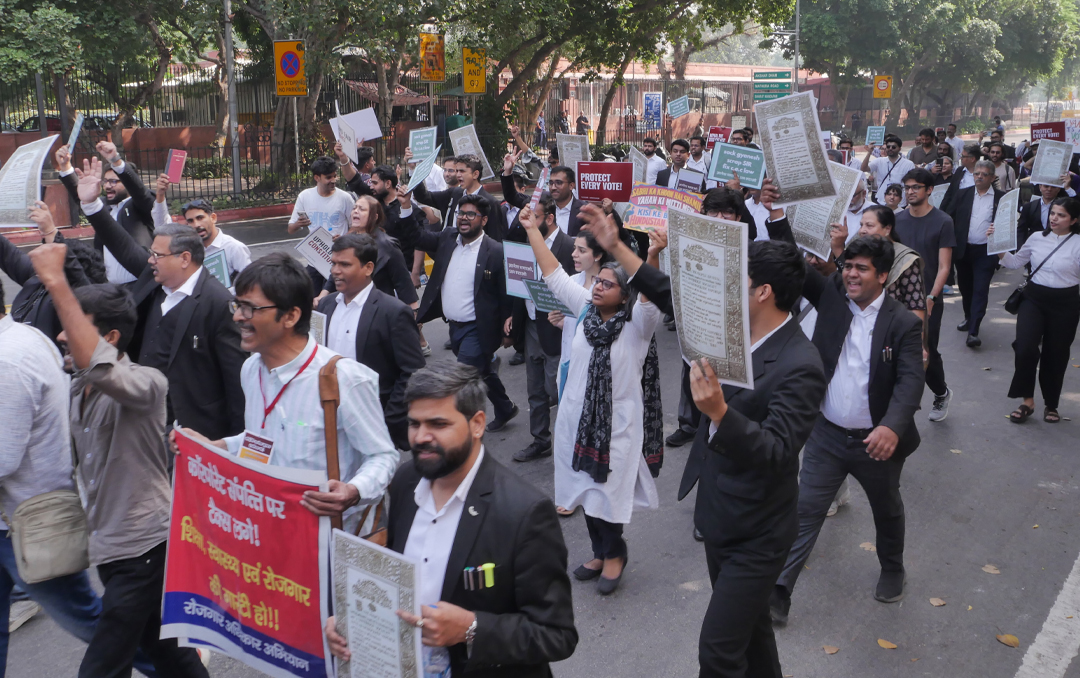
“I managed to get away somehow,” said Adv. Awstika Das, one of the few left behind on the Mandi House Circle after around 70 protesters were “detained” and driven away, forcibly dispersing the small march. “They’ve taken the rest to the Yamuna Sports Complex, there are senior advocates there, too. They’ve been beaten,” she said.
While the lawyers were released shortly afterwards in less than two hours—in stark contrast from the many thousands in Delhi who have been detained day after day in an ongoing cat and mouse game between state and citizen since the start of the SIR protests on 2 October—due to a “special, unprecedented” intervention by the Chief Justice of India, the question remained, why were they taken to the complex in the first place, as opposed to a police station with a notified holding facility or lock-up?
“I’m not sure that there is any statutory authority supporting this… this repurposing of public spaces or government offices for detention,” said Advocate Archit Krishna, who specialises in criminal law. Advocate Vertika Mani, a human rights lawyer, similarly expressed skepticism about the legality of such repurposing.
“It should be challenged in court,” she said. “There is no legal basis for this.”
The Delhi Police Act, 1978, which governs the operations of the force in charge of security operations in the capital, which is now overwhelmingly being described as “under siege” of said forces (‘an undeclared Emergency’), provides a wide array of protections and special powers to the Delhi Police official, distinguishing him from the common man to the degree that an FIR may not be filed against him even if he is accused of commiting a cognisable offence, say murder or rape. Such has been the case with one former ACP Vivek Bhagat, who was accused of molestation by a woman journalist on 3 October 2026, against whom an FIR has still not been filed under these special powers. Instead, he has been promoted, and an FIR has been registered against the woman complainant, NewsDiggy reporter Rosy.
Notably, though, even this legislation does not empower the police to use public amenities as detention centres or give any authority to detain people within them under any circumstances, qualifying the detentions of 10 October as false imprisonment. Chapter IV, Section 36 of the Act allows for the police to temporarily reserve for themselves and therefore prevent public entry into public spaces or streets, but even this reservation requires for a written public notice to be issued by the Commissioner of Police.
“The Commissioner of Police may, by public notice, temporarily reserve for any public purpose any street or other public place and prohibit persons from entering the area so reserved, except on such conditions as may be specified,” the Act says.
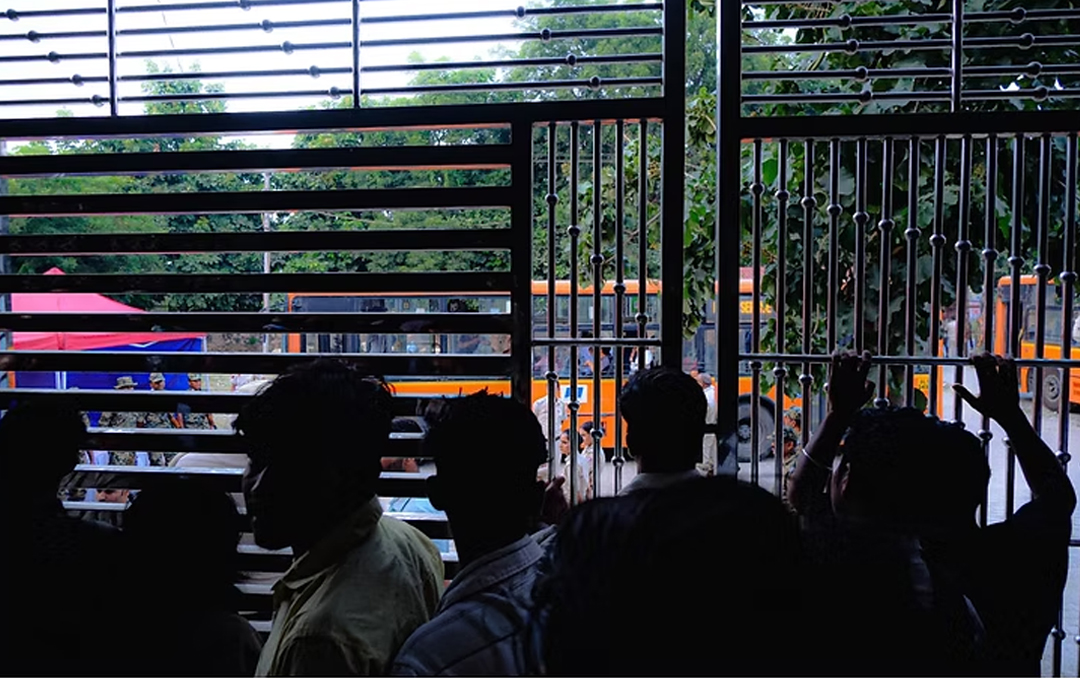
Daulatpur Community Centre turned into a detention centre for protesters
As of 14 October 2026, no such public notice has been given, but at least 7 public facilities in addition to the YSC have been “identified” and “prepared” to be used as makeshift prisons during protests, as reported by various mainstream broadcasters including the Hindustan Times, attributing unnamed “government sources”. Many of them have also revealed themselves after repeated mass detentions, which included the illegal detentions of minors, women after sundown, as well as grave allegations of custodial torture. These locations are: Pandwalan Kalan Community Centre, Najafgarh; Yamuna Sports Complex, Surajmal Vihar (Jhilmil); Maharaja Surajmal Stadium, Nangloi; Chhatrasal Stadium, Model Town; Rajiv Gandhi Stadium, Bawana; Daulatpur Community Centre, Najafgarh; Major Dhyanchand Stadium, India Gate; and Nirankari Samagam Ground, Burari, at least.
Yamuna Sports Complex? Actually, It’s Quite Simple
It cannot be understated that while the YSC is a ‘public’ facility, it is not one that is free to use, even to the public. The largest closed space within the facility is the show court auditorium, which boasts of a massive capacity of 3,200 persons, the kind that would be necessary to in fact detain the scale of masses that took the streets in July earlier this year, which is the purpose police officers on ground as well as the nameless government sources speaking to Hindustan Times have repeatedly stated these locations have been ‘identified’ to serve. In addition to the question of statutory authority and absent public notices, is another, simpler one: who is paying for these services, and for how long?
According to Hindustan Times, the preparation to detain people at stadiums and public halls began on at least 9 October 2026. With detentions taking place at the YSC on 11 October and continuing at least till the 13th, when 24 people were detained at the Daulatpur community centre, and no notice of the amenities’ resumption of regular activity having been made, it seems as if the sites have been indefinitely co-opted by the Delhi Police. The catch, of course, is that booking a space like the YSC, say, its 3200 seater show court, is enormously expensive, with charges going up to Rs. 2,50,000/- a day for political and corporate events.
In just 2024, former Delhi LG VK Saxena ordered the removal of YSC’s secretary over the alleged “appalling state of affairs” in its maintenance. Saxena had visited the sports complex in east Delhi, and asked for a complete makeover of this iconic site within two months, as per Raj Niwas officials.
“Dismayed at the appalling state of affairs as far as maintenance was concerned, Saxena has directed that the officials in charge of the sports complex be immediately removed,” the officials said in a widely circulated press release. His directives were then to “not only restore the complex to its earlier glory but also ensure that it develops into a top-of-the-class sporting arena for sportspersons and also a self-sustaining recreational destination for the people of east Delhi,” the latter half of which explains the steep rates the complex now charges. An unused building at the gate of the complex was also identified by Saxena to be immediately developed and repurposed as a clubhouse with restaurant and recreation facilities.
If Saxena had had the foresight, he could perhaps have directed for the building to be turned into an illegal holding facility instead, which it has now come to serve as anyway.
“What the Hell are we Moving Towards?”
Anjali is one of the few people who managed to take the dreaded devices of Delhi Police’s worst nightmares—placards, posters, and of course, vocalised dissent—into the inner sanctum of the 50 square kilometre radius that now forms the ‘Emergencified’ blackbox of central Delhi. She, researcher and activist Paran Amitava, artist Aban Raza (of the acclaimed series, Nothing Human is Alien to Me) and economist Jean Drèze, were one person short of violating the 5 or more curfew in place across the 4km radius around Jantar Mantar under an ostensible ‘Section 163 BNSS Order’ that has yet to be produced in the public eye as they made their way into the barricaded labyrinth, and were immediately detained anyway.
“Don’t separate us!” Anjali screamed as a swarm of female police officers attempted to tear the three women apart. Drèze had long since been dragged away by enough policemen that even his face couldn’t be seen beyond the Khaki. After all, it is a recognisable face: Drèze is a world renowned economist who has co-authored research on famine and employment with nobel laureate Amartya Sen, and much of his life’s work had been dedicated to a law that formed a lifeline to millions in India, the National Rural Employment Guarantee Act (NREGA), which has now been axed by the Modi government.
Ever since her detention on the 10th, from which she was released late in the day after a lengthy tour of the city on a DTC bus on special hire by the Delhi Police (again, who is paying? How much? The DCP refuses to answer, and Amit Shah is unlikely to take this reporter’s calls) Anjali has been bouncing between station to station, holding cell to holding cell, forming the anchor that connects disparate detentions of individuals who simply got picked up for being at the wrong place at the wrong time to students, activists, and various other protesters who are being brutalised on a strategic, regularised basis day after day.
On 11th, she found herself outside the Pandwalan Kalan Community Centre, near an isolated village on the outskirts of Delhi named Pandwalan Khurd, where a small group of lawyers had somehow managed to reach after becoming panicked by the strange location the detainees were being taken to, and finding themselves locked outside the iron gates of the centre that became prison bars for the those inside.
“They’re not letting lawyers inside. One of the guys inside was badly injured, another’s shirt was torn, and now they’ve cut off the power,” she said, also sharing videos of the same, with those being held inside alleging that they had been brutalised on the bus, though the police denied it. Koushiki Saha has covered the matter in detail for the Times of India, including the account of one of Adv. Gaurav Jain, who was among the earliest to arrive and who was caught on camera pleading with the officials to be allowed to speak to the detainees and officials in-charge.
Just two days later, Anjali ended up making still more distress calls from Najafgarh, this time from the Daulatpur community centre, where 24 people were held (ten of them women) till near 10 PM at night. The accounts of detainees, including RWPI’s Naureen, and several others from the Disha Students Organisation have gotten repetitive enough to feel normal by now, which is exactly what Anjali is afraid of.
“Something needs to be done,” she says. “This detention centre situation needs to be addressed, because if it gets normalised, then I don’t know what the hell we are moving towards.”
What we are moving towards, of course, is obvious.
Earlier the same day when Disha’s protesting youth were detained outside the LIC building at Rajiv Chowk for protesting SIR and ongoing police operations in Delhi, a press conference led by senior journalists at the Press Club of India spoke of how the current regime’s response to the ongoing civilian agitation constituted an unprecedented attack on journalists. Caravan’s Ryan Thomas described how he was forced into a bus despite “maintaining a distance” from on duty officials as media personnel have repeatedly been ‘instructed to do’, where officials attempted to snatch his camera, asked his name, slapped him, and eventually threatened to shoot him dead.
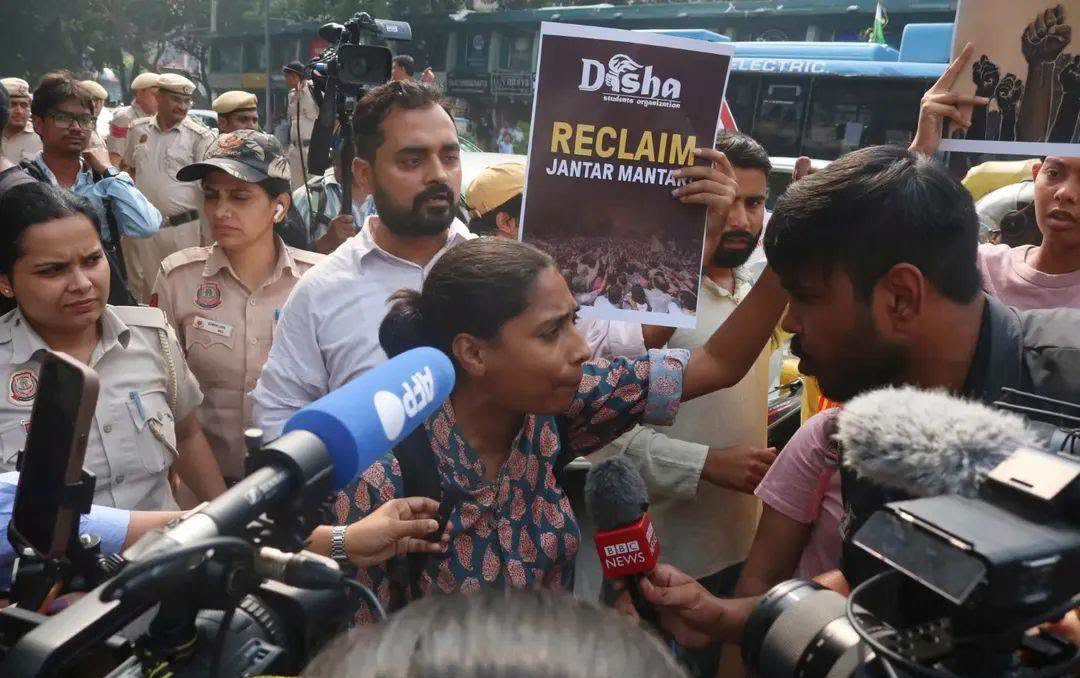
“I did not resist, I did not assert myself. I told them I was co-operating. But as soon as they heard my name, they said, ‘iske liye toh rifle hi nikaalni padegi’, and then pointed a rifle at my chest,” Thomas said at the conference.
Another reporter who was detained during the operations, though, Scroll’s Shoaib Daniyal, pointed to the link that connects these unofficial, repurposed—and crucially, illegal—detention centres with that which everyone is too afraid to name: “After they picked me up, they simply let me go after a few rounds of the bus, because they did not know what to do with me,” Daniyal said. “They are trying to make India into Germany, but ultimately, it is not Germany.”
It is not Germany, yet.
Capacity, purpose, and time
In 2008, an order by the Guwahati High Court established ‘detention camps’ in the state, for the “short-term detention of undocumented immigrants, refugees and people awaiting trial before a Foreigner’s Tribunals.” Eighteen years later, one detention centre has turned to six, and ‘short term wait-period for trial’ has turned to lifelong, endless captivity. Over 1100 people are bound within the high walls of these detention centres. By 2020, 29 had died.
The truth is, India has had her concentration camps for a while now, and most of them trace their roots back to the same citizenship crisis that SIR itself is the newest face of. As per the Union Home Ministry, there are at least four more detention centres in India other than the six in Assam: in Lampur in Delhi, Mapusa in Goa, Alwar Central Jail in Rajasthan, and Amritsar Central Jail in Punjab. Three new facilities began construction in 2021 in Matia in the Goalpara district of Assam, Tarn Taran in Punjab, and Bengaluru in Karnataka.
The answer to the dilemma plaguing the police officials who briefly abducted Shoaib Daniyal lies here: ‘what will we do with them?’ is not a crisis of spirit but of resource, and it ceases to exist when one’s capacity to arbitrarily ‘detain’ a person begins to touch infinity.
To contextualise the difference in scale between a public arena and a prison, consider the fact that Delhi currently has fewer than 20,000 people housed within her prisons—of which fewer than 2500 are convicts and the remaining are undertrials. The Jawaharlal Nehru Stadium on the other hand can alone house 1,30,000 people, which is more than the uppermost estimates of the total number of people who took the streets on 20 July combined. Germany was not Germany, either. The allocation of space for indefinite detention is singularly the most powerful resource a carceral state can possess, and Delhi’s process of acquiring it has already begun.
The visuals of armed men guiding unarmed men, women and children into stadiums and auditoriums by the force of gun and baton, received single servings of bread and water as they wait for a release that is entirely out of their hands is eerily reminiscent of the 1985 Maragaret Atwood dystopia, The Handmaid’s Tale. In the book, public school auditoriums, gyms, and sports stadiums were repurposed as detention centres after an overthrow of the democratic republic in the United States by members of an armed religious group who established a militant theocracy where women and minorities were persecuted. What ended up becoming of those stadiums and gyms I leave for the reader to discover on their own.
Let’s just hope fact isn’t bloodier than fiction.
Mouli Sharma is a journalist based in New Delhi. She currently writes for GroundXero, and her work has appeared in various publications.