
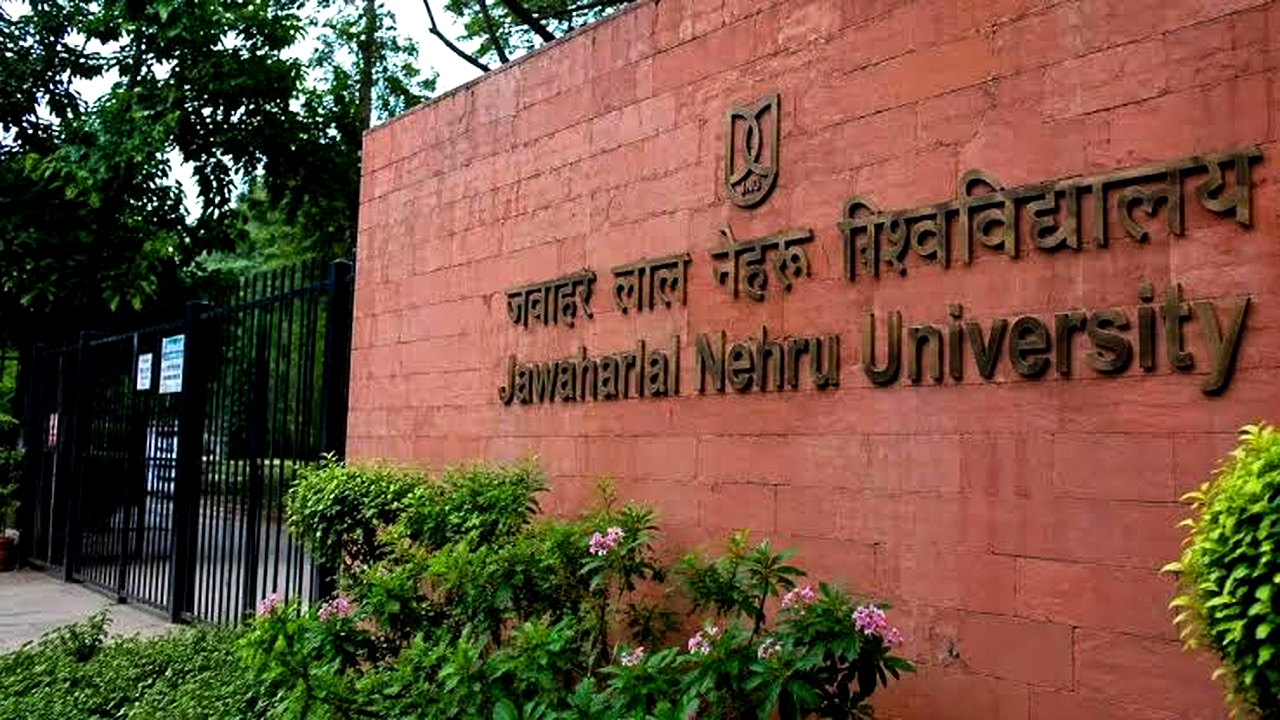
After over 1200 workers at the Jawaharlal Nehru University (JNU) threatened to go on strike on 28 September 2026 over alleged exploitation and labour code violations, a hearing overseen by a labour department conciliator has led to the management being warned over “legal implications” of repeated violations of binding labour agreements, and issued orders for immediate provision of safety equipment to workers, halting layoffs, constituting a Grievance Redressal Committee, and more. The strike has been called off for the time being under the assurance of the management’s future compliance.
by Mouli Sharma
New Delhi, 28 September 2026: In the matter of an industrial dispute between the contract workers of Jawaharlal Nehru University, New Delhi, represented by the All India General Kamgar Union and the university as well as private middle-man firms through which over 1200 of the university’s employees are contracted, a hearing on 25 September 2026 overseen by labour department conciliator Vinay Rana has led to stern warnings for the university and private firm managements over non-compliance with several labour laws, as well as directions for immediate rectification.
As per the 25 September settlement, the AIGKU, on 11 September 2026, served a notice to the university Registrar and Vice Chancellor announcing a contract workers’ strike on 28 September 2026 in pursuance of eight demands. These demands sought the rectification of various alleged labour-code violations by employers that jeopardised workers’ safety, made their employment financially exploitative and precarious, and undermined their rights and working conditions. The eight violations enlisted were as follows:
- Non-payment of minimum wages on account of alleged manipulation of attendance.
- Non-grant of earned leave and casual leave and uncompensated work on gazetted holidays.
- Non-payment of statutory bonus with arrears for three years.
- Augmentation of manpower in view of increased workload.
- Unfair labour practices against workers and union office bearers.
- Termination of contract workers engaged in hostel housekeeping and mess work with effect from August and September 2026.
- Non-issuance of wage slips, identity cards, protective equipment, second uniform to security guards and non-display of statutory notices.
- Illegal deductions, unilateral punishment of security guards and non-constitution of the Grievance Redressal Committee.
Copies of the notice were, as per the settlement, endorsed to the Deputy Chief Labour Commissioner (Central), New Delhi, the Chief Labour Commissioner (Central), New Delhi, and the Secretary, Ministry of Labour and Employment. The notice was then forwarded to the second Assistant Labour Commissioner, named Devendra Kumar Ram on the Labour Department website, in the office of the Chief Labour Commissioner (Central) in Dwarka Sector 10. It was received on 24 September 2026, and the conciliation meeting overseen by Rana was held there the following day.
JNU is the principal employer responsible for the welfare of the aggrieved employees, but like most disputes in the contracting era, not the sole one. Two private security firms, Rakshak Securitas Pvt. Ltd. and A.E. Securitas Security and Allied Services (the security contractors of the university), along with Q Group (contractors of housekeeping staff in the university hostels) and Max Maintenance Services Pvt. Ltd. (contractors of maintenance staff) were also named.
Such conciliation proceedings take place in industrial disputes under Section 53 of the Industrial Relations Code, 2020.
AIGKU was represented by its President, Sucheta De, along with State Secretary of the All India Central Council of Trade Unions (AICCTU, which is a major Indian trade union affiliated with the CPI(ML) Liberation), Surya Prakash (State Secretary, AICCTU), Vice President of AIGKU’s JNU unit, Surya Prakash, and a member of AIGKU’s Executive Council, Manikant Patel.
JNU was represented by its Deputy Registrar and Labour Welfare Officer Abhishek Kumar Singh; Section Officer (Legal) Vineet Kumar Bizenia; “Assitant Admin (sic)” Imran Kataria; Sanitation Inspector Saurabh Kumar and Data Entry Operator Sandeep Kumar. None of the private contracting firms showed up to the meeting, despite being called upon by the authorised conciliator to appear and present written submissions and relevant employment records.
It was also further noted that conciliation proceedings on certain related issues had already taken place at least once before by the Regional Labour Commissioner (Central) on 22 June 2026 earlier this year—the eighth demand of the workers, against alleged illegal deductions, “unilateral punishment of workers” and the University’s failure to constitute a Grievance Redressal Committee, was in reference to these very proceedings.
After the meeting began just after 5 PM, the JNU management was held responsible for ensuring the presence of its private contracting firms in the following meeting, after which some of the alleged violations was considered, but it is noteworthy that any detailed discussions or directives for rectification for a number of demands is also entirely absent from the agreement.
For instance, while first, fourth, sixth, seventh and eighth concerns listed above were discussed, the second and third concerns were seemingly clubbed under a bracket of “less payment of wages” and the fifth demand against alleged unfair working practices and employees who form part of unions was not even mentioned. Similarly, the concerns of employees not being granted leaves, or being forced to work on gazetted holidays, etc. among other pressing concerns hidden within the details of the demand charter find no mention in the results of this conciliation.
With regards to the first (non-payment of minimum wages on account of alleged manipulation of attendance), it was held that the managements did not offer “any satisfactory submission”.
“The management(s) is required to bring all the records contemporaneous to the service of the workmen of last financial year on the next date of conciliation,” the settlement said. “In case the documents are not in possession, the management shall furnish a statement to that effect, duly signed by authorized signatory.”
It was also held that the union and present management (of the university) agreed to the appointment of Nodal officers to resolve such issues (of non payment of wages) at the first instance in the future.
“In view of maintaining Industrial Harmony, both the parties are in agreement in assigning Nodal Officers, a functionary for resolving issues of Less Payment of Wages at First Instance (sic).”
The verification of this appointment is set to take place in the next hearing, on 14 October.
There is no further comment on the allegations of non-grant of earned leave and casual leave, uncompensated work on gazetted holidays, and non-payment of statutory bonus with arrears for three years.
Coming to the fourth concern—that of increased workload—AIGKU submitted that “the workload has increased exponentially over the period of year, whereas the number of workmen are not increased to facilitate the management.” In response, JNU management was “advised” to verify the Human Resource Planning in this regard and submit any proposals or policy updates in the next hearing on 14 October.
Again, there was no cited discussion of the “unfair labour practices” that employees, particularly union office bearers were allegedly subjected to.
With regards to the sixth concern, that of the alleged terminations of housekeeping staff and mess workers between the months of August and September, neither JNU and nor the absent contractors provided the required data of past retrenchments, causing a meaningful redressal of the issue to be delayed, again, till the next hearing on 14 October.
“The Managements [are] required to furnish details of the workmen retrenched in the past 3 years on the next date of hearing,” it was held.
Rana did, however, issue a stern warning to all five managements in the matter of layoffs. They were first apprised with Sections 78 & 79 of Industrial Relations Code, 2020, the first of which prohibits arbitrary layoffs while the latter lays out the conditions and procedures to do so within the legal framework.
Further, the management(s) were “advised” against carrying out any further layoffs while the dispute was ongoing.
The seventh accusation was the first to be apparently openly acknowledged by the management. Unlike in various other demands, where JNU’s failure to have presented required data in the meeting deferred cause after cause to the “next date”, the non-issuance of salary slips, ID cards, absence of notice boards, and most pressingly, the failure to provide employees with safety equipment essential to the health and wellbeing of sanitations staff became the key concerns directly acknowledged and addressed. Rana issued orders for the immediate rectification for each of these gross violations, but the settlement makes no mention of consequence for the management responsible for the fact that these violations occurred in the first place. Further, while most directions were held as requirements, some were again, “advisory”.
“The Management is required to furnish salary slips, Identity Cards to all the workmen with immediate effect. The Management is required to submit the copies of the same on the next date of hearing. The management is advised to display revised notice boards as per Codes in sufficient numbers with immediate effect. The Management is advised to supply safety equipment and other necessary tools to Sanitation Workers as mandated under OSHWC Code, 2020.,” the settlement said.
Coming to the final concern, the conciliator referred to the aforementioned pre-existing settlement. JNU management was warned that such conciliatory settlements made under authority of the labour department are legally binding, and that their violation is tantamount to statutory violations themselves. The university’s continued failure to constitute a Grievance Redressal Committee for these over 1200 employees was met with instructions for immediate rectification.
“In reference to Memorandum of Settlement signed on 22.06.2026, [JNU] management is apprised of the legal implication of violation of the binding settlement signed on the said date. In this regard, formation of GRC is to be materialized with immediate effect, no later than 07.10.2026.”
Manjeet Singh, Sanjeev Vaid, Sunil, Anju, and Manorajan Minz (sic) were named as representatives of the workmen in this GRC, and it was placed on record that the failure to meet this deadline may entail “adverse inference against the parties.”
Another general warning was issued to the management, “advisorily”, to adhere to Section 90 of the IRC, 2020, which protects workers against retaliatory action while such conciliatory proceedings are underway. Under this, employers cannot change any “terms of service” during ongoing conciliation so as to “punish” workers for seeking redressal.
“It is made clear that the violation of the same is punishable under law,” the settlement said.
JNU management submitted that over 1200 contract workers deployed through various contractors are under its employ. The management was then, “in the interest of Industrial Harmony”, required to submit a detailed report on compliance status of applicable sections under Labour Codes for these 1200 employees.
AIGKU also sought inspection of all managements and contractors with immediate effect. The submission of relevant records and verification of the compliance of the 22 June 2026 Memorandum of Settlement was also slated for the next hearing, and it was held the AIGKU agreed to call off the strike with the assurance that all managements will issue a circular stating their “inclination and due diligence in complying and fulfilling its statutory liabilities under labour codes by 29.09.2026, 11.00AM.”
The settlement sets an optimistic precedent for the struggle of contract workers’ organisation in India’s new labour order. But while their strike may have been called off for now, their struggle is far from over, and much depends on the actions or inactions that follow on 29 September, 7 October, and 14 October.
Mouli Sharma is a journalist based in New Delhi. She currently writes for GroundXero, and her work has appeared in various publications.