
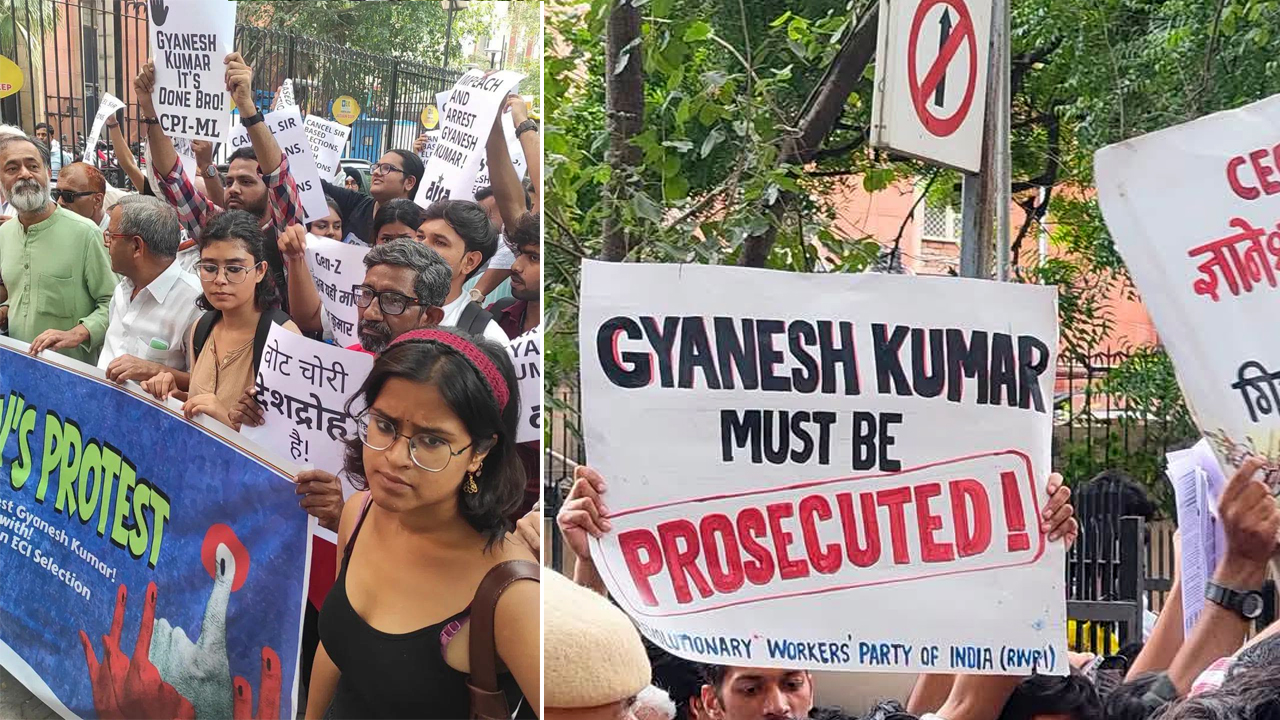
Hours after the Cockroach Janta Party’s ultimatum to the BJP run incumbent Union government to resume the massive mass protests that shook the capital in late July earlier this year if the Chief Election Commissioner Gyanesh Kumar does not tender his resignation within two days, Jantar Mantar has been put on lockdown. At least 123 protesters were detained and taken to various police stations in the outskirts of the city.
by Mouli Sharma
25 September 2026, New Delhi: “There were more policemen than protesters in sight,” says Nandita Narain, who arrived on site at around 2:10 PM. One of the panelists invited to speak at the demonstration, she was unable to even enter the protest venue, being trapped within an onslaught of khaki clad policemen and Rapid Action Forces.
“Some of them looked as old as the hills, you know,” she says. Narain is a retired professor of Mathematics from the University of Delhi, and a veteran of Delhi’s activist frontline, so she knows a thing or two about experience. “These are clearly people who’ve just been given uniforms and I don’t know… some of them were looking really way beyond the retirement age,” she says.
“But then one can’t be sure,” she’s quick to add.
The protest at Jantar Mantar on Friday afternoon was called for on an urgent basis by AISA following the Cockroach Janta Party’s ultimatum to the BJP run incumbent Union government to resume the massive mass protests if the Chief Election Commissioner Gyanesh Kumar does not tender his resignation within two days. The Cockroach Janta Party and others have led the anti-paper leak movement in June-August 2026, which brought tens of thousands of people onto the streets in cities across India, and succeeded in pressurising a Union Minister to resign following gross governance failures for the first time since the BJP-led NDA alliance came to power in 2014. This time, though, the focus has moved from education to elections—the second item on the CJP’s manifesto since the satirical outfit was ‘established’ earlier this year.
“If any legit vote is deleted, whether in a CJP or opposition-ruled state, the CEC shall be arrested under UAPA, as taking away voting rights of citizens is no less than terrorism,” the second item of the five point manifesto reads (next up are women’s parliamentary reservation, audits of Godi media finances, and a 20 year ban on defectors (the first item, which opposes retirement rewards for Chief Justices, may also return to the roster)). As such, the ‘school thik karo abhiyan’ which saw a ground level campaigning by CJP volunteers in urban and rural government schools and exposed failures of governance and misappropriation of funds at the grassroots level in public education, has taken a backseat, as the ruling party’s Special Intensive Revision has placed the very essence of India’s democratic identity at peril.
The CJP has put forth three demands: First being ‘immediate accountability’.
“We demand the resignation of Gyanesh Kumar in 48 hours,” the outfit says. They also demand the initiation of criminal proceedings and answer to the question, “Who gave him the orders?”
The second demand is an immediate terminus on elections and SIR. “Put all upcoming polls on hold,” the party says, addressing the government. “Freeze SIR and roll back to the January 2025 voter list. Constitute an Independent Inquiry Commission to examine how SIR decisions were taken. Direct the Supreme Court to seize all files related to SIR and its decision-making process.”
The third demand is that of an ‘independent leadership’: “Repeal the 2023 law on the appointment of Election Commissioners,” they say. “Enact a new law that inspires public confidence, with active participation from civil society.”
The structure is identical to that of the movement against paper leaks and corruption in the Higher Education Sector that became the start of CJP’s transition from screen to street on June 6 2026, when CJP founder Abhijeet Dipke’s flight first landed in India at the start of what would become one of the most significant nationwide mass agitations in recent history. But the state’s response is far from comparable.
Saurabh from AISA Jamia says, “AISA gave the call for protest at Jantar Mantar following CJP’s 48 hour ultimatum. Nandita Narain, Yogendra Yadav, Prashant Bhushan, and others were invited to speak.”
“There were such few people, and such a huge number of cops,” said a protester outside Jantar Mantar, who had narrowly escaped detention. “If they just allowed it to happen, then what would have been the big deal? It’s not as if it was a huge crowd.”
By 3:30PM, bystanders allege that the crowds had been dispersed and Janta mantar was put on lockdown, with barricades blocking the station entry in a sight reminiscent of the final week of July. “There was no intention of letting any protest happen. We weren’t allowed to even enter,” Narain said, who ended up delivering her speech to media persons crowded around the outer barricades of the venue. “The program never began.”
As per Lawyers for Detainees, one of many lawyers’ collective of its kind formed after the protests against Dharmendra Pradhan, at least 30 individuals were detained at Jaffarpur Kalan PS in the Dwarka district, including activist Yogendra Yadav and CPI(ML) general Secretary Dipankar Bhattacharya; 33 at Narela PS, including former JNUSU president N. Sai Balaji and other student activists; 14 at the Dwarka PS including RTI activist Anjali Bhardwaj, an unnamed journalist and students, including a minor; 14 at Kanjhawala PS including Neha Bora; and 32 at Samaypur Badli.
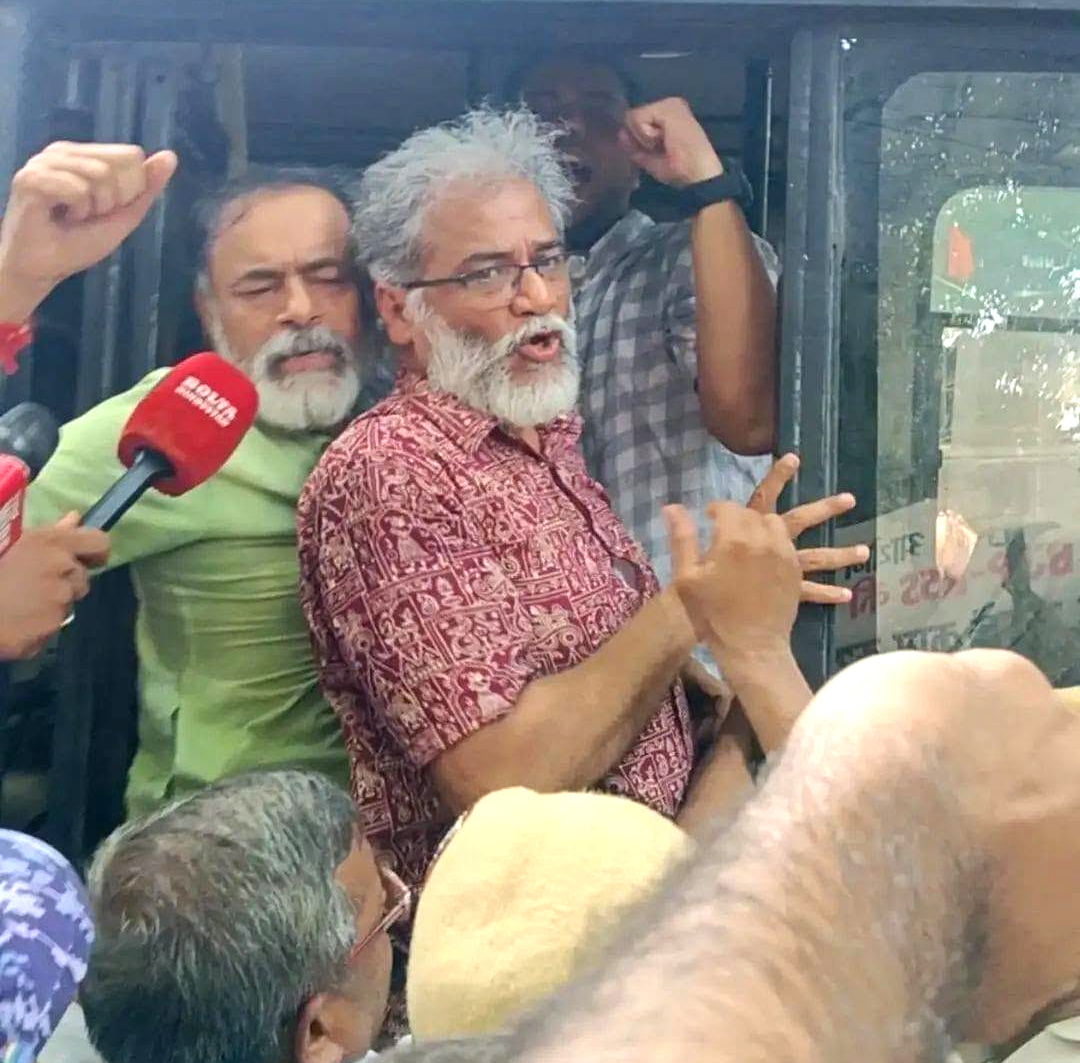
By 10 PM (notably long after sundown), all detainees were released and no arrests were made.
“When big-named activists like Yogendra Yadav are present, it makes every detainee safer,” said a member of the group. “It means the whole country is watching these police stations. Otherwise detentions can get far more dangerous.”
“It just shows a sign of desperation,” Narain said, describing the massive deployment of security forces at the protest site as an ‘overkill’.
When asked if she thinks this agitation against the SIR process, which has led to the deletion of nearly 14 crores voters from national rolls in three phases and issuances of notices to another 5.43 crores, has been repeatedly described by election analysts and human rights activists alike as a discriminatory and antidemocratic exercise, has the potential to grow into something like its predecessor, Narain is optimistic.
“Definitely,” she says. “The number of protests that [are taking place]… people all over. It’s everyone. Even the poorest of the poor, you know, they know that at some point of all that, all your livelihood concerns are connected to these voting identities. People have been writing articles about how their names have been struck off for no reason… no change in name, no change of address.” She acknowledges that the burden is not the same for everyone. “Of course the empowered lot will manage to get their names back in some way or the other, but it’s the other lot who won’t even know what’s happening and then they’ll be disenfranchised. So it is a very serious matter and more people are talking about it.”
“It’s not going to die,” she concludes.
An ongoing litigation is already in effect in the High Court of Delhi regarding alleged irregularities and procedural violations by the Election Commission of India; Adv. Mehmood Pracha filed a petition against the body back in July 2024, and the matter has seen repeated delays and evasions on part of the respondent in response to demands for the preservation and presentation of videography of the ‘Lok Sabha Elections conducted in Delhi in May 2024’. In the latest substantial order in the matter, which was passed on February 13 earlier this year, the ECI submitted “said videography does not exist any longer.” The HC was set to consider this response in the following hearing, but Justice Amit Bansal remained unavailable for both the hearings that followed, and is now set to hear the matter on 2 December 2026.
Mouli Sharma is a journalist based in New Delhi. She currently writes for GroundXero, and her work has appeared in various publications.