
The petition ultimately asks the Supreme Court to confront not merely the legality of the Noida prosecutions (or lack thereof), but the police investigative culture that made them possible.
By Mouli Sharma
The Shakambhari writ petition, one of several eponymous petitions filed in India’s courts of supposed justice by the imprisoned 60-year-old journalist Satyam Verma’s spouse, is an artifact of the nonsense the UP Police have made of the Noida workers’ protests of April 2026. This second installment of GroundXero’s five-part series examines allegations and public-domain evidence of the police’s persistent violations of investigative procedure in the case. It reminds us that there are two sets of laws for those who wear the uniform of the state in this country—and that neither appears to matter when the crimes committed are against a certain kind of citizen.
Twenty-two years ago, shortly after midnight on 11 July 2004, personnel from the 17th Assam Rifles forced their way into the home of the 32-year-old activist Thangjam Manorama Devi in Manipur. They had neither a search warrant nor an arrest warrant; indeed, there was not even an FIR against her. They dragged her from her home, assaulted members of her family at gunpoint, and forced them into the backyard, where they could hear her screams. Half an hour later, the soldiers returned with an arrest memo. By daybreak, she was dead.
The Assam Rifles claimed that she had been shot ‘while trying to run away’. But there was no blood around her bullet-ridden corpse, which was recovered not by the army men who confessed to killing her, but villagers for whom her mutilated body had been left to find. The post-mortem report documented injuries consistent with torture, including bullet wounds to her vagina, while forensic examinations found human semen on her clothes.
Twenty-two years later, no one has been held accountable for Manorama’s abduction, torture, gang rape, and murder. Multiple official inquiries have been constituted by the courts, the state government, and even the Assam Rifles, but their reports have never been made public. Public outrage—from prolonged strikes and road blockades to the now-iconic protest by Manipuri women outside the Assam Rifles headquarters and even acts of self-immolation—failed to produce a single conviction.
Why? Because Section 6 of the Armed Forces (Special Powers) Act, 1958 provides that:
“No prosecution, suit or other legal proceeding shall be instituted, except with the previous sanction of the Central Government, against any person in respect of anything done or purported to be done in exercise of the powers conferred by this Act.”
“There should be some fiction, some stories, some lies,” psephologist and political activist Yogendra Yadav remarked at a press conference on 7 July 2026, referring to the fabricated evidence and procedural violations in the UP Police’s investigation into the Noida workers’ protests. “We should preserve at least some illusions,” he said.
“One of them is the rule of law.”
II
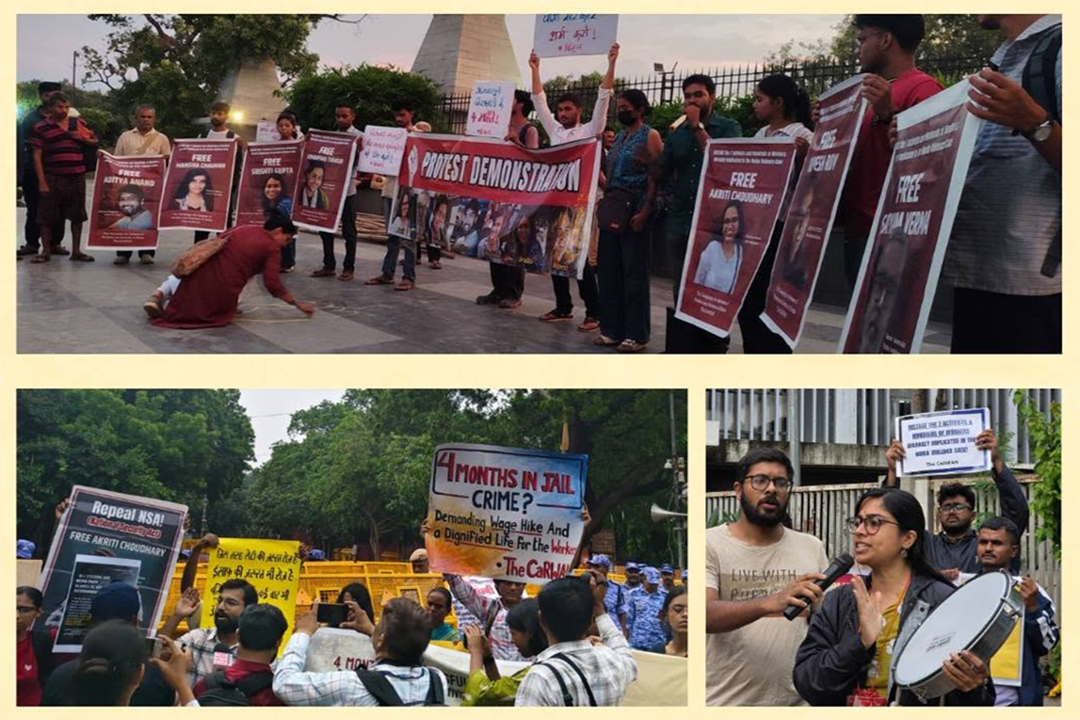
There is another sense in which 11 July was significant. Marked by protests across the country, beginning at Jantar Mantar in New Delhi and extending to Kolkata, Hyderabad, Pune, Vizag and elsewhere, the date marked three months since the Noida incarcerations began on 11 April 2026.
In a six-minute video recorded at around 7 p.m. that day inside Botanical Garden Metro Station, two women are seen trying to shield a man from overzealous uniformed officials and an even more overzealous group of men in plain clothes. In broad daylight, the men attempt to take him away against his will while he and the women repeatedly ask who they are, what they want, and why they are doing this. They receive no response. The man is Rupesh Roy, one of the accused in the present case; the unidentified men—at least those in uniform—are members of the UP Police SWAT team, according to friends and family of the accused.
The arrest is striking not only because it took place inside a busy Metro station, with CRPF personnel standing nearby, but because although every visible officer involved is male, by the end of this series of videos not only Roy but also the two women attempting to shield him, Manisha Chauhan and Akriti Choudhary, have been taken into custody. As per the BNSS, 2023 (section 46, subsection 5), arresting women after sunset (or before sunrise) is an exceptional undertaking, and requires a woman officer to submit a written report requesting special magisterial permission for the same prior to the arrest. Needless to say, none of these procedures were followed.
Nor does it end there. The person recording the incident, Shrishti Gupta, was also arrested. Yet the police make no reference to her filming the incident in her grounds of arrest, nor do they acknowledge that Chauhan and Choudhary were attempting to prevent what they believed to be Roy’s violent and unlawful detention in either of theirs.
Eight individuals have been identified by the police as the alleged masterminds behind what it describes as a conspiracy linked to the Noida workers’ protests. Three appear to have been arrested by happenstance, seemingly only because they were getting in the way and the circumstances of their alleged ‘arrests’ seem better described as assault and abduction rather than anything resembling due legal process.
In the chargesheet for FIR 169, filed on 3 July 2026—one of eleven FIRs naming each of the eight activists—there is a striking internal contradiction.
“Case Diary 24, page 6 claims that Akriti’s phone was recovered from a bag belonging to her that was found in a park in Nimmi Vihar, near PS Phase 2, on 26 April 2026. But in Case Diary 21 of the chargesheet for FIR 169/2026, the last recorded location of Akriti’s phone is Botanical Garden Metro Station at around 7.04 p.m. on 11 April 2026, approximately the time she was picked up by the UP Police.”
Keshaw Anand of the Campaign for the Release of Workers and Activists of Noida (CaRWAN) highlighted the discrepancy at a press conference on 7 July 2026, arguing that the arrest records of all four activists taken on 11 April had been falsified.
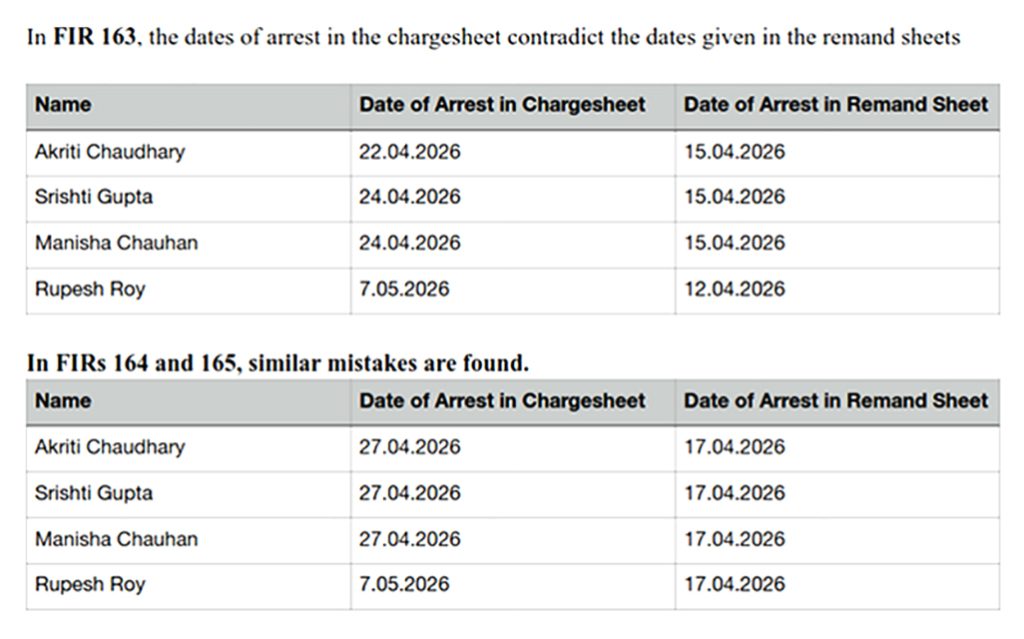
Analysis by Advocates Zia Kabir Chaudhary and Kawalpreet Kaur
The contradiction is hardly surprising. The footage itself shows police officers snatching Shrishti Gupta’s phone before escorting the four detainees from the Metro station, while the next recording—captured on a bystander’s phone—ends with that device being seized as well. The subsequent movement of Shrishti’s phone, documented in the police’s own chargesheets, points not to lawful recovery but to illegal seizure, fabrication and an apparent attempt to reconstruct the chain of evidence after the fact.
This is a handful of videos, of four detentions. Hundreds more remain in the public domain. These videos, real-time footage of arrests and invaluable evidence, have been entirely omitted from the UP police’s final investigative reports, their chargesheets. Instead, the prosecution’s own evidence—the location data of the accused persons’ phones—ultimately exposes the weaknesses of its narrative.
“Every allegation made by the State is not only untrue,” Supreme Court advocate Zia Kabir Chaudhary observed, “it is also a confession.”
And so it goes.
***
If one were particularly obtuse, one might ask why the police would fabricate details such as the date and time of an individual’s arrest or the last recorded location of their mobile phone. But fabricate they have—and with considerable creative effort.
“We took the female accused [Shrishti] out of the women’s holding room (under the custody of female personnel) in a PCR van to the location indicated by her for the purpose of recovering a mobile phone and other items,” reads the aforementioned Case Diary 24.
Inspector Harendra Singh proceeds to narrate an elaborate account of this supposed recovery operation, allegedly conducted on 24 April 2026—nearly two weeks after Shrishti had been taken into custody—even though location data indicate that the device from which she had live-streamed the incident remained with her at the time.
“Shrishti had the vehicle stopped. She stepped out, looked around, and walked towards the bushes. She then signalled to us police personnel, identifying a bag lying there as her own and stating that her mobile phone was inside it. She was afraid to retrieve the bag herself because of the thick undergrowth and filth, and hesitated for quite some time before asking us to do so. She stated, ‘This is my bag; you may pick it up.’ Consequently, I, Harendra Singh, picked up the bag identified by Shrishti and opened it for inspection,” it says, sparing no potentially imaginary details.
Singh goes on to state that the police attempted “to secure public witnesses during the recovery”, but that no member of the public was willing to participate, claiming personal constraints and leaving without disclosing either their names or addresses. A few paragraphs later, he nevertheless records that, “Supreme Court guidelines were adhered to during the recovery process.”
The reason police violate statutory safeguards is the same one as to why those safeguards exist in the first place: power corrupts, and institutions protected from accountability learn to lie.
Details such as the date of an individual’s arrest matter, not merely as matters of fact but because they trigger statutory protections. Ninety days is the maximum period ordinarily permitted for filing a chargesheet in serious criminal proceedings. At the time of writing, commission of chargesheets in ten of the at least fourteen FIRs in the Noida matter remains pending more than four months after the earliest arrests. Failure to file a chargesheet within the statutory period constitutes a serious investigative lapse and ordinarily entitles the accused to what is known as default bail. Since bail has been repeatedly denied to the eight activists in over half the FIRs (all of them have been named across eleven FIRs each), such provisions have become crucial.
Delaying the registration of FIRs and mislabelling the dates of seizure and arrest by recording them days or even weeks after they actually occurred serves a straightforward purpose: it buys the UP Police time—first, to fabricate evidence, and later, to delay the filing of chargesheets, thereby frustrating the accused’s entitlement to default bail.
Another reason why delays in FIRs are considered egregious violations of investigative procedure, according to Advocate Kabir, is, because it compromises the investigative process. “The Supreme Court has held in a number of cases that even a few hours’ delay in an FIR is fatal because this means that [the police] utilize that time to embellish the FIR and concoct a story,” he said.
***
In another video from Noida that went viral on X (formerly Twitter), uniformed police officers can be seen repeatedly striking a woman with lathis. After the footage provoked widespread public outrage, Police Commissioner Lakshmi Singh responded on X rather than through an official statement.
“A gazetted officer has been assigned to inquire into the facts pertaining to the video,” read a post published by the official @noidapolice account on 16 April 2026. “Prima facie, the video appears to be morphed or AI-generated and does not seem to be from Noida, but from some other location. Please do not resort to rumour-mongering over unverified videos.”
Unfortunately for the gazetted officer entrusted with the inquiry, the footage was both authentic and filmed in Noida, as established through geolocation analysis and comparison with PTI footage in Ayush Tiwari’s investigative report for Scroll, published on 19 April 2026. Tiwari also identified one of the officers shown assaulting the woman as Sub-Inspector Prabhat Kumar of Sector 6, Noida. His superior, Shailendra Kumar, confirmed the officer’s identity, declined further comment, and took no apparent action against him.
Lakshmi Singh never publicly responded after those findings debunked the police’s initial claims.
***
On 23 April 2026, The Caravan published a video report documenting events in Noida during the industrial protests between 9 and 15 April. Entitled Blow upon Blow: Workers’ Protests and Police Repression in Noida, the report depicts not merely a breakdown of law and order but one produced by policing itself.
“My brother has been locked up for two or three days,” said Mehraj Alam, whose brother Shehryar Raza had been picked up from a field. “I have been wandering around hungry for the last two days looking for him. We heard that people were being picked up and quietly taken to jail without anyone being informed. Today we find out he has been locked up all this while.”
Raza’s father, unnamed in the report, recalled pleading with police officers simply to confirm whether his son had been detained or to disclose where he was being held. No officer answered his questions.
Another detainee, Rudra Pratap, was represented in the report by his younger sister, who described the circumstances of his detention. Uniformed and plain-clothes police officers forced their way into the family home, assaulted both her and her elder sister, who was pregnant, locked them inside a room, and abducted Rudra. She further alleged that the officers verbally and physically abused their disabled father, who was unable to walk.
Account after account, and video after video, emerging from the days of the uprising depict a profound collapse of lawful policing, in which the UP Police appear less as law-enforcement officials and more as corporate goons defending the interests of Noida’s companies, such as Kent, one of whose young female workers was abducted and at time of publication of Caravan’s report, was still missing. Workers were allegedly taken from their homes and workplaces, while the police’s apparent access to private residential and employment records suggested possible collusion between the companies accused of exploitation and the state administration.
Under the Supreme Court’s landmark judgment in K. S. Puttaswamy v. Union of India (2017), commonly known as the Privacy Judgment, such conduct—if established—would amount not merely to an investigative irregularity but to a violation of the fundamental right to privacy under Article 21 of the Constitution, which protects life and personal liberty.
The Puttaswamy judgment fundamentally strengthened constitutional protections for privacy by overruling earlier decisions, including M. P. Sharma and Kharak Singh, which had denied constitutional recognition to that right. Yet when the privacy rights of criminal defendants are concerned, Indian procedural safeguards remain markedly weaker.
The case diary discussed earlier records that:
“[Srishti’s] recovered mobile phone was unlocked, and its WhatsApp chats and gallery were examined; screenshots were taken of chats, videos, and audio files related to the incident.”
Under the statutory requirements governing electronic evidence—including search authorisation, seizure procedures, hash-value documentation, seizure memoranda, independent witnesses, and video-recording of recoveries—such procurement would itself be unlawful. Yet the term unlawful acquires a peculiar emptiness in Indian criminal procedure because, as the courts have repeatedly held, evidence obtained illegally is nevertheless admissible.
“The law of this country is not what is written,” Yogendra Yadav remarked during the press conference of 7 July. “This is another parallel empire. You are reading the papers for no reason.”
***
Unprovoked lathi charges, curfews that prevented families from searching for missing relatives presumed to be in police custody, and the detention of schoolchildren without guardians’ presence have, to date, resulted in no criminal proceedings against UP Police officers for brutality or unlawful confinement.
There is a cleverly performed maneuver here, in the imbalance between what is and is not crime, depending on who does or does not commit it. The Shakambhari petition argues that this reflects a system of selective criminalisation: while workers exercising their right to collective action face prosecution, factory owners accused of violating labour laws remain untouched.
“No FIRs have been registered, or even preliminary inquiries conducted, against factory owners for massive wage theft, forgery of salary slips, and violations of the Factories Act and the Minimum Wages Act. Conversely, multiple FIRs carrying severe charges—including Attempt to Murder and Criminal Conspiracy—have been registered against hundreds of impoverished workers, along with civil rights activists, journalists, and students who stood in solidarity with them. They have been summarily arrested, subjected to custodial torture, and continue to remain in prison.”
The petition argues that this constitutes a textbook violation of Article 14 of the Constitution, which guarantees equality before the law. The same criticism extends to the absence of proceedings against police officers alleged to have committed comparable abuses.
Nor is the petition silent on the wider constitutional consequences. The petition contends that indiscriminate baton charges, serial harassment and surveillance of women activists, and the enforced disappearance of large numbers of detained workers have created “a permanent chilling effect across the industrial belt”.
“The police have officially arrested 396 individuals and registered FIRs implicating over 4,000 ‘unidentified’ persons under draconian charges like Attempt to Murder (Section 109 BNS),” it says. These figures are lower caps of the true extent of detention. The 396 named individuals were counted across 14 FIRs as of 19 May 2026, including more than 170 unique names repeated across FIRs. The number had increased by July, although a fresh total remained unconfirmed.
Nor is the petition silent on the wider constitutional consequences. Writing in December 2013, lawyer and constitutional scholar Gautam Bhatia observed that Indian courts have rarely engaged with the doctrine of the chilling effect, despite its long-standing place in constitutional jurisprudence elsewhere as describing the suppression of lawful expression and association through state action.
The Shakambhari petition contends that indiscriminate baton charges, serial harassment and surveillance of women activists, enforced disappearance of large numbers of detained workers have created “a permanent chilling effect across the industrial belt.”
“The police have officially arrested 396 individuals and registered FlRs implicating over 4,000 ‘unidentified’ persons under draconian charges like Attempt to Murder (Section 109 BNS),” it says. As previously established, these numbers are lower caps of the true extent of detention, which the state is concealing even now. 396 is a summation of named individuals across the 14 FIRs as of May 19 2026, which include over 170 unique names (repeated across the FIRs). Come July, this number has been exceeded, for at least one Yogesh Meena was arrested on 29 May 2026, and a fresh number remains unconfirmed, though as of August 11 2026, most of these individuals barring the eight activists have been granted bail.
***
The reference to 4,000 “unidentified persons” effectively grants the State discretion to arrest thousands more under existing FIRs, while charges like Attempt to Murder will facilitate prolonged detention. In the past, such as following the controversial police action in Delhi’s Turkman Gate in January this year, the charge has been alleged to be weaponized against protesting masses.
Advocate Supantha Sinha of the All India Lawyers’ Association for Justice argues that indiscriminate use of Attempt to Murder is a familiar device for extending judicial custody.
“Section 109 requires an act demonstrably intended to cause death,” he said, adding that vague descriptions of acts of destruction or even assault could “by no stretch of imagination” amount to the same.
Similarly, Supreme Court advocate Kawalpreet Kaur notes that the FIRs in the Noida matter neither identify which accused attempted to murder whom nor specify the acts said to constitute that offence. The essential requirements of mens rea and actus reus, she argues, are absent from the prosecution’s case.
The implication of 4,000 unnamed individuals in charges of Attempt to Murder then serves little investigative purpose. Its principal effect is deterrence: discouraging future protest by transforming democratic participation into a source of existential legal risk.
The two-judge Bench of Justices B. V. Nagarathna and Ujjal Bhuyan was set to hear arguments in the Shakambhari petition, which identifies these procedural abuses as the second of five major illegalities allegedly committed by the Yogi Adityanath administration and the Lakshmi Singh-led UP Police during the Noida prosecutions on 21 July 2026, but due to the judge’s absence, this hearing was postponed. Again on August 7, citing a busy post-lunch schedule, the hearing was yet again postponed. Now, it is set to be heard on August 21 by a new Bench consisting of Nagarathna and Justice R. Mahadevan.
***
On 28 July 2026, the Delhi High Court dismissed a petition seeking to remove Additional DCP (North-East) Sandeep Lamba from supervising a court-directed police inquiry based on videos in which the officer appears to assault a woman during the Jantar Mantar protests against the incumbent government and former education minister Dharmendra Pradhan.
Justice Girish Kathpalia defended the officer on the ground of the presumption of innocence, a right every accused is entitled to. But this misses the point. The petition was not seeking Lamba’s conviction; it questioned whether a police officer accused of abusing his authority should be entrusted with investigating alleged procedural violations by other police officers.
Instead of addressing that concern, Kathpalia accused the petition of ‘discrediting the institution’. “Now just because this person happens to be caught on some video clip allegedly slapping a lady, we cannot tarnish him,” he said. “Even assuming he is ultimately held guilty, can it be assumed that he will act unfairly in every case?”
The question is precisely why the allegation matters. Countless women activists and workers have come forward since April 2026 with allegations of sexual harassment and assault by UP Police personnel during the Noida workers’ protests. Delhi-based activists have also alleged being stalked and psychologically terrorised by Noida police officers beyond their state’s borders. A petition filed on behalf of one of the accused has raised further serious allegations of custodial torture, all the more horrific considering one of the accused is a senior citizen and three of the eight activists are young women in their 20s.
In the eyes of the court, all these people are ‘accused’, too. Yet the presumption of innocence appears to acquire a different force when the accused is a police officer like Lamba.
The judgment is a slap in the face to hundreds of people still trapped in the judicial process of the Noida investigation, many of whom spent months incarcerated and had to pay tens of thousands of rupees in bail amounts in order to regain their freedom after police filed FIR upon FIR accusing them of arbitrary and serious crimes without prima facie evidence.
What is this ‘fair trial’ that Kathpalia refers to? How is it fair when an officer accused of abusing his authority and assaulting a woman in public has neither been arrested nor investigated, remains on duty, and is then assigned to investigate procedural violations by another police station?
At one point in the judgment, Kathpalia said: “The entire Delhi Police today is in the dock? Then should they stop registering FIRs?” The remark is revealing. It effectively reduces the question of individual accountability to an institutional inconvenience.
The 28 July judgment is particularly troubling because it reinforces the collective legal illusion described by Yogendra Yadav: citizens, journalists, lawyers, activists and workers are expected to obey a detailed framework of democratic legal procedure, even as the institutions enforcing that framework appear routinely exempt from it.
The dual nature of law is, therefore, a reality for Indians not merely an abstract problem. If the Armed Forces in Kashmir and the North East can rape, kill and loot; if the Delhi Police can beat, kidnap and poison; if the UP Police can molest, stalk and conspire, then the social contract upon which judicial logic rests begins to collapse.
Two laws are as good as no law at all.
As it stands, two of the petition’s principal prayers seek judicial intervention: first, the prosecution of the officers over the criminal allegations that have been levied against them; and secondly, the quashing of the blanket implication of 4,000 unnamed individuals across multiple FIRs.
The petition ultimately asks the Supreme Court to confront not merely the legality of the Noida prosecutions (or lack thereof), but the police investigative culture that made them possible. All this before we’ve even addressed the third and most sensational illegality—to be discussed in the next part—the alleged involvements of Sub-Inspector SI Bina and one Anil Kumar, driver of DCP Vijay Gupta, as agent provocateurs themselves.
Mouli Sharma is an author and journalist from New Delhi. She has been featured in publications like The Mooknayak, GroundXero, Frontline, Maktoob Media, The Observer Post, The Leaflet, Nivarana, The Polis Project, Article 14, NewsClick, SabrangIndia, Think Global Health, etc.
Also Read: Reading Shakambhari I: ‘A Living Wage is Not a Public Order Problem’