
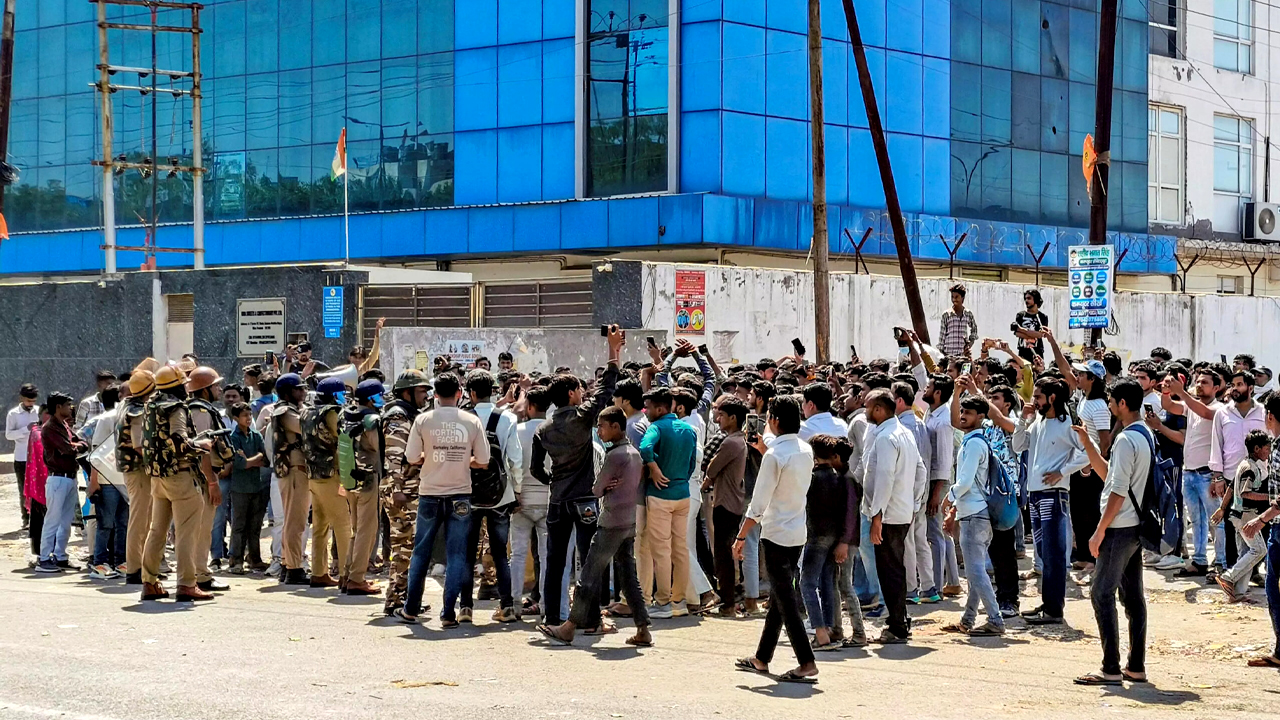
The Shakambhari writ petition in the Supreme Court is one of several petitions filed by Shakambhari, the wife of the imprisoned sixty-year-old journalist Satyam Verma, across the Indian courts of law in the wake of wave of arrests that took place following mass protests and workers’ strikes in Noida through the second week of April 2026. It is also one of the most revealing documents to emerge from the Uttar Pradesh Police’s response to the same.
On its face, the petition concerns Satyam Verma: his abduction, his prosecution, and the extraordinary legal violations committed by the Uttar Pradesh police in the course of their supposed investigation. But if we read it more carefully, the petition is, however, an example of how workers’ protest itself and solidarity actions towards it were transformed into a criminal conspiracy, and of how the Indian legal system has responded to that transformation.
By July 2026, Shakambhari had become more than a plea for legal relief. It had become a record of the contemporary Indian state: an essential document for understanding India’s present legal milieu which reveals that the judiciary can no longer be understood simply as the arbiter of justice, but as an institution increasingly complicit in its systematic denial.
Reading Shakambhari I : ‘A Living Wage is Not a Public Order Problem’
By Mouli Sharma
In the 1970s, the renowned late physicist—and notable Epstein Island visitor—Stephen Hawking discovered an unsettling property of black holes. Applying semiclassical quantum field theory to their study, he concluded that black holes emit identical radiation regardless of what formed them. As they grow, information about their origins disappears beyond recovery, erased from the observable universe. The problem became known as the information paradox.
The Supreme Court hearing of Shakambhari on 19 May 2026 began, in much the same sense, inside a black hole.
“We have no way of recovering it now,” recalled the renowned Hindi poet and veteran activist Katyayani of book distributor Janchetna, referring to the Facebook post that first brought Satyam Verma to the attention of the Uttar Pradesh Police. Verma had published the short post on his personal Facebook account on 9 April 2026. It no longer exists.
“They asked him to delete it,” Katyayani said. “He was called to the Hasanganj police station and told, ‘upar se orders hai’ (‘the orders are from above’). Satyam initially refused and tried to reason with them. But the moment anyone became even slightly assertive with these officers, their behaviour shifted into outright intimidation. They made it very clear they were not asking.”
That single Facebook post triggered the chain of events that culminated, on 17 April 2026 as the poet told GroundXero, in Uttar Pradesh Police officers forcing their way into Janchetna’s Lucknow office, disabling the CCTV cameras, confiscating employees’ phones, threatening and intimidating anyone who tried to stand up to them, and eventually abducting Verma in the middle of the night, and transporting him to a then undisclosed location.
Verma was one of more than 1,100 people taken into custody by the Uttar Pradesh Police that month and over those that followed. They came from the more than 42,000 workers and supporters who participated in the Noida protests between 9 and 15 April and from many thousands others who expressed solidarity elsewhere in the country. Most were detained unlawfully. Many were released without any formal record. Hundreds were not.
One can speculate endlessly about why Indian police routinely detain people they never intend to arrest or prosecute, only to release them a few days later without leaving any official record. One need not speculate, however, about what this practice achieves. It allows unlawful detention without any legal accountability.
Satyam Verma’s case, like at least 396 others arrested in the context of April 2026’s Noida “unrest”, is as much a travesty of justice as it is a farce. This is not because state repression is something uncommon but because of the sheer absurdity of the legal process itself as it transpired.
For two days after his abduction, Verma’s family and friends, including his wife, the eponymous Shakambhari, had no idea where he was. When the police finally broke the silence and informed them of his whereabouts, the irony was difficult to miss. He had been taken to Noida, thrown into jail, and arrested. He was charged with conspiring to support the movement he had written about.
The Petition
Over two months after the Noida crackdown—a crackdown whose victims, astonishingly, still include people whose whereabouts remain unknown—the total number of arrests has yet to be officially confirmed. The Campaign for Release of Workers and Activists of Noida (CaRWAN), a coalition of individuals in solidarity with those implicated in the police action, had mapped out a petition for court-ordered transparent disclosure of the same along with the whereabouts and case statuses, but it had to be dropped due to overwhelming bureaucratic responsibilities, say the media correspondents of the group.
Till date, 58 people remain in pre-trial detention, with at least 171 having been arrested and repeatedly named across nearly 400 criminal cases spread over an absurd 18 FIRs registered in the singular matter, the overwhelming majority of them factory workers. These are workers who went on strike because they were not being paid even the statutory minimum wage. They now find themselves packed into overcrowded jails, burdened with dozens of criminal charges and FIRs thick enough to rival the dossiers of seasoned organised criminals—all for one instance of protest.
In that sense, Satyam Verma is one of the fortunate ones. His story is known. He is now lodged in Luksar Jail. Alongside seven others—journalists, labour organisers, artists, students, engineers, and factory workers—he occupies the increasingly familiar club of India’s prisoners of conscience. In chronological order of arrest, they are — 25-year-old thespian Akriti Choudhary, 44-year-old labour leader and auto-rickshaw driver Rupesh Roy, 26-year-old artist Shrishti Gupta, 22-year-old labour activist and factory worker Manisha Chauhan, 28-year-old software engineer Aditya Anand, 24-year-old history student Himanshu Thakur, and 23-year-old law student Yogesh Meena.
The Shakambhari petition is not primarily about Satyam Verma and his fellow prisoners. Nor is it the petition seeking Verma’s immediate release or relief from the custodial torture alleged to have followed his abduction as a senior citizen.
Instead, the petition asks a broader question: What happens when an entire criminal prosecution is itself unlawful
***
Heard on 19 May 2026 by a two-judge Bench of Justices B. V. Nagarathna and Ujjal Bhuyan of the Supreme Court, the petition under Article 32 of the Constitution challenged what it described as the Yogi Adityanath-led Uttar Pradesh government’s “systemic and chilling subversion of the criminal justice system,” and a new Bench consisting of Nagarathna and R. Mahadevan is set to hear arguments for the same on 21 August 2026.
“The State has weaponized its police machinery to arbitrarily crush a legitimate labour agitation in Noida, Uttar Pradesh, shielding corporate entities from liability for rampant wage theft, and maliciously criminalizing the working class and civil society members through dragnet criminal proceedings,” the petition reads.
Verma, represented through his spouse, Shakambhari, and a team of renowned human rights advocates—including Paras Nath Singh, Shahrukh Alam, and Deeksha Dwivedi—set out three immediate prayers before the Court:
First, to consolidate the multiple overlapping FIRs filed against him into a single proceeding.
Second, to quash the arbitrary implication of approximately four thousand unnamed citizens across the numerous FIRs registered in connection with the April 2026 Noida protests.
Third, to order an independent investigation into evidence recovered through a sting operation in April suggesting that Uttar Pradesh Police personnel infiltrated public WhatsApp groups while posing as workers and themselves sent the “provocative” messages later used as evidence to allege criminal conspiracy.
These are important prayers. However, the petition’s real significance lies elsewhere. Read carefully, Shakambhari reconstructs the entire Noida prosecution through five interconnected illegalities.
First: the refusal to prosecute employers despite widespread and longstanding labour-law violations, or mediate the labour dispute.
Second: the harassment, surveillance and unlawful detention of workers, journalists, labour movement activists, and civil society members.
Third: the manufacture of a conspiracy through entrapment, fabricated evidence and police infiltration.
Fourth: the deliberate fragmentation of criminal proceedings across multiple FIRs.
Finally: the ideological profiling of journalists, trade unionists and activists — political witch-hunting in the name of investigating a ‘conspiracy’.
Each section of what will hereafter be a five-part series, of which this is the first, shall examine one of these violations, asking not merely whether the police acted unlawfully, but whether the documentary record assembled by the State ultimately becomes evidence against the State itself.
I
When veteran journalist T. K. Rajalakshmi, in an interview with Frontline, asked CITU General Secretary Elamaram Kareem what he thought of the Noida Police establishing an “industrial cell” to resolve labour disputes, his answer was short and unequivocal: “The police are not the authority to [do that].”
That brief statement reveals the most fundamental illegality at the heart of the Noida prosecutions. The dispute was never, in the first instance, a police matter. It was a labour dispute. And Indian labour law already provides a mechanism through institutions for resolving such industrial disputes.
The relationship between worker, employer, and the State is not governed by police discretion. It is governed by labour laws. Industrial disputes in India are meant to be resolved through tripartite institutions: negotiations between workers and employers, mediated by the State through labour departments and labour tribunals. Neither the police nor the executive possesses the legal authority to substitute itself for that process.
The Noida protests did not arise spontaneously. They followed years of continuing violation of the law by the UP administration without consequence, the state’s longstanding neglect of said statutory violations—not by one, or two, or even three hundred of Noida’s factories, but by virtually all of them. The immediate catalyst was the Uttar Pradesh administration’s failure to convene the statutory tripartite process for the revision of wages not once, but twice: first in 2019 and then again in 2024.
This means that the Uttar Pradesh administration was itself in continuing violation of the law for well over a decade, without consequence. For 14 years, the Uttar Pradesh government failed to carry out the statutory revision of minimum wages, despite the Supreme Court, in 1982, stating clearly that extracting labour below the statutory minimum wage constitutes a form of slavery—”forced labour” under Article 23 of the Constitution. The tripartite wage-setting process due in 2019 was never completed. Nor was the one due in 2024. By 2026, workers in one of India’s largest industrial belts were still being paid wage rates effectively frozen since 2012.
Beyond wage theft, the working conditions across hundreds of factories—including those operated by multinational conglomerates such as Kent, the Motherson Group, Richa Global, Samsung, and Oppo—were abysmal in countless other ways. One example alone is that shifts routinely lasted 12 to 13 hours without overtime pay, in clear violation of the eight-hour workday convention of the International Labour Organization (ILO), which India ratified more than a century ago, on 14 July 1921.
Investigative reporting in the independent media has documented abusive conditions for years—from unpaid overtime to physical and verbal violence by supervisors—long before the April 2026 strikes.
When the protests erupted in Noida, even mainstream media like BBC, Frontline and others reported the scale of labour-law violations in Noida. On 29 April 2026, CITU formally petitioned the ILO, accusing both the Union and Uttar Pradesh governments of suppressing workers’ rights.
Yet throughout this period, neither the employers nor the State’s own labour department became the subject of criminal investigation. The judiciary also looked away, even though the violations are not merely administrative, they are constitutional.
Returning to 1982, in the landmark People’s Union for Democratic Rights v. Union of India, judgement, Justice P. N. Bhagwati wrote:
“The Rule of Law does not mean that the protection of the law must be available only to a fortunate few… The poor too have civil and political rights and the Rule of Law is meant for them also, though today it exists only on paper and not in reality.”
The judgment continued:
“If the sugar barons and the alcohol kings have the Fundamental Right to carry on their business… certainly the ‘chamaras’ belonging to the lowest strata of society have the Fundamental Right to earn an honest living through their sweat and toil.”
The significance of those observations extends beyond rhetoric. For over a decade, successive governments in Uttar Pradesh failed to enforce labour protections that the Supreme Court had already recognised as integral to the Constitution’s guarantee against exploitation. The highest judiciary with the powers of Suo Moto and expanded jurisdiction didn’t intervene on its own even as private corporations paid workers a meager Rs. 11,000 to Rs. 13,000 per month in a city where minimum living costs exceed Rs. 28,000.
When workers finally erupted in protests and went on strikes in April 2026, the State confronted them not as victims of longstanding statutory violations, but as criminals. This reversal is the foundation upon which the Noida prosecutions stand.
On 14 April 2026, amid escalating labour protests, the Uttar Pradesh government, to pacify the uprising, revised the state’s minimum wage, the first revision in eleven years. Near-identical, authorless reports mushroomed across the mainstream media, announcing that the government had granted a 21 per cent wage hike in response to the widespread labour unrest. Ironically, no such announcement had actually been made at the time. The formal notification order was not issued until 17 April—the very day Satyam Verma was abducted from his home office in Lucknow and taken to Noida. The coincidence is more than chronological.
The wage notification acknowledged precisely what the criminal investigation sought to obscure: that workers had legitimate grievances and justified demands rooted in years of neglect and exploitation. Yet even this apparent concession concealed another illegality. The increase was not done through the statutory wage-revision process. It was an improvised political settlement dressed up as administrative compliance.
The notification that purported to resolve the labour dispute would itself become evidence of illegality in the Shakambhari petition.
The High-Level Committee and Wage Revision
The Shakambhari petition does not dwell on details in the 17 April wage revision notification, it squarely addresses both the illegality and the insufficiency of the purported 21 per cent wage increase by invoking the Supreme Court’s decision in Workmen v. Management of Reptakos Brett & Co. Ltd.
“The right of workers to demand a living wage is not an act of extortion or a public order problem; it is a constitutional aspiration under Article 43, read with Article 21…. Employers cannot cite financial hardship to default on this payment.”
That observation becomes far more significant when read alongside the notification itself, issued on 17 April 2026, by the Uttar Pradesh Labour Department’s Chief Secretary. It also revealed how the wage revision hiked wages by roughly Rs 3,000—a sum that, at the time, would not even have covered the cost of a single LPG cylinder, whose price had climbed beyond RS 4,000 amid the war in West Asia.
Four days earlier, on 13 April 2026, the Uttar Pradesh government had constituted what it called a “High-Level Committee” under the Infrastructure and Industrial Development Department (IIDD) ostensibly to monitor the situation and maintain industrial peace amid the ongoing labour unrest, according to the gazetted notification issued by Dr M. K. Shanmuga Sundaram. According to veteran labour researcher Rakhi Sehgal, this constitution is itself implicatory of the government’s allegiances lying with corporations and not workers, as in her words, wages are, “solely the jurisdiction of the Labour Department,” and such a committee has no business being constituted under the IIDD.
If the title of the committee suggested an institutional response, its composition suggested something rather less impressive. The committee consisted of senior bureaucrats from the IIDD and the Labour Department, together with five unnamed workers’ representatives and three unnamed employers’ representatives.
On 13 April 2026, when the labour “unrest” was supposedly at its peak, the committee visited Gautam Buddha Nagar and allegedly held a discussion with this handful of factory workers, industrialists, and contractors. That was the entirety of its inquiry. It did nothing else. And this single meeting became the foundation of the supposedly “high-level” committee’s recommendations for a statewide wage revision affecting millions of workers, compiled in less than a day, and notified in less than four. The notification identifies no survey of living costs, no methodology, no regional price analysis, and no formula for calculating the revised wages.
The Committee in its findings said: “The workers informed that due to an increase in living expenses, they are struggling to run their households. Most workers live in rented housing and landlords have increased rents. Therefore, there is a need for wage increase.”
In other words, the State formally acknowledged the workers’ central grievance that had animated the Noida strikes, and, by extension, of the Shakambhari petition itself. In doing so, it directly contradicts the criminal conspiracy narrative advanced by the Uttar Pradesh Police. None of the eighteen FIRs lodged by the police engage with the prolonged failure to revise minimum wages or with the employers’ statutory obligations, in fact, as per police diaries reviewed by GroundXero, several of them outright deny it. Instead, they treat the protests as the product of a pre-planned conspiracy rather than workers’ legitimate spontaneous reaction to continued violations of labour laws by the employers.
The notification then records the employers’ response:
“… the employers stated that increase in global duties and other economic burdens have adversely affected business.” “Additionally, the recent events (sic) in West Asia have negatively impacted business operations. Due to ongoing labour unrest, many roads have been blocked, causing supply chain disruptions.”
This, they argued, had made raising wages commercially difficult. Those concerns may or may not have merit but legally, they are irrelevant. In Reptakos Brett, the Supreme Court held that the only consideration for the calculation of Minimum Wage is a worker’s living expenses, nothing else—not employer profitability, production costs, or market conditions.
The bench of Justices Kuldip Singh and Rangnath Misra identified six components relevant to the calculation of a minimum wage: food, clothing, housing, fuel, miscellaneous expenses; together with an additional twenty-five per cent of the wage to cover children’s education, medical requirements, minimum recreation (including festivals and ceremonies), and additional provision for old age and marriage expenses.
Conspicuously absent from the list are employers’ financial constraints and production costs. The Court’s conclusion was unequivocal.
“The employees are entitled to the minimum wage at all times and under all circumstances,” the Bench held. “An employer who cannot pay the minimum wage has no right to engage labour and no justification to run the industry.”
The wage notification, however, contains an even more revealing admission. Before announcing the revised wage rates, it acknowledges that statutory revisions scheduled for 2019 and 2024 had never been carried out. By the government’s own account, employers in Uttar Pradesh continued paying workers according to wage rates derived from price indices calculated in 2012, after which living costs in the state have nearly doubled, despite recognising that revisions had been legally due years earlier.
The government does not explain why. The Committee gave no justification for this gross incompetence, merely stating it like an everyday fact.
Yet even after acknowledging this failure, the notification does not correct it. Instead, it invokes the Code on Wages, 2019. Under the new legislative framework called Labour Codes, state governments are responsible for determining minimum wages “on the basis of geographic conditions, cost of living, nature of work, and other relevant factors.”
But, at the time the notification was issued, the Uttar Pradesh Code on Wages Rules had not yet been notified. No statutory methodology existed. No statewide survey had been conducted. No legally prescribed calculation had been completed.
The notification makes this chilling confession before quietly announcing new wage rates. The elaborate discussion of historical consumer-price indices in the notification therefore performs a rhetorical rather than analytical function. It creates the appearance of methodological rigour without disclosing any method capable of producing the figures ultimately announced. Had the notification applied the indices it reproduces, the revised minimum wages would have been substantially higher — 18,846, 20,336, and 22,779 respectively for unskilled, semi-skilled and skilled workers — than those eventually notified. Instead, it announced figures — 13,690, 15,059 and 16,868 respectively for unskilled, semi-skilled and skilled workers — for which it offered no transparent explanation.
GroundXero sought clarification from the Labour Department and asked whether a detailed report of the committee’s work existed. No response was received. Sehgal told GroundXero that Additional Labour Commissioner Rakesh Dwivedi himself failed to tell her the formula used, and surmised the revision as having been a ‘political decision’ rather than a scientific one.
The significance of this document therefore lies not merely in what it announces, but in what it inadvertently reveals. The notification confirms that workers’ grievances were genuine. It confirms that statutory wage revisions had been ignored for years. It confirms that the State recognised those failures only after mass workers’ agitation.
And yet nowhere does it ask the question that should have preceded every arrest made in Noida: If the law had been violated by employers for years, why were the workers and their supporters the ones prosecuted?
***
In a police report drafted by the station-in-charge of the Noida Phase 2 PS, Raghvendra Singh, books and newspapers found in Satyam Verma’s office 500km away from Noida (specifically the Mazdur Bigul Newspaper and ‘books of quotations of Mao’) are enumerated as “objectionable anti-democratic system articles.” Singh cited his report in a joint proposal to the Deputy Commissioner of Police (Central Noida), Shailendra Kumar Singh, to invoke the draconian NSA against Verma, stating that “the evidences” (though nowhere in the proposal is it elaborated which of the annexed evidences) “directly reveal” that these articles made an “active contribution” in “inciting violence which led to such a large-scale violence (sic)” and “arson causing large-scale disturbance” and, most crucially, “obstruction in the even tempo of public life.”
This “even tempo” of life is a favoured phrase throughout the proposal, being repeatedly used and even translated throughout the otherwise Hindi-language documents. In another instance defending the sacred ETL (‘EVEN TEMPO OF LIFE’, as Singh puts it), he goes as far as to say that protesting workers held a 40km stretch of Noida “hostage.”
The tenuous relations between worker, state, and law; industry, money, and consumer are complicated truths colored by centuries of history and context, that take people decades to understand. But there is one truth much simpler: For over ten years, action has been taken against neither UP’s failing labour department, nor the private employers whose abuse it has enabled—though the petition only mentions the latter—responsible for what India’s case law explicitly classifies as a form of slavery.
What happened in Noida between April 9 and 15 is an uncomplicated truth whose admission by the government itself can be found quietly tucked away in the annals of the UP State Gazette by anyone trying to look: after the labour department failed to renew wages for the third consecutive time in over 14 years as per schedule on April 1 2026, workers had enough and went on strike.
Instead of mediating the dispute or prosecuting employers for statutory violations, though, the State unleashed severe police brutality and criminalized the workers’ rights to collective bargaining under Article 19(l)(c): the freedom to form associations or unions or co-operative societies (yes, indeed, these are fundamental freedoms in the Constitution of India, not crimes enlisted in the erstwhile Penal Code).
The only conspiracy here is between the sugar barons and alcohol kings of Justice Bhagwati’s ire, who four decades later have changed shape and form to multinational conglomerates in Okhla’s industrial hub and high level bureaucrats sat within labour departments and police commissionerates. The only threat to law, order, and the even tempo of life here is the backwards movement of Indian society, which has turned so apathetic towards its own people that it doesn’t even realise that circuses can only do so much once the bread begins to run out.
Mouli Sharma is an author and journalist from New Delhi. She has been featured in publications like The Mooknayak, GroundXero, Frontline, Maktoob Media, The Observer Post, The Leaflet, Nivarana, The Polis Project, Article 14, NewsClick, SabrangIndia, Think Global Health, etc.