
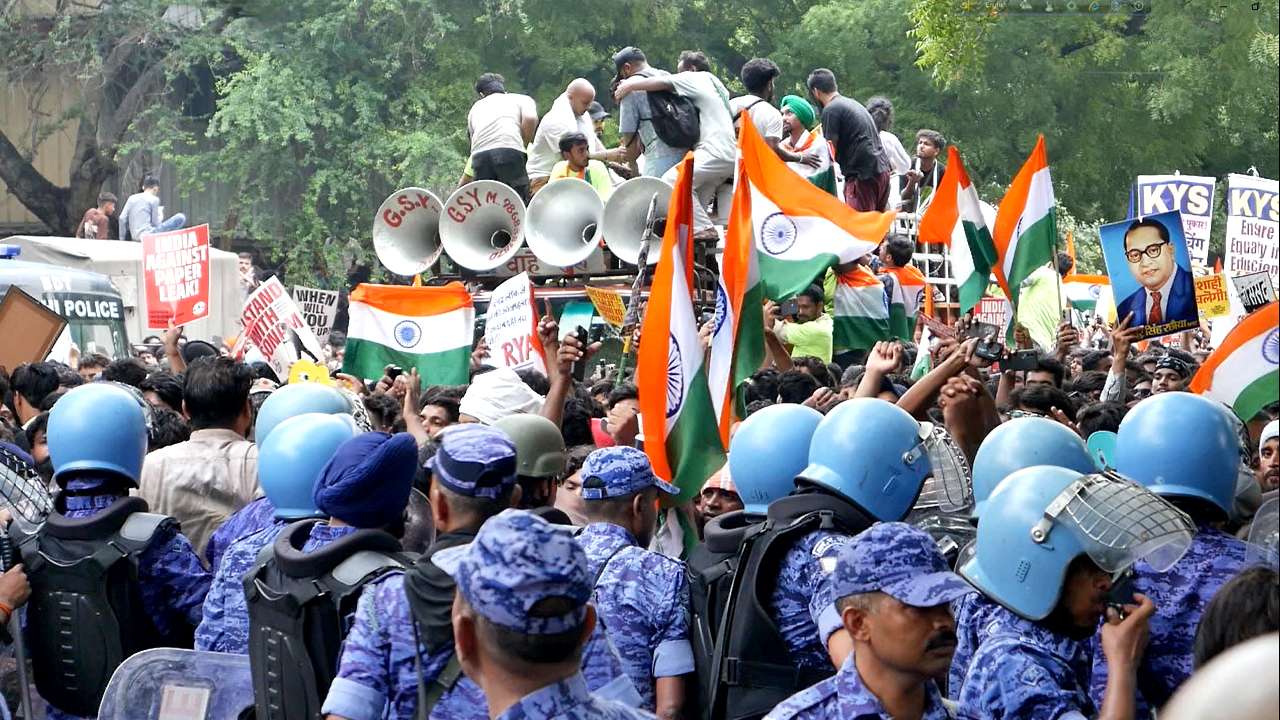
The outrage of over one lakh Indians at 20th July’s ‘Chalo Sansad’ call for Union Education Minister Dharmendra Pradhan’s resignation has exposed the Union government’s strategic urban infrastructure disguised as dormant policing machinery–along with all its violent cracks.
By Mouli Sharma
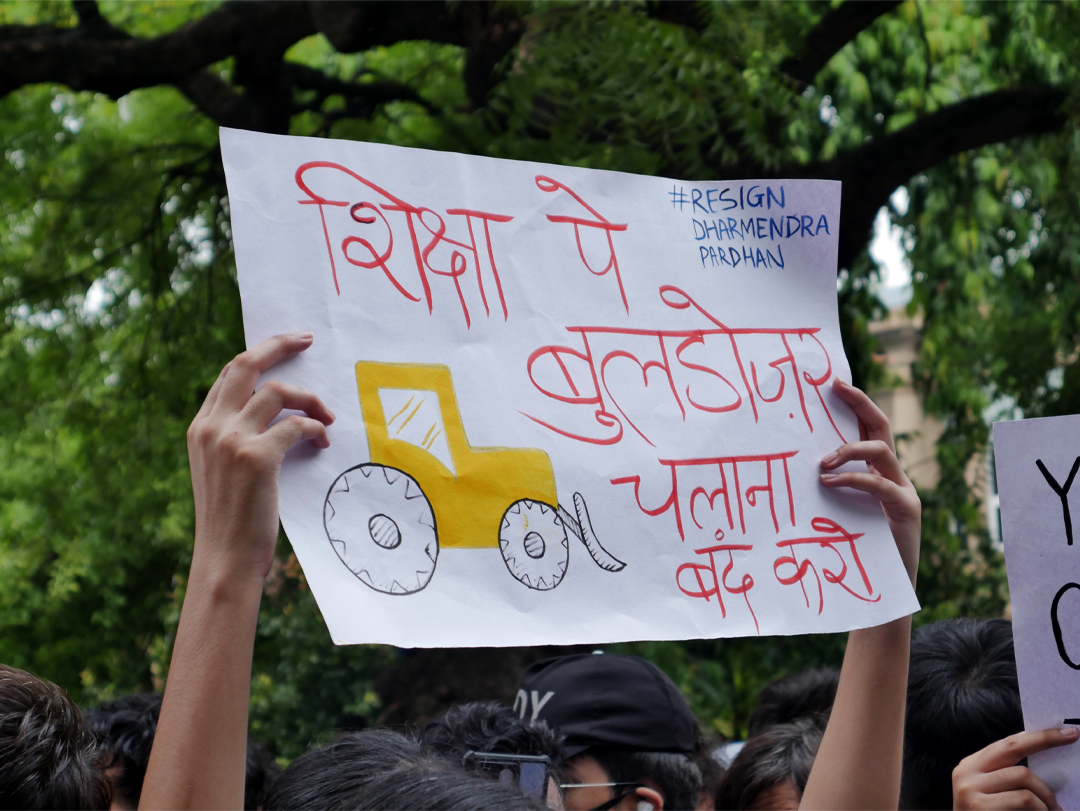
New Delhi, 20 July 2026: Approximately one lakh people took to the streets of Delhi on Monday morning to join the protest call for Dharmendra Pradhan’s resignation, a movement that has gained exponential traction since a satirical outfit named “Cockroach Janta Party” began a pan-India movement for the minister’s removal on 6 June 2026, citing widespread corruption in India’s public education sector.
The movement, which started in the heart of Central Delhi at the capital’s unofficially designated protest space, the Jantar Mantar Road (which has since become its physical base), struck a chord with India’s general populace after one of the movement’s leaders and public faces, Sonam Wangchuk, was forcefully removed from the protest site after 20 days of a historic hunger strike.
The Ladakhi activist had been on an indefinite hunger strike alongside four students of the All India Students’ Association (AISA) as part of 28 day sit-in protest by Cockroach Janta Party and numerous other organisations at Jantar Mantar. Protesters alleged that he was bodily dragged out of his bed at the camp by policemen in plainclothes, hidden behind white bedsheets and detained at the Safdarjung hospital.
The action sparked outrage among supporters and onlookers alike, who flooded social media platforms with messages committing to make the 20 July ‘Chalo Sansad’ march—ahead of which Wangchuk was detained—a success in response to what they viewed as disrespect shown to the senior activist by the Union government and law enforcement agencies. Wangchuk’s spouse, Gitanjali Angmo, revealed that police had gone so far as to interfere with his medical treatment, making her feel concerned for his safety, as reported by the Free Press Journal.
Many, including Angmo herself, believed that Wanchuk’s illegal detention was a strategic move to suppress the momentum behind the march, which was quickly gaining speed even before the alleged abduction of 18 July. But as the morning of 20 July rolled out, it became clear that what happened was the exact opposite.
***
As early as 8:30 AM in the morning, 30 minutes before the march was scheduled to start for the Sansad Bhawan (Parliament) from the protest area at Jantar Mantar, at least five stations on the Delhi Metro’s Yellow Line were shut. The yellow line traverses a significant portion of the Central Delhi region, and is crucial to all intra-city commuters. Lok Kalyan Marg and Seva Teerth (formerly Udyog Bhawan) were among the first stations to be shut, followed in quick succession by Patel Chowk, Rajiv Chowk, and Central Secretariat.
“The train will not stop at Patel Chowk metro station,” announced the Delhi Metro’s broadcasting system at 8:14 AM, just two stations short of its arrival, forcefully rerouting hundreds of protesters and regular office goers alike.
Interchange stations on other metro lines soon followed suit, as Janpath (Violet line) and Barakhamba Road were shut down, essentially turning hundreds of protesters within each station into prisoners.
At the same time, much of Central Delhi—the administrative heart of the Narendra Modi-led Union government—was put on lockdown. Banners announcing the implementation of Section 163 BNSS were hung across Janpath Road, and the entire intravenous road network in the administrative heartland of the nation’s capital was strategically barricaded, turning the city into a spiral of isolated prison chunks.
The main spiral of barricades radiated outward from the movement’s epicenter at Jantar Mantar road, toward which heavy pedestrian traffic was directed with a simple and effective strategy: let them go in, but do not let them come out.
This unidirectional flow (with road and metro movement being severely curtailed) was enforced by through a massive deployment of RAF, which manned each barricaded checkpoint in riot gear, armed with rifles, lathis, water cannons, and trucks full of tear-gas and rubber bullets. Their aim was to draw crowds into the protest site, which was soon becoming a claustrophobic chokepoint doubling as a makeshift detention centre for protesters who were not allowed to advance towards Sansad Marg (Parliament Street), where ministers and senior government officials were sitting cushy.
Huge swathes of crowds that arrived later (nearly 5,000 people were seen at the Charkha Museum in Connaught Place as late as 4PM in the evening; nearly the same number marched from the Kartavya Path police station toward Sansad Marg in batches throughout the day) were isolated within different parts of the city’s administrative centre, breaking an unprecedented number of on-ground protesters into manageable groups.
Internet jammers blockaded the network across a massive 20 square kilometre landmass in the centre of the city, preventing protesters from communicating with loved ones or navigating the complicated maze of policing. Service providers like Jio directly suspended users’ services in the region at the government’s behest, preventing even blind spot regions of physical jammers from being formed, and creating a black hole of communication where real time footage or geo-locations could neither escape nor be used for intercommunication, rendering many people trapped and unable to locate their loved ones if separated.
Every possible measure was taken to intimidate, surveil, and control the outraged public, and the way these measures were aided by the strange neo-architecture of Delhi’s, and possibly India’s, most influential bylanes perhaps makes their design seem not so strange at all. But a simple fact revealed itself on the morning of 20 July: an angry mass is not manageable, no matter how byzantine your city plan may be.
***
At about 8:30 AM, a mob of nearly 200 people forced open the gates at the Central Secretariat Metro Station and spilled directly onto the Rafi Ahmed Kidwai Marg, minutes away from the Indian Parliament. The mob swelled as massive barricading and armed officials ahead of RAF trucks containing long-range tear-gas explosives prevented them from moving ahead, eventually forcing the police to give them way. Interestingly, the police directed people away from the Parliament and onto Raisina Road, on a winding journey toward the locked down protest site.
Similar mobs erupted across the map, making their way to the protest site over the course of the entire day. But approaching 10:00 AM, already past the scheduled time for the march, the trapped mass within the epicentre began to lose patience.
“We forced our way past the RAF team at the South exit of the protest site, toward Sansad Marg,” said a young lawyer whose upper body was littered with injuries from lathi charges and resulting stampedes. “But after every set of barricades there were more. Past every one of them, a round of severe beatings and stampedes. A bike fell over me at one point and people walked over my shoulders and chest till I was on the brink of unconsciousness. I really thought I might die,” she said.
This first group of protesters managed to tear through several radii of barricading, with individuals, mostly women, sustaining brutal injuries largely at the hands of male police officers, many of which were filmed on camera. “The women officers were just standing there holding their lathis, probably so that when we accuse them of what they’ve done, they can fall back on the female RAF team as a defence,” said another protester, yet another young lawyer.
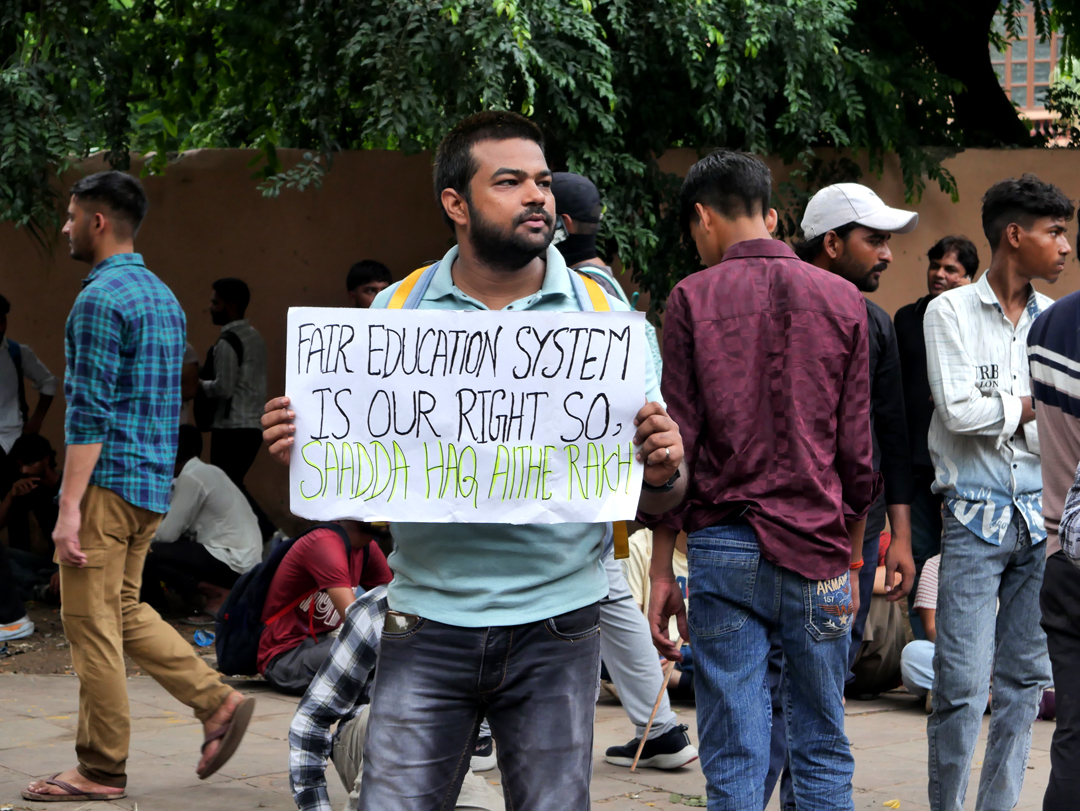
By 12:20 PM, the group had reached the Old Court Building on Sansad Marg, but there they were met with brutal lathi charge and forced into a nearby building under what seemed like threat of police detention. To their surprise, the protesters eventually learnt they were being held inside a bank! An LIC banking office had been turned into a convenient holding cell, where the numerous men and women were held for over an hour without food or even water.
“They shut the blinds so they wouldn’t have to look at us because we were demanding water. Meanwhile the bank workers were serving the policemen with full thalis of food,” said the protester injured in the stampedes, not without humour. “They enjoyed matar paneer as I sat bleeding.”
It was also alleged that 15-20 people were being covertly held inside the Sansad Marg police station. A protester who was separated from her friends during the above mentioned lathi charge said she went in hoping to find them. “They initially denied there was anyone there. But when I insisted, they showed me where the protesters were being held,” she said.
“There were people with head wounds and torn clothes littered across what appeared to be a badminton court inside the police station. My friends weren’t there, but when I asked them why they wouldn’t leave, they told me the police wouldn’t let them.”
***
Back at Jantar Mantar, Chandrashekhar Azad and the Bhim Army attempted to lead a march past the Southern barricading of the main site, toward Kerala Bhawan. This took place around 10:15 AM, and triggered what would become the first of a series of brutal assaults by a heavily armed RAF team ahead of the immediate barricading. Unnamed RAF officials were seen targeting journalists and women, leading to brutal injuries which were heavily photographed and videographed. This journalist saw another fellow-professional (with visible identification) specifically informing the police that he was from the press, which in turn spurred the unnamed officer on, who said, “Saala press se hai, behenchod,” (“Bloody press, motherfucker,”) as he assaulted him anyway, without provocation.
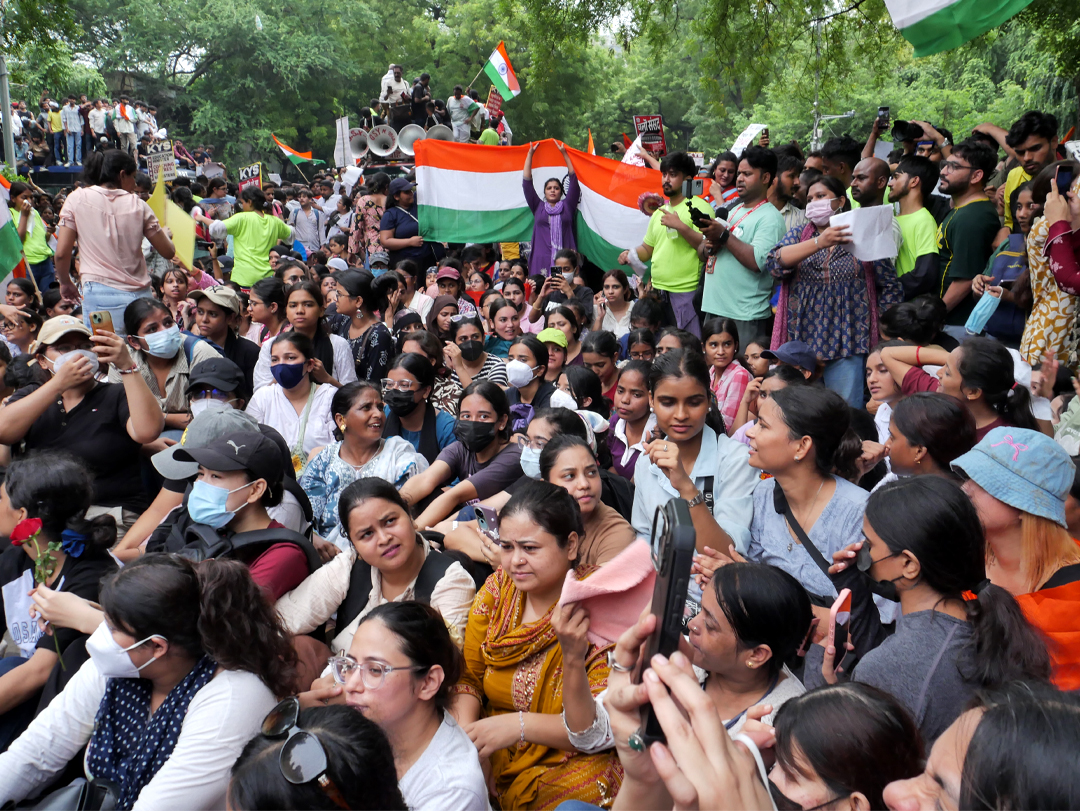
Here at the South end toward the Kerala Bhawan, this cycle of attempting to leave only to be being pushed back by brutal lathi charge would continue till approximately 12:30 PM, after which Abhijeet Dipke (founder and key face of CJP) along with party spokesperson Ashutosh Ranka reached the front of the protesting crowd atop a speaker-adorned truck and began negotiating with the police. The duo held up a copy of the constitution and a photograph of Ambedkar, and asked the protesting crowd to sit down at the site, stating that he would not march past the police barricading without their (the police’s) permission, and requested protesters to “not damage the police’s barricades.”
This essentially brought the South end protest to a complete impasse, at which it remained till late evening.
But unbeknownst to the crowd cordoned off here, all they way at the North end of the site, three rogue leaders from another of the Dharmendra Pradhan resignation movement’s significant factions, the Aam Aadmi Party, managed to break the police’s hold on the path leading to the Janpath Road, and led a mass of over 2,000 protesters straight toward the Parliament. These were Manish Sisodia, Atishi, and Sanjay Singh respectively, the former two of whom have remained the party’s education ministry officials themselves, and academically renowned ones at that.
As per the crowd who followed them, the three were detained near Sansad Marg, where the march managed to reach after breaking at least six layers of barricades and enduring relentless lathi charging. Slippers lined the roads after the crowds passed, leaving behind evidence of the desperation that such stampede-prone crowd channels create–evidently the Delhi Police’s strategy.
Like the first batch of protesters though, this batch too met with the full brunt of the police force’s brutality only once they’d arrived at Sansad Marg around 12:45 PM, from the East end of the Parliament instead of the North, right back at the severe barricading and tear-gas trucks encountered by the mob that tore through the locked exits of the Central Secretariat metro station earlier in the morning.
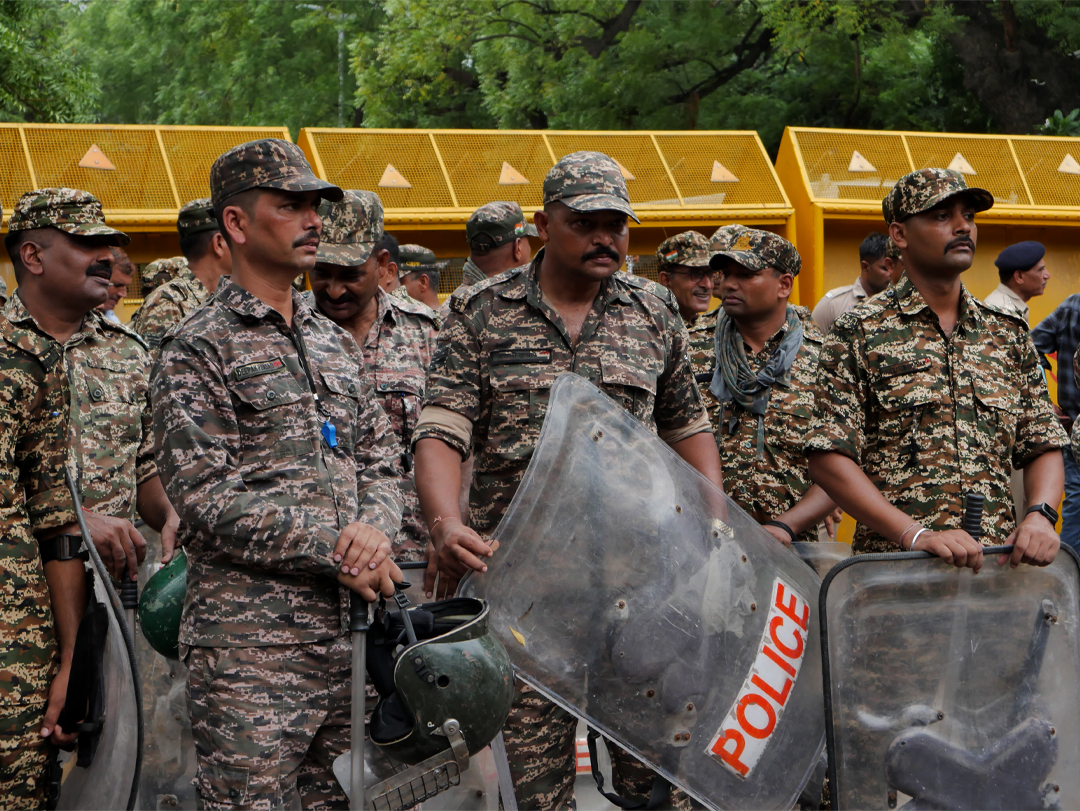
“Their brutality was kicked up to a level we could not imagine. They surrounded us from both sides before we realised it, and began tear gassing us with canisters in the front, and launching long-range tear-gas explosives towards the back so that we couldn’t run anywhere. We were cornered. And then they began to lathi charge,” said Vishnu, one of the many students who barely escaped the violent stampedes that followed with their lives (if not their shoes).
Some protesters alleged that the tear-gas being used, like in the Farmers’ Protests of 2020, was expired, as many canisters captured on film could be seen exploding instead of merely dispersing the gas, causing physical injuries to the protesters far beyond the justified use of tear-gas. It should be noted, that even when used within expiry limits, tear-gas is far from a ‘safe’ method of crowd dispersal.
According to a 2021 study by the Universities of Washington and Minnesota, the claim that tear-gas doesn’t have ‘long-term ill-effects on health’ is entirely unscientific. Tear-gas, or chemical demonstration control agents (DCA), was in fact originally created as a class of weapons to “severely disable or kill enemy troops,” and despite now being banned in war, they continue to be used in domestic policing. Additionally close contact with a malfunctioning/exploding canister can lead to burns and deformities.
The relentless tear-gassing and beatings forced the crowd back and brought this march to an end as well. “They chased us all the way till the Mandi House Metro Station,” which was fortunately functional.
***
These are three instances; littered along the daylong protest spanning 15 square kilometres are dozens, if not hundreds more. From isolated events of police brutality to collective assaults demonstrating the sheer disdain possessed by law enforcement officials for the common man. It is noteworthy that crowd control measures and absurd security protocols may well be justified and explained away in the court of law through bureaucratic formalities (consider the arbitrary implementation of Section 163 deeming every individual in Central Delhi on 20 July essentially a criminal, or the potential entrapment of protesters like in the alleged case of a truck filled with stones being planted near the protest site by police officials themselves, who were caught on camera in a video that went viral in the early morning of the 20th near 2-3AM), but there is much else that cannot be explained.
The numerous instances of abuses being hurled at protesters as the police attacks them–often unprovoked–with visible glee, the bald faced manipulation of herding people like a flock of sheep into enclosed spaces without exit, the protecting of millionaire politicians while discarding the democratic rights of working class citizens like childish entitlements; the turning of their city into a waking prison, speak clearly that whatever the legal jurisdictions of the police may be (or be made out to be), their politics is one of contempt toward the common man. Their classification as public servants is a misnomer at best and a propagandistic lie at worst: it is clear who they serve, and it is not those at the receiving end of their batons.
***
Whatever these notes from an historic day may reveal about the architecture of the modern, urban republic–how roads, trains, and subways are as much tools of controlling and preventing public movement as they are in aiding it, how network providers’ business deals with the government in power transfers digital freedom from a consumer right to a loaned privilege that may be revoked whenever the powers that be please; how no one is free till everyone is free–they also reveal something much simpler. A truth about anger, mobs, and a history lesson condemned to be forever retold: life, no matter how small, will defend itself, and a beaten people, no matter how beaten, will fight back.
As briefly mentioned earlier, at around 4PM outside the Charkha Museum near Connaught Place, a free moving crowd of wandering protesters began to gather and swell. The crowd was unorganised and leisurely, most sitting alongside the Museum’s outer boundary, or shouting slogan and song from the footpaths, non-violent by even the most sensitive of definitions—read: those that substitute state property for civilian life as victims of ‘violence’—as there was no barricading in the region. Despite this, police vans quickly arrived at the location alongside a truck containing the formerly mentioned long-range tear-gas explosives, and began firing them into the crowds relentlessly.
Shops around the market—those that had remained open, anyway—began to shutter themselves closed, yet again trapping customers inside as shopkeepers feared victims of the tear-gassing would run inside for shelter. With the exception of a few open pharmacies, most operating businesses in the region were hostile to the working class public, opening doors only to the wealthier sections of the protesting crowd regardless of the need for sanctuary.
(Dominoes is a noteworthy exception. According to Namita (name changed), an artist who went there after leaving the protest site along with two other friends, she and her party were outright refused service due to their participation in the protest. It should be noted that Dominoes is also one of the more significant targets of the BDS movement due to their, “openly supporting apartheid Israel and/or [providing] generous in-kind donations to the Israeli military amid the current genocide.”)
Upwards of 20 tear-gas explosives were fired back to back in less than 45 minutes, and with nowhere to escape, the already dispersed protesters and even unsuspecting passersby formed a massive road blockade near the LIC building on the same stretch, a huge crowd of at least 5,000 people. People could be seen flocking to tea stalls for water and helping each other wash the chemical out of their eyes. Someone, unidentified, threw a rock, and all hell broke loose.
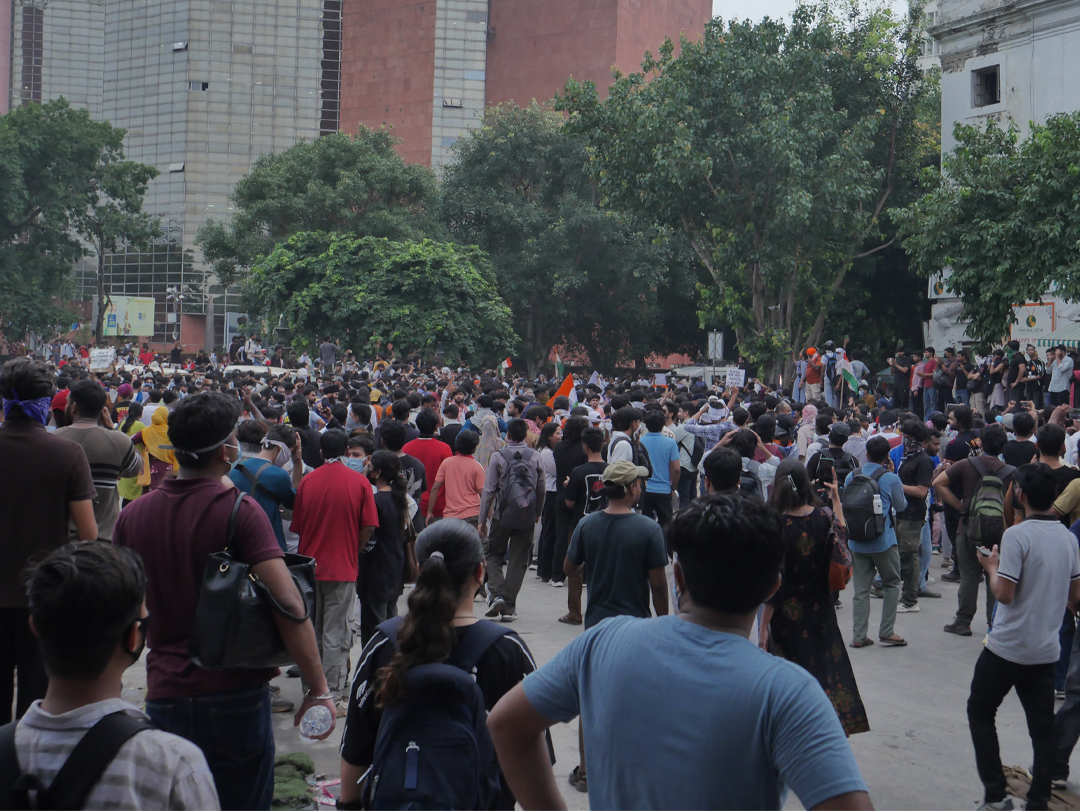
Stone-pelting and a brutal lathi charge ensued, pushing the crowd back toward the Charkha Museum and into the CP Main Circle. Someone, unidentified, smashed the window of a police car.
I will add here that in addition to the viral video of the planted truck full of rocks from early morning of the 20th, there are also videos from today’s protest, especially around the main protest site, that explicitly show police officers throwing stones at peaceful protesters trapped behind barricades. Near the Old Court Building where the first march met with its end, people filmed little children who had climbed onto trees to throw rocks and provoke crowds (and the police) who were alleged to be hired by the BJP-RSS nexus.
“We know they do this, we know they hire men to disrupt protests” said Rinky, who produced several videos of the alleged goons to the reporter for review. “But it was horrifying to see how young they were. Some of these boys looked no older than 12,” she said. So there are many contending narratives around who initiated any alleged violence, and the only confirmed record is that of the police doing so themselves.
I wish to make a comment here, as reporter, citizen, conscience-haver—whatever feels most convenient. Opinions are usually relegated to the outside of my reports, but I feel compelled to express this one here, if only due to the fact that in certain frequencies, opinions have a mischievous habit of turning into facts, or at least things that feel like them, and countering them becomes a factual endeavour of its own: There is no such thing as a peaceful protest.
In the 1968 documentary, Tell Me Lies, renowned civil rights activist Kwame Ture said the following about the historic movement against racial segregation in the United States: “Peace isn’t the answer.”
“Liberation is the answer,” Ture said. “That’s what you should talk about, never peace. That’s the white man’s word, ‘peace.’ Liberation is our word.”
As the night rolled around, many things had happened in the relatively small region of conflict that is Central Delhi for a relatively small demand that just so happened to become something relatively very large indeed. Dipke was detained from atop the truck near the Kerala Bhawan, released, forcibly removed from the protest site along with everyone else there, and eventually managed to make his way back inside for the night after having announced that the protest will go on, till the demands for Pradhan’s termination are met in full.
In the afternoon, he’d announced that he would call off his hunger strike upon request from Sonam Wangchuk for him to do so. Little information arrived from authorities regarding statistics of arrest, detention, or injuries—and in all fairness, they surrendered all journalistic privileges surrounding the ‘right to response’ the minute they struck card-carrying reporters in the face while hurling abuses at the very idea of free press.
The point is, it doesn’t matter who threw the rocks. There is no peace in the picture when one lakh people have to take to the streets to demand the termination of a minister who forms part of an allegedly democratically elected government cabinet. There is no peace in the picture when cellular networks, public transport, and the country’s very own public education sector is sold to private corporations or societies without parliamentary decree to return crores of profits like a vintage car being stripped and sold for parts. There is no peace in the picture when 20 children are dead because killing themselves is preferable to taking a government exam.
But the bigger point is, that peace is not the point at all. Peace is a white man’s word in a country that has exchanged colonial bureaucracy for a homemade substitute. The point, is liberation.
May the city be set free.
Mouli Sharma is an author and journalist from New Delhi. She has been featured in publications like The Mooknayak, GroundXero, Frontline, Maktoob Media, The Observer Post, The Leaflet, Nivarana, The Polis Project, Article 14, NewsClick, SabrangIndia, Think Global Health, etc.