
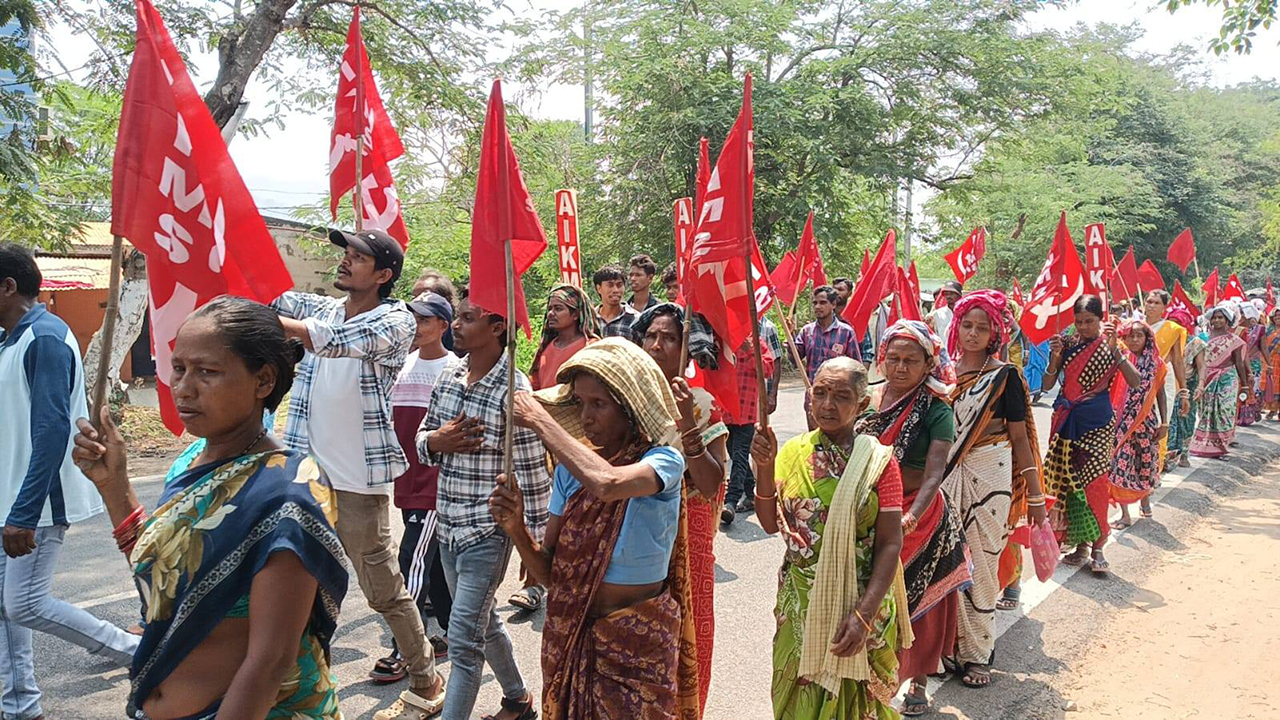
The release of Umuri Majhi after 68 days in jail brings renewed attention to the struggle unfolding in the Sijimali hills of Kalahandi. Her experience reflects the hardships faced by Adivasi communities resisting bauxite mining and defending their land, forests, and livelihoods.
Dwit David Philip
Kumerdei Majhi, whose official name is Umuri Majhi according to her Aadhaar card, hails from Talampadar village in Thuamul Rampur block of Odisha’s Kalahandi district. She spent 68 days in jail in connection with an alleged offence that is yet to be proven in court. While in prison, particularly after the release of nine other women co-accused, she appeared visibly distressed and withdrawn. Following her release, however, she has regained her smile.
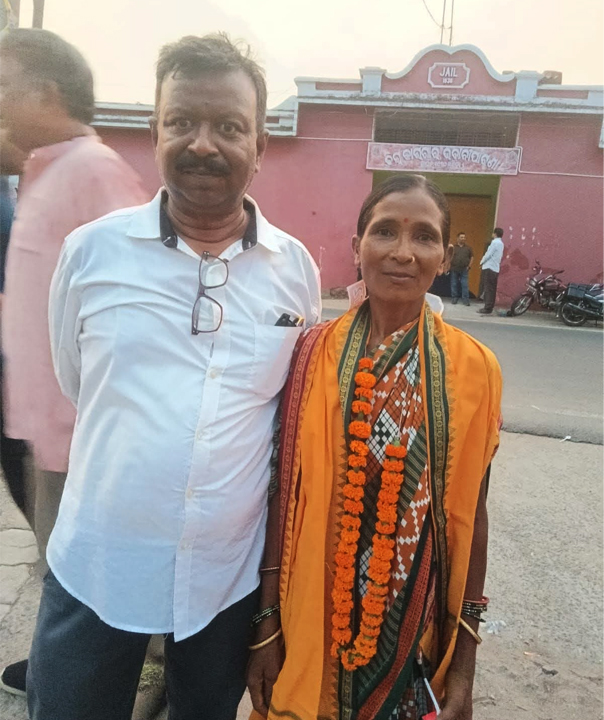
Umuri Majhi with advocate David Philip after her release from jail.
As her advocate, I visited her home to understand her experience and that of the co-accused, while also reflecting on the psychology and emotional condition before and after their release.
Her story offers a glimpse into the realities of contemporary India — its police, companies, and politicians — where forest-dwelling communities often feel that their lives and livelihoods are being sacrificed in the name of “Viksit Bharat.” These are Indians who may not identify with Sanatanism, Hindutva, or political democracy in conventional terms, yet remain equal citizens under the Constitution of India, possessing Aadhaar cards, voter identity cards, and all the rights guaranteed to Indian citizens.
It is felt that legal action should be considered against the police for recording her as Kumerdei Majhi, whereas her actual identity, as per the Aadhaar card, is Umuri Majhi. At her home, she offered Mandia (ragi) sarbat, the only drink she had, serving it with a warm smile.
This is not merely a story about events that unfolded on 23 May 2026. It reflects a deeper pain — a human tragedy in independent India, where political parties across the spectrum like BJP, Congress, BJD, and all of us, in one way or another share responsibility for failing to ensure justice reaches every corner of the country, while becoming opportunistic consumers and beneficiaries of corporate interests. Meanwhile, communities such as those in Talampadar continue to fight for survival, often in isolation.
The company is presumed by many villagers to be behind the arrests, because the real conflict lies between mining companies and the indigenous inhabitants of Talampadar and the 52 neighbouring villages likely to be affected by the project. The incident involving villagers attacking an alleged company dalal appears to be just a triggering point; the conflict itself has a long history.
Many villagers believe that corporate interests lie behind the arrests because the underlying conflict is between mining companies and the indigenous inhabitants of Talampadar and the 52 neighbouring villages likely to be affected by the project. The alleged assault on a local intermediary may have triggered the immediate police action, but the conflict itself has a much longer history.
Many among us are concerned and making small efforts to support the villagers, but it is not enough, because the effects of mining are far-reaching and multi-fold.
According to villagers and activists, the struggle over the Sijimali hills has unfolded over several years. The chronology of events suggests that L&T had once attempted to take control of the Sijimali range and its villages. With villagers, activists and NGOs, protested and eventually resisted the company’s efforts. Now, according to villagers and certain documents, Maitri and Vedanta are seen as the companies involved, obtaining permissions from gram sabhas, government departments, and securing support from political leaders, administrative systems, and police, while attempting to silence and suppress opposition.
Whether these companies succeed or fail in mining, NGOs, activists, media, authorities, and intermediaries may all gain recognition in different ways. Yet the imprisoned villagers remain the true sufferers, even if mining ultimately is halted. Jail means punishment, confinement, and disruption of the cohesive social life of the Tribal and Dalit communities, many of whom survive with or without formal land ownership documents. Families lose their means of livelihood. Sources of survival are disrupted. These villagers depend on agriculture, forest produce, and small local businesses for food and income. Separation from family members inflicts lasting psychological trauma on both prisoners and their communities.
Kumerdei Majhi @ Umuri Majhi was imprisoned along with her son and daughter. Her house lies at the edge of Talampadar village, close to the forest and Sijimali hill. It is difficult to imagine that she crossed nearly 150 houses at night to attack someone in another hamlet. She, along with her son and daughter, was arrested on March 10 midnight by police from the Karlapat PS located around 10–15 km from the village. Based on reports from co-villagers, despite names not appearing in the FIR, arrests were reportedly made merely on suspicion.
Today’s India appears increasingly influenced by companies. They renovate roads in remote villages and brand government hospitals and schools in their names. Yet after mining operations end, the names, logos, and facilities often disappear as well. Outsiders frequently become landholders, businessmen, and owners of schools and hospitals. Prices rise sharply. Locals often become mere consumers, customers, servants, helpers, cleaners, and support staff. Environmental pollution increases, while dependency on alcohol, medicine, junk food, and disruptions in social life follows.
Yesterday, Bhawanipatna experienced temperatures of 42°C, while Talampadar remained below 30°C. Reflecting on her experience, Kumerdei Majhi says, “In jail everything was hot — police, food, room, bed, toilet, toiletries, garments — everything burned my life and soul. No ragi/mandia was available to cool me. Now I feel cool here, and I do not want to go to jail again.”
Yet the struggle over Sijimali appears far from over. Villagers continue to march from one settlement to another, raising the slogan: “Sijimali amarta, naise eta kahar buarta” (“Sijimali belongs to us, not to anyone else’s fathers.”).
Meanwhile, police surveillance of protests remains intense. Villagers maintain that their struggle is fundamentally about protecting their land, forests, and future. The full story of the conflict—and the role played by the state, corporations, and local communities—will ultimately be judged by time and by history.
Dwit David Philip is an advocate, Bhawanipatna, Kalahandi, Odisha.