
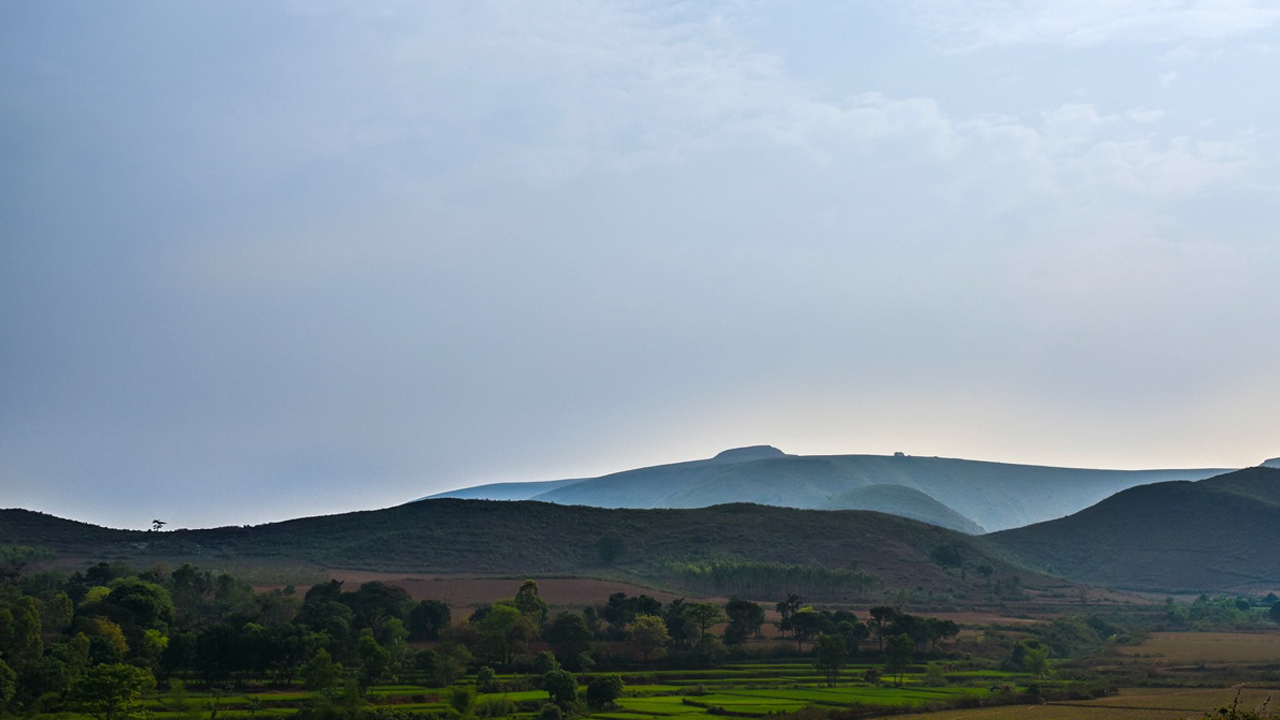
Amid escalating protests and allegations of police repression in Odisha’s mineral-rich tribal regions, the state’s push to fast-track bauxite mining projects in the Eastern Ghats has intensified. Even as questions mount over consent, legality, and environmental impact, key constitutional institutions have remained largely unresponsive, deepening concerns among affected local communities.
A day after the alleged state repression against tribal residents of Kantamala village related to the Sijimali Bauxite Block, in which about 70 persons reportedly sustained injuries, and amid widespread unrest across the Eastern Ghats, the Odisha State Pollution Control Board, issued three notices on 8 and 9 April 2009 for conducting public hearings on the neighbouring Kutrumali Bauxite Block and Kodingamali Bauxite Mine; The Tribal Advisory Council (TAC), the Governor, and the President remained unresponsive.
Bhubaneswar | April 22, 2026
By Prakash Kumar Samantsinghar
A day after the alleged pre-dawn brutal and inhuman police attack on 7 April 2026 against tribal residents of Kantamala village in Kashipur block of Rayagada district—reported to have resulted in injuries to around 70 people and linked to road construction for the Sijimali mining project by the Vedanta Group (operated by Mythri Infrastructure and Mining India Private Limited)—the State Pollution Control Board, Odisha issued Notice No. 5333 dated 08 April 2026. The notice announces the rescheduling of a public hearing to 13 May 2026 at 10:00 AM at the Kashipur Block Office premises in Rayagada district, in place of the earlier date of 24 April 2026 at 10:00 AM at Dharada High School, Odia Pentha. The hearing pertains to the grant of environmental clearance by the Ministry of Environment, Forest and Climate Change (MoEF&CC) for the proposed mining operations in the Kutrumali Bauxite Block by the Adani Group, operated by Kalinga Alumina Limited, in accordance with its submitted Environmental Impact Assessment (EIA).
Why Is Kutrumali in the Spotlight Following Sijimali, and What Are the Underlying Reasons?
The Sijimali Bauxite Block, with an estimated reserve of 311 million tonnes of bauxite, is situated across 18 villages—10 (Tijmali, Chulbadi, Ambajhola, Mahajal, Nakrundi, Taramundi , Upper Salebali, Tadadei and Tal Ambapadar) in the Thuamul Rampur tehsil of Kalahandi district and 8 (Malipadar, Dumerpadara, Katibhata, Kutamal, Pelanakona, Aliguna@Aligana, Bundel, Shagabari@Sagaban) in the Kashipur tehsil of Rayagada district—and the Kutrumali Bauxite Block , with an estimated reserve of 127.737 million tonnes, is located across four villages—Kutrumali, Lelingapadar, Rakhigurha, and Bhikapanga—within the tehsils of Thuamul Rampur and Kashipur in the districts of Kalahandi and Rayagada, respectively. Both the Sijimali Bauxite Block and Kutrumali Bauxite Block lie within areas notified under the Fifth Schedule of the Constitution of India.
The Sijimali Bauxite Block area extends over approximately 1,548.79 hectares, comprising 722.9 hectares of government land, 699.7 hectares of forest land, and 127.9 hectares of private land, and lies within an ecologically sensitive zone containing 21 Reserved Forests and 9 water bodies within a 10-kilometre radius. This land is a sacred abode of Tij Raja, the supreme deity and spiritual presence for the Kondh community. Two Kondh villages of Malipadar and Tijmali sit on this land that is the peoples’ grazing land, source of livestock, fuel wood, medicinal plants, sacred groves and burial grounds, and water streams.
The Kutrumali Bauxite Block spans an area of 701.792 hectares, of which 198.847 hectares is classified as forest land and it lies within an ecologically sensitive zone that mandates the Specific wildlife conservation plan for the Schedule–I species as per the Wildlife Protection (Amendment) Act, 2022.
The Sijimali Bauxite Block was allotted to the Vedanta Group (operated by Mythri Infrastructure and Mining India Private Limited) pursuant to a Letter of Intent (LoI) dated 1 March 2023, and Kutrumali bauxite block was allotted to Adani Group (Kalinga Alumina Limited formerly known as Mundra Aluminum Limited) pursuant to a Letter of Intent (LoI) dated 27 February 2023 issued by the State of Odisha under the government led by Naveen Patnaik, following an open and competitive bidding process. Thereafter, the tribal Chief Minister, Mohan Charan Majhi, has been accused of promising to hand over the jami, jal, jangal, (Land, Water & Forest ) and natural resources (Ratna Bhandar) of Adivasi communities to corporate interests, effectively enabling their exploitation.
Biswapriya Kanungo, an eminent human rights defender, states that the Ministry of Environment, Forest and Climate Change (MoEF&CC), Government of India, had initially deferred granting Stage-I environmental clearance for the Sijimali Mining Project. However, despite receiving complaints from affected local tribal communities, the State Government recommended the project to the Union Government for Stage-I clearance on the basis of a report prepared by the concerned District Collector, which claimed that there was no opposition and that local communities had unanimously consented to the project.
He further alleges that the recommendation of the Rayagada Collector was based on false, fabricated, manufactured and misleading information. According to him, such actions by the Collector and other officials involved in preparing the report may attract penal provisions under applicable laws, including Section 7 of the Forest Rights Act, 2006. He also contends that the entire process undermines the fundamental spirit of the Gram Sabha as envisaged under the Panchayats (Extension to Scheduled Areas) Act, 1996 (PESA) and the Forest Rights Act, 2006.
He reiterates that the report failed to reflect the ground reality. The Union Government subsequently granted clearance, reportedly taking into account the project’s significant revenue potential. He further questions both the State and Union Governments as to why they have not initiated steps to revoke the Stage-I clearance, despite the strong and sustained opposition from the affected communities.
He added that on the other hand, innocent tribal citizens who raised their voices—peacefully and in a democratic manner—for their constitutional and statutory rights have been criminalized by the state. False and fabricated cases have been registered against them, and police force has been used to suppress and silence their dissent. The state has also been surveilling them using drone cameras to track their movements and facilitate arrests. As a result, they live in constant fear, and their privacy has been severely compromised—so much so that tribal women are unable to bathe in nearby water bodies with dignity and without apprehension. He stated that this reflects the grave extent of human rights violations involved, particularly as state authorities are allegedly using coercive measures to obtain the consent of the Gram Sabha in furtherance of corporate interests.
Absence of Clear Provision for Permanent Employment of Affected Villagers
As per the Executive Summary of the projects, the Sijimali Mining Project and Kutrumali Mining Project are expected to generate direct employment for approximately 600 and 246 persons, respectively. However, this is subject to the condition that preference will be given to local candidates based on prescribed requirements and eligibility criteria. This raises concerns that many local tribal individuals may not be able to access these opportunities, as they may not meet the company’s qualification and experience requirements.
Furthermore, the Executive Summary does not clearly specify how many of these positions will be permanent versus temporary, nor does it indicate the proportion of employment that will be offered to individuals from the directly affected villages. Thus, there is no clear assurance of permanent employment for affected villagers.
At the same time, the Kutrumali Project indicates that more than 300–350 people may benefit from indirect employment opportunities. The document highlights potential avenues for such opportunities, including transportation, workshop establishment, petty contracts, horticulture, and small commercial enterprises such as shops and canteens.
Despite these stated provisions, local tribal villagers and activists have raised concerns that the projects may not ensure meaningful or adequate employment opportunities for the affected tribal communities.
Numerous violations in Eastern Ghat including Sijimali mining projects and Community Response
Numerous violations have been reported, as per the findings of a study report published by the Human Rights Lawyering Clinic at the National Law School of India University, Bengaluru, in April 2024 titled “Under the Surface: Human Rights and Environmental Implications of the Proposed Sijimali Bauxite Mine in Odisha” and key clearances are still pending.
In the neighbouring areas of Sijimali, tribal and Dalit communities from 83 villages surrounding Serubandha Hill in Koraput district have continued their resistance under the banner of Serubandha Parvat Surakhya Samiti (SPSS) since 2015. The movement further intensified after National Aluminium Company Limited (NALCO) received permission to undertake mining operations in 2024. Villagers from 59 villages across six Gram Panchayats—namely Kotia, Nuagaon, Maliput, and Pottangi under Pottangi Block, as well as Khudi and Sorishapadar under Semiliguda Block in Koraput district—have been staging sustained protests at Purunapadar Square. Since 6 April 2026, they have reportedly been guarding the site round the clock to prevent construction of a road for mining or any mining-related activities. The protest includes voices and slogans stating “Ladhenge Jitenge (We will fight, We will win)” and “NALCO Go Back” with threats stating no kind of natural resource mining would be permitted, irrespective of whatever may come.
Further, the local tribal community of Lanjiberna in Sundargarh district has been continuing its protest for over two and a half months against the alleged “illegal” expansion of mining activities by corporate giant Dalmia Cement (Bharat) Limited. On 28 March, tensions escalated when protesters reportedly broke through barricades following reports that the company had resumed excavation on agricultural land.
Similar resistance is being witnessed among tribal communities in Patna (Keonjhar), Mali Parbat in Similiguda, and Nageswarimali in Nandapur, as well as in several other parts of the Eastern Ghats. These regions fall under the Fifth Schedule of the Constitution of India, where communities continue to assert their constitutional and customary rights over land and resources.
However, concerns have been raised that state authorities have proceeded to grant project approvals in the interest of corporate entities through allegedly fabricated Gram Sabha processes, in violation of the Panchayats Extension to Scheduled Areas (PESA) Act 1996 and the Forest Rights Act 2006, both of which mandate prior and informed consent of local communities before any such project is approved.
Amid growing resistance from tribal and Dalit communities across the Eastern Ghats—often described as the “Aravalli of Odisha” by activists—the situation has escalated into widespread unrest, particularly in the Sijimali Hills region. Delegations from major political parties, including the Biju Janata Dal, Indian National Congress, and several Left parties, have visited affected areas, engaged with local communities, conducted fact-finding inquiries, and submitted reports to constitutional bodies and authorities such as the President of India, the Governor of Odisha, Chief Minister Mohan Charan Majhi, Union Tribal Affairs Minister Jual Oram, and the state’s Director General of Police. Subsequently, a delegation of senior leaders from the ruling Bharatiya Janata Party, led by Nabarangpur MP Balabhadra Majhi and including MLAs Raghuram Machha, (Koraput), Rupu Bhatra (Kotpad), and Sudhir Pattjoshi (Dharmagarh), visited Kantamal and Sagabari villages in Rayagada on 15 April 2026 to engage directly with affected communities. These developments highlight the intensity of opposition, with local residents firmly resisting mining activities and declaring that they will not allow their land to be accessed for mining under any circumstances; however, despite these interventions, the issue remains unresolved.
Constitutional institutions remain unresponsive to tribal concerns
As Chairperson of the Tribal Advisory Council(TAC)—and concurrently holding the Home portfolio—the tribal chief minister and self proclaimed “Lokank Sarakar (Peoples’ Government)” has also been criticised for failing to address alleged police repression against tribal communities across the state. It is alleged that the tribal Chief Minister failed to protect the rights of tribal communities in the state, as he did not order an independent inquiry into the matter.
Further, the Governor serves as the custodian of Fifth Schedule areas, while the President of India exercises supervisory authority over their administration under Article 244(1) of Constitution of India. However, it is alleged that neither the Governor nor the tribal President of India, Draupadi Murmu has intervened to date or ordered a probe into these concerns.
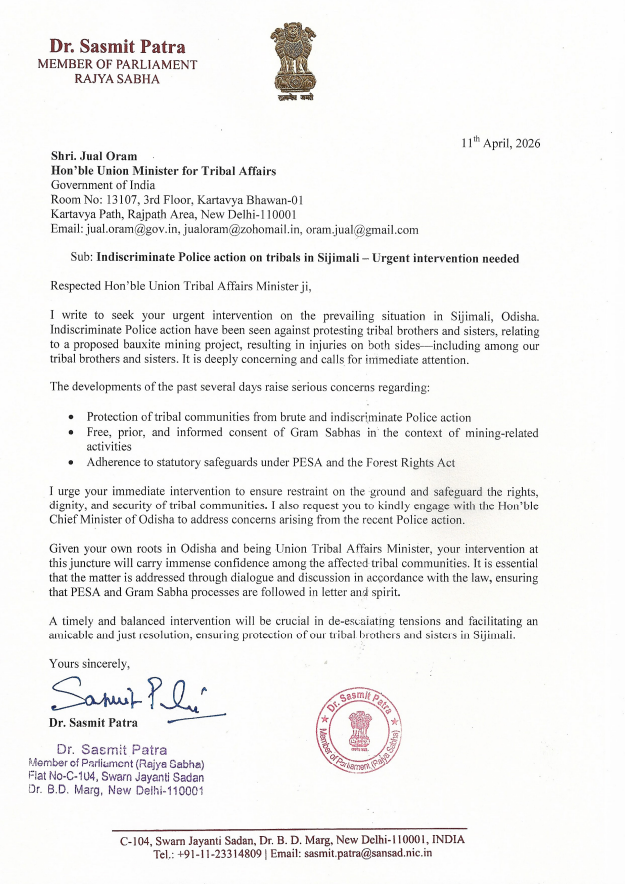
In addition, it is alleged that Union Tribal Affairs Minister Jual Oram has failed to intervene in the reported police repression in Sijimali and to safeguard the rights of tribal communities in the state, as no action was reportedly taken despite his having received a letter dated 11 April 2026 from BJD Rajya Sabha MP Sasmit Patra.
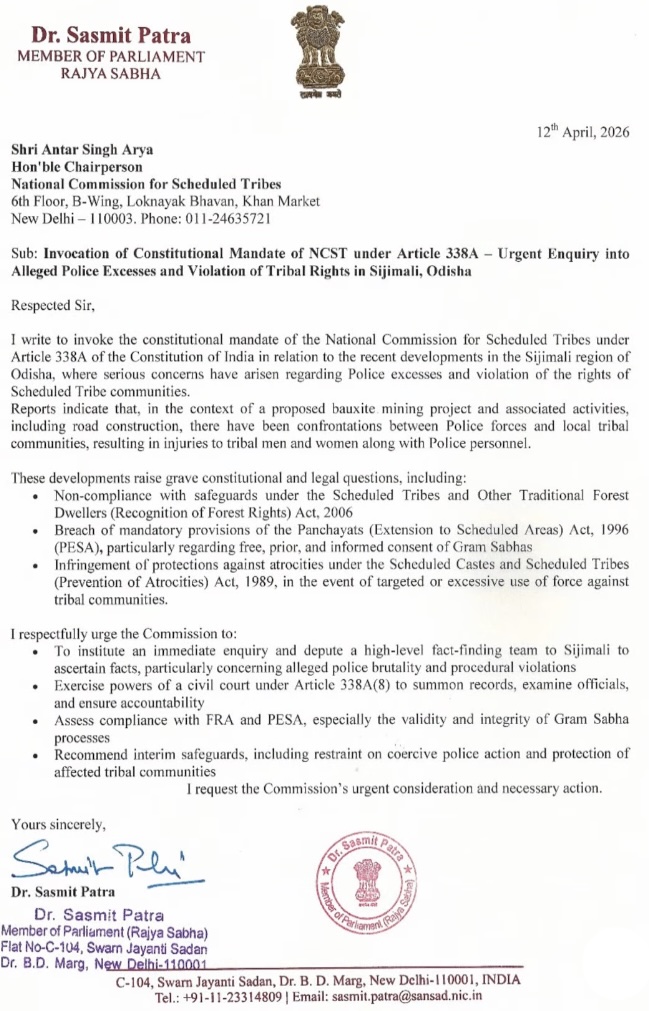
The following day, on 12 April 2026, Patra filed a Petition with the National Commission for Scheduled Tribes (NCST) seeking an inquiry into the Sijimali matter. He urged the Commission to immediately institute an independent enquiry, invoke its powers under Article 338A(8) of the Constitution to summon records and officials, review compliance with the FRA and PESA in connection with the road and bauxite mining project, and recommend urgent interim protections for the affected tribal families.
Subsequently the NCST registered a case after admitting the petition. During his meeting with Shri Antar Singh Arya, Chairperson of NCST, on 20 April 2026, Arya assured that appropriate action would be taken, including issuing notices and seeking responses from the concerned authorities. He further indicated that a senior-level fact-finding team is likely to be deputed to Sijimali shortly and added that he would personally hear the matter. The developments are being closely watched in political circles in Odisha.
In the meantime, on 18 April 2026, Malvika Devi, a Member of Parliament (Kalahandi) from the Bharatiya Janata Party (BJP), has written to Union Minister of Coal and Mines, G. Kishan Reddy, highlighting the “ongoing disturbance” in the Sijimali region spanning Kalahandi and Rayagada districts. She has urged the Union Minister to review the clearances granted for the controversial Sijimali Bauxite Project amid continuing tribal protests in Odisha. There has been no immediate response yet from the Union Minister of Coal and Mines G. Kishan Reddy.
The apparent lack of action has led to criticism that most government bodies—including constitutional and regulatory institutions —remain unresponsive to tribal concerns.
Odisha Pollution Control Board Reschedules Kutrumali Hearing and Announces Multiple Hearings for Kodingamali Amid Unrest in Tribal Regions
In this context, the decision of the Odisha State Pollution Control Board (OSPCB), to issue a notice dated 08.04.2026 announcing the rescheduling of the public hearing within a short period has raised serious concerns. It has prompted questions as to why, amid prevailing tensions and widespread opposition, the State Government appears to be expediting the public hearing process to facilitate environmental clearance from the Central Government for a private company such as the Adani Group.
In addition, the State Pollution Control Board, without providing any reason, rescheduled the public hearing originally fixed for 24.04.2026 at 10:00 AM at Dharada High School, Odia Pentha, in Koraput district. The hearing has been deferred to 16.05.2026 at 10:00 AM and relocated to Champi High School, Champi (GP), under Laxmipur Block of Koraput district. This change was notified vide Notice No. 5354 dated 08.04.2026 in connection with the grant of environmental clearance by the Ministry of Environment, Forest & Climate Change (MoEF&CC), Government of India, for the expansion of bauxite production at the Kodingamali Bauxite Mine by M/s Odisha Mining Corporation Limited, in accordance with its submitted Environmental Impact Assessment (EIA).
Further, on the following day, the Board issued another notice (Letter No. 5525 dated 09.04.2026) concerning the same Kodingamali Bauxite Mine, announcing an additional public hearing to be held on 15.05.2026 at 10:00 AM at Ashok Kalyan Mandap, opposite GCD High School, Rayagada, in Rayagada district.
The findings of a case study report by research scholar of Department of Sociology, Utkal University, Vani Vihar, Odisha which is published by the International Journal for Multidisciplinary Research (IJFMR), in Jan-Feb 2026 titled “Impact of Mining on Health: A Case Study of Kodingamali Bauxite Mine, Koraput” reveals that mining activities in the Kodingamali region are associated with changes in water, air, land, and community life that have implications for local health. Water pollution has increased concerns about water-borne diseases and skin problems. Air pollution from dust is linked to respiratory difficulties among residents. Agricultural decline and environmental degradation have reduced food production and affected livelihood security, which may influence overall health and nutrition. In addition, livelihood uncertainty and environmental changes have contributed to psychosocial stress within the community. Overall, the findings suggest that the impact of mining on health is not limited to one factor but is connected to environmental and social conditions. Strengthening environmental management and improving access to healthcare services may help reduce health risks in mining affected areas. The study underscores the need for stronger environmental regulation, community-focused health interventions, and inclusive development policies in mining-affected tribal areas.
This may be one of the reasons local communities are opposing the expansion of the Kodingamali Bauxite Mine, and why government authorities including regulatory body (OSPCB) are proceeding with the public hearing without routing it through the Gram Sabha, amid unrest in the Eastern Ghats region.
Fear and Police Presence May Suppress Public Participation
Critics have alleged that these actions signify that the State is advancing mining projects at a time when the Eastern Ghats region remains tense. They contend that many affected persons may refrain from attending the public hearings due to fear of arrest in allegedly fabricated cases. It is further argued that conducting multiple hearings could result in lower recorded participation, thereby enabling the authorities to report reduced local opposition. According to these critics, such arrangements may fragment community participation, whereas a single, consolidated hearing would allow people to express their views more freely and collectively. Allegations have also been made that the regulatory process is being carried out under significant police presence.
Prafulla Kumar Samantara, an environmentalist and convenor of Lokashakti Abhiyan, has strongly opposed the move of the regulatory authority. He has written to the Member Secretary of the State Pollution Control Board, Odisha, raising the above concerns.
In his letter, he requested the Board not to conduct the public hearings at a time when local villagers are reportedly living in fear due to alleged police repression. He further urged that the hearings be scheduled in a manner that ensures meaningful participation, allowing people to express their views freely and collectively. He also called for the venue to be fixed at a location accessible to people from all affected areas so that they can attend without having to travel long distances.
He further alleged that both the Sijimali and Kutrumali bauxite projects were approved without conducting Gram Sabha proceedings. He contended that proceeding with public hearings without obtaining the free, prior, and informed consent (FPIC) of the Gram Sabha renders the exercise ineffective, as it bypasses the statutory role of Gram Sabha under PESA Act 1996 and FRA 2006. Activists alleged that this reflects reluctance on the part of the government and regulatory body to ensure a genuinely free, fair, and transparent Gram Sabha and public hearing process.
CAG Report Flags Major Irregularities in Land Acquisition in Scheduled Area
The Comptroller and Auditor General (CAG) of India has prepared a report for the financial years 2017–18 to 2021–22 for submission to the Governor of Odisha under Article 151 of the Constitution of India, for being laid before the State Legislature. The report presents significant findings from the Performance Audit of Land Management in the Scheduled Areas of the State. The audit reveals that, although obtaining the prior consent of the Gram Sabha is a pre-requisite for acquisition of land in Scheduled areas, in 126 (43 per cent) out of 294 Land Acquisition cases, preliminary notifications for acquisition of land had been issued without conducting Gram Sabha meetings, conducting Gram Sabha meetings without the requisite quorum, in the absence of consent of Gram Sabha and by means of post facto conduct of Gram Sabha meetings.
Thus, it may be concluded that the concerned state authorities in Odisha, allegedly in collusion with corporate entities, bypassed the requirement of obtaining the free, prior, and informed consent (FPIC) of the Gram Sabha in 43 percent of cases. Similarly, in the instances of Sijimali, Kutrumali, Kodingamali, Serubandha, Lanjiberna, Patna, Mali Parbat, and Nageswarimali, this requirement has been reportedly overlooked to advance bauxite mining in the Eastern Ghats in favour of corporate interests, despite heightened tensions in the region, as alleged by activists.
Prakash Kumar Samantsinghar (Email: educarexpert@gmail.com) is a Human Rights Defender and RTI activist based in Bhubaneswar, Odisha.