
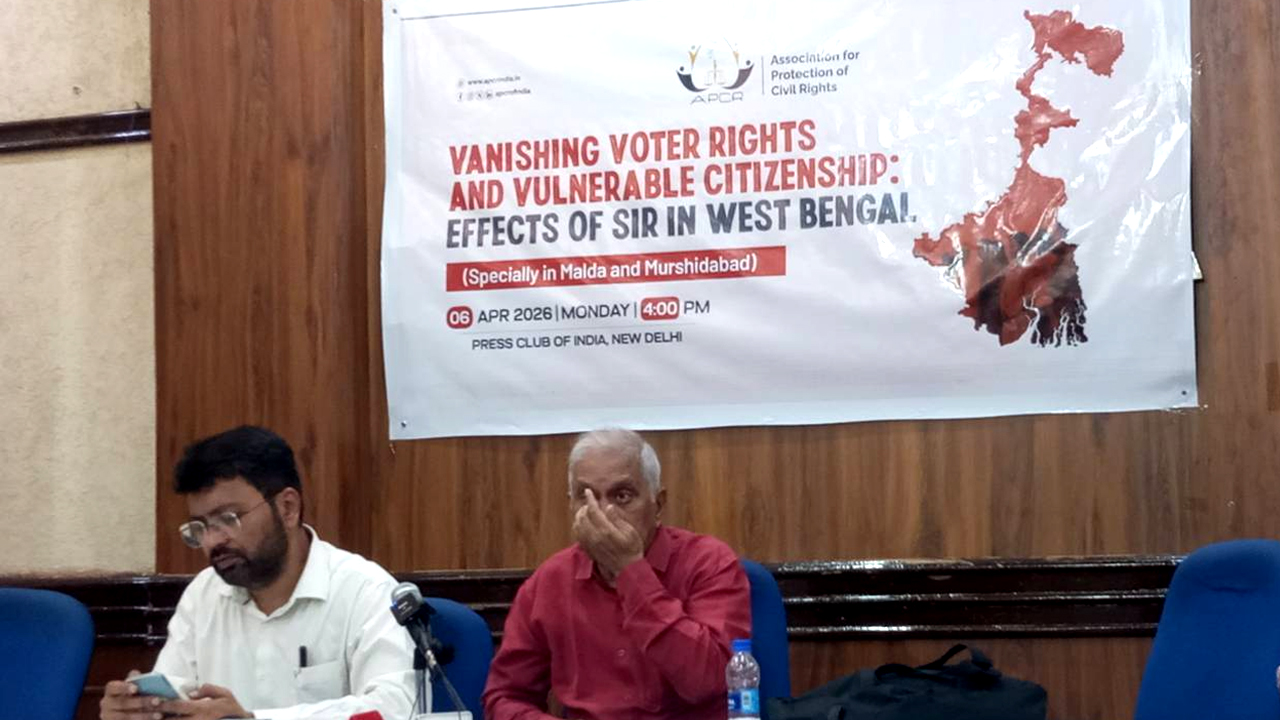
At a press conference held at the Press Club of India on Monday, concerns were raised over large-scale deletions from electoral rolls in West Bengal just ahead of the Assembly elections, with speakers alleging that the exercise reflects a grave assault on federal democratic processes by the ECI.
Organised by the Association for Protection of Civil Rights (APCR), the press conference brought together prominent public figures including former Union Minister Salman Khurshid, senior advocate Prashant Bhushan, and political analyst Yogendra Yadav, among others.
More than 91 lakhs voters out of approximately 7.6 crore in West Bengal have been removed from voter lists under the Election Commission of India’s “Special Intensive Revision” (SIR) process—an exercise they described as unprecedented in scale and deeply irregular.
Mouli Sharma
Groundxero | April 7, 2024 | New Delhi
At an urgent press conference at Delhi’s Press Club of India on Monday, activists, advocates, experts, and political analysts from West Bengal and across the country slammed the Union Government and Election Commission of India’s alleged ‘Special Intensive Revision’ exercise in the state whose first phase was executed in Bihar prior to the state’s assembly election in November last year.
With 296 assembly seats, West Bengal is India’s third largest electoral state, and the ruling Bharatiya Janata Party has not been able to win the state so far.
“Bengal was the real target all along,” said Prof. Ajit Jha of Swaraj India. “The question never was how many voters were removed or how many bogus entries added in Bihar. The question was if anything could stop them. They tested the Supreme Court, they tested the Tribunals, and they tested the public,” he said.
In August 2025, three months before VVPAT slips from voting machines were found dumped on a road two days into Bihar’s assembly elections, the Supreme Court gave the Election Commission of India a ‘slap on the wrist’ in the form of an order chiding them to conduct SIRs in a ‘proper manner’ after receiving numerous petitions by those aggrieved by arbitrary deletion.
“ECI has a right to conduct the exercise,” said the bench constituted by Justice Surya Kant and Justice Joymalya Bagchi of the Apex court. 33 election officials died during the ECI’s ‘exercise’ till December 17th 2025, little over a month into the second phase of nationwide revisions. 9 of them killed themselves.
“Their goal was to test the limits of their arbitrary power,” Jha said. “And they found that there were none.”
Renowned Supreme Court Advocate Prashant Bhushan said at the conference that there was no historical or legal precedent for what the ECI is presently doing in the name of “SIR”, and that the exercise is patently illegal.
“The provision for Special Intensive Revision specifically dictates that if needed, it can be undertaken in a single constituency, or in part of one. The due process for doing even that then requires the election commission or representing officers to release a public notice stating the grounds for why an SIR is necessary,” Bhushan said, elaborating that a legitimate SIR has never been a process to be so casually undertaken in 80 years of India’s constitutional rule.
An SIR process typically takes upwards of six months, even for single constituencies. This is because each vote, much like in a census—that hasn’t been conducted in India a single time since the BJP came to power in 2014—needs to be individually vetted. The steps toward a legitimate SIR process, one that the ECI refused to provide the guidelines to, but that political analyst Yogendra Yadav was able to access via sources, were outlined by Bhushan in the press conference as follows:
The identity and address of each voter already on the rolls is verified. The dead voters are removed, and fresh majors are added.
If the credibility of a living voter already on the list is doubted, the ECI must give written notice to the voter of why they have this doubt.
In response, the voter is then required to assert their legitimacy as a voter, using only two documents: proof of address (any proof of address suffices for this, such as a gas connection, electricity/water bill connection, bank documents, an ADHAAR, or even a government school transfer certificate) and a declaration self-identifying themselves as Indian citizens.
If the ECI continues to be unsatisfied by this response, say, due to ‘logical inconsistencies’ in the residence proofs like mismatch of name spellings or suspicion over the self declaration form, they are authorised to forward the voter and their details to a Foreigners’ Tribunal, or the courts. Those authorities may take a final decision in ascertaining the voters’ eligibility, and till they do, the voter’s name must remain on the rolls.
This last point is the most crucial. The ECI does not and never has possessed the authority to determine a voter’s ‘eligibility’. “All they can do is flag an inconsistency,” Bhushan said. “They have no authority to determine someone’s citizenship.”
This is why the SIR process, one that has only been conducted 8 times in 8 decades, has always been exhaustive, laborious, and immensely time consuming.
On the ECI’s website, a 19-page presentation on the need for “SIR” advertises this blatantly illegal operation of recreating the electoral rolls of 10 states and 3 Union Territories from scratch as a Special Intensive Revision, following it up with the claim that SIRs are ordinary, expected, and historical parts of the Indian electoral process. Make no mistake; this is a bald faced lie.
The infantalising and highly misleading release, which can be read here, conveniently omits the above due process of the 8 SIRs as they boast have been previously conducted, for it would reveal that what they are doing now, is unprecedented.
“Never in the history of SIR has the electoral roll of an entire state, let alone that of multiple states, “been revised,” said Bhushan. “The Supreme Court should have declared it illegal the minute they announced the plan.”
Beyond the reality of legal loopholes and human rights violations is the material cost of the ECI’s ludicrous, invasive and indulgent excercise: Countless accounts and suicide notes of BLOs have described the work pressure they faced from ‘higher authorities’ to be inhumane and impossible, with a digitised process being enforced on ground level workers when the digital infrastructure to do so does not exist. “One scanned form takes 15 minutes to upload,” said a BLO from South Kolkata to Archan Kundu, writing for The New Indian Express. Each booth has upwards of 800 voters.
With the BLO’s (mostly government school teachers) busy with work that is pushing them to kill themselves, their real jobs came to a standstill. Sabir Ahmed, an activist who analysed available data of intensive revisions in WB constituencies, said that 1 crore 16 lakh hours have passed since the onset of SIR, where no teaching has taken place in Bengal’s government schools.
“This is unlike the pandemic, when the schools were closed,” said Ahmed. “The schools remain open, but no teaching takes place because 70% of teachers have been assigned BLO duty.”
Caste, gender, and of course, religion were found to play clear roles in the ECI’s deletions, which, despite the SC orders, were not publicly made available along with specified reasons for non-inclusion. “We had to use our own connections to access their ‘logical discrepancies’,” which is the term the ECI has been using—nay, abusing—to disguise clearly discriminatory patterns of revision.
“We changed our title analysis [of the revised roll] and it’s clearly showing the upper caste people,” said Ahmed. “I’m sorry to say, but Chakraborty, Mukherjee, and Banerjee’s names are not figured [in the deleted names]. There are some cases, but not in our analysis. It’s rounding to 0 percent. It’s not there.”
The rest, he says, is no surprise. “Today we published Nandigram data. 96% Muslims voters were deleted in Nandigram, where the leader of the opposition would be contesting. So it is abundantly clear. They’re targeting the minorities and the women.”
“I will say it in clear words: the way is being paved for BJP’s victory by a mass deletion of Muslim voters from wherever their population is significant,” said Nadeem Khan, National Secretary of the Association for Protection of Civil Rights. “In Malda, in Murshidabad, in Nandigram, in Choubis [24] Pargana… people whose parents are on the roll, people with passports, retired judges, pensioners… and if you can believe it,” he paused, as if to allow the absurdity of what he was about to say to settle in, “in Malda and Murshidabad, the names of two BLOs were also deleted. The BLOs themselves!”
“I have a list here from a few polling stations. Every single name that was forwarded from some of these has been deleted. Every single name,” said Khan. Reading out ECI data from Shamsherganj, an assembly constituency, Khan noted that from a polling station at a government school, 534 names were sent for adjudication, of which 0 were retained. “The entire polling station was deleted.”
“This is the data from station after station. 51 names revised, all deleted; 536 names revised, 6 retained, all the rest deleted; 104 names revised, all deleted… 100% deletion. There are over 101 other stations where the deletion rate is above 98%.”
In the name of culling out ‘logical discrepancies’ of the kind that have been a permanent fixture of Indian bureaucracy since the days of its colonisation, not the fault of individuals but indeed of this bureaucracy itself, entire villages and towns are being erased from India’s electoral profile.
Hidden within the illogic of the Election Commission granting itself arbitrary powers to determine the ‘eligibility’ of voters—nay, demanding voters to prove their own eligibility, virtually citizenship to the ECI—is the BJP’s longstanding modus operandi: feeding people poison in the name of honey. Just last year, the government binned the landmark MNREGA Act, 2005, a one of a kind global provision that conferred employment to be a fundamental right of an Indian citizen, replacing it with the manipulative VB G RAM G Act, 2025 that took away this right in the name of improving upon state-led employment efforts.
Economist Jayati Ghosh said, “The newly proposed bill weakens the right-based nature of rural employment and presents it as a gift from the government.” Annie Raja of the National Federation for Indian Women said women workers would be the most affected, and that, “For many women, NREGA is the only independent source of income.” Economist Jean Drèze said the proposal “undermines the idea of the right to work that MGNREGA established”.
At the heart of the BJP-ECI machinery’s so-called “SIR” is a similar false logic: right is being exchanged for charity. An Indian citizen is being presented with benevolence what is already his, and he is being asked to be thankful to them for the trade—only this time, it is not the right to work, or live, or speak; it is the very right that defines Indian democracy, after which there will remain nothing left to fight for at all, even illusorily.
“We used to joke when this whole thing began that in a democracy, voters choose their government. Now, under the BJP, it seems that the government will choose its voters,” Jha said concluding his address. “It doesn’t seem like a joke anymore.”
Meanwhile, the Supreme Court has declined to stay the freezing of voter rolls or take any other action to ensure that people whose names have been arbitrarily deleted are able to vote. Instead it has directed the NIA—India’s anti-terrorist agency—to investigate and take action against those protesting for their right to vote.
Mouli Sharma is an independent journalist from New Delhi. Her work has appeared in publications like Maktoob Media, GroundXero, The Observer Post, The Leaflet, Nivarana, The Polis Project, Article 14, Feminism in India, and been republished in SabrangIndia, NewsClick and Think Global Health.