
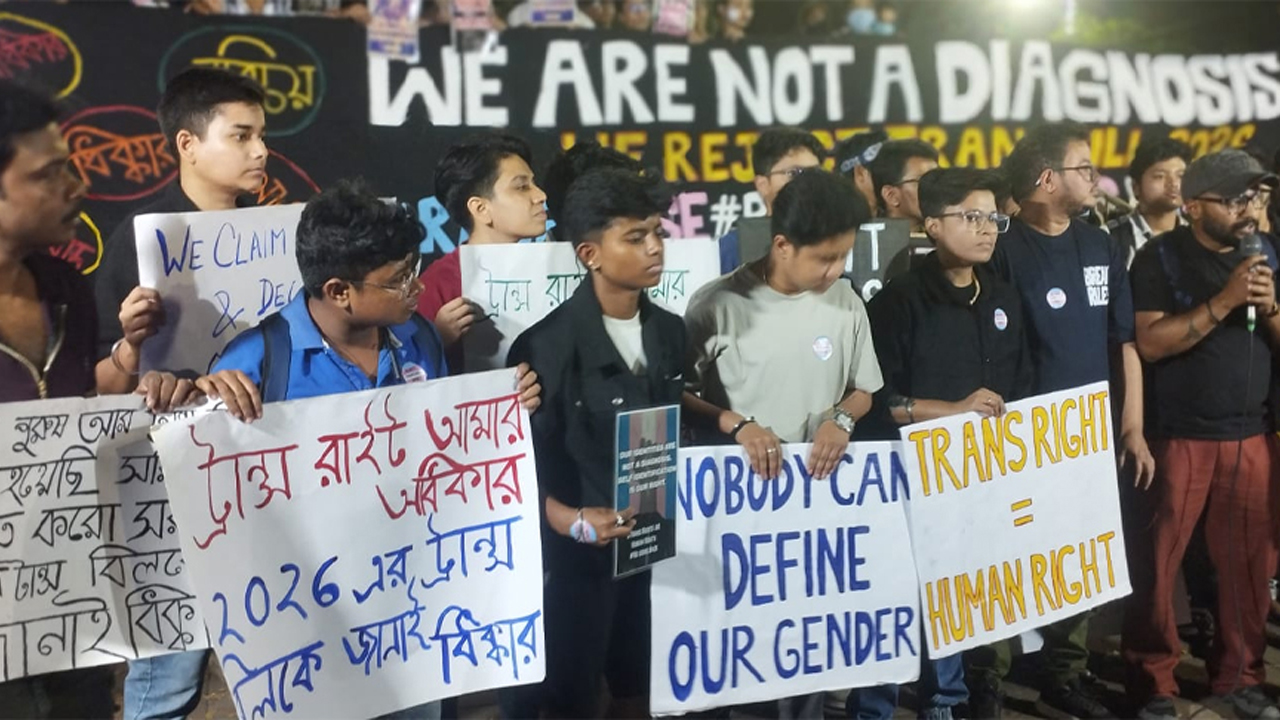
Calling on the President to act as “guardian of constitutional values,” the signatories demanded that the Bill be sent back for detailed scrutiny and wide-ranging consultations with transgender and gender-diverse communities.
Groundxero | 26 March, 2026
A broad coalition of lawyers, feminists, and civil society members has urged the President of India Smt. Droupadi Murmu to withhold assent to the Transgender Persons (Protection of Rights) Amendment Bill, 2026, calling it “deeply regressive” and unconstitutional.
In a letter dated March 26, members of the All-India Feminist Alliance (ALIFA) and the National Alliance for Justice, Accountability and Rights (NAJAR), associated with the National Alliance of People’s Movements (NAPM), appealed to the President to return the Bill back to Parliament for reconsideration by exercising powers under Article 111 of the Constitution.
The signatories to the letter alleged that the Bill was pushed through both Houses in “undue and unjustifiable haste,” without adequate debate or stakeholder consultation. They pointed out that the legislation was introduced in the Lok Sabha on March 13 through a supplementary list of business, limiting MPs’ opportunity to examine its provisions. Demands from several parliamentarians to refer the Bill to a Standing or Select Committee were rejected in both Houses, the letter notes.
Raising procedural concerns, the group said the government bypassed the Pre-Legislative Consultation Policy, 2014, and failed to engage even with the National Council for Transgender Persons. Reports of resignations from the Council were cited as evidence of a “severe democratic deficit.”
The letter also flags substantive constitutional violations. It argues that the Bill undermines the right to self-identification of gender recognised by the Supreme Court in National Legal Services Authority v. Union of India by removing statutory guarantees of self-perceived gender identity. The introduction of a medical board for certification, the signatories contend, contradicts the apex court’s rulings and infringes upon the right to privacy affirmed in Justice K. S. Puttaswamy v. Union of India.
Further, they warn that the amended penal provisions could criminalise expressions of transgender identity and weaken community support systems. The letter also refers to concerns raised following the Supreme Court’s recent ruling in Jane Kaushik v. Union of India, noting that recommendations from a court-appointed advisory body were ignored.
Calling on the President to act as “guardian of constitutional values,” the signatories demanded that the Bill be sent back with the recommendation that it be referred to the relevant Standing Committee or a Select or Joint Parliament Committee for impartial and thorough scrutiny and extensive consultations with members of the transgender, intersex, non-binary and genderqueer communities, collectives and civil society, civil liberties groups.
The appeal comes amid ongoing protests and growing opposition from rights groups across the country, which have criticised the amendments as exclusionary and violative of fundamental rights.
The full letter along with the signatories has been reproduced below.
To,
Smt. Draupadi Murmu,
Hon’ble President of India,
Rashtrapati Bhavan,
New Delhi.
Sub: Lawyers, Feminists & concerned citizens urge you to exercise powers under Article 111 of the Constitution to send the Transgender Persons (Protection of Rights) Amendment Bill 2026 back to Parliament for reconsideration
Respected Madam,
We, the undersigned lawyers, law students, feminists and social activists – members of the All-India Feminist Alliance (ALIFA) and National Alliance for Justice, Accountability and Rights (NAJAR) – pan India platforms associated with the National Alliance of People’s Movements (NAPM) are extremely alarmed and distressed at the undue and unjustifiable haste with which the Lok Sabha and Rajya Sabha have passed the deeply problematic and regressive Transgender Persons (Protection of Rights) Amendment Bill, 2026 completely disregarding community concerns, opposition voices and in violation of established parliamentary procedures and multiple binding judgements of the Supreme Court.
We strongly urge you not to grant assent to the Transgender Persons (Protection of Rights) Amendment Bill, 2026 and instead send it back to Parliament for reconsideration by exercising your power under Article 111 of the Constitution of India.
We provide the following grounds for you to withhold your assent:
Procedural infirmities in the manner in which the Bill was passed by Parliament
- Virendra Kumar, Minister of Social Justice and Empowerment (MoSJE), introduced the Transgender Persons (Protection of Rights) Amendment Bill (hereinafter ‘the Bill’), 2026 in Lok Sabha on 13 March 2026. The Bill was suddenly added to the agenda of the House through a supplementary list of business without affording MPs sufficient opportunity to read the Bill before its introduction.
- Violating the mandate of the Pre-Legislative Consultation Policy, 2014, the Government did not undertake any prior public and stakeholder consultation on the Bill before introducing it in Parliament.
- The Bill was subsequently taken up by Lok Sabha and passed on 24 March 2026 despite severe opposition. Going against settled parliamentary conventions, the reply by Finance Minister to the debate on Finance Bill was postponed to suddenly take up the Bill.
- In the Business Advisory Committee as well as on the floor of the House, several MPs requested the Government to send the Bill to a Standing or Select Committee for proper scrutiny, analysis and stakeholder consultation. However, the Government refused to send the Bill to a Committee without providing any cogent reason for the same.
- The Minister of Parliamentary Affairs, Kiren Rijiju also misled the House by claiming on the floor of Lok Sabha that extensive debate had happened on the Bill, when in fact, Government had not undertaken any consultation on the Bill.
- The Bill was immediately taken up by Rajya Sabha the next day, i.e. on 25 March 2026. Again, several MPs moved motion to refer the Bill to a Select Committee and demanded this during debate on the Bill as well, but the Government again refused to do so.
- At no point of time has the Government explained the reason for the extraordinary rush with which the Bill was pushed through Parliament without proper scrutiny and stakeholder consultation when widespread protests have been ongoing against the Bill.
- There was also no consultation even with the members of the National Council for Transgender Persons (NCTP) constituted under the 2019 Act, before bringing in these amendments. At the last minute the NCTP members were invited to Delhi, on 22nd March, 2026; but the Minister, MoSJE didn’t meet the Council. As on date, it is reported that multiple members of NCTP have resigned, owing to severe democratic deficit in the entire process and the far-reaching effects this regressive Bill would have on transgender persons.
Constitutional violations through the provisions of the Bill
- In National Legal Services Authority v. Union of India (2014) 5 SCC 438 [“NALSA Judgement”], the Supreme Court held that the right to self-determination / self-identification of one’s gender is a fundamental right protected under Articles 14, 19, and 21 of the Constitution. The Bill omits Section 4(2) of the Principal Act, which guaranteed every person the right to self-perceived gender identity, thereby violating constitutional rights of citizens of India.
- The Bill introduces a new “authority,” defined as a medical board, whose recommendation the District Magistrate is required to ‘examine’ before issuing a certificate of identity. The Supreme Court in NALSAjudgment expressly rejected the requirement of medical evaluation as a pre-condition for recognizing gender identity.This also violates the right to bodily integrity and privacy protected under Article 21 (Puttaswamy v. Union of India).
- While the Bill is presented as making implementation ‘more effective’ by reaching those who are “in actual need of protection” the amendments will in fact exclude a vast majority of the most marginalized – economically, culturally and socially – transgender people from accessing protections and rights, they are entitled to under law.
- The new penal provisions under the substituted Section 18 criminalize compelling any person to “outwardly present a transgender identity.” Read alongside the substantially narrowed definition of “transgender person,” these provisions effectively treat self-determined transgender identity as an outcome of ‘coercion’ or ‘deception’ rather than as a legitimate expression of personhood. They further risk being deployed against transgender communities and their support networks that have long functioned as informal safety nets, in the face of social and economic vulnerability and absence of state protection.
- The Bill also severely violates the recent Judgement of the Supreme Court in Jane Kaushik vs. Union of India (2025 INSC 1248) – Judgement dated 17 Oct, 2025. The Chairperson of the Advisory Committee appointed by the Supreme Court in this case, Justice (Retd.) Asha Menon wrote an urgent letter to the Union Government (MoSJE) on 25-3-2026 to withdraw the Bill, but the Government still passed it in Parliament.
Therefore, in light of the above-mentioned concerns and constitutional violations, we the undersigned concerned citizens of India, urge you, as the guardian of the fundamental rights of citizens and custodian of constitutional values and morality, to:
- Withhold your assent to the Transgender Persons (Protection of Rights) Amendment Bill, 2026 as passed by both Houses of Parliament.
- Instead, by invoking your powers under Article 111 of the Constitution of India, refer the Bill back to the Parliament of India with the recommendation that the Bill be referred to the relevant Standing Committee or a Select or Joint Parliament Committee for impartial and thorough scrutiny and extensive consultations with members of the transgender, intersex, non-binary and genderqueer communities, collectives and civil society, civil liberties groups on the operational and procedural aspects and limitations of the 2019 Act and the present Bill.
We are hopeful that you will stand with the citizens of India and exercise your constitutional powers and discharge your constitutional responsibility in advancing the rights of one of the most marginalized communities of India.
Your sincerely,
| ALIFA Members | NAJAR Members |
|
|