
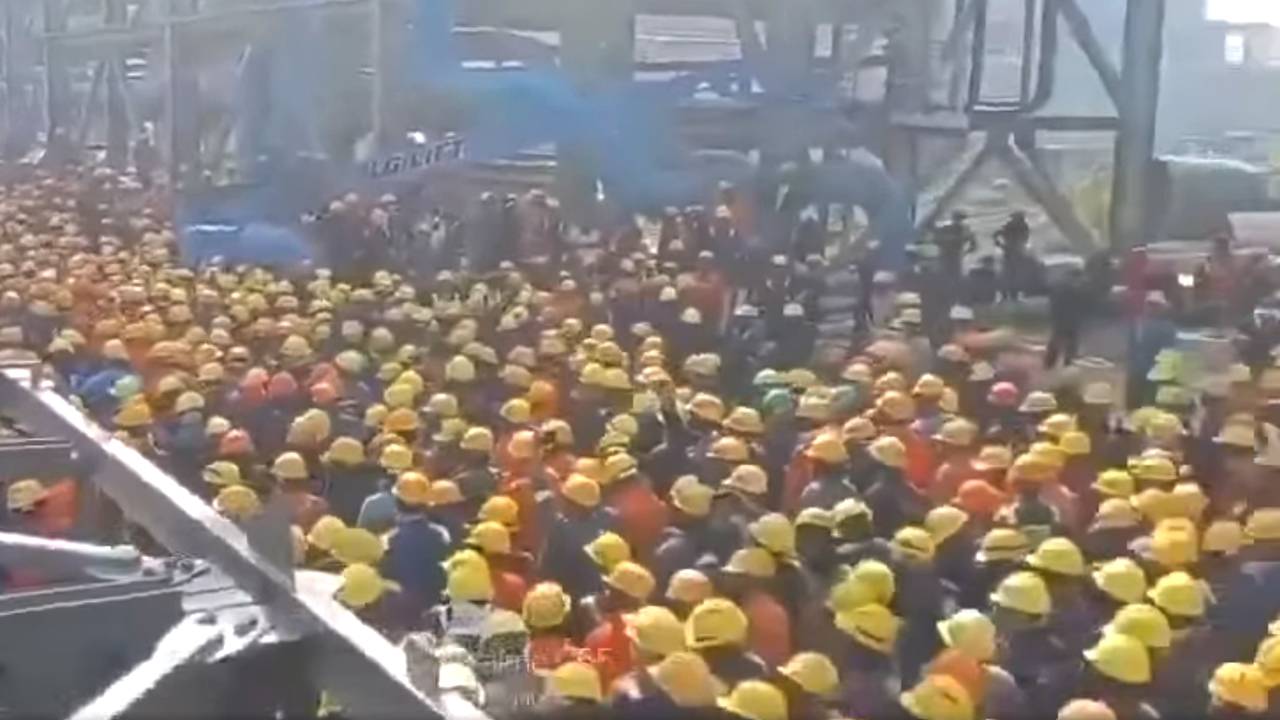
Fact-finding team flags deaths, injuries, and systemic violations as thousands of workers continue agitation. The findings point to a deeper and more structural crisis—one rooted not merely in immediate grievances, but in years of institutionalised exploitation of workers under the contract labour system.
Groundxero | Feb 24, 2026
A major labour conflict has erupted at the Panipat refinery of Indian Oil Corporation Limited in Haryana, where between 30,000 and 40,000 workers launched a strike on February 23, 2026. The protest began at 11 a.m. at refinery gates 1 and 4, with workers raising long-standing grievances over wages, working hours, and unsafe conditions.
Within hours, the situation escalated as police resorted to a lathi charge to disperse the gathering, reportedly injuring several workers. Eyewitness accounts indicate that personnel of the Central Industrial Security Force (CISF) fired in the air, further intensifying panic and anger among the workers.
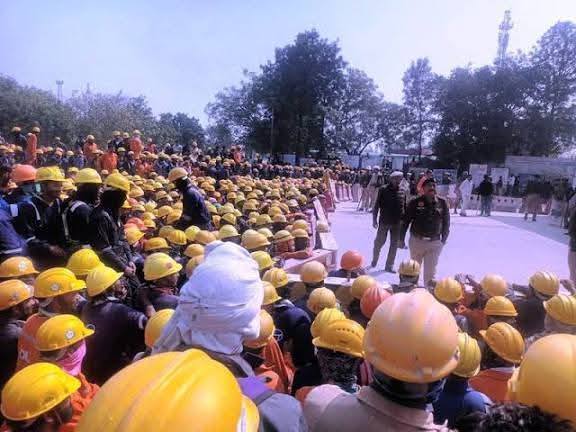
A fact-finding team comprising members of Mazdoor Adhikar Sangharsh Abhiyan (MASA), along with associated organisations and independent activists, visited the protest site on February 24. Their findings point to a deeper and more structural crisis—one rooted not merely in immediate grievances, but in years of institutionalised exploitation under the contract labour system.
Trigger: Fatal Workplace Accident
According to a fact-finding team from Mazdoor Adhikar Sangharsh Abhiyan (MASA), the immediate trigger for the February 23 spontaneous outburst of worers was a tragic workplace accident two days prior, which led to the death of two contract workers and severe injury to another, whose leg was amputated. According to workers, the management’s response to the incident was marked by indifference and delay, which ignited widespread anger among workers already enduring years of exploitation.
For many workers, the incident became the breaking point. Years of excessive working hours, wage theft, unsafe working conditions, and humiliating treatment by contractors and management had already created a volatile atmosphere. The deaths exposed what workers describe as a regime where profit is prioritised over human life.
“12 Hours Work, 8 Hours Pay”: Everyday Exploitation
Testimonies of contract workers collected by the fact-finding team reveal a pattern of systemic labour law violations at the refinery, including:
- 12-hour shifts with payment for only 8 hours (no overtime compensation)
- Only two days off per month, with compulsory work on remaining Sundays
- Frequent delays in wage payments
- Irregular and manipulated provident fund (PF) deductions
- Lack of basic facilities such as toilets, drinking water, and canteens
Despite being employed at one of South Asia’s largest refineries—operational since 1998 and employing over 50,000 workers— the majority of the workforce remains employed through layers of private contractors, effectively excluding them from job security, legal protections, and dignity at work.
Repression and Information Blackout
The state’s response to the workers’ protest has drawn sharp criticism. Apart from the lathi charge and reported firing in the air, the fact-finding team reported that mobile network jammers were installed across the refinery premises, particularly at protest sites, to restrict communication and prevent news of the repression and protest from spreading.
Additionally, an FIR has reportedly been filed against 2,500 “unknown workers,” while no legal action has been initiated against management or contractors for alleged labour law violations, use of force against protesters, and for conditions leading to the fatal accident.
The asymmetry is telling. While workers face criminalization for collective assertion of labour rights, those responsible for unsafe and illegal working conditions remain untouched.
Workers Reject “Vague Assurances”, Continue Agitation
Sensing the defiant and explosive mood of the workers, the administration and management issued a written assurance acknowledging the legitimacy of workers’ demands. However, instead of taking immediate action on their demands, the assurance merely promised to communicate these demands to higher IOCL officials.
Workers have rejected this as a tactic to diffuse the movement. They have decided to continue the strike and demonstrations until their demands are met without getting bogged down by vague assurances. They have also started the process of forming a committee of leading workers to organise their struggle.
Charter of Demands The striking workers have put forward clear demands, including:
- Enforcement of an 8-hour workday
- Timely payment of wages between the 1st and 7th of each month
- Payment according to company board rates
- Regular and transparent provident fund deposits
- Double-rate overtime pay
- Full compensation and accountability in case of workplace accidents
- Restoration of basic facilities, including toilets, drinking water, and canteens
- Recognition of national holidays and regulation of working days
Mazdoor Adhikar Sangharsh Abhiyan (MASA) has expressed full solidarity to the struggle of the Panipat refinery workers and demands the immediate implementation of the legitimate demands.
Furthermore, while strongly condemning the police repression of protesting workers, MASA demands legal action against the responsible officials and the IOCL management and contractors who have been openly violating labour laws for years. The workers’ collective said “The FIRs registered against the workers should be scrapped immediately, and no further legal action should be taken against them.”
Additionally, MASA demands the repeal of the new Labor Codes that dismantle the rights of workers across the country.
Broader Context: A Political Economy of Precarity
The Panipat refinery struggle is not an isolated flashpoint. It is emblematic of a broader transformation in India’s labour regime, where contract employment has become the primary employment arrangement not just in the private sector, but also in public undertakings and government companies, which intensifies exploitation by nullifying the basic rights of workers.
The fact-finding report also situates the conflict at Panipat within a wider transformation of labour relations in India. The increasing reliance on contract labour—even in public sector undertakings—and the implementation of the new labour codes have eroded labour rights such as job security, regulated working hours, and the ability to unionize and strike.
The 4 new Labor Codes implemented by the Modi government last year, by dismantling all central labour laws. The codes have made this contract system and its even more dangerous form, ‘Fixed-Term Employment,’ universal across all sectors. As a result, basic labour rights such as permanent employment, 8-hour workdays, overtime, and PF—which the working class achieved through decades of struggles—have been abolished in one stroke. Not only this but forming unions and going on strike have been made nearly impossible and criminalised.
In this context, the Panipat refinery strike reflects not only immediate grievances but a broader resistance of workers pushed to the brink by state-backed reforms intensifying regime of precarious and exploitative employment.
The formation of a workers’ committee indicates an attempt towards sustained and organised resistance. At the same time, the use of force and legal intimidation signals the state’s willingness to suppress workers’ resistance in strategic industrial sectors. Whether the Panipat agitation will force concessions from management—or face further repression—remains to be seen. What is clear, however, is that the refinery has become a crucial site in the unfolding struggle of the working class over labour rights and dignity.
The report is based on a press release by Mazdoor Adhikar Sangharsh Abhiyan (MASA).
The pdf of the statement by MASA is attached below.
MASA statement on IOCL workers struggle