
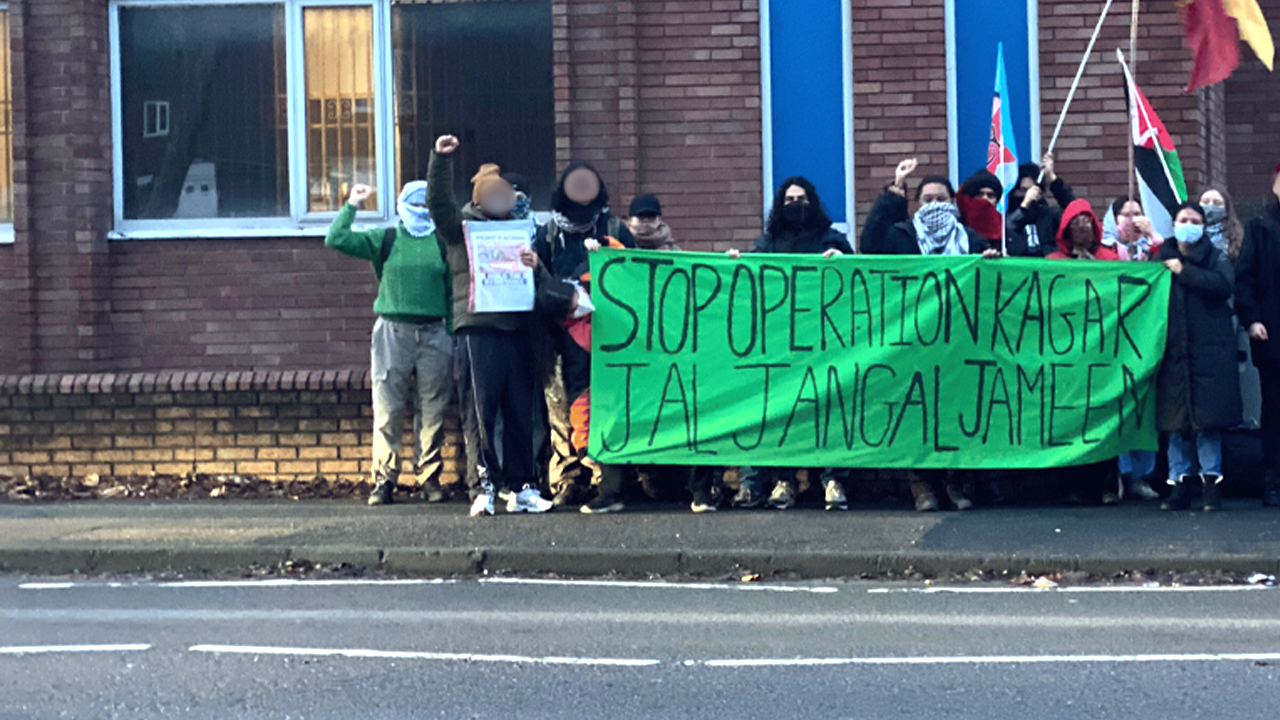
The protest—organised by the Joint Committee to Stop Repression in India (JCSRI) along with several international organisations—marked the first public demonstration against Operation Kagar in Britain. The JCSRI, said the protests were part of a growing transnational movement against militarism, imperialism and genocide—from Central India to Palestine and the Philippines.
Groundxero | Feb 7, 2026
Activists and solidarity organisations gathered outside the Consulate General of India in Birmingham on January 27 to protest what they described as the Indian state’s genocidal counterinsurgency campaign, Operation Kagar, an operation critics say has unleashed mass displacement, militarisation and repression in Adivasi regions under the pretext of fighting Maoist insurgency.
The protest—organised by the Joint Committee to Stop Repression in India (JCSRI) along with several international organisations—marked the first public demonstration against Operation Kagar in Britain. It coincided with parallel protests at the European Parliament and outside the Indian Embassy in Brussels, held on the same day as meetings of the European Parliament’s Subcommittee on Human Rights and negotiations around the proposed EU–India Free Trade Agreement (FTA).
Coming a day after India’s 77th Republic Day, demonstrators said the timing underscored the growing contradiction between constitutional claims and the lived reality of militarised repression in Central India.
Speakers at the protest, highlighted how the mineral-rich and forested Bastar region has been transformed into one of the most heavily militarised areas in the world. Under Operation Kagar, they alleged, entire Adivasi villages have been displaced, forests cleared, and civilian populations subjected to violence and surveillance in the service of extractive corporate interests.
Protesters described the operation as an assault on “jal, jangal, jameen”—water, forest and land—a slogan historically associated with Adivasi resistance leader Komaram Bheem. Chants of “Inquilab Zindabad,” “Long Live the Revolution,” and “Stop Operation Kagar!” echoed outside the consulate.
A statement issued by the Delhi-based Forum Against Corporatisation and Militarisation, marking both Republic Day and the second anniversary of Operation Kagar, was read out, condemning the operation as an “anti-people, pro-imperialist war on India’s indigenous communities.”
Several speakers linked Operation Kagar directly to the interests of global mining and infrastructure corporations. London-based Vedanta Resources was specifically named as one of the beneficiaries of land clearance and militarisation in Adivasi areas. Protesters also called out the Adani Group, pointing to its extractive projects in Central India and its complicity with genocidal Israel, including ownership of Haifa Port in Israel and arms manufacturing collaborations with Elbit Systems.
The displacement, organisers argued, represents not only a humanitarian catastrophe but an ecological one. United Nations Committee on the Elimination of Racial Discrimination experts has previously described the situation in India’s Adivasi regions as an “unprecedented” large-scale human rights violation. Vast tracts of biodiverse forest are being converted into mines, industrial corridors and military zones, critics said.
“The Indian state is continuing colonial violence against native inhabitants,” one speaker said, “only now in service of a new set of imperialist masters.”
The protest also highlighted the extension of repression into India’s urban centres. Participants pointed to recent arrests and assaults on progressive activists in Delhi, who were branded “anti-national” for linking the city’s severe air pollution crisis to resistance against militarisation and displacement in Central India.
“This regime criminalises dissent wherever it emerges,” a protester said, describing the government’s actions as fascistic and rooted in aggressive nationalism that tolerates no opposition.
Organisers emphasised that international solidarity has previously played a decisive role in halting militarised operations in India. They pointed to the pressure that contributed to the winding down of Operation Green Hunt in 2014 as evidence that global mobilisation can have material impact.
The JCSRI, said the Birmingham and Brussels protests were part of a growing transnational movement against militarism, imperialism and genocide—from Central India to Palestine and the Philippines. “As long as global institutions enable these crimes through trade deals and strategic partnerships,” organisers said, “international resistance will not only continue—it will grow.”