
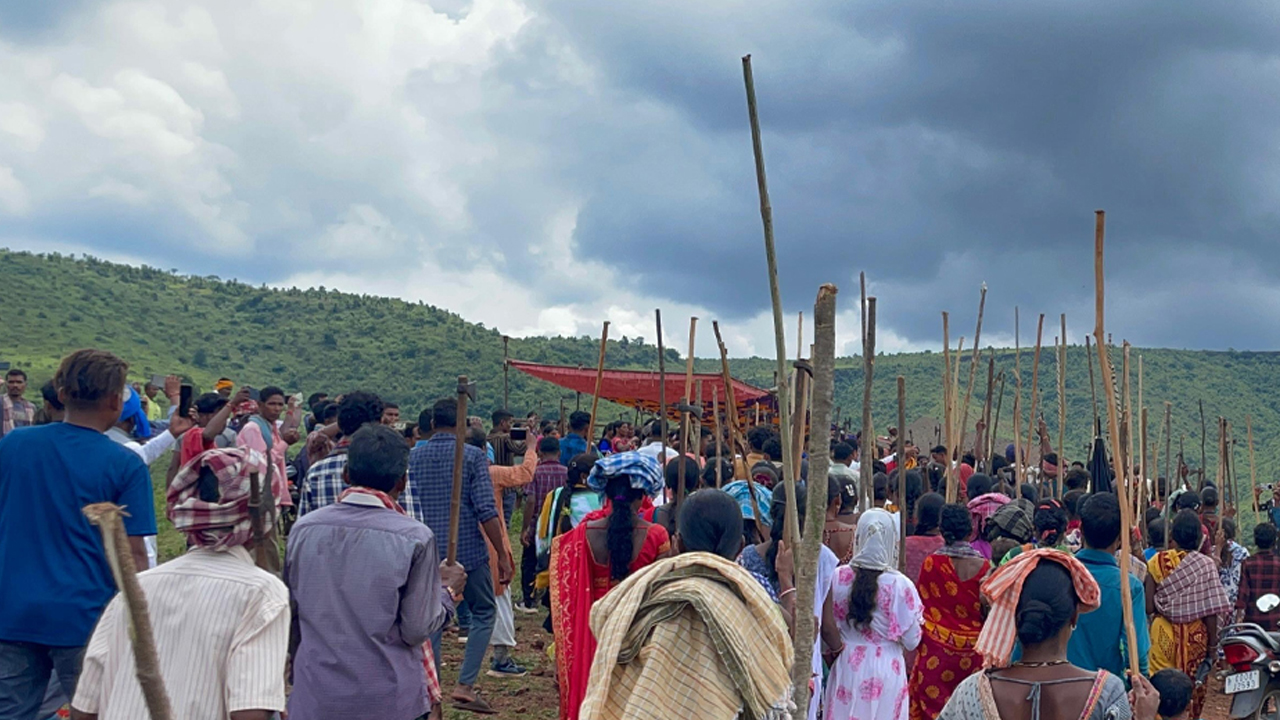
More than 125 lawyers, legal professionals (faculty), and law students from all over the country have called on the Governor of Odisha to urgently intervene to stop state repression on protesting villagers and take steps to halt all illegal administrative actions aimed at handing over community-managed forest land to Vedanta for bauxite mining in Sijimali.
Groundxero | 15 December, 2024
Over 125 lawyers, legal professionals (faculty) and law students from across the country have launched a nationwide protest against what they describe as the illegal acquisition of forest and Fifth Schedule land in Odisha’s Rayagada and Kalahandi districts for Vedanta Ltd.’s proposed Sijimali bauxite mining project, and the sustained criminalisation and intimidation of Adivasi villagers resisting it.
In a detailed petition addressed to the Governor of Odisha, the Director General of Police, and the district collectors and superintendents of police of Rayagada and Kalahandi, the lawyers have demanded immediate intervention to halt land acquisition in Fifth Schedule areas, withdraw criminal cases against villagers, and curb what they call “colonial-era repression” unleashed to facilitate Vedanta’s mining project in Sijimali.
The lawyers’ intervention comes amid escalating police action in the Sijimali region, where villagers opposing Vedanta’s mining plans say they have been living under an atmosphere of fear for nearly two years. According to a press note issued on December 14, villagers have faced repeated arrests, re-arrests, detentions and threats, leading to what the petition describes as an atmosphere of terror and a breakdown of the rule of law across the region.
One of the most serious incidents cited occurred on December 7, 2025, when men allegedly dressed as civilians attempted to abduct village leaders in broad daylight at Sunger Chowk in Kashipur block. More than nine youth leaders from affected villages are currently lodged in jails in Rayagada and Bhawanipatna, with several others reportedly being routinely picked up or threatened with arrest.
“The presence of armed police in villages has created such a reign of terror that people are afraid to go to hospitals or even weekly markets,” the lawyers said, adding that daily economic activity has virtually come to a halt.
The petition points out that when villagers gather to make decisions about the illegal diversion of their land for mining, or when they oppose the flouting of established norms in obtaining necessary environmental and forest clearances, they face extreme police brutality.
Background to the conflict
At the heart of the conflict is Vedanta’s proposed bauxite mine at Sijimali, spread across Rayagada and Kalahandi districts. On March 1, 2023, Vedanta Limited was declared as preferred bidder and allocated Sijimali block with an estimated reserves of 311 million tonnes of bauxite. Vedanta has proposed mining of 9 million tonnes per annum (MTPA) of bauxite in 1,548.786 hectare in Sijimali. The mining project is likely to displace 100 families from 18 villages and also affect the livelihoods of an additional 500 families.
Since the mining area is spread over villages in districts classified under Schedule V in the Constitution due to the preponderance of the Adivasi population, the consent of the entire adult population of these villages through Gram Sabhas is mandatory before exploiting their natural resources.
Apart from environmental clearance for the project, Vedanta also need to secure forest clearance too since the mining lease area includes 699.7 hectares of forest land. Also, there are two villages affected by the project that fall within the notified eco-sensitive zone of the Karlapat Wildlife Sanctuary.
As resistance of the villagers on the ground against the mining project continues in the face of severe state repression, the Sijimali struggle in Odisha has emerged as a critical test case for the protection of Adivasi rights and the limits of state power exercised in service of corporate mining interests.
The project gained momentum after the Forest Advisory Committee (FAC), at its meeting on December 2, 2025, recommended that the Odisha government grant state-level approval for Stage I forest clearance for the diversion of 708.24 hectares of forest land—nearly half of the total lease area of 1,548.786 hectares.
Fake Gram Sabhas; Illegal mining lease
The lawyers in their petition to the Governor argue that the mining lease itself is illegal, as it was granted without the free, prior and informed consent of Gram Sabhas in a Fifth Schedule area. Nearly half of the land involved is forest and community-controlled land protected under the Forest Conservation Act, 1980; the Panchayats (Extension to Scheduled Areas) Act, 1996 (PESA); the Forest Rights Act, 2006; and the Orissa Scheduled Areas Transfer of Immovable Property Regulations, 1956. These laws require the free and informed consent of residents before any transfer of land.
A key allegation in both the press note and the lawyer’s petition is that Vedanta, in collusion with the administration, “manufactured consent” through fake Gram Sabhas. According to the lawyers, at least 10 such Gram Sabhas were purportedly held on December 8, 2023, in villages under Sunger Gram Panchayat in Kashipur block of Rayagada district and Talaampadar Gram Panchayat in Thuamul Rampur block of Kalahandi district, in the presence of armed police and company staff, to obtain the purported consent of villagers.
RTI replies from the Kalahandi district administration dated February 8, 2024, the petition claims, revealed that villagers were forced to put thumb impressions on consent resolutions while company officials, armed police and local strongmen were present at these so-called Gram Sabhas. All 10 Gram Sabhas were shown as having been held on the same date and at the same time across all 10 villages, rendering them coerced and ‘fictitious’, and the resolutions invalid.
The petition also draws the Governor’s attention to the fact that despite directions from the Ministry of Tribal Affairs (MoTA) to conduct an inquiry into allegations of fake Gram Sabhas, no such inquiry has been initiated so far.
The lawyers have further accused district administrations of creating land banks for the Odisha Industrial Infrastructure Development Corporation (IDCO) by de-reserving protected forests and converting gochar and other community lands into “wasteland” to make them available for Vedanta and other corporate projects.
In Tijmali village of Kalahandi district, the administration has reportedly initiated private land acquisition for over 70 acres without providing information to the 30 affected families. Such acquisition, the petition argues, violates Fifth Schedule regulations issued by the Governor to prohibit or restrict the transfer of tribal land.
The petition also points to a highly incomplete Environment Impact Assessment (EIA) report prepared prior to the Gram Sabhas, which allegedly undercounted perennial streams and water sources and was objected to during public hearings.
Villagers reject mining, face repression
In contrast to the alleged fake Gram Sabhas, local communities organised ten special Gram Sabhas in September 2024, where they unanimously passed resolutions rejecting Vedanta’s mining proposal, citing threats to their land, water sources, forests and livelihoods. Complaints regarding forged signatures and fake Gram Sabhas were submitted to local police stations and station diary entries were made. However, no FIRs were registered. Instead, the petition alleges, severe police repression was unleashed.
These facts were placed before the Odisha High Court in a writ petition [WP(C) No. 3729/2025]. In its order dated May 5, 2025, the court reiterated the applicability of rights under the Forest Rights Act and directed the Union government to take note. Subsequent representations to the Union government, the lawyers stated, elicited no response.
Criminalisation of protest and pressure on even lawyers
According to the petition, police and company personnel have maintained a constant presence in villages protesting the land acquisition process over the past two years (2023–25). These lands and forests, the villagers assert, are community resources cultivated and protected for generations. In response to protests, they allege a pattern of intimidation, harassment, detention and arrests by local police.
Since June 2025, prohibitory orders and breach-of-peace proceedings under Section 163 of the BNSS have been imposed on members of the Ma Mati Mali Surakhya Mancha, a local organisation opposing the mine. More than nine leading activists are currently in detention on what the lawyers describe as false criminal cases, while others continue to face threats and arrests.
The petition further alleges that lawyers representing villagers have been pressured by the police, allegedly at Vedanta’s behest, to seek a “compromise with the company” in exchange for withdrawal of cases. Detained activists have reported custodial torture, casteist and racist abuse, and threats aimed at preventing them from speaking freely before judicial magistrates.
Police have also reportedly attempted to stop public observances such as United Nations World Environment Day, United Nations World Indigenous Peoples’ Day, and Birsa Munda Jayanti, claiming—without evidence—that villagers were assembling with “weapons” to intimidate those supporting Vedanta.
Demands for immediate action
The petitioners have called on the Governor to halt all actions aimed at handing over community-managed forest land to Vedanta. “There is absolutely no excuse for colonial-era levels of subjugation of citizens, and the deliberate breakdown of fair and law-abiding administration, in a free India,” the petition states.
Invoking the special powers of the Governor under the Fifth Schedule of the Constitution, the lawyers have urged immediate intervention to restore peace and good governance in Scheduled Areas, stressing that these constitutional responsibilities cannot be abdicated in favour of corporate interests.
Key demands include a review of the mining lease granted to Vedanta, withdrawal of all FIRs against villagers, release of detained leaders with compensation for illegal arrests and torture, and a complete halt to all project-related work until Gram Sabhas can take decisions in a fear-free environment.
The lawyers have also sought an independent inquiry into police and administrative excesses, a ban on company staff entering villages, and Gram Sabha approval for any police deployment in the area.
As resistance on the ground continues, the Sijimali struggle has emerged as a critical test case for the protection of Adivasi rights and the limits of state power exercised in service of corporate mining interests in Odisha.
________________
Feature Image: Villagers gather to observe 30th anniversary of the International Day of the World’s Indigenous Peoples. Pic courtsey: Srijan Dutta.