
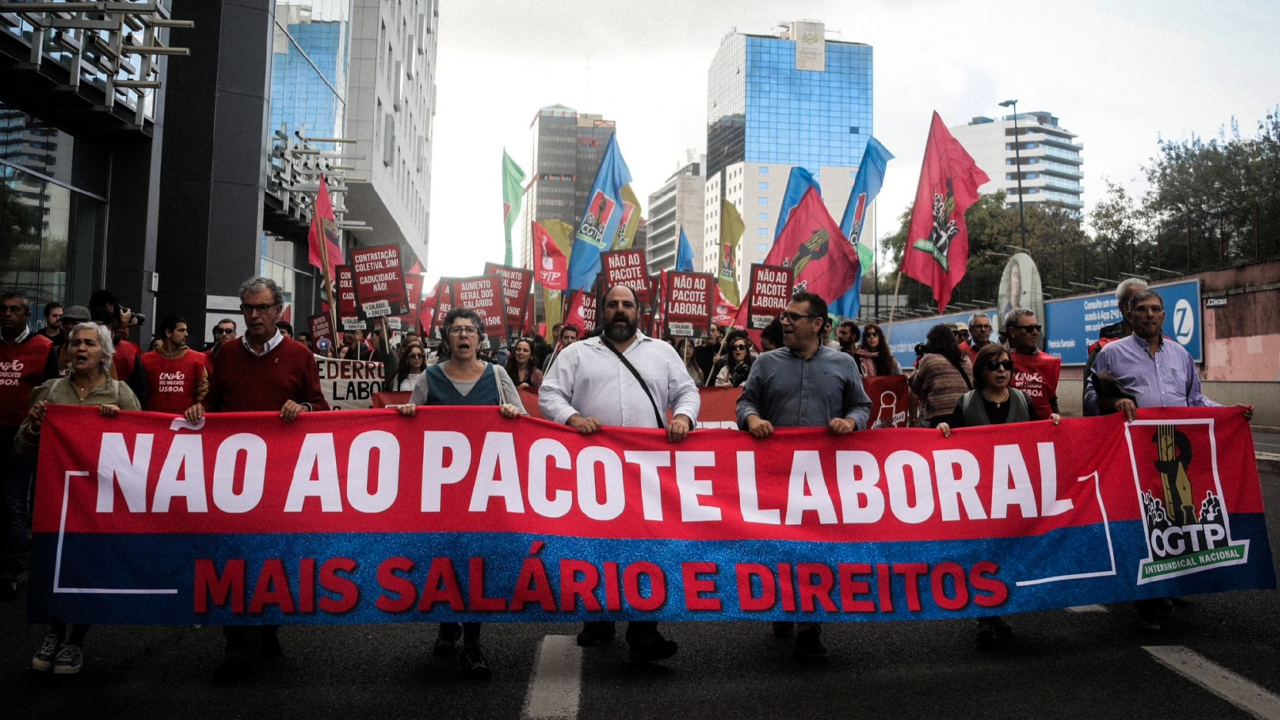
Tens of thousands of Portuguese workers walked off the job in the country’s first general strike in 12 years. The massive show of force is a direct challenge to the right-wing government’s aggressive assault on labor rights, wages, and collective bargaining.
Groundxero Report| December 14, 2025
Portugal was brought to a standstill on December 11 as tens of thousands of workers walked off the job in the country’s first general strike in 12 years, mounting a decisive challenge to the minority right-wing government’s sweeping assault on labour rights. From ports and factories to schools, banks, and transport networks, the strike marked an open confrontation between organised labour and a government determined to rewrite the labour laws in favour of capital.
The one-day general strike was jointly called by the Socialist Party (PS) aligned UGT and the Communist Party (PCP) aligned CGTP. It was a first general strike since the Eurozone debt crisis in June 2013, when Portugal was subjected to harsh austerity measures under an international bailout that slashed wages, cut pensions, and raised taxes.
At the centre of the confrontation is the government’s proposed “profound reform” of the Labour Code, revising more than 100 articles. Trade unions say the reform package will decisively tilt power towards employers, making it easier to dismiss workers, expand employer’s control over working hours, allowing wider outsourcing of work, weakening collective bargaining, and rolling back maternity protections.
The reforms also seek to broaden minimum service obligations during strikes, extending them to more sectors and further curtailing the right to strike. The Unions have accused the government of amending the labour-codes to neutralise labour resistance while institutionalising precarious employment.
On the day of the strike, thousands of workers rallied near the parliament building in central Lisbon, carrying placards reading “No to the labor package” and “Firing without reason is doing the boss’ bidding”.Similar demonstrations were held in cities and towns across the country, turning the strike into a nationwide show of force.
The strike brought large parts of Portugal to a standstill. The scale of the shutdown underscored the depth of opposition. The strike action halted ports, grounded flights, shuttered schools, and stalled public transport. Banking, insurance, industry, communications, and the cultural sector were also affected, with some workplaces reporting participation rates between 50 and 100 percent. Goods drivers and truckers joined the action, disrupting deliveries and fuel logistics.
Portugal’s largest industrial exporter, the Volkswagen Autoeuropa plant, was effectively shut down, with production halted and its supply chain paralysed. Workers from every sector said they will no longer accept a return to deeper exploitation and austerity.
The strike marks a decisive escalation in the confrontation between the working class and the minority right-wing Democratic Alliance (AD) government of Prime Minister Luís Montenegro. Montenegro insisted the government would not retreat. “The government respects the right to strike,” Montenegro said, “but it is a government with a reformist spirit and will not give up on being reformist and transformative.”
Workers on the ground voiced a sharply different view.
“We do not accept unjust laws,” said Conceição Lobo, who has worked 44 years at the Lameirinho textile mill. She voiced widespread rejection of the proposed plan to force workers to work until age 70 before retirement. “We are in the street, together, defending dignity, respect, and a future for those who work,” she said.
One of the most politically significant features of the strike was the unprecedented participation of private sector workers, long burdened by precarious contracts, low wages, high turnover, and fear of dismissal. For over a decade, labour actions in Portugal had been routinely dismissed by governments and sections of the media as the protests of “privileged” public sector employees. December 11 punctured that narrative.
The General Confederation of the Portuguese Workers (CGTP-IN) stressed that the attack on workers’ living standards comes not during an economic crisis but amidst growth and steep rises in corporate profits. The union federation said the labor package constitute “an assault on the rights of all workers.”
UGT General Secretary Mário Mourão urged the government to heed the scale of the mobilisation. “I hope the Government pays attention to the signals,” he said, calling the massive response to the strike as a “clear rejection of the labour package.”
The Portuguese Communist Party (PCP) denounced the reforms as a direct weapon at the service of capital designed to suppress wages, normalize precarious work, dismantle collective contracts, and restrict the right to strike. “The great and expressive scale of today’s General Strike is an enormous statement of the workers’ strength and unity,” PCP said.
“The path that is needed is one that increases wages, that fights against precariousness, that values collective bargaining, that defends and strengthens public services,” the PCP added. “This path is in the hands of the workers, of the people and of the youth, with the immense strength that was on display today.”
International solidarity also poured in. The World Federation of Trade Unions (WFTU), which represents 110 million workers across 134 countries, expressed its “undivided solidarity” with striking workers. It condemned the “brutal attacks” in Portugal that “undermine essential social and labor rights,” and demanded the immediate withdrawal of the anti-worker policies.
What December 11 has made unmistakably clear is that Portugal’s working class is no longer willing to accept another round of assault on labour rights in the name of “reforms”.
________________
Source:
1. General strike brings Portugal to a standstill
2. Historic general strike by Portuguese workers
Feature Image: Workers marching during the general strike – via the Portuguese Communist Party