
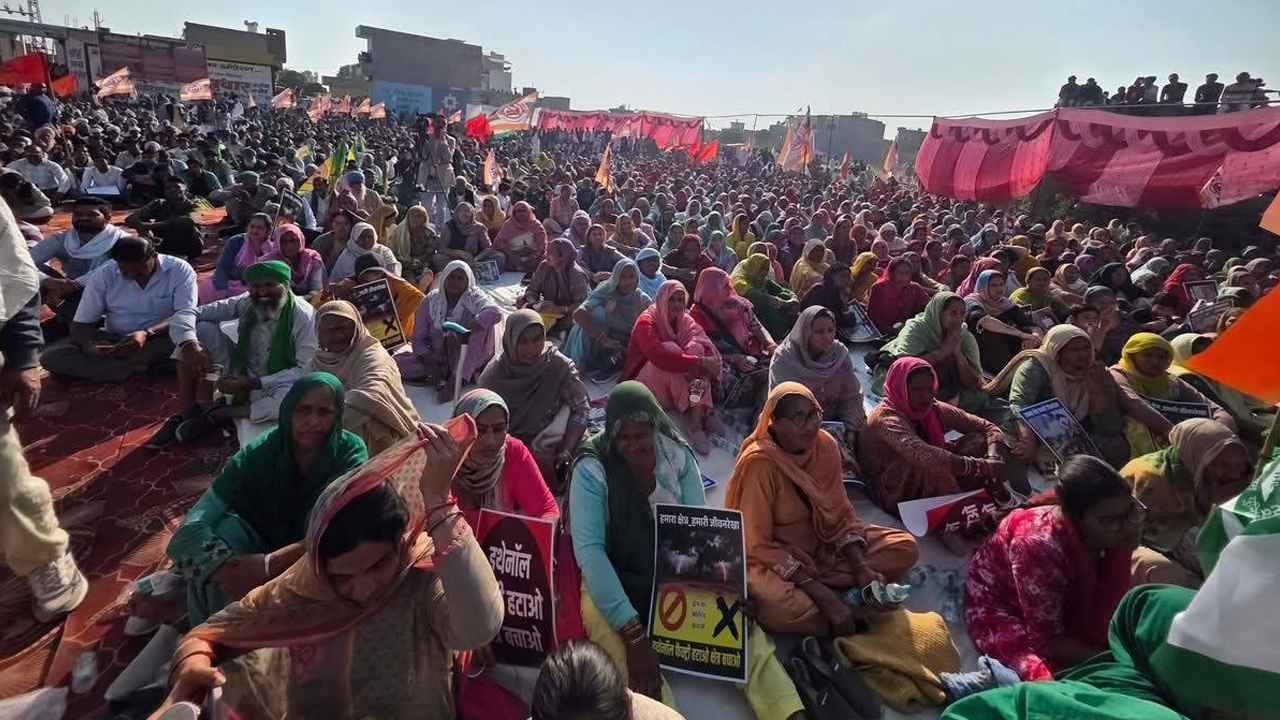
The violent clashes in Hanumangarh have brought a simmering 17-month peasant struggle in Rajasthan to national attention. Farmers in Tibbi tehsil are resisting the construction of what is touted as Asia’s largest ethanol plant—a project they say threatens their land, water, and livelihoods. The police crackdown has only deepened anger in a region against what farmers describe as an ecologically destructive, corporatised model of development.
Groundxero | 12 December 2025
On Wednesday, December 10, the BJP-led Rajasthan government carried out a brutal lathicharge on farmers protesting the construction of what is being promoted as Asia’s largest ethanol factory in Rani Kheda village of Tibbi tehsil in Hanumangarh district of Rajasthan. The farmers say they are defending fertile, multi-crop land and the region’s fragile ecology from irreversible damage.
Thousands of farmers had gathered for a Mahapanchayat after their 17-month-long dharna, which began in April 2024, failed to persuade the state government see reason and halt the project.
Clashes After Talks Fail
The confrontation erupted around 4 p.m. on Wednesday, 10th December, after talks at the Sub-Divisional Magistrate’s office failed. Hundreds of farmers, mobilised by the Ethanol Factory Hatao Sangharsh Samiti and demanding cancellation of the project, marched to the site and used tractors to ram through barricades in an attempt to storm the construction site of Dune Ethanol Private Limited in Rathikheda village. Security personnel retaliated with tear gas shells and lathicharges. The police high-handedness further enraged the protestors, who clashed with security forces, broke through the police cordon, entered the factory premises, and torched more than a dozen vehicles, including a police jeep.
A large number of farmers, as well as policemen, were injured in the clashes. Local Congress MLA Abhimanyu Poonia—who had joined the agitation alongside MP Kuldeep Indora and farmer leaders from Haryana and Punjab—sustained injuries and were hospitalised.
Following the violence, the Hanumangarh administration imposed internet blackout across Tibbi and neighbouring villages, continuing into Thursday. Section 144 was enforced, banning public gatherings. Schools and shops were closed amid fears of further escalation.
Background to the Struggle
The Chandigarh-based Dune Ethanol Private Limited purchased 40 acres of farmland in 2020. On June 16, 2021, the Ministry of Environment, Forest and Climate Change (MoEFCC) granted clearance for a 1320 KLPD grain-based ethanol plant with a 40 MW co-generation power facility.
The company assured to provide local employment and maintains that the project will support the Union government’s Ethanol Blended Petrol (EBP) programme by boosting ethanol production. The state government tried to reassure farmers by promising improved compensation package from the company.
The protest of the local peasants against the Ethanol plant began in April 2024. The peasants, who were initially misled with promises of jobs and development, woke up from their slumber and realized the ecological and agrarian costs of the project. Experiences of similar project in other areas made them realize that even their existing means of livelihood will become a total waste land.
Farmers’ Concerns; Ecological and Environmental Impact
The project is part of the E20 ethanol-blending initiative. Brewing ethanol from food grain requires massive amounts of groundwater—approximately 10 to 17 litres of water for every litre of ethanol. With a capacity of 13,20,000 litres per day, the factory would need to draw 10 to 17 times that amount of water daily.
The process also leaves nearly 90% of output as waste. This waste contains harmful intermediaries—mycotoxins, heavy metals, bioamines, organic aldehydes and acids, pesticides, and toxic gases—that can contaminate soil and water sources and pose serious health risks to humans and animals. Farmers allege that ethanol plants routinely push this waste into underground wells because there is no cheap disposal alternative.
The massive 40 MW co-generation unit will burn paddy stubble, producing poisonous gases and over 220 quintals of ash per day. There is no proper disposal mechanism for this ash, which farmers say will poison the soil. They point out that farmers across India are prosecuted for burning stubble, yet the BJP-led government is allowing this plant to burn stubble daily.
Tibbi’s agriculture thrives on water from the Indira Gandhi Canal. The area forms part of the rich Ghaghar basin—an intermittently flowing river system known for floods and ecological fragility—where farmers grow two to four crops and practice animal husbandry. It is one of the few green belts of Rajasthan and sustains the livelihoods of lakhs of people.
Locals fear that ethanol brewing will deplete groundwater, industrial effluents will contaminate canal water, and poisonous ash will worsen air pollution. They cite the example of Zira in Punjab, where a similar ethanol plant was recently shut down following peasant protests.
A Lesson from Zira
In Zira (Ferozepur district), farmers have protested since July 2022 against an ethanol and liquor plant accused of causing severe groundwater and environmental pollution. They allege the plant dumped untreated or partially treated effluents—fly ash and toxic chemicals—into the ground.
While the Punjab government shut down the distillery portion in January 2023, farmers insist the ethanol unit continues to seek operational permissions. As of late 2025, protests continue, as the legal battle proceeds in the National Green Tribunal (NGT). In November 2025, the Punjab government submitted an affidavit supporting the permanent closure of the plant.
Political Support and Escalating Tensions
The peasants are determined to fight till the end. The Ethanol Factory Hatao Sangharsh Samiti has led dharnas, marches, and submitted memorandums, but claims authorities dismissed their pleas without site inspections or environmental impact reassessments. The peasants accused the BJP-led state government of consciously promoting corporate interests ruining land, soil and water bodies that gives food and livelihood.
For over last 17 months, farmers in this canal-dependent agricultural belt have opposed the ethanol factory, arguing it poses severe threats to groundwater levels, soil fertility, and crop yields through potential environmental pollution and ecological destruction.
Political support to the protesting farmers has swelled, with leaders from opposition parties decrying the project as anti-farmer, and lending support to their agitation.
The last discussion with the administration was to take place on 25th November, however ahead of the meeting on 19th November a massive police force arrested key leaders of the agitation. Hence a Mahapanchayat was called on 10th December to decide the future course of the struggle, which drew thousands of peoples from about 15 villages of Tibbi tehsil. When the police baton charged the protestors, the provoked peasants reacted, resulting in the violent clashes with security forces. The violence was an outburst of anger and frustration as their peaceful protest had failed to make the state government see reason.
The Struggle Continues; SKM Lends Support
Even after the state repression, the farmers have continued their protest. Farmer organizations have vowed that the ethanol factory will not be allowed to operate until fresh environmental clearances are obtained and the consent of local residents is ensured.
The Samyukt Kisan Morcha (SKM) has strongly condemned the violence on peasants saying that in order to serve corporations and MNCs, the Narendra Modi led Union Government and the double engine state governments are continuously attacking farmers and usurping rich farmland.
SKM has extended wholehearted support to the farmers’ struggle against the Ethanol plant in Rajasthan. It has warned Bhajan Lal Sharma government against suppressing democratic protests of people and being insensitive towards burning agrarian issues.
Reiterating its demand of no permission without consent of locals for conversion of farm land for industrial purpose, SKM has asked the government to immediately release all the arrested farmers, provide compensation to all injured and hold discussions with the Sangarsh Samiti to resolve all the burning demands of the farmers.
________________
The report is based on a press release by theSamyukt Kisan Morcha (SKM).