
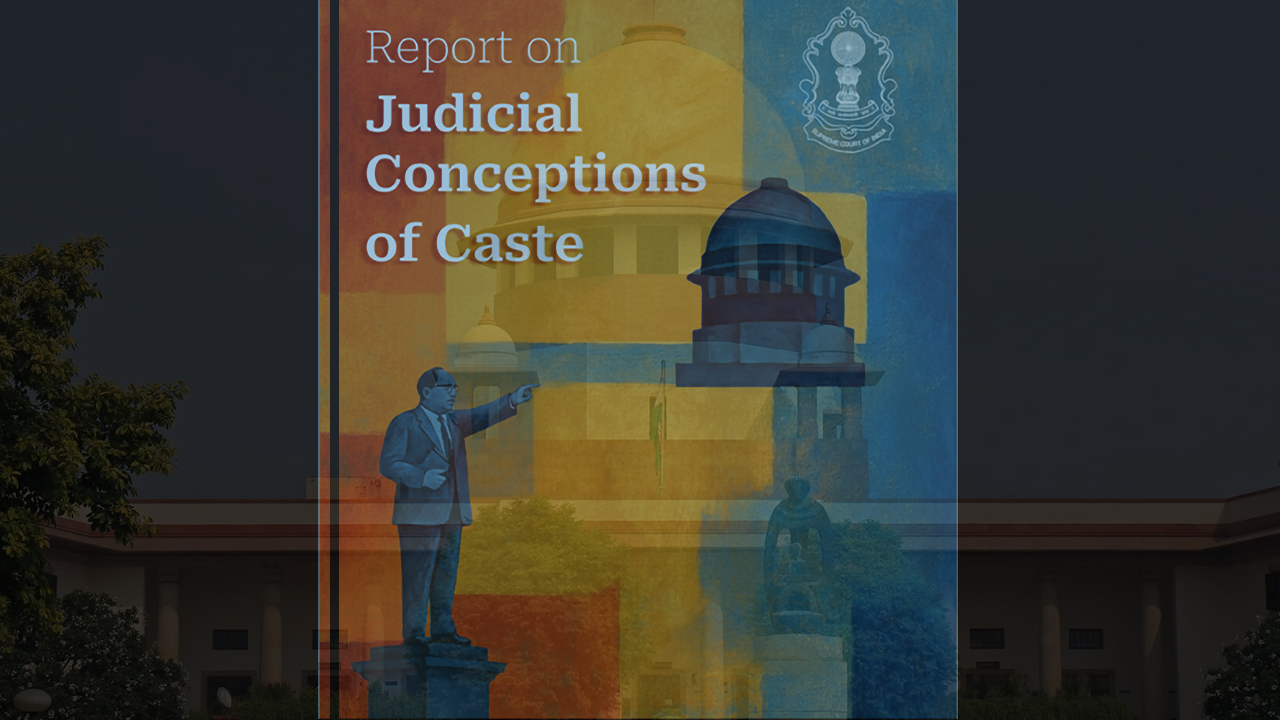
The Supreme Court’s Centre for Research and Planning (CRP)’s groundbreaking new report examines how the Apex Court itself has spoken about caste over the past 75 years. By analysing the language used in major Constitution Bench judgments—from Champakam Dorairajan (1951) to State of Punjab v. Davinder Singh (2024)—the report reveals a judiciary wrestling not just with law, but with the vocabulary of inequality itself.
Groundxero | Nov 23, 2025
The Supreme Court of India’s Centre for Research and Planning (CRP) has released a landmark report analysing 75 years of judicial discourse on caste, tracing how the apex court has described caste, spoken about oppressed communities, and approached caste-based remedies in Constitution Bench judgments of five or more judges from 1950 to 2025. The 60-page report, authored by Dr. Anurag Bhaskar, Dr. Farrah Ahmed, Bhimraj Muthu and Shubham Kumar, is the first systematic attempt by the court’s own research unit to map the language and interpretive choices judges have used while deciding seminal caste cases.
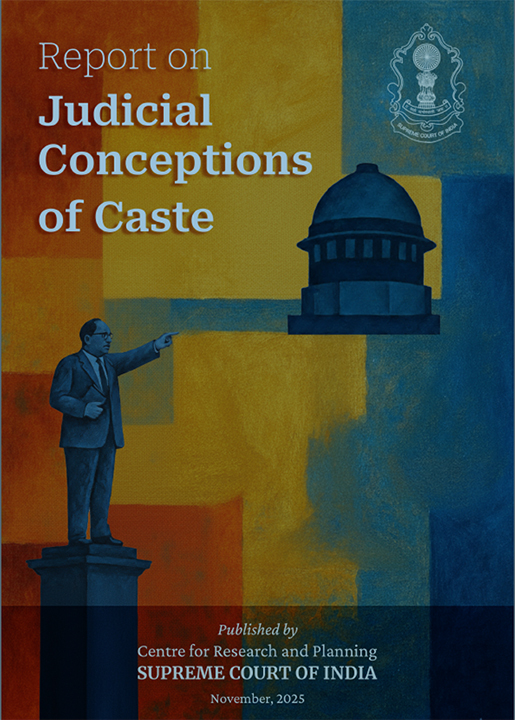
The report shows how judicial descriptions of caste have oscillated between empathy and paternalism, insight and misconception, progressive constitutionalism and outdated social assumptions. In doing so, it offers a rare self-reflective look at the Supreme Court’s role in shaping, and sometimes distorting, the nation’s understanding of caste and equality.
The report makes it explicitly clear that it aims not to critique individual judges, but to sensitise the judiciary, policymakers, and the public to how judicial vocabulary shapes constitutional understandings of equality and social justice. The judicial descriptions of caste and of marginalised groups influence how the law imagines dignity, equality, merit, and the role of the State in undoing historical wrongs and facilitating inclusive development.
The report acknowledges the institutional limits of commentary by a body within the Supreme Court system.
The report organises seven decades of jurisprudence into three broad themes:
1. Judicial Conceptions of the Caste System
The report finds that the Court has exhibited strikingly divergent understandings of what caste is. While some judgments recognise caste as a rigid, hereditary hierarchy based on notions of purity and pollution, rooted in the traditional varna system others describe caste as an ancient occupational order or even as a voluntary association. Still others treat caste as a phenomenon limited to Hinduism, while many judgments acknowledge caste-like hierarchies across religions.
2. Judicial Characterisations of Oppressed Castes
Perhaps the most sobering section of the report is its catalogue of the judiciary’s own metaphors. The report documents how, particularly in early decades, judges of the SC relied on metaphors equating reservations with “crutches”, describing backward classes as inherently “handicapped”, or implying that their presence would naturally lower administrative standards. This is not merely offensive vocabulary. It shapes jurisprudence.
By speaking of caste disadvantage as though it were a personal deficiency rather than the result of structural oppression, the Court historically reinforced the very stereotypes it was charged with dismantling. However, the Court has also made powerful affirmations: recognising historical exclusion, rejecting the merit–reservation binary, and emphasising dignity and agency. Progressive strands include statements underscoring that the “weaker sections” demand rights, not charity, and that affirmative action is an entitlement, not benevolence.
The report call for linguistic reform and use of alternative vocabulary is more than aesthetic. Use of terms like “structural inequality”, “historical disadvantage”, and “systemic exclusion” rather than “handicap” situate the problem where it belongs: in society’s barriers, not in people’s bodies or communities.
3. Judicial Discourse on Remedying Caste Injustice
Across cases on reservations, the Court has oscillated between competing visions of how to dismantle caste inequality. The report also exposes the ideological tug-of-war in the Court’s thinking on remedies.
Education as a solution: Some opinions have suggested caste would fade with education and “qualification,” a proposition the report critiques as overly idealistic and unsupported by empirical realities of discrimination and persistence of caste bias in universities and public services, and the heartbreaking trail of campus suicides by Dalit and Adivasi students.
Reservations as equality instruments: Another major strand of judgments articulate reservation as a constitutional obligation—an instrument of restoring equality, not granting favours. Key judgments affirm that equality and efficiency can coexist and that merit itself is socially constructed, not an innate trait.
Poverty vs caste: A contrasting line of cases downplays caste, attributing backwardness to poverty alone. The report notes such views lack empirical grounding and risk obscuring caste’s structural role in producing inequality. Other judgments—like those by Justices Chinnappa Reddy and Pandian—explicitly link caste to entrenched poverty and argue caste is not incidental to poverty; it structures it.
Beyond reservation: Reservations alone are not a panacea, the report notes, and several judges have echoed this. Some judges emphasise the need for broader social and economic development, arguing that reservation alone cannot correct historical injustice. This includes calls for investments in education, healthcare, nutrition and housing to ensure oppressed groups can fully utilise opportunities.
Recent discourse also points to the responsibility of private employers in dismantling caste discrimination, especially in an increasingly liberalised economy.
Conclusion
The report concludes that judicial engagement with caste is neither uniform nor static. Instead, it reflects layered and often contradictory approaches, influenced by shifting social understanding and judicial philosophy. It reflects something deeper: a court trying to interpret caste while being shaped by caste-consciousness itself. When judges reach for scripture to explain caste, or speak of ancient hierarchies as though they were relics and not living realities, the Constitution’s promise of substantive equality risks being filtered through outdated social lenses.
The CRP’s work is a reminder that constitutional justice is as much about vocabulary as it is about verdicts.
It highlights:
- The normative power of judicial language in shaping ideas of dignity, equality, merit and justice.
- The coexistence of transformative constitutional discourse with outdated, paternalistic vocabulary.
- The need for a context-sensitive, historically informed judicial vocabulary aligned with the Constitution’s ideals of substantive equality.
- The importance of rejecting outdated terms (like “Harijan” or “primitive”), interrogating inherited assumptions, and foregrounding caste as a continuing constitutional concern.
The report ends with a simple but profound call: adopt language that affirms dignity, recognises structural injustice, and reflects the Constitution’s transformative promise.
It is, in a sense, a call for the Court to rewrite itself.
________________
Pdf of the report is attached here.