
On 26 November, on the fifth anniversary of the 2020–21 farmers’ movement, SKM, CTUs and worker unions through nation-wide mass action, seeks to launch a protracted, massive pan-India struggle to confront the authoritarian, pro-corporate, communal policies and press for the basic people’s demands.
Groundxero | November 19, 2025
Samyukt Kisan Morcha (SKM) leaders addressed an online Press Conference today to announce mass protest demonstrations of farmers and workers at state and district level across India on 26th November 2025 to mark the 5th year of the beginning of the historic farmers’ struggle at Delhi borders.
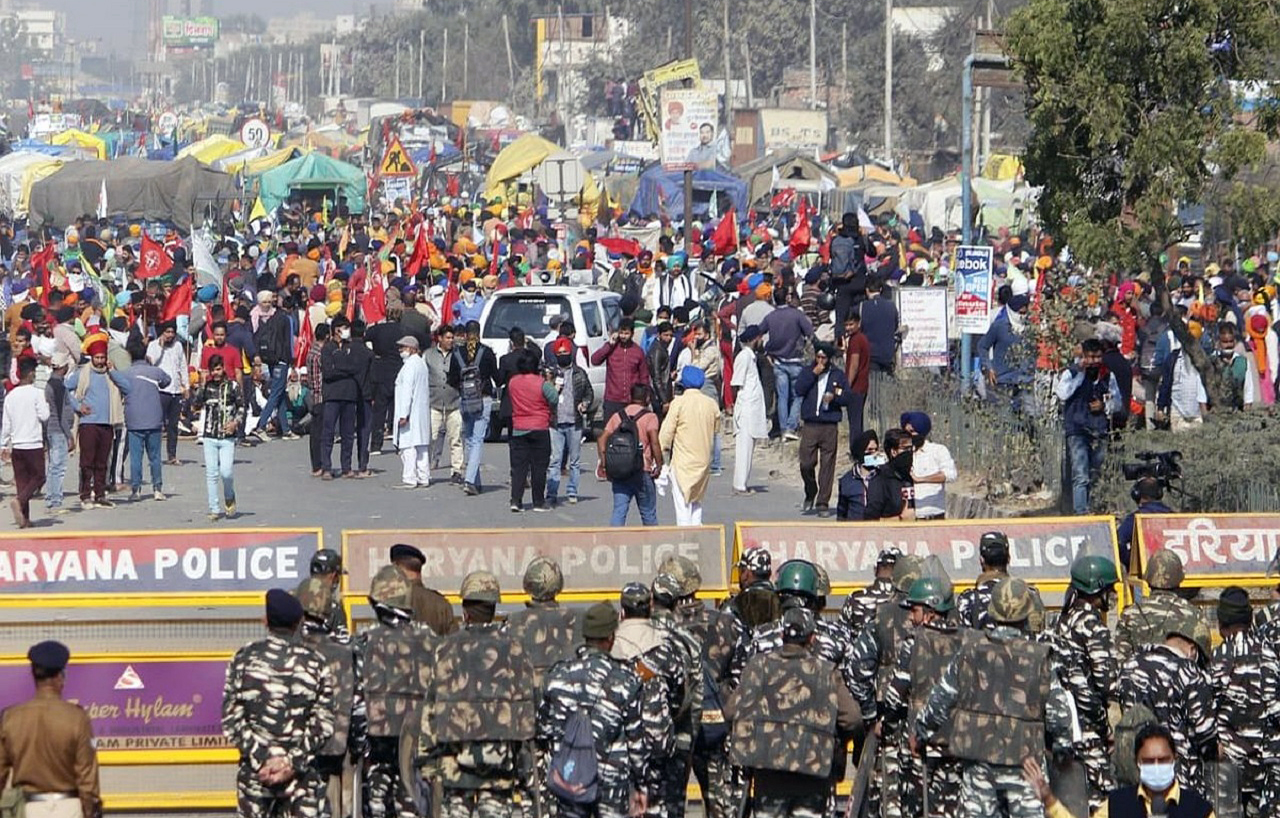
Five years have passed since the historic morning of 26 November 2020, when thousands of farmers from Punjab, joined by their brethren from Haryana, Uttar Pradesh and beyond began their march towards Delhi, initiating what would become one of the largest and longest sustained mass movements in independent India. The farmers lifted the siege to Delhi in November 2021 only after the BJP-led Union government gave a written assurance to withdraw the three pro-corporate and anti-people Farm Laws in Parliament.
SKM reminded that 736 people—farmers, workers and supporters—were martyred during the 380-day sit-ins around Delhi. Five years since, the core demands that powered that historic agitation remain unfulfilled even today. SKM sees the current moment as a dangerous convergence of agrarian crisis, authoritarian governance and corporate-driven economic policy. And on 26 November 2025, farmers and workers across the country will hold coordinated state- and district-level demonstrations to mark the fifth anniversary of the historic movement and “renew the struggle”. The call was given by Samyukt Kisan Morcha (SKM), Central Trade Unions (CTUs) and other unions of workers and agricultural workers.
Leaders participating in the press meet included Rakesh Tikait, Dr. Ashok Dhawale, Balbir Singh Rajewal, Rajan Kshirasagar, Vadde Shobenendra Rao, Dr. Sunilam, Satyawan, Prem Singh Gehlavat, Kanwarjit Singh, Indrajit Singh, Sufal Kumar Mahato and Ramesh Mahapatra and others. The farmer leaders emphasised that the November 26 protests would be held jointly with central trade unions (CTUs), agricultural labour unions and other workers’ organisations.
Government Betrayal, Unmet Demands
SKM leaders say that implementation of the written assurances given to them on 9 December 2021 has simply not materialized, particularly the promise of a legal guarantee for MSP at C2+50%. “Though five years have passed, PM Narendra Modi just formed a committee, but yet to implement the written assurances on MSP@C2+50%, debt relief and privatisation of electricity given to SKM on 9th December 2021,” the press note said.
SKM pointed out how the farmers in India are reeling under near complete collapse with distress sale of their produce. The press note cited the steep gap between existing MSPs and actual market prices, especially for paddy, cotton and maize. Paddy, with an MSP (A2+FL+50%) of RS 2,369 per quintal is reportedly selling at just RS 1,400. Cotton, with an MSP of Rs 7,761 per quintal, is being sold at approximately Rs 6,000. Maize, whose MSP should be around Rs 2,400 per quintal, is selling for about ₹1,800. Paddy MSP as per C2+50% formula demanded by the SKM should be Rs. 3012 per quintal.
SKM leaders also alleged that the Modi government has waived Rs.16.41 lakh crores of corporate debt in over the last 11 years but “not a single rupee” of farmer debt has been written off.
The demands: From MSP to labour codes, FTAs to federalism
On 26th November 2025, SKM and CTU’s, other unions of workers and agricultural labourers, reflecting a widening coalition between farmers, workers, agricultural labourers and public-sector employees will organise massive demonstrations at the state/district level.
The main demands are:
- A law guaranteeing MSP at C2+50% with assured procurement: Immediately enact a law to realize MSP@C2+50% with guaranteed procurement. (Due to no procurement system, farmers are forced to sell crops at distress rate of below 30% of the MSP based on A2+FL+50% approved by the Union cabinet)
2. Comprehensive loan waivers: SKM urge that rising indebtedness, frequent crop failures and predatory recovery practices by Micro-Finance Institutions (MFIs) have created a cycle of unending distress, particularly for marginal farmers and tenant cultivators. The farmer unions demanded the Union Government to declare a Comprehensive Loan Waiver Scheme for farmers and agricultural workers, enact law to regulate MFIs, interest rates, and end harassment of borrowers.
3. No privatisation of electricity and Public Sector Units (PSUs): SKM has demanded a stop to privatization of electricity and PSUs, and repeal of the Electricity Bill 2025. It has opposed the installation of pre-paid Smart Meters, and demanded 300 units of free electricity per month to all households.
4. Protecting sovereignty in trade policy: SKM asked the government to treat imposition of 50% US Tariff on India as violation of India’s sovereignty, and urged it take to strict reciprocal action. It reiterated its opposition to Free Trade Agreement (FTA) that hurt the interests of farmers and workers. It demanded the government to repeal the notification that scrapped 11% import tariff on cotton. And withdraw the draft Seed Bill 2025.
5. Repeal the four Labour Codes and protect the right to minimum wage.
6. Natural calamity compensation and recognition of severe floods as national disasters: SKM demanded the release Rs. 1 lakh crore compensation for all calamity-affected states and Rs. 25,000 crore to Punjab. It urged the government to protect the right to compensation of tenant farmers and agricultural workers.
7. 200 days of work MGNREGS: SKM has demanded the government to ensure 200 days of work annually and Rs.700 as daily wage for MGNREGS workers and linking the scheme with agriculture and dairy to benefit farmers. It asked the government to end the ban on recruitment, outsourcing and contractualization of permanent jobs, and immediately fill the 65 lakh vacant posts in government and the public sectors. It also demanded reinstatement of Old Pension Scheme, and strict implementation of social reservations for SC/ST/OBC/Minorities.
8. Land rights and opposition to “Bulldozer Raj”: SKM criticises the indiscriminate acquisition of agricultural land without due process or compensation, demanding full compliance with the LARR Act of 2013.
Seeds Sovereignty
SKM has strongly demanded the withdrawal of the draft Seed Bill 2025 that it accuses of surrendering “the seed sovereignty of India and is aimed at predatory pricing by the corporate monopolies.” They argue the Bill will open the door for corporate monopolies to fix seed prices and control the seed market in India.
It has also warned the Union government against conceding on harmful clauses in the summit to be held in Lima, Peru from 24th to 29th November on the International Treaty on Plant Genetic Resources for Food and Agriculture (ITPGRFA).
“Strong States for Strong India”
An important, and increasingly political, dimension of SKM’s campaign under the slogan “Strong States for Strong India,” is to turn federalism itself into a mass issue and launch pan-India struggles to safeguard the federal rights of states.
SKM has demanded increase of state share in the divisive pool (including cess and surcharge) from the current 31% to 60% and amend the GST Act to reinstate taxation power of states.
SKM argued that financial autonomy of the states is necessary to realize MSP and minimum wage through augmenting public investment to modernize agriculture, build agro-industries and share the surplus out of processing, value addition and trade on all crops, thus to end agrarian crisis, peasant suicides and distress migration.
SKM declared that it will resist the National Cooperation Policy (NCP), New Education Policy (NEP), National Policy Framework on Agriculture marketing (NPFAM) and Electricity Bill 2025 that trespass on powers of states.
Democracy in danger
Moving beyond agricultural issues, SKM’s statement also addresses the health of India’s democratic institutions. The press note stated that SKM recognizes that democracy is facing a dangerous situation under BJP-NDA rule and “authoritarian laws are being used to suppress free speech and political dissent.”
Hence it appeals to all political parties to strongly demand:
- replacing the Home Minister with the Chief Justice of India in the panel selecting Election Commissioners,
- public funding of elections,
- repealing laws like UAPA and the Public Safety Act,
- ending the practice of detaining people for years without charge-sheets,
- amending the new penal codes, which, SKM argues, expand police powers and shrink civil liberties.
The unions also accuse the BJP and NDA of deepening communal and caste divisions to facilitate “corporate takeover of agriculture and the entire economy.” Demanding to free all the institutions of governance, including judiciary and bureaucracy, from communal influence, SKM said that it will actively strive for a proactive people’s movement to protect secular unity especially Hindu- Muslim Unity.
This wide political spectrum reflects a belief within SKM that agrarian distress cannot be separated from the attack on the country’s democratic institutions. SKM announced that farmers and workers will organise meetings, conventions, padayatras, cycle yatras, village level general bodies, leaflet distribution, door to door campaigns to support the 26th November protest. In their words, these efforts are meant to “connect local grievances to national policy demands”—from distress sale of crops and land acquisition to prepaid smart meters and lack of compensation for natural disasters.
Renew of Mass Struggle
The message from SKM is clear: the issues that triggered the historic farmers’ movement—agrarian crisis, corporate takeover of agriculture, collapse of rural incomes—have only worsened. The farmer unions intent to fight, once again, jointly with the workers.
As the press conference ended, one of the senior farmer leaders said, “Five years ago, we marched to Delhi because we had nothing left to lose. Today, the crisis is deeper. Our unity must be stronger.”
On 26 November, on the fifth anniversary of the 2020–21 farmers’ movement, SKM, CTUs and worker unions through nation-wide mass action, seeks to launch a protracted, massive pan-India struggle to confront the authoritarian, pro-corporate, communal policies and win the basic people’s demands.
________________
Feature Image: Haryana Police barricade roads to prevent farmers from marching to Delhi during the 2020–21 farmers’ movement.