
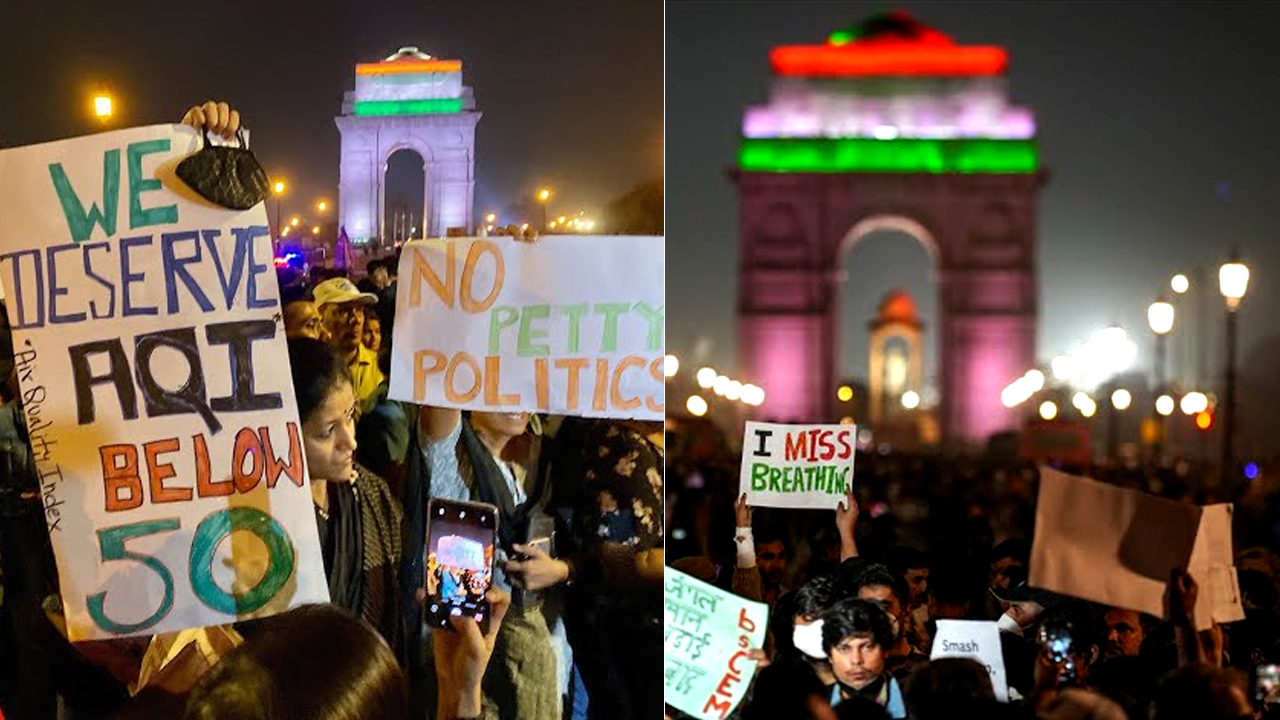
NACEJ strongly condemns the abject failure of the Government in systemically addressing the air pollution crisis and the brazen, arbitrary detention of peacefully protesting citizens, organizing against this public health catastrophe. It said Delhi NCR pollution crisis needs firm policy shifts and institutional action against prime polluters, not citizens. Restore Fundamental Right to Breathe!
Groundxero | November 12, 2025
As Delhi’s air quality plunged to its worst level in four years, the National Alliance for Climate and Ecological Justice (NACEJ) — a pan-Indian forum under the National Alliance of People’s Movements (NAPM) — has strongly condemned the government’s “failure to systemically address the air pollution crisis” and the “brazen, arbitrary detention” of peacefully protesting citizens, students, parents, environmentalists, workers and activists, who are courageously organizing against this public health catastrophe.
In a sharply worded statement issued on Wednesday, NACEJ said the Delhi government’s decision to use police force against peaceful demonstrators on November 9 “violates democratic rights and disregards the dire public health emergency” faced by millions in Delhi-NCR. The group demanded the immediate release of detained protestors, the withdrawal of any cases filed, and a public apology from the Chief Minister.
NACEJ urged the Delhi and the Union governments must immediately recognize the magnitude of this public health emergency and the legitimate outrage of the people of Delhi-NCR, instead of treating it as a ‘law and order issue’ or a political blame game. It said that unchecked governance failure-fuelled has directly led to record-breaking pollution, with hazardous air choking the region and pushing public health to the brink.
The NACEJ statement called the current crisis as not just an environmental failure, but a governance and human rights issue. It accused both the Delhi and Union governments of evading responsibility through “blame games” over stubble burning and political rivalries, instead of taking decisive, year-round measures.
The NACEJ statement said:
Despite years of crisis and public outcry, air pollution remains a severe and escalating public health hazard, with Delhi NCR and several other Indian cities suffering the world’s worst air quality. This crisis causes millions of preventable deaths and immense economic losses, while disproportionately impacting poor and marginalized communities, outdoor and informal workers, women, elders, children and those living in congested or industrial areas. Government actions have consistently excluded the most vulnerable, widening environmental injustice.
While the government often blames farm fires in Punjab and Haryana for Delhi’s winter smog, NACEJ cited recent scientific studies from IIT Kanpur (2023) showing that the dominant pollution sources are vehicular emissions, industrial discharge, road dust and construction waste, with stubble burning contributing only seasonally.
“Vilifying farmers while subsidizing major polluters like the automobile and waste incineration industries is unjust and unscientific,” NACEJ said. “The air crisis is rooted in structural failures — poor urban planning, unregulated industry, weak enforcement and an utter disregard for public health.”
The alliance alleged that some authorities tampered with air-quality data — including the use of water sprinklers near monitoring stations to artificially lower readings. Such practices added to citizens’ anger, and destroy public trust and delay meaningful action, the statement said.
“Those who can afford air purifiers escape indoors, but the poor — construction workers, hawkers, rickshaw drivers — breathe poison daily,” said Medha Patkar of the Narmada Bachao Andolan and NAPM. “Air pollution in Delhi is a mirror of India’s inequality and ecological injustice.”
Economic losses, NACEJ noted, run into billions of dollars each year due to lost productivity and healthcare burdens. According to Lancet Planetary Health (2024) estimates, air pollution contributes to over 1.6 million premature deaths annually in India, with Delhi consistently ranking among the world’s most polluted cities.
Delhi’s Air Crisis by Numbers
- 675 µg/m³ — Peak PM2.5 concentration recorded post-Diwali 2025, the highest in four years (CPCB data).
- 30+ days — Number of days Delhi’s air quality remained in the ‘Severe’ or ‘Hazardous’ category in October–November 2025.
- >90% — Delhi’s population living in areas where annual PM2.5 levels exceed WHO safe limits by tenfold or more.
- 40% — Approximate share of Delhi’s pollution attributed to vehicular and industrial emissions, as per IIT Kanpur Source Apportionment Study (2023).
- 6,000 tonnes/day — Estimated construction and road dust generated within Delhi NCR, a persistent year-round pollutant.
The alliance outlined a comprehensive set of policy measures to tackle the crisis, urging the government to move beyond symbolic actions.
The Key NACEJ demands are:
- Year-Round Clean Air Action Plan: A transparent, time-bound strategy with clear accountability of all statutory authorities for air-quality management.
- Strengthen Public Transport: Massive investment in metro, bus and surface rail networks, and integrated Bus Rapid Transit (BRT) corridors to reduce private vehicle use.
- Phase Out Diesel Vehicles: Immediate ban on non-BS6 diesel vehicles and removal of diesel subsidies for private cars and SUVs.
- Permanent Ban on Firecrackers: Enforce a year-round prohibition and create a transition plan for affected firework-industry workers.
- Regulate Waste-to-Energy (WTE) Plants: Classify all WTE units as ‘Red Category’ industries; stop new approvals near residential and ecologically sensitive areas.
- Real-Time Data Transparency: Ensure public access to credible, real-time air-quality and health data across all monitoring stations.
- Dialogue, Not Detention: End the criminalization of peaceful environmental protests; create structured platforms for civil society consultation.
________________
The National Alliance for Climate and Ecological Justice (NACEJ) is a pan-Indian initiative of the National Alliance of People’s Movements (NAPM). It brings together community activists, ecologists, scientists, and environmental researchers from across states to advocate for climate action rooted in human rights, justice, and co-existence of all species.
Signatories to the statement include Medha Patkar (NAPM & Narmada Bachao Andolan), Alok Shukla (Chhattisgarh Bachao Andolan), Apoorv Grover (People for Aravallis, New Delhi), Dr. Babu Rao (Scientists for People, Telangana), Disha Ravi (Fridays for Future India), Dr. Gabriele Dietrich (Penn Urimay Iyakkam), Meera Sanghamitra (NAPM Telangana) and many other environmental activists from across the country.