
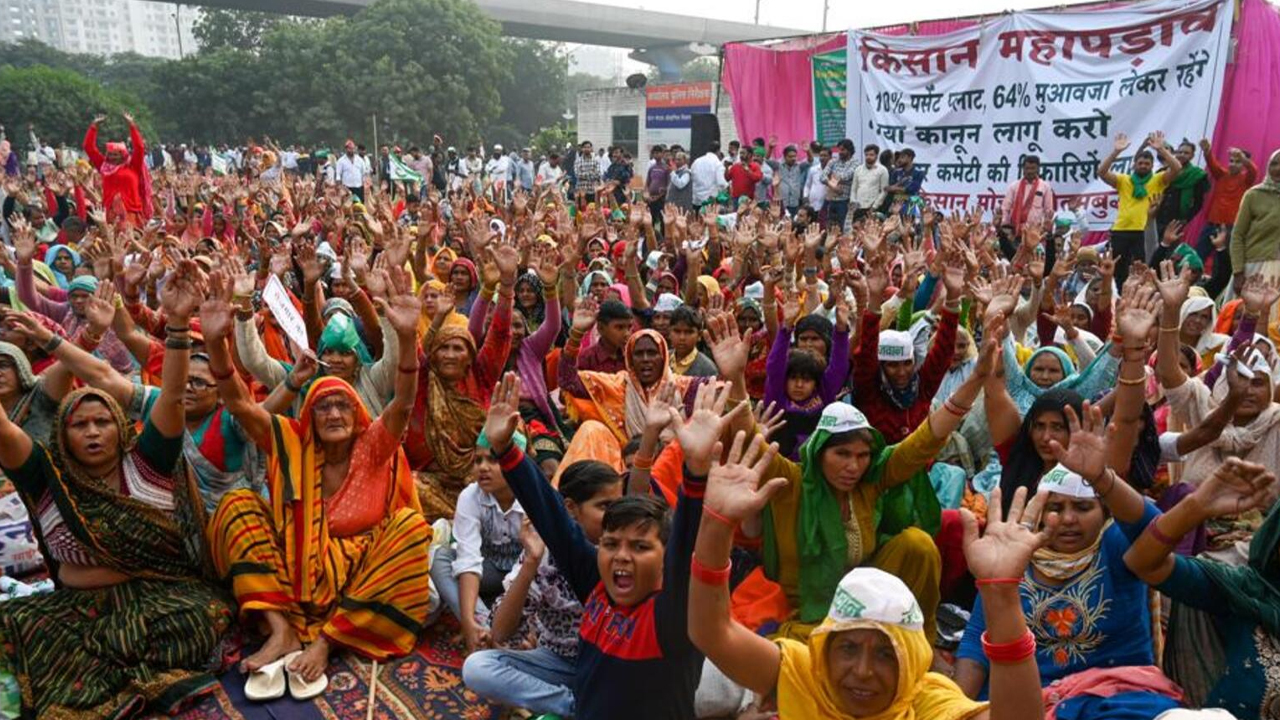
SKM alleges government behaving like a real estate agent; profited massively from reselling land to corporates acquired from farmers at throwaway prices. Farmers to hold a Mahapanchayat at Sohna on November 6 over ‘Haryana Model of Land Trade’.
Groundxero | Nov 5, 2025
The Samyukt Kisan Morcha (SKM) has called for a massive Mahapanchayat on November 6 at IMT Sohna in Nuh district, Haryana, to protest what it describes as a “Haryana model of land trade” — where the state acquired farmland at low prices from the farmers and later sold it to corporations at exorbitant rates.
The protest centers around the acquisition of about 1,600 acres of land between 2010 and 2012 by the Haryana State Industrial and Infrastructure Development Corporation (HSIIDC) from nine villages between Sohna and the Kundli–Manesar–Palwal (KMP) Expressway in the Mewat region.
According to SKM, the farmers have been fighting the acquisition for 13 years, alleging both legal irregularities and massive economic injustice. “This is a case where the State has turned land acquisition — meant for public purpose — into a profit-making business model,” the farmers’ body said in a statement issued on Tuesday.
The Price Gap: From Rs 46 Lakh to Rs 23 Crore
The dispute traces back to the compensation rates fixed at the time of acquisition. Farmers in Roz-ka-Meo and adjoining villages were initially offered Rs 25 lakh per acre, which was later increased to Rs 46 lakh per acre following widespread protests.
In contrast, the prevailing market rate for developed land in nearby areas at the same time was around Rs 2 crore per acre, as determined by a court order in Chandawali village.
Over the years, the difference between what farmers received and what the government later earned has widened dramatically. According to SKM and local reports, HSIIDC is now selling developed industrial plots in IMT Sohna for between Rs 13 crore and Rs 18 crore per acre, with some registries recording transactions as high as Rs 23 crore per acre.
“The land that was forcibly acquired from farmers under the guise of development has become a commodity for corporate profiteering,” the SKM said. “The government bought it cheap and is now selling it at commercial rates — it’s farmers’ loss and government’s profit.”
The Controversial Agreement
At the heart of the legal battle is an agreement or affidavit signed by many affected farmers in 2012, which barred them from seeking judicial review of their compensation. SKM alleges that the district administration and HSIIDC officials coerced farmers into signing these documents as a precondition for receiving the revised compensation.
Under the Land Acquisition Act, 1894, landowners dissatisfied with compensation have a statutory right under Section 18 to approach a civil court for a fair determination. This right cannot be waived through coercion or duress, legal experts have noted.
“Any such waiver of a statutory or fundamental right obtained under pressure is invalid in law,” said an SKM representative. “The entire exercise of forcing farmers to sign away their right to judicial review renders the agreement null and void.”
Farmers’ unions say the document was presented as a “no-objection affidavit,” but few understood that it would restrict their ability to challenge compensation rates in court. “We were told we had to sign if we wanted to receive the increased rate,” said a farmer leader from Roz-ka-Meo. “We signed under pressure, not consent.”
From Land Acquisition to ‘Land Trade’
SKM has accused the BJP-led Haryana government and senior HSIIDC bureaucrats of institutionalising profiteering at the expense of the farmers through land acquisition.
“This is not industrial policy — this is state-sponsored land trading,” said SKM in its statement. “The government’s role should be to ensure equitable development, not to behave like a real estate agent reselling farmers’ land to corporates for profit.”
The farmer unions collective claimed that the government has rebranded the exploitation of farmers as a model of industrial growth. “The so-called ‘Haryana Model’ has become a euphemism for dispossession,” said a senior SKM functionary.
Farmers in Nuh and Mewat districts have long argued that industrial corridors like IMT Sohna have failed to deliver local employment or basic civic facilities, even as land prices skyrocketed for private investors and developers.
Demands of the Farmers:
The Joint Action Committee of the nine affected villages has listed a comprehensive set of demands, which SKM has endorsed and is rallying around at the upcoming Mahapanchayat on Nov. 6. These include:
- Immediate cancellation of the 2012 agreement denying farmers’ right to judicial review, and official notification of its withdrawal by the state government.
- Additional compensation of Rs 2 crore per acre in line with market value escalation and court precedents.
- Residential plots of 400 square metres for land-owning families and 200 square metres for landless families.
- Guaranteed employment to all affected families in industries and services established in IMT Sohna.
- Comprehensive civic infrastructure, including drinking water, drainage, power supply, schools, hospitals, playgrounds, community centres, libraries, and industrial training facilities within the IMT area.
“These are not unreasonable demands,” said SKM. “They are basic rights under the Right to Fair Compensation and Transparency in Land Acquisition, Rehabilitation and Resettlement (LARR) Act, 2013.”
Legal and Policy Context
The IMT Sohna issue is not isolated. Haryana has faced several land acquisition disputes in recent years, with farmers alleging that land earmarked for public purposes was later sold or leased to private corporations.
Under the LARR Act, 2013, which replaced the archaic 1894 law, land acquisition is required to ensure transparency, rehabilitation, and consent. However, since the IMT Sohna acquisition took place before the new law came into effect, the farmers’ claims rest on a mix of contractual invalidity and denial of judicial rights.
Legal experts point out that even under the old Act, farmers retained their right to contest compensation, and any coercive waiver of that right could be challenged in court. “The statutory right to judicial review cannot be taken away by administrative order or conditional compensation,” said a Delhi-based lawyer familiar with land litigation cases.
A Decade-Long Struggle
The affected farmers have held numerous protests and petitions since 2012. Multiple delegations have met government officials seeking compensation parity and rehabilitation, but progress has been limited.
The SKM, which emerged as a major farmers’ coalition during the 2020–21 farm law protests, said it stands “in full solidarity” with the Sohna IMT Land Struggle Committee. “We will not let the exploitation of Haryana’s farmers go unnoticed,” the organisation said.
Local leaders said the upcoming Mahapanchayat aims to unify farmers across the state around the issue of land justice, similar to the earlier mobilisation against the farm laws. “The fight is not just for Nuh — it’s for every farmer whose land is treated as a profit source,” said one organiser.
Call for Negotiation and Accountability
In its statement, SKM appealed to the Haryana government, the Nuh district administration, and HSIIDC officials to begin immediate dialogue with the farmers’ Joint Action Committee.
“The government must show good faith by cancelling the invalid agreement, restoring farmers’ legal rights, and negotiating fair compensation and rehabilitation terms,” SKM said.
“This is not merely a land dispute — it is a question of justice, dignity, and constitutional rights,” SKM declared. “The State must prove that development does not mean dispossession.”
The Mahapanchayat on November 6 at IMT Sohna is expected to draw thousands of farmers from Haryana, Rajasthan, Punjab, and western Uttar Pradesh. Organisers said the protest will remain peaceful but firm in its demand for justice.
“We want to show that the land beneath our feet is not for sale to profiteers,” said a farmer from Nuh. “It is our livelihood, our right, and our future.”
________________
With inputs from the Samyukt Kisan Morcha (SKM), and local farmer representatives in Nuh district. The SKM is a joint platform of over 40 farmer unions, which led the historic year-long farmers’ protest against the three central farm laws in 2020–21. SKM continues to coordinate nationwide movements on agrarian, environmental, and livelihood issues.
Feature Image is representative.