
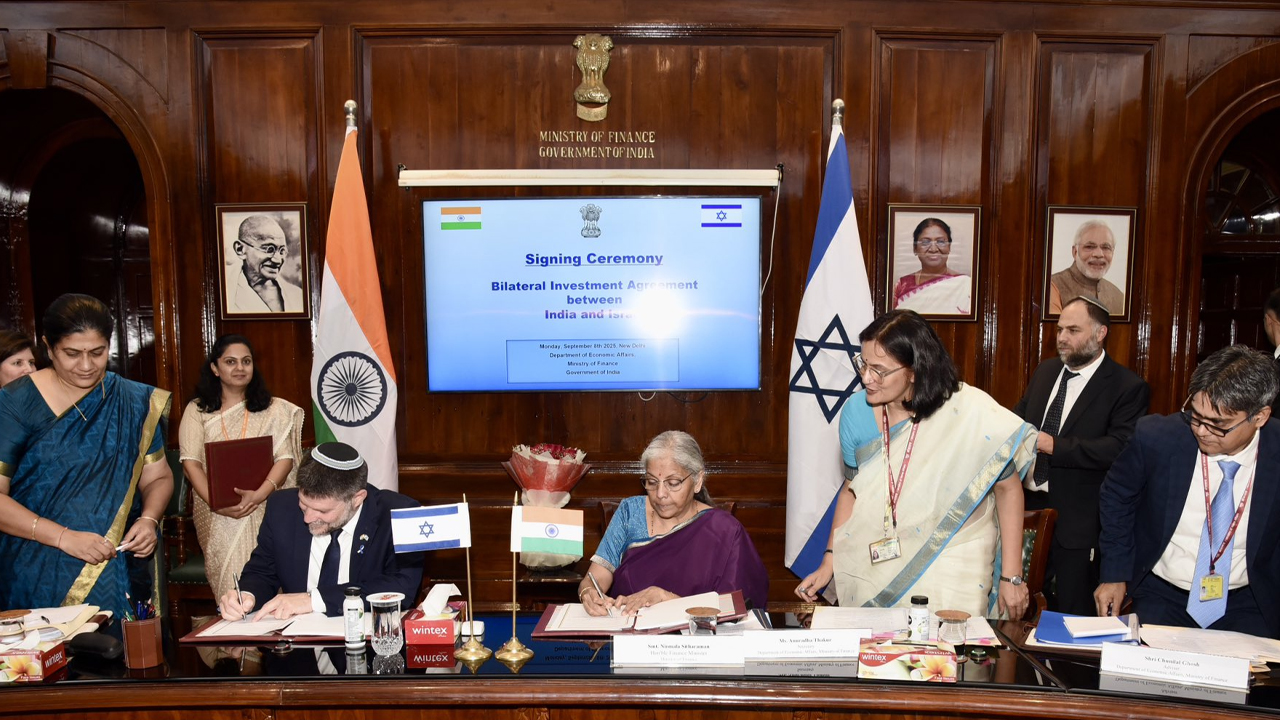
The hosting of Smotrich by New Delhi is not simply a diplomatic faux pas. It is a deliberate act that aligns India’s domestic trajectory of majoritarian authoritarianism with Israel’s colonial occupation.
Arkadeep Goswami
Groundxero | Sep 9, 2025
On 8 September 2025, New Delhi became the stage for a moment of profound moral abdication. India’s Finance Minister Nirmala Sitharaman signed a Bilateral Investment Agreement (BIA) with Israel’s Finance Minister Bezalel Smotrich—a man widely recognized not as a statesman, but as one of the most dangerous proponents of genocide in the contemporary world. For the government of India to extend a red carpet welcome to Smotrich is not merely a matter of misguided diplomacy. It is a declaration that the Indian state, under the hegemony of Hindutva, is willing to discard the legacies of anti-colonial struggle in favor of an alliance with an apartheid regime, a rogue state that thrives on occupation, dispossession, and the weaponization of terror.
This embrace was made even more grotesque by the timing. Smotrich’s visit occurred as Israel escalated its war of annihilation against the Palestinian people, expanded its annexationist ambitions in West Asia, and—in a brazen act of international aggression—launched strikes against Qatar, a state that had been mediating humanitarian aid, release of hostages and ceasefire. For India, a country that once prided itself as a leader of decolonizing nations, to host and normalize such a figure marks a betrayal not just of Palestine, but of the entire anti-colonial tradition.

The Agreement as a Political Signal
Officially, the Bilateral Investment Agreement was presented as a technical achievement: India’s first such treaty with a member of the Organization for Economic Cooperation and Development (OECD). It promises legal protections for investors, mechanisms for dispute resolution, and closer cooperation in fintech, digital payments, and innovation. The Ministry of Finance described it as a “landmark moment” in bilateral relations.
But to view this event only through the narrow lens of economics is to miss its political essence. Every treaty is a statement of values, and this one was signed with an individual sanctioned by numerous countries—including the UK, Canada, Australia, New Zealand, Norway, Slovenia, the Netherlands, and Spain—for openly inciting ethnic cleansing of Palestinians. Smotrich has dismissed the very existence of the Palestinian people, called for the “erasure” of Palestinian villages, and is now directly involved in drawing maps for the annexation of large swathes of the West Bank.
By signing this treaty, India did not merely recognize Israel as a partner, it validated Smotrich personally, rehabilitating a man whom the international community regards as an architect of genocide. It told the world that profit and military partnership matter more to India than solidarity with oppressed peoples, human rights, or even international laws.
Smotrich and the Machinery of Terror
Smotrich’s political profile is well documented. As a leader of the Religious Zionist Party, he embodies the most extreme visions of settler colonialism: an unyielding commitment to permanent occupation, expansion, and demographic engineering. He has openly described Palestinians as a demographic threat, and his policies are designed to force their displacement through siege, bombing, and deprivation.
Israel’s assault on Gaza over the past year, in which tens of thousands of Palestinians have been killed, bears Smotrich’s imprint. He has framed the campaign not as a military conflict but as a war of elimination. His language and actions align with the classic patterns of settler colonial violence: to make life unlivable for the indigenous population so that “voluntary emigration” appears to be the only option.
This same logic of colonial terror was on display during Israel’s unprecedented airstrike on Qatar on Tuesday. By attacking a sovereign Arab state that has hosted ceasefire and hostage release negotiations, Israel flouted international law yet again. It confirmed its status as a rogue state, one that does not recognize the United Nations, treaties, or global norms when they obstruct its settler colonial project. Such behavior is not an aberration but a continuation of Israel’s historic reliance on terrorism—state terror as policy, collective punishment as doctrine, assassination and bombardment as diplomacy.
India’s Complicity and the Betrayal of Anti-Colonial Legacies
For India to host Smotrich in such a context is a crime of complicity. It signals not neutrality, but active partnership in the machinery of genocide. This partnership is not accidental. It arises from the ideological affinity between Zionism and Hindutva: two projects that reimagine nations as ethno-religious homelands, deny equal citizenship to minorities, and view pluralism as weakness.
Hindutva, since its inception, admired Zionism’s ruthless determination to create an exclusivist state. Vinayak Damodar Savarkar and M. S. Golwalkar openly praised the Zionist model of ethno-nationalism. In today’s political landscape, that admiration has matured into a strategic nexus. India imports Israeli weapons, surveillance technologies, and counterinsurgency doctrines, which are deployed not only against Pakistan but also against its own people in Kashmir, the Northeast, and increasingly against dissenting citizens nationwide.
Thus, the hosting of Smotrich is not simply a diplomatic faux pas. It is a deliberate act that aligns India’s domestic trajectory of majoritarian authoritarianism with Israel’s colonial occupation. It makes visible a transnational axis of repression: Hindutva and Zionism as partners in building states that define belonging by exclusion and maintain order through permanent war.
Palestine, West Asia, and the Decolonizing World
The tragedy is that this turn represents a radical rupture from India’s own historical commitments. During the era of anti-colonial struggle, India’s leaders understood Palestine not as a distant conflict but as part of a shared battle against imperialism. Mahatma Gandhi opposed the Zionist project as a colonial imposition. Jawaharlal Nehru supported Arab–Palestinian sovereignty as part of the Bandung spirit of solidarity among decolonizing nations.
By contrast, today’s Indian state has inverted that legacy. It identifies less with the peoples of West Asia who continue to resist occupation, and more with the occupying power itself. In doing so, India alienates itself from the broader postcolonial world—from Asia, Africa, and Latin America, where memories of anti-colonial resistance remain alive and where Israel is increasingly viewed as a pariah state.
For countries still struggling with neocolonial exploitation, the Indian government’s embrace of Israel appears as a betrayal: a former colony siding with a colonizer. It undermines the possibility of South–South solidarity and weakens the collective voice of decolonizing nations in global forums.
Israel as a Rogue State
The label “rogue state” is not an exaggeration. Israel has violated countless UN resolutions, annexed territory in defiance of international law, and institutionalized an apartheid system condemned by Amnesty International and Human Rights Watch. Its use of terrorism is systemic: from the bombing of refugee camps to targeted assassinations, from collective punishment through siege to the destruction of cultural heritage sites.
The airstrikes on Qatar are emblematic. It was not an act of defense but of aggression—meant to intimidate a postcolonial state that dared to provide diplomatic space for Palestinian survival. By striking Qatar, Israel effectively declared that no Arab or West Asian state is safe if it even puts any obstacle in the colonial project. This behavior is indistinguishable from the practices of rogue regimes throughout history.
The Moral Bankruptcy of Hindutva Pragmatism
Proponents of the India–Israel partnership often claim that it is driven by “pragmatism.” They argue that in a world of shifting alliances, India must seek technological and defense cooperation with Israel. But pragmatism without morality is simply opportunism. And when that opportunism makes you endorse even genocide of an entire population, it becomes complicity.
India’s rulers present themselves as global statesmen, yet their choices reveal provincial chauvinism. They seek validation not from solidarity with oppressed peoples but from proximity to colonial powers. They believe that aligning with Israel will win them favor with Western imperial centers. But in reality, such alignment isolates India from its own historical allies: the decolonizing nations whose struggles once mirrored its own.
Opposition and Voices of Resistance
Thankfully, this shameful alliance has not gone unchallenged within India. The Communist Party of India (Marxist) condemned the agreement as complicity in genocide. AIMIM leader Asaduddin Owaisi called the deal “despicable.” Civil society groups, student organizations, and Palestinian solidarity networks across India have denounced the government’s actions. While many of these acts of opposition is just symbolic in nature, in the time of genocide, every thing matters.
These voices remind us that the people of India are not identical with the policies of the Hindutva state. Just as there are Israelis resisting Zionism, there are Indians resisting Hindutva’s embrace of Zionism. The solidarity with the struggle of self-determination of Palestinians remains alive in India, rooted in the same anti-colonial consciousness that once animated the Non-Aligned Movement.
Toward a Postcolonial Reorientation
To resist this moral collapse, India must recover its postcolonial compass. That means remembering that anti-colonialism was never just about ejecting the British; it was about rejecting all forms of imperial domination. It means seeing Palestine not as a bargaining chip in foreign policy but as a mirror of India’s own unfinished struggles against dispossession, caste oppression, and authoritarianism.
A postcolonial perspective insists that the destinies of colonized and formerly colonized peoples are intertwined. When India legitimizes Israel’s genocidal ministers, it weakens not only Palestine but itself—because it affirms the colonial principle that might make right. By contrast, when India stands with Palestine, it reaffirms its own liberation story, its own moral claim to sovereignty and justice.
Conclusion: Choosing Sides in History
History will not remember the Bilateral Investment Agreement as a triumph of economic diplomacy. It will remember it as a moment when India stood at a crossroads and chose the wrong side. By hosting Bezalel Smotrich, India chose to side with apartheid over liberation, with colonialism over decolonization, with genocide over solidarity.
But history is not closed. The resistance of Palestinians continues. The conscience of the Indian people remains. Across Asia, Africa, and Latin America—the continents of anti-colonial resistance—the demand for justice still echoes. The question is whether India will return to that chorus, or whether it will persist in the shameful role it has now chosen: as an accomplice to a rogue state that is doing ethnic cleansing of Palestinians as policy and genocide as a medium to achieve it.
________________
Arkadeep is a political activist and writer based in Kolkata.