
The unprecedented series of attacks on Bengali speaking migrant workers in different states across the country are making headlines for the last one month. Particularly Bengali speaking Muslim migrant workers from West Bengal are being targeted as Bangladeshi infiltrators, detained, abused, and forced to leave from states like Odisha, Assam, Haryana and Delhi, where they had gone to earn their livelihood. The inhuman treatment meted out to these workers and their forcible ‘push back’ into Bangladesh in several instances is indicating that the very identity of being a Bengali is putting the life and security of the migrant workers at grave risk.
But if we trace back these incidents, we’ll see that it all started back in August-September 2024. News of lynching of migrant worker Sabir Mallik in Haryana, the murder of Pabitra Roy in Tamilnadu and many other such incidents of harassment and attacks on Bengali speaking migrant workers’ in different states were indications enough that the migrant workers from West Bengal were already under immense threat and risk.
Groundxero will be publishing a series of articles on attacks on migrant workers from West Bengal. In November 2024, Sudarshana Chakraborty from Groundxero spoke to Shakila Sardar Mallik, wife of the deceased Sabir Mallik. Today, we publish the transcription of her conversation with Sakila.
***
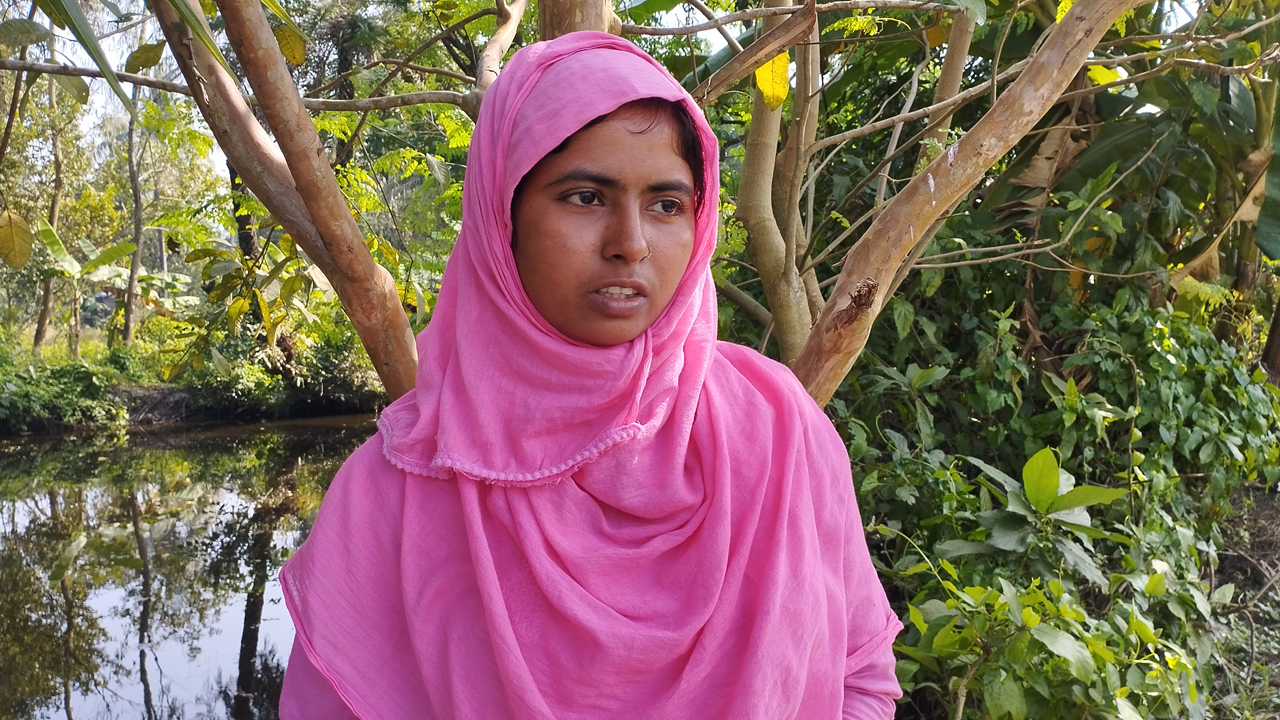
“Just six months back, he took us to the Kolkata zoo, he took me to Pune, Mumbai. He loved me a lot. Even if we had a fight, he would make up and would make me talk to him,” as 23 years old Sakila Sardar Mallik was saying this – reminiscing her days with husband Sabir Mallik, the migrant laborer from West Bengal, who was lynched by the ‘Gau Rakshak Vahini’ or the ‘Cow Vigilante Group’ in Haryana, over suspicion of cooking and eating beef, which has been proved a lie in the lab test report done on the confiscated meat from his shanty – her voice broke, tears rolling down from her swollen eyes. It was a sunny November morning in 2024, when I went to meet Sakila at her village home.
Sabir Mallik, a 22 years old migrant labourer was living with his wife and infant daughter in a shanty in Hansawas Khurd village in Charkhi Dadri district of Haryana. He was working as a rag picker. Unable to find any work in his home state of West Bengal after the Covid lockdown, he decided to leave with his family for a better future. On August 27, 2024 he was beaten to death over suspicion that he consumed beef. Though a lab test report done later found the meat found inside his shanty was not beef. Sakila confirmed it was not even cooked in their home. Till the day Sakila gave this interview, 10 persons were arrested in connection with the lynching, two amongst the arrested were juveniles. “He used to earn 300-400 rupees a day. Occasionally, I also joined him. But usually I used to stay back with our daughter, and look after the household. We were poor, but we used to live a very happy and peaceful life. How inhumanely and cruelly they had beaten him up and killed him…” Sakila couldn’t complete her words as she was sobbing inconsolably.

Sabir Mallik
It was November 15 when I met Sakila at her village home in South 24 Parganas district of West Bengal, close to Sundarban. It happened to be her daughter Sania’s birthday. The kid turned four on that day. But there was no celebration. It was like any other day in Sakila’s natal home, where she is staying nowadays with her parents, two sister-in-laws, their kids and elder brother. Her younger brother has returned back to his migrant worker’s life in Hyderabad, though he is now scared after what happened to his elder brother Sabir in Haryana.
At just 23 years old, Sakila has become much more calm, oriented and stronger. Her voice chokes continuously as she speaks, but soon regains strength and determination. The West Bengal government has provided her a job as office attendant in the Block Land and Land Reform office in Basanti block of the district, under the state government’s Department of Land & Land Reforms & Refugee Relief & Rehabilitation.
Sakila was married off to Sabir in 2018. She was underage (which is still an existing phenomenon in rural Bengal). “As I was 17 years old, my husband did not take me home. A year later, when I became 18 years old, he took me to my in-laws place. He was working as a tailor then. We were there for two years. Then the lockdown happened, there was no work. I came back to my father’s home. We first went to Surat. I became pregnant and so we returned home. When my daughter was three months old, we went to Haryana. Today, 15th November is my daughter’s birthday, she will complete three years. And this is what happened with us there,” said Sakila.
“We dreamt of building a home, and staying there together. We thought of returning back soon, build our own house and sending our daughter to school. That is not going to happen anymore,” she struggles hard to fight back her tears as she narrates her story to me.
I asked her about her first reaction when she heard the news of Sabir being lynched. “My mother (Sakila’s parents and younger brother were staying with them at that time) didn’t tell me. I was very tense, and was constantly crying. There was no news of Sabir for two days. I was worried because he went off all of a sudden. I got the news that someone had been beaten up and had died. But I didn’t realize it was Sabir. All other family members knew, even my in-laws knew. Everybody was getting ready to return back to west Bengal. But I kept telling them, ‘I don’t know where my husband is, how can I go?’ Then my husband’s maternal uncle (who brought up Sabir) and other family members told me over phone to come back. They told me that Sabir was alright and was in a hospital. Then I agreed to come back.”
It was only after they retuned back to their village, she was informed about her husband’s lynching and consequent death. Her whole life was shattered within a moment. But there were also other complexities. Her in-laws didn’t believe Sabir was lynched. “We were not given anything in writing, the post-mortem report was also not with us, so my father-in-law accused my father and brother of murdering my husband. I can understand their reaction, they also lost their son. Then when the video of the lynching went viral, and it became national news, they believed us and even apologized.”
Sakila said that they never had a hint that such an incident could happen with them. There were no other Bengalis in their neighborhood and they were the only Muslim family in the locality, she confirmed. They were never threatened or questioned before. Though Sakila also conveyed in the beginning they were often marked as Bangladeshi Muslims by the Hindus of the area. As they are Muslims but speak Bengali they were identified as Bangladeshis and told “Most of the Muslims who live in West Bengal are from Bangladesh.” Sakila and her husband used to protest this, saying, “Who told you all these lies? We are Indians and we have all the documents to prove that. We have our Aadhaar cards and everything.”
I asked, “If this played a role in the lynching of Sabir?” Sakila said the Muslim identity was the reason. But this suspicion of being Bangladeshi Muslims might have played a role too. She was not sure, but told me that she heard later that the lynchers asked Sabir to chant ‘Jai Shri Ram’ if he wanted to survive.
She said her maternal family, her neighbors, her husband’s maternal uncle all are very supportive towards her and her daughter. Now when she leaves for her job in the morning (the duty hours are from 10-5/5.30), her sister-in-laws take care of her daughter. Sakila belongs to a family of humble background. Her parents do farming on land taken on lease. Her younger brother is a migrant laborer. Her elder brother does a small part time job in Kolkata. The neighbors or relatives behave as before, the incident has not brought any stigma on her. Sabir Mallik’s friends also keep in touch with them. Most of them are migrant laborers. Sakila says, “They are also shocked and scared. They also have to go to other states for work. What can they do? There is no work here. To earn for their families they have to go. But they keep on saying, ‘If this has happened to our friend (Sabir), what is the guarantee that it will not happen to us? A good man like him went away suddenly.’ They work in Mumbai, Delhi and other places. They all are scared for their life but are compelled to leave the state to earn.”
I asked Sakila about her plans to bring up her child. Sakila said, “I will bring her up just the way her father desired of bringing her up, good education, a decent job and marry in a good family. If she does well in education she will get a job.” Sakila herself studied till class VII and now feels if she could have studied further it would have been better. She cannot resist her tears as she remembers her husband with their daughter, “He loved her so much. He used to cook for her, feed her, apply oil on her, bathe her, play with her a lot, take her out to roam around.”
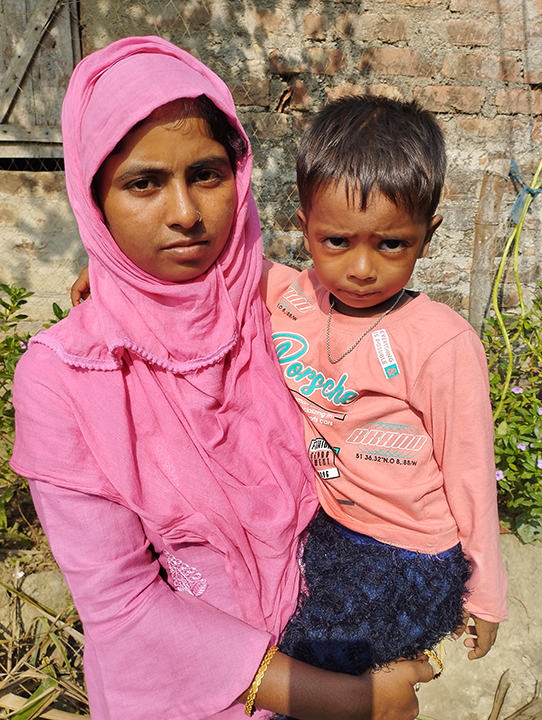
Sakila with her daughter
She is determined to give her and her daughter’s lives a shape now that she has to perform double responsibilities. Where is she garnering the courage from? Eyes down, with a low but firm voice, Sakila replied, “I’m getting the courage from my husband – to live like a good human being. He wished for our daughter to become something with education, he never got the chance to get education. His parents were separated and both of them got married a second time. He was brought up by his maternal grandmother and maternal uncle. He had seen a lot of hardship. I’m also living with his dreams for her daughter. I’m unfortunate. My husband had to die for doing nothing wrong. They killed him suspecting we were cooking beef. I hope what has happened with us, will not happen with any other woman. The government must ensure that everyone works in their own state, nobody has to go out of their state to earn. If anyone has to go to work outside, the government must ensure their safety and security.”
Sakila without hesitanting said, “Muslims are not safe anywhere, especially under the Modi government. There the ‘Gau Rakshak Vahini’ who gives security to cows did this. When the video went viral, people from the state government said – ‘what can we do? This was done by the public.’ Should’t they take responsibility? Only for being Muslim, one can be tortured in such a cruel way and killed for no reason? Even now, when the police report proves that the meat was not beef, the government there is not saying a word. They are doing nothing to ensure that the perpetrators get punished. Maybe the government wants them to be released and kill more Muslims. The ‘Gau Rakshak Vahini’ is actually a group of hooligans, the government in the name of saving the cows has given open license to hooligans. They are killing only Muslims. If Muslims were safe in our country such incidents would not have taken place. There was a crowd, but no one protested when he (Sabir) was beaten up, the post-mortem was not done, nothing was being done to punish those who were arrested.”
“He is no more. I just want that no one’s family gets destroyed like mine, no one with such a little kid has to face this. They must be punished. If they are let loose, there is no guarantee of how many other people they will kill! They should be hanged. There were many others, all should be arrested,” said Sakila.
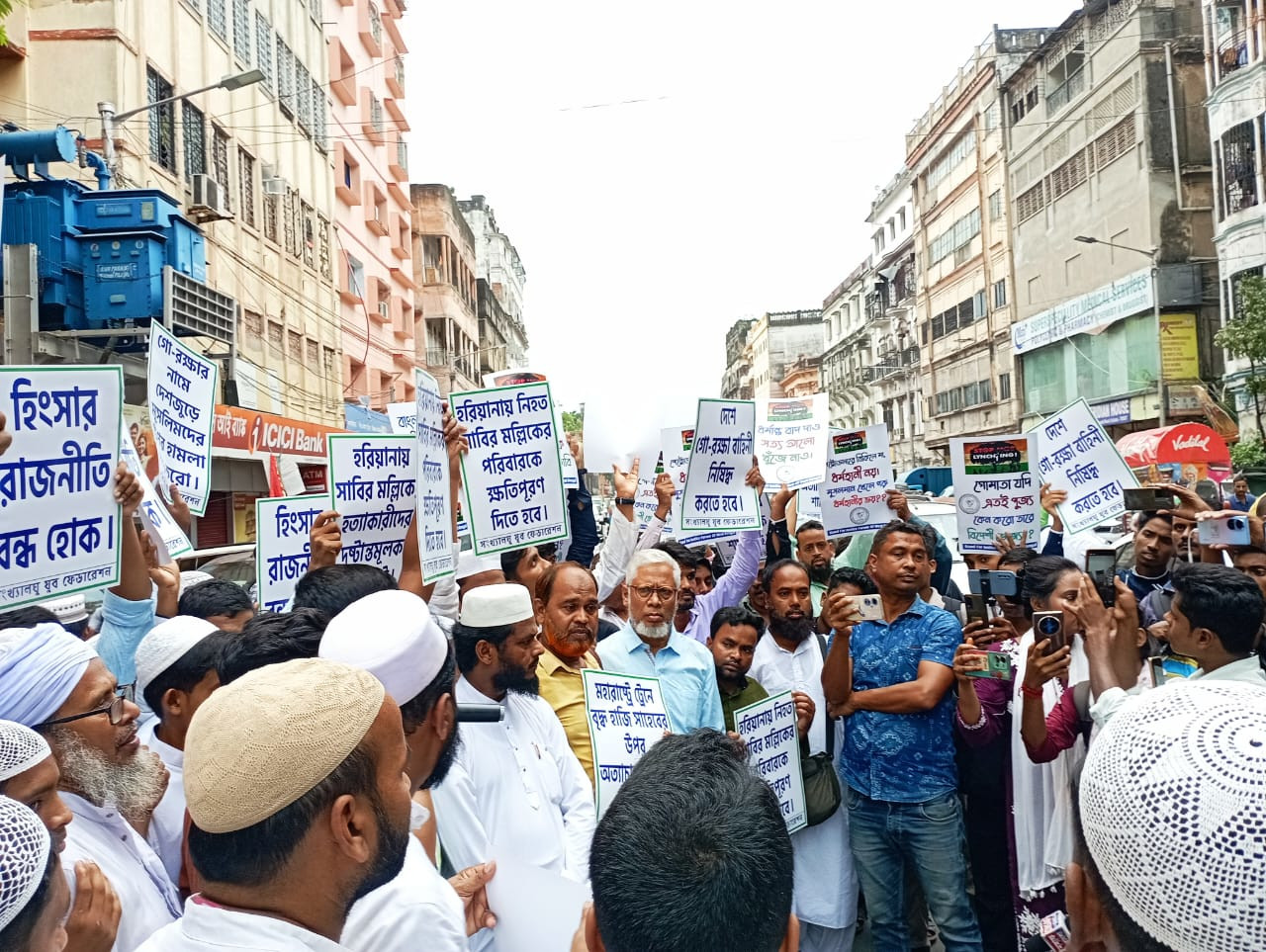
A protest demonstration in Kolkata demanding justice for Sabir Mallik
The West Bengal government has compensated her with a government job, does she feel if her husband had a job in the state, his death could have been avoided? She replied, “Yes, I think that too. If he had got something, we wouldn’t have moved out of this state. Even my younger brother is forced to move out as a migrant laborer, even after such a tragedy has taken place in our own family. It’s a compulsion. How long one can stay at home without work when one has to feed wife and children. This is not right. I want everyone to stay in their own state. The pain that me and my daughter are going through, I don’t want anyone else to suffer that.”
Does she herself get afraid at any point? She thought for a moment and said, “When I think of my old age. Who will look after me? My daughter will be married off.” But then she reassures herself, “We always had the courage, We didn’t have many people beside us when we decided to leave with our newborn baby to a new state to start our new life. Now I’m thinking I’ll live with the courage which my husband had.”
“We have to show courage and live on,” Sakila said with her head held high.