
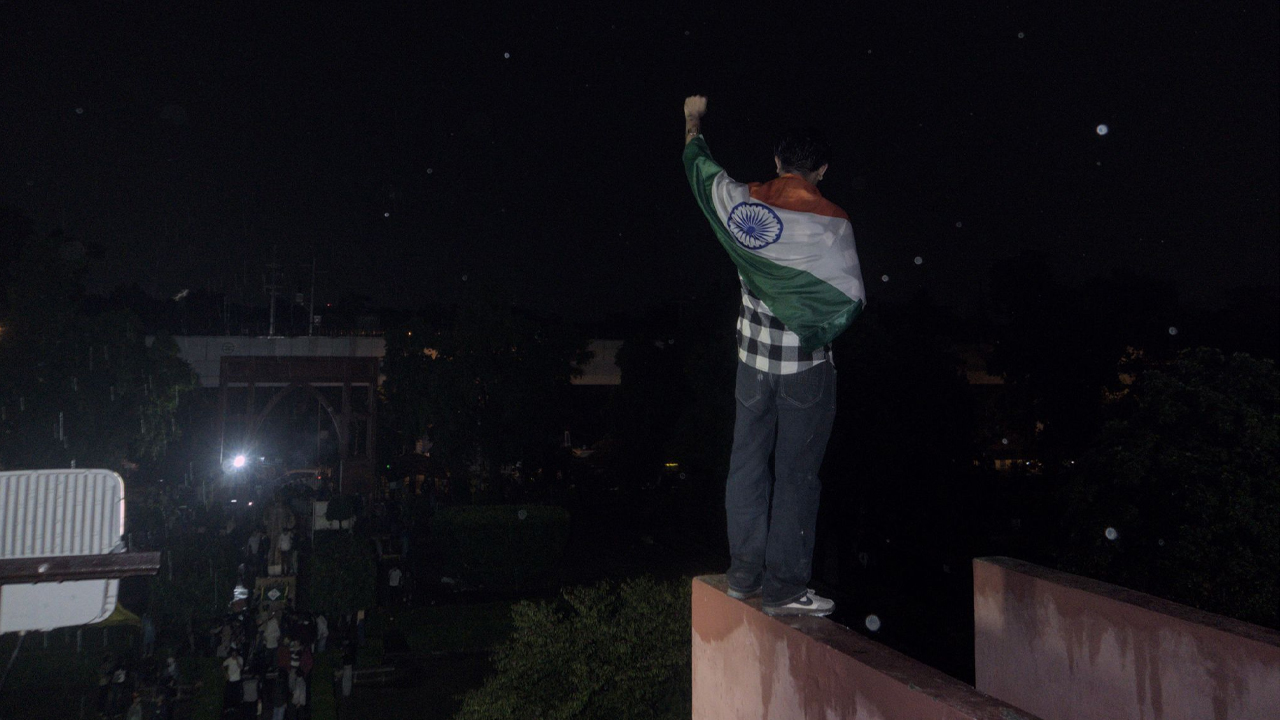
On the 106th anniversary of her foundation, Jamia’s student union came back to life.
Mouli Sharma
Mahawat falls cold and brutal in Delhi’s October, announcing the coming winter and daring you to test her like only nature can.
In South East Delhi, rain is sickness, mosquitoes, and waterlogging; the roads in and around Jamia Nagar (Haji Colony, Gaffar Manzil, Batla House, Okhla Vihar, Sarai Jullena, etc.) are ill-tempered and poorly maintained—everything floods (except the posh New Friends Colony, home to a covert ‘counter-intelligence unit’ of the Delhi Police’s ‘Special Cell’).
Sometimes, of course, rain is rebirth. Autumn washing away the sins of the season past.
Since 12 October 2026, Jamia Millia Islamia’s banned Student Union had been clawing its way out from six feet under. Between an indefinite hunger strike, a multi-departmental occupation, a campus lockdown and five arrests, the University’s ‘sanghi’ administration and collective student body had been in the midst of a political showdown. Unbeknownst to both, judgment day was going to come as the protests (described as the biggest in Jamia since Shaheen Bagh) entered their 18th day, on the 106th anniversary of the University’s own radical birth.
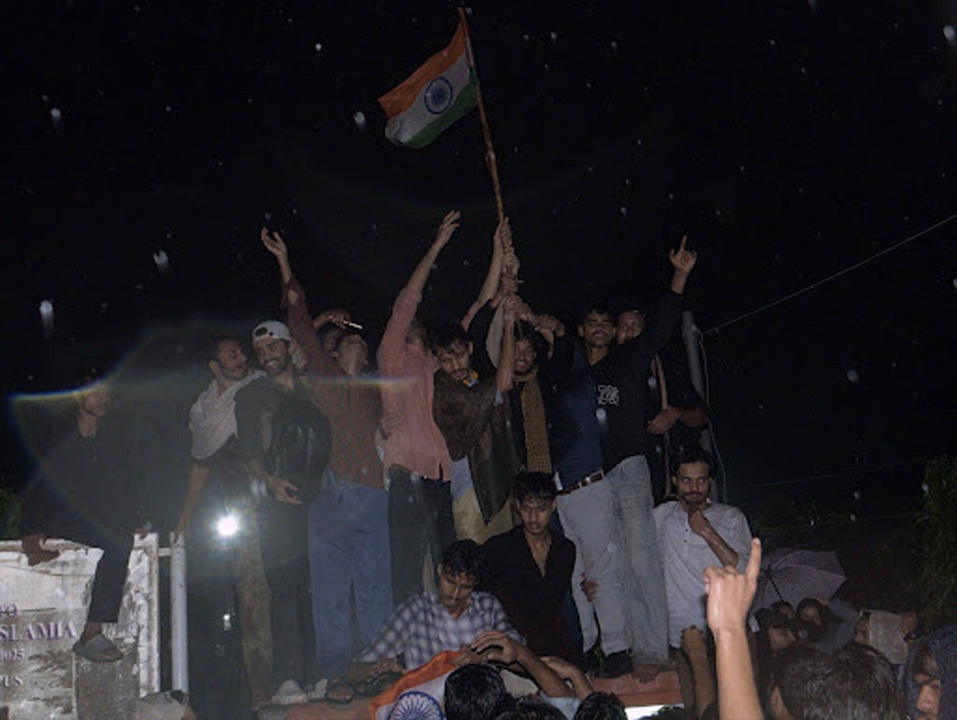
On the 106th anniversary of her foundation, Jamia’s student union came back to life.
In the early 1900s, policies of the British Raj that prompted a mass exit of students and faculty from the Aligarh Muslim University—primarily due to pro-establishment policies aimed at preventing, discouraging, and penalising participation in the Freedom Movement, i.e. suppressing academic dissent—paved the way for collective desire for a “National Muslim University” free from authoritarian intervention.
“Many students of Aligarh too were disappointed with the administration’s pro-British policies which prevented teachers and students from taking part in the freedom movement,” says a memorial piece on Shaikhul-Hind Mahmood Hasan, one of Jamia’s most prominent founders, in the Milli Gazette from a decade ago, halfway between the perceived bookends of this story. “In 1920, some students suddenly left the Aligarh Muslim University. A free and private “National Muslim University” was planned to accommodate these students. Despite his bad health and frail body, Maulana Mahmood travelled to Aligarh and laid the foundation-stone of this institution on 29 October 1920. It later came to be known as Jamia Millia Islamia.”
As the piece goes on, Mahmood is remembered as being advised against going to Aligarh, to lay Jamia’s founding stone, on 29 October 1926. His response is one of the more telling anecdotes about this foundation:
“If this pains the British, I will do it.”
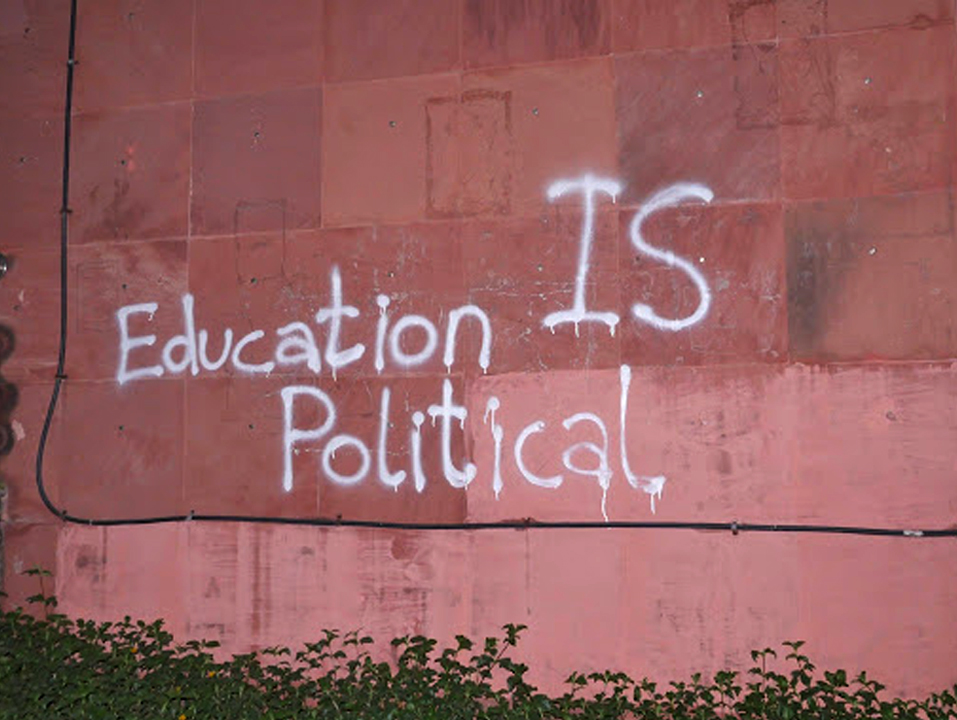
***
Sab Kuch Yaad Rakha Jayega?
Eight decades later, a different regime did to Jamia what the British had done to AMU in their time. Contrary to the understanding of ‘2006’ as the definitive year of the JMISU’s two decade stint under the ground, the body’s existence had been tenuous for long before that, having been banned once prior in 1996, after merely 15 years of existence since the first union elections in 1981. The 2006 ban followed what was merely eight months of resurfacing, with a union having been constituted for the first time in a decade in July 2005, only to be banned under the Manmohan Singh-led UPA government the following year, by the university administration itself, ostensibly due to concerns over ‘campus violence’, and an alleged attack on then Vice Chancellor, Late Prof. Mushirul Hasan.
The purpose of the ban, both in motivation and impact, is debated till date.
“Mushirul is the last VC Jamia had that did anything in the university’s interest,” a professor who would rather not be named tells me over tea and nostalgia in another university campus—JNU, where he feels freer to talk. “You see the road that passes through the campus today?” he asks with disgust. It is this, Okhla Road, splicing through the belly of Jamia’s largest continuous territories, where armed vehicles and central forces have remained since the anti-CAA-NRC-NPR protests of 2020, and where they stood through 18 days of protest that took place there through the second half of October.
“He planned to have it razed; combine both the campuses. The police would not be able to militarise the campus the way they’ve done and are doing if that had happened. This entire architecture lends itself to repression,” he said, recalling how faculty had opposed the construction of the Delhi metro over and snug next to campus grounds as well, for they are legally considered CRPF territories.
“It’s an eyesore,” the professor recalls Mushirul saying about the road, reflecting his own feelings on the metro campus sat beside the Noam Chomsky complex.
Like this anonymous professor, much of the faculty remember Mushirul fondly. The same cannot be said of the VC’s that followed, beginning with Najeeb Jung in 2009 (who went on to be promoted to Delhi’s Lieutenant Governor immediately after the end of his tenure at Jamia), and culminating with the infamous Mazhar Asif, who is a former Sangh member himself.
Conversely, the same also cannot be said of the students’, for very different reasons.
“The students hated Mushirul,” Shrikant, an alumnus who graduated from Jamia in May 2006, two months after the dissolution of the union, tells me. “Not the progressive groups, or even the religious groups, really. Probably the average student of Jamia at the time was more conservative than anyone in the SIO (Students Islamic Organisation),” he says.
The gentrification of South East Delhi plays a role in this ideological lineage, according to Shrikant. “This ‘average’ student, one must understand, has never stepped foot outside of Jamia. They go to school from first grade in Jamia, and then they do their graduation there, then their post grad… and so on. Jamia is more like an extension of their conservative families and neighbours (who become their batchmates and teachers) then the exposure a university should bring. When a highly progressive individual like Mushirul came into the picture and began changing the ‘way of doing things’ it did not sit well with this crowd.”
When asked to give examples of some of these changes, Shrikant enlists three primary policies: Appointments of non-Muslim faculty, architectural interventions leading to conflict with local land mafia, and a general progressive academic identity.
“A large number of non-Muslim appointments began to take place under his tenure. He was a highly progressive man, but also highly idealist. Many people who wear the garb of progressivism do not challenge the status quo like that. But Mushirul was not interested in the ‘keeping it in the family’ philosophy of appointments that goes on everywhere; he would appoint people based on qualifications. He was bringing in faculty from JNU, from DU, from Oxford, etc,” he says. “Plus there were a lot of architectural changes that were happening very quickly during his time. A lot of Jamia’s land is tied up in ownership conflicts and there is a big land mafia in operation here. Mushirul was trying to put all those conflicts to bed. He was just, all around, a generally progressive guy. It was jarring to the people, and the student union at the time easily bent to this popular will.”
“Even I don’t remember exactly what happened, but the union and a lot of students supporting them,” at the time presided by his rival and long-time friend Shams Perwaiz if Shrikant’s memory serves him right, “led a March, some time before the triggering incident [assault on VC] toward the MCRC.”
“Back then,” as it is today, “MCRC was somewhat isolated from the rest of the student population. These people were stylish, higher income individuals who did not bother to mingle with the rest of us. They kept to themselves, and it seemed like the university skimmed the cream off to give to them before even looking our way,” he says.
“That march got extremely out of hand. If the individual organisations, particularly the left ones hadn’t intervened that day, MCRC would’ve been ransacked and destroyed.”
Looking back, it is clear that the antagonism against Mushirul had much more to do with conservatism than with student disobedience or revolutionary polity—an article in The Chronicle from November 29 1996 documented how Hasan had to be effectively exiled from the campus in 1992 after publicly criticising state censorship. The Indian government had banned Salman Rushdie’s novel, The Satanic Verses, which many Muslim organisations had labelled ‘blasphemous’ at the time, and Mushirul’s defence made him a target for the country’s own fundamentalist groups—and not just Muslim ones. In an interview in 1995, Mushirul stated explicitly that the political leaders who would lead and address the gatherings inciting violence against him, were members of the Janata Dal.
“There used to be 4,000-5,000 people who would gather on the campus and the locality in the evenings,” he said. “These meetings would be addressed by political leaders of all hues. Obaidullah Azmi, Mohammed Afzal and Shahabudin, all from the Janata Dal then, attended and addressed these meetings.”
Regardless, as Shrikant’s account reveals, Mushirul’s return to the campus in 1996 and eventually his promotion from Pro-VC to VC in 2004 did little to quiet the violence. Despite this, it was during his first term in office that the union was reconstituted, only for another attack to follow, and another ban.
Following the implementation of a national policy initiative, under which the Supreme Court of India on 2 December 2005 constituted a recommendation committee (chaired ironically by a former Chief Election Commissioner, J.M. Lyngdoh) to issue directions regarding the regulation of student bodies and union elections in higher education institutes, ostensibly to address concerns over expenditure and alleged ‘unrest’. Two months before this committee had even submitted its report on 26 May the following year, the JMI student union was dissolved again.
This historical context is often omitted from—or has perhaps simply been lost to—the annals of history and the new wave of reportage generated after Jamia re-entered mainstream discourse and news trend cycles with the 2026 protests. Articles and explainers published across news outlets of, as Mushirul put it, all hues (and sizes), have certainly marked their algorithmic attendances on the agenda of the ‘JMISU protests’ (largely on or after repeated crackdowns by the police and administration after an alleged clash between security personnel and students on 24 October following which the university ‘shifted’ classes online and essentially placed the campus on lockdown, a massive 12 days after the hunger strike began), capitalising on the growing curiosity around the institute’s political history, few have in fact answered the questions surrounding the ‘20 year’ depoliticisation that dominated headlines.
Consider NDTV, for instance: In its English language digital feed, NDTV published 15 reports in a single week between 24 and 31 October about the Jamia protests, i.e. nearly two reports a day. Not a single one of these names Mushirul Hasan or meaningfully addresses the 2006 ban. One report, by Divyankar Tiwari, says the following on the subject:
“The JMISU was dissolved in 2006, and the university has not held students’ union elections since. The administration reasoned that the disbanding was due to “a series of violent incidents, the last being the attack on the Vice Chancellor.”” The quote is unattributed, and no part of the report preceding or following this ever expands on this extremely vague reference.
A consequence of these omissions, in addition to a growing sense of collective amnesia about Jamia’s history, are certain quiet, unreliable, and false implications: the refrain of ‘20 years’, ‘20 years’, ‘20 years’ reinforces an idea that pre-2006, a JMISU did exist without conflict. It did not. The vague language and lack of clarity around the inciting incident leave people leaning toward conclusions that map the past through the lens of the present, and fill in the blanks about a possibly progressive student-administration conflict having been at the heart of this ‘hear-say’esque “attack on a VC”. It was not.
In a general body meeting of the soon to be union on the night of 24 October 2026, a student leader compared the incumbent BJP-RSS Union and Delhi administration to the British Raj itself, building on the myth that is Jamia today.
“Dissent is in the very foundation of Jamia. This is not a university that was built out of co-operation,” said Shoaib, a Masters student. “The people who hadn’t the nerve to go against the British are now telling us to go quietly in the night. It’s not going to happen.”
But when asked about the far more recent history of the Mushirul era, the leadership is silent—to speak nothing of the ordinary student or freshly hired faculty.
“Uh, I’m not sure exactly what happened. Only, I have some vague information about some firing that happened at that time. But it was heard from an old PhD Scholar that the violence was part of a plan from the administration to put an end to the elections. But I also don’t know how credible this information is,” said Anjan Azad of the All India Revolutionary Students’ Organisation (AIRSO), a significant leader of Jamia’s student politics since the last six years and an alumni who continued to support the October protests, so much so as to be preventively detained by the Delhi police alongside two others on 26 October 2026.
Far from being uncommon, this was the unanimous response found on the Ghalib lawns that night, the first through which the entire campus was occupied, including two departments (Political Science and Geography) by nearly 500 students.
The collective amnesia around the JMISU’s history effectively prevents any meaningful questions about it to be raised, presupposing their answers with political speculation and platitude. Fraternity Movement’s (student wing of the Welfare Party of India) Lubaib, speaking to India Today’s Rishabh Chauhan, summarised the rhetorics circulating throughout the aforementioned mainstream and non-mainstream reportage about the protest about the triggers and inspirations for the emergence of a demand for a union in October 2026: Inspiration from JNU and AMU’s recent successes (AUD’s recently suppressed protests for the democratisation of campus spaces, of course, saw no mention), generational dissent gaining momentum through the CJP protests of July and October, and of course, cult leadership from student icons like Sharjeel Imam, Umar Khalid (the legacy of the Shaheen Bagh movement) and now Neha Bora.
What people do ‘remember’, then, appears to be reconstructed from more familiar ideas. The policies of the past half decade following the latest dissolution of the JMISU have been striking in similarity to those of founder Mahmood’s ire at AMU in the 1920s, which is why many were surprised on 12 October 2026, when it was none other than students affiliated with the NSUI itself (the student wing of the Congress), alongside those of other regional organisations that sat down on the Ghalib Lawns demanding a reinstatement of the institute their own parent party had axed, say members of DISSC and AISA.
“[NSUI] or [the regional parties] did not discuss this idea with anyone before sitting down on the strike,” said Saurabh from AISA, revealing that while the students and student bodies of Jamia certainly became and remained a united front through the 18 days of intense state repression, in their words, attempting to crush the movement, it’s beginning evades even them.
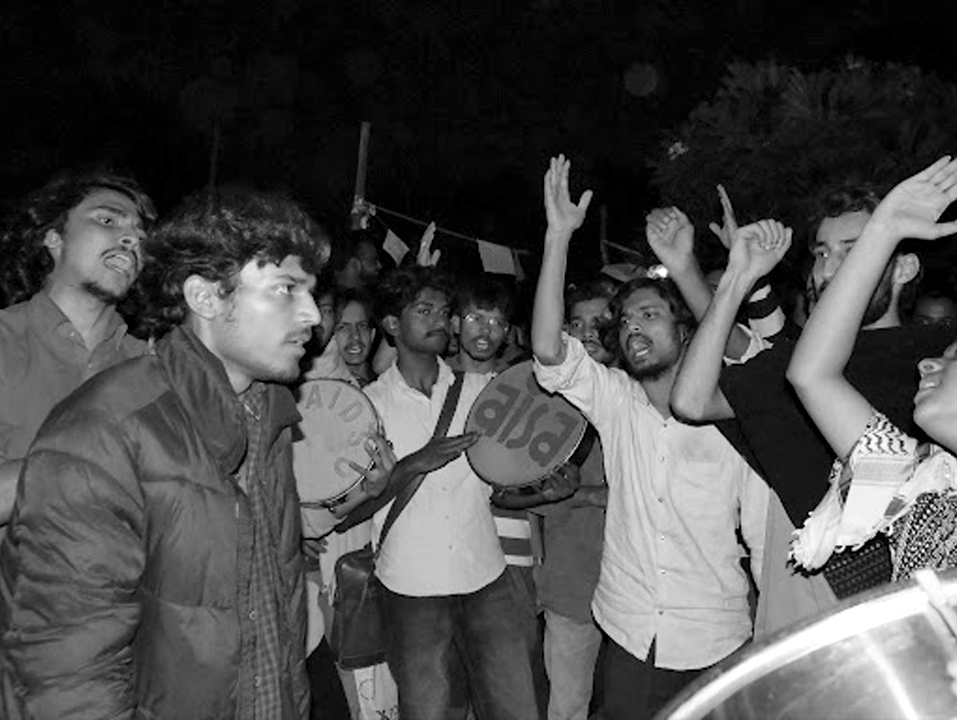
“Of course, we have their back. This is not any one party or organisation’s movement. SFI, AIRSO, DISSC, MSF, Fraternity, AISA, AIDSO, SFI, and indeed even NSUI and MSW, are all part of this call now,” he added.
Jyoti from DISSC, another PhD scholar, formidable activist, and the kind of politician Bertolt Brecht was probably referring to when he said there will still be songs in times of darkness (on the night of the 24th on Ghalib lawns, the song was a ‘Jamian’ iteration of the famous workers’ medley by Gorakh Pandey, Kahab Toh Lag Jaai Dab Se) seconded Saurabh’s mixed feelings.
“[Jamia’s all-organisation collective] are trying to keep names out of this movement. But there is an undeniable irony to NSUI and the [Mewati Students’ Union] becoming the face of a movement when their own party led to the demise of the JMISU in the first place.”
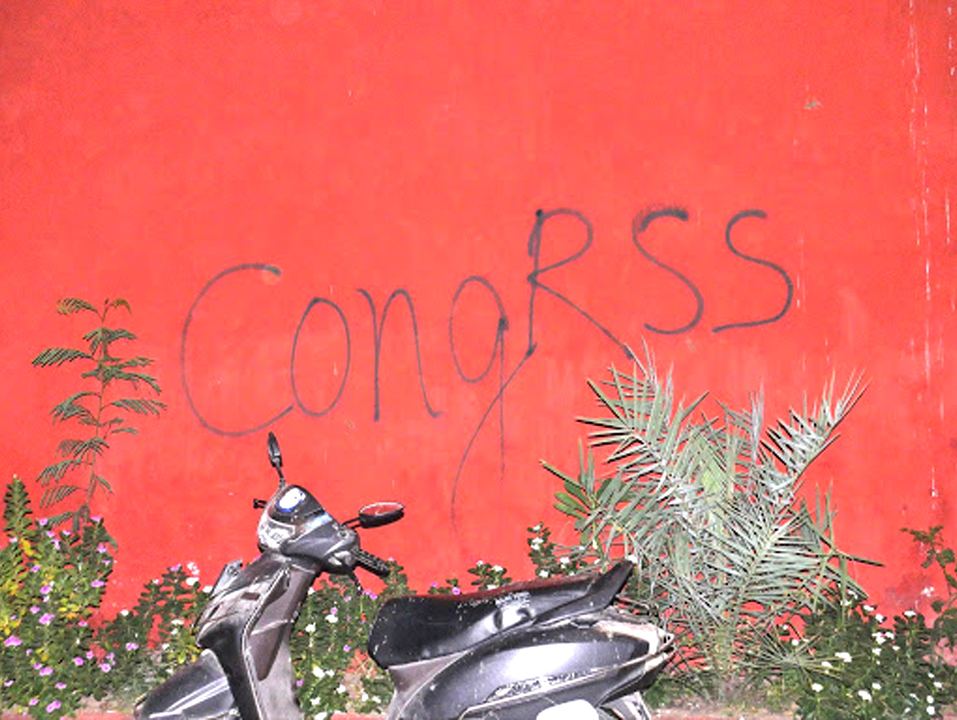
Of course, it is Jamia’s lost historical context that makes clear that throughout her eras of dissent and repression, the antagonists have remained the same: cultural orthodoxies, puritanism, and authoritarian regimes that wear the flags of both, whether inside or outside the classrooms. ‘Congress’ was never the sole opponent.
***
Jamia Tum Sangharsh Karo
The first week, between 11 and 18 October, little news came out of Jamia.
Competing agendas, primarily the protests against Gyanesh Kumar and the growing militarisation of Central Delhi meant that even Jamia’s own student activists—consider Disha’s JMI unit, who were getting detained night after night, or those from AISA Jamia, whose members were assaulted badly enough on the march at the Safdarjung flyover and beyond in police custody on the 10th as to have lengthy MLCs filed and remain confined to their homes for days afterwards—had treated the movement more as a domestic agenda, having long since 2020 internalised that what goes on on Okhla Road remains on Okhla Road.
“No one cares about Jamia,” a student told me on the 24th, incidentally also the first day I visited campus. “[The media] are just waiting for either guns or tear gas canisters to go off. The only people here are Jamians themselves.”
There was little I could do to argue; I am a Jamia alumnus myself, and that is the primary capacity in which I went and remained there till judgment day. Saumya Singh’s reportage of allegedly violent clashes between private security forces employed by the university through contractors and student protesters on the other hand began as early as 18 October, following similar incidents the previous day (which she says drew her attention to the cause in the first place), and was among the first that began to gain traction on social media.
“I hadn’t planned to cover it,” she says. “I was physically and emotionally drained after witnessing state violence and surveillance [through covering the Gyanesh Kumar protests] [but] as I prepared to pause, news broke that JMI students, who had been on a hunger strike for six days demanding restoration of their student union (banned since 2006), were brutally attacked by campus guards and police on October 17.”
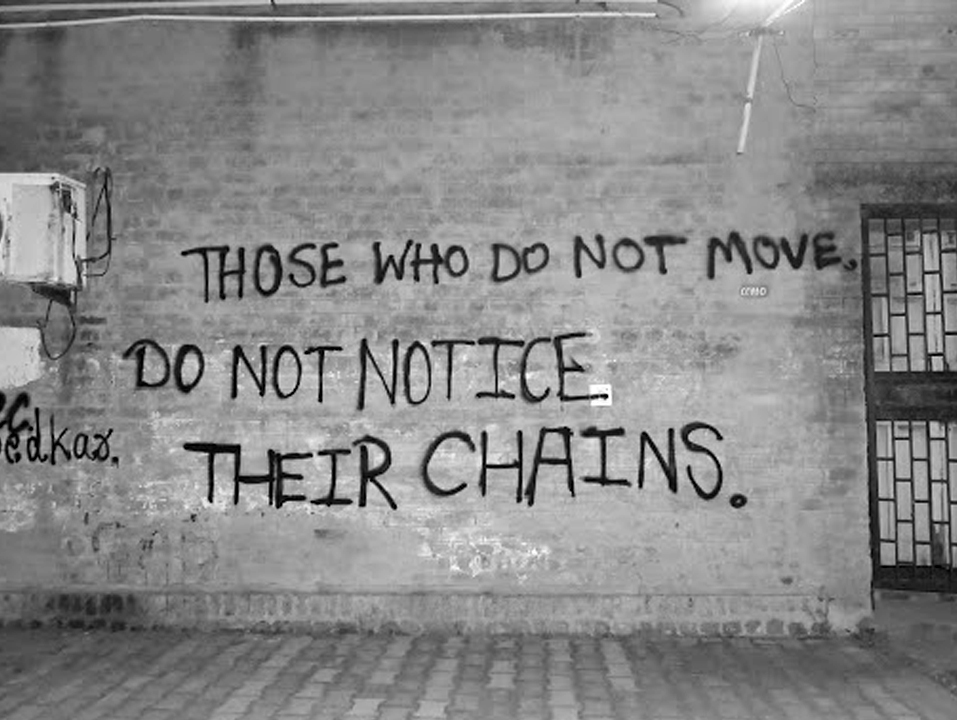
The ‘news’ Saumya refers to, of course, is videos and SOS calls posted to the social media accounts of protesting students and student organisations themselves, for despite what would follow in the form of her continuous on the ground reportage on Jamia for the next 12 days, the ‘fascism, militarisation, and saffronisation of the university’ that she witnessed would scarcely make it into headlines till the 24th of October, when the administration went as far as to suspend offline classes altogether.
As the hunger strikers slept, some in the tents at Ghalib lawn (which would fall by night, under thunder and rain), some inside the student-claimed political science department building, a General Body Meeting of upwards of a hundred students organised itself in front of gate no. 7. Without organisational banners, without titles—and importantly, without cameras—Shoaib read out to the group the prepared list of demands (those now accepted in full, minus the VC and Registrar’s resignations) extracted from speeches and led by the guidance of PhD scholars often first in line to be targeted by the university due to their financial dependence on it. He repeated the same scepticisms about the press and public: “They need sensation to care about Jamia.”
“If our sisters need to take the frontline just so these people can get their thumbnails and their viral clips, I know our sisters are with us,” he said. A young man behind me made crude jokes about women and pressure cookers. I was reminded of the conclusion to an article on misogyny at the 20 July CJP protests: “A woman’s home is the revolution, because she has no other place to go.”
By 25 October, over 500 students had successfully managed to keep the Ibn Sina Block open and ensured the central library’s return to ordinary hours come morning. But as the day waned and people returned to their homes to eat, sleep, shit and repeat, the over 500 armed officials who had slept through the night curled up in DTC buses on the roads outside and security officials easily removed the majority of the few left on site, and by the end of the day, entry and exit into the university was completely closed off. Gates no. 4 and 7 were left open only to medical teams checking up on the fasting students (they refused to communicate with the press) and administrative officials themselves, while the remaining gates were sealed shut with brick and mortar.
On 26 October 2026, the University released a notice ostensibly ‘accepting’ the demands of the protesting students (after two weeks (if not two decades) worth of using the full force of their institutional machinery to suppress them), leading to celebrations much like those of the 29th breaking out across the north campus at the turn of the calendar. This celebration, of course, was premature and fractional, with hunger strikers Ebin Basil and Rehan Khan alleging that it was a ploy by University management to “mislead them” into breaking their then 15 day indefinite hunger strike alongside Jasim Ali Khan, Rehan Hyder, and Rida Naushad Khan.
The same day, three alumni—Anjan, Munna, and Arbaaz—were “preventively” detained by the police.
Under the specified sections, police are obligated to provide little more justification for their actions than discretion. Advocate Rafat Jahan, who represented the former three alongside Advocate Anas Tanwir Siddiqui at the Amar Colony Police Station in front of Special Executive Magistrate Rajesh Dogra, even alleged that the official refused to hear the arguments of the defence counsel entirely before approving the police’s request for preventive custody, and even more concerningly, prevented them from being placed on record.
“He wouldn’t hear us,” Rafat said. “He did not let our arguments be put on record.”
Students who witnessed two of the three detentions outside Gate no. 7 said that the only action that had prompted the detentions was the provision of food and water to protesting students, and that the third person had been nowhere near the campus when detained.
“Police detained Niranjan from a point outside the campus and the other two while passing food and water aid to students inside the blockaded north campus on the evening of 26 October 2026,” said Advocate Rafat. “All three were taken to Kalkaji Police station where they were charged with sections 170, and 126 of the BNSS, and kept at the station overnight after the conduct of MLCs.”
The version that did get put on record, naturally then, is that of the police. The arresting officer of all three was SI Pradeep Kumar, who in two diary entries (one for Munna and Arbaaz) and another for Niranjan, describes the arrests as necessary despite no offence being committed. The former two are accused of ‘hungama karna’ (making noise) and ‘maahaul kharaab karna’ (‘disturbing the vibe’) outside the north campus, while the latter has been accused of ‘jumping out of the university’s boundary wall, then stating that he is an alumni participating in the protest’.
“He said, “I am a University pass-out and I am participating in the student union protests here, what will you do about it?” And then he started yelling that he has participated in protests before and no one has stopped him before and we won’t be able to stop him today and then he started sloganeering ‘Delhi police murdabad’,” Kumar alleges. “I had to arrest him, for if I didn’t he surely would’ve done something,” the diary goes on to say.
Anjan categorically denies these allegations.
“It is completely fake,” he says. “I was having tea from a shop at Gafoor Nagar near Batla House.”
On 27 October, their presentation before Dogra took place at the Amar Colony PS. After their sentencing at 4-5 PM, their immediate whereabouts remained unknown for hours.
“First, from somewhere, we got to know they had been taken to New Friends Colony station,” the lawyers told GroundXero. Visiting the station, this reporter verified that this was not the case. The police officials at the station also refused to give any categorical answer about their involvement in the operations at Jamia, despite belonging to the South East District, whose DCP had allegedly issued extensive prohibitions allegedly under Section 163 of the BNSS’, and also refused to confirm whether a magisterial order (not in possession of the force deployed at Jamia) had been issued to them.
“You should visit the DCP office in Sarita Vihar,” a constable at the NFC PS said. “Ask them these questions, not us. Or should we call them for you?” He asked, calling for more personnel to the room. Feeling unsafe, me and a fellow reporter left the scene hastily.
The lack of clarity led to a brief panic among the students’ well-wishers and advocates alike that they might be kept in police custody at the NFC special cell—infamous for allegations of custodial torture and false imprisonment of student activists.
Despite the arrests, protests did not cease.
To the admin’s surprise, both Ebin and Rehan returned to the strike the very next day, joined by three more, filling in for the latter three whose health had deteriorated severely: Ritik, Abu Zahir, and Mohammad Altaf. The university responded with an intensified crackdown, as did the Delhi Police and other Central armed forces deployed there at length liberally. An order, never published in a gazetted notification or issued to the students, was allegedly issued under section 163 of the BNSS, banning not only public assemblies of five or more persons and possession of weapons in the area, but even the shouting of slogans and delivering of speeches.
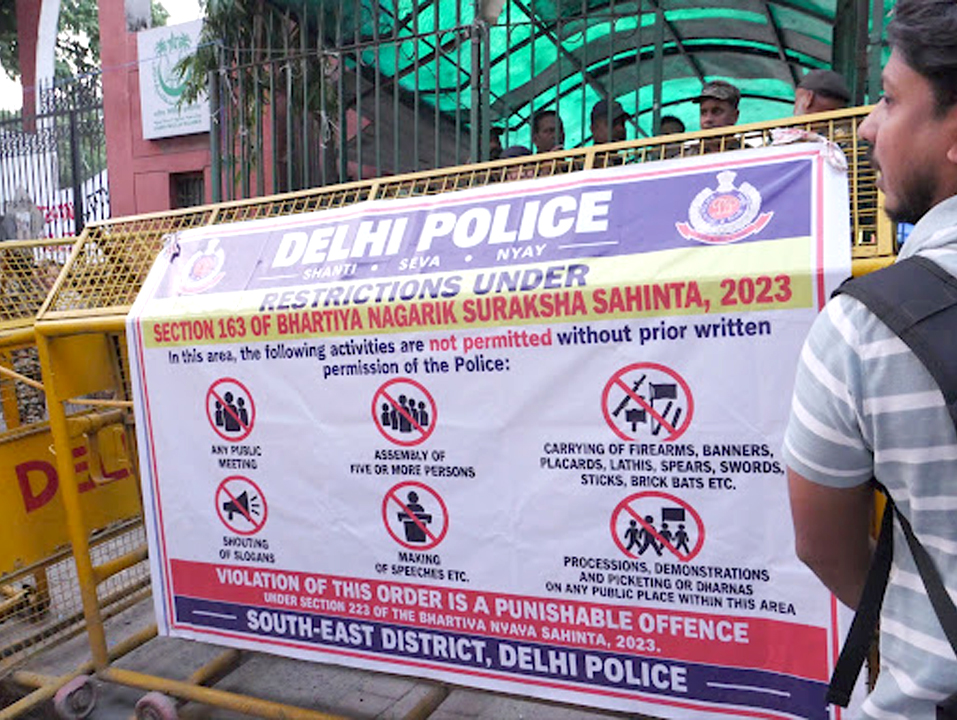
The next day, two more students, NSUI’s Zeeshan and Faizan, were placed under preventive arrest using the same playbook as the former three. On this, the 28th, the University parallelly issued a notice announcing that the academic session was being shifted fully to ‘online mode’ till November 24, including the conduct of the upcoming Semester Exams—effectively shutting down the campus.
A professor called the move ‘desperate and senseless’.
“This administration is desperate. They could have solved this problem within days,” he said. “There is no reason to hold out on a student union. A university’s students are entitled to a union, that’s it. It should never have been dragged this far. And now you are shutting down the library this close to the exams? Is there any sense in this? Fine, you moved the classes and the exams online. Why are you closing off the central library? How are students going to prepare for these exams now?” He asked.
But the administration was in no mood to hold back. Eviction notices began being issued to students en masse announcing a complete closure of campus, including hostels. The Provost of the BHM hostel, Sheema Aleem was caught on camera in a viral video threatening an audience of resident female students by stating that she had a “list of their names” and that they would face consequences if they did not fall in line.
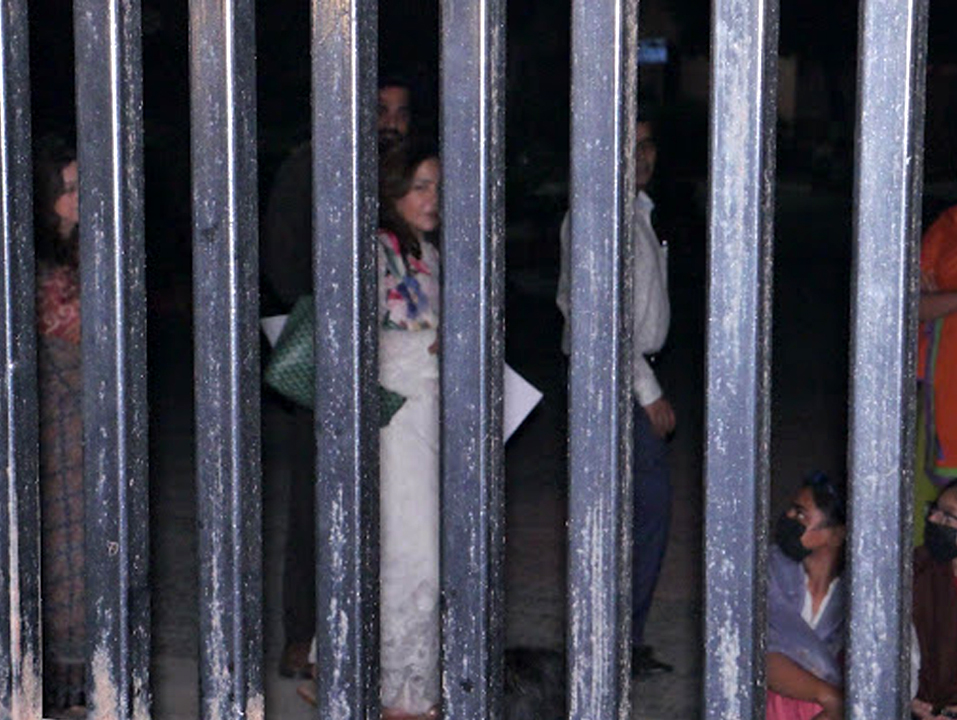
DSW Neeloafer along with the proctorial team including the Chief Proctor give protesting J&K residents a visit.
On the intervening night of 28 and 29 October, 30-50 girls from the J&K hostel staged a sit-in protest at the University’s Centenary Gate, and brazenly defied even these threats. They demanded immediate demilitarisation of the campus along with resumption of offline classes. Even after repeated attempts at intimidation and threats like above from the proctorial team or the hostel administration including provost Nikhat Manzoor (observed plainly by this reporter), the girls did not back down and even submitted a written charter of demands (though the Proctor did not sign the girls’ receiving copy).
“There’s only so much more students can keep this going,” said an alumni from the Faculty of Law, one of many alumni who returned to campus or helped extend support to the sustained student movement from outside the campus. Past midnight outside the Centenary Gate, he was part of a small team coordinating to help provide water and other logistical necessities to the J&K girls.
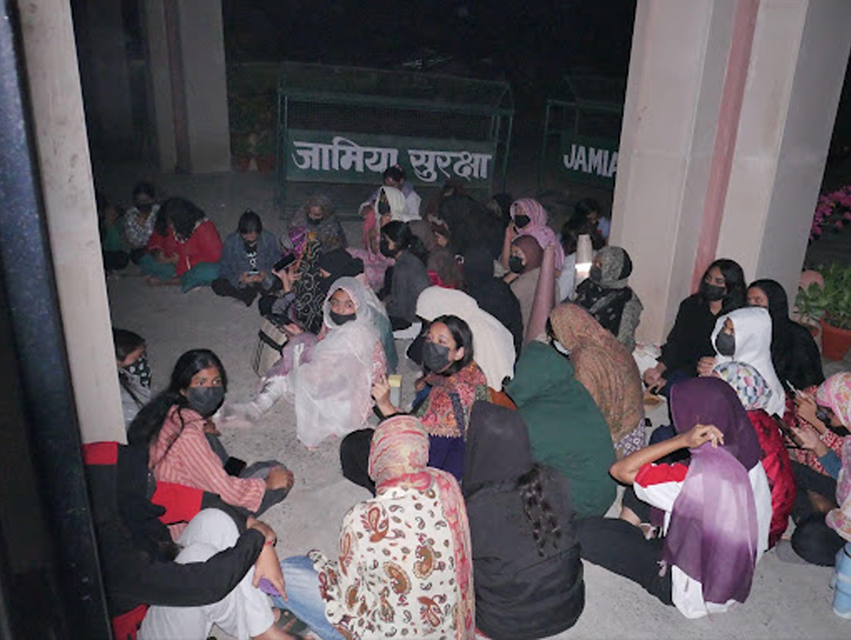
Come morning, the annual and traditional festivities that usually surround founder’s day were nowhere to be seen. Members of the faculty, speaking on the condition of anonymity, said that professors and non-teaching staff alike were effectively forced to attend the flag hoisting celebrations that took place in the South Campus while protesting students in the North Campus were imprisoned within sealed gates, and every other enrolled student of the campus was locked outside of it, on the 106th anniversary of their own University.
“It was a sad sight,” a professor who has taught at the university for nearly all the two decades through which the JMISU remained banned said. “Students excluded like that. Sham of a celebration.”
As evening came, though, something somewhere shifted, and suddenly, unpredictably, the administration succumbed.
Like déjà vu of three nights before, Vice Chancellor Mazhar Asif and Registrar Mehtab Alam Rizvi made their way to the Ghalib lawns and acceded to the students’ demands—all but those of their own resignations. This time, students were wary enough to wait for the notice to come.
By 10 PM, an order addressed to all bureaucratic authorities of the university was issued by the office of the registrar, announcing 15 May 2027 (as per consultation with students) as the deadline for approval and implementation of the JMISU Constitution, declaring the first six weeks from the start of the academic session on July 16 as the timeline of elections, and committing to revoke all ongoing show cause notices, campus bans, rustications, suspensions and “disciplinary actions” taken in relation to the protests.
“In view of the above, the protesting students shall call off their protest/hunger strike with immediate effect,” the order concluded, and with it, as did the indefinite fast of the five remaining hunger strikers.
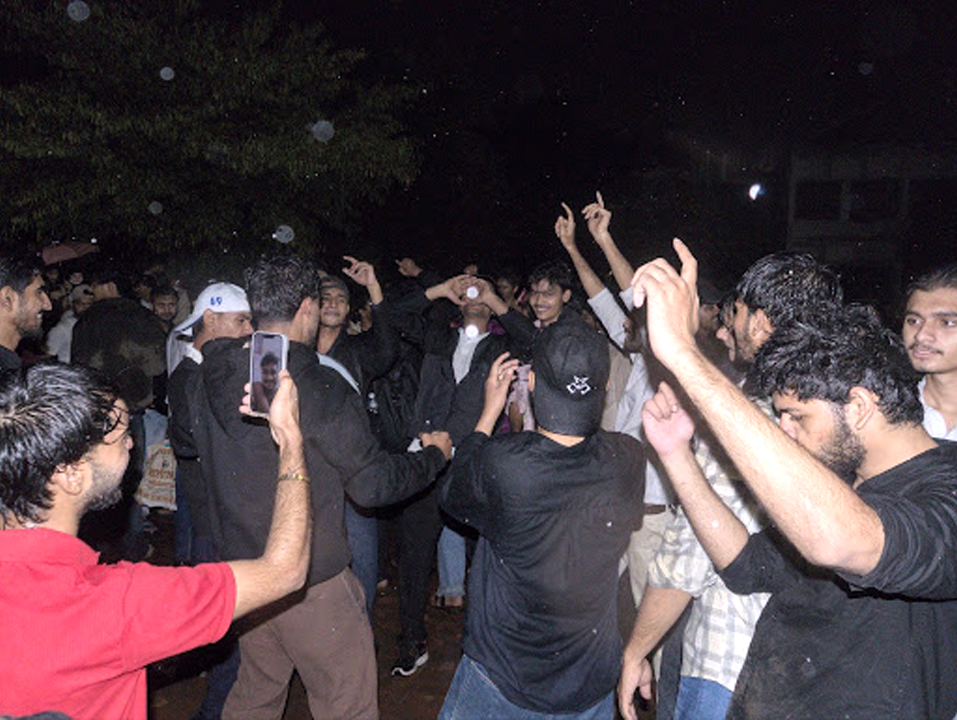
“Today marks the 18th day of our hunger strike, and I am calling an end to it following the official registration of the Jamia Millia Islamia Students’ Union,” said law student Ebin Basil of the NSUI addressing the press at the University gates. “The university administration has agreed to all the demands we put forward. I would like to extend my heartfelt thanks to all the students of Jamia who stood by us, and to our comrades and sathis who joined me in this hunger strike. A special thanks goes to our very respected Haris Beeran Sir, Rajya Sabha MP, as well as the Jamia Alumni Association and all other alumni of Jamia. I am deeply grateful to everyone across the nation and worldwide who supported our movement for the restoration of this democratic process.”
Earlier in the day, fellow hunger striker Rehan Khan, told IANS, “The administration left no stone unturned in putting pressure on us.”
“It closed our hostel gates and locked them,” he said. “The water and electricity supply to the department where we were sitting was also cut off. Our friends who were bringing food for us from outside were also detained to prevent food from reaching us. Five of our fellow students, Arbaz, Munna, [Anjan], Faizan and Zeeshan, ended up in Tihar Jail simply because they were bringing water and food for us from outside. The administration did everything it could to suppress us and silence our voices.’”
“This is a victory of student unity,” he said in the evening after the arrival of the notice, ending a massive 15 day fast. “This is history.”
JMISU’s second coming is historic in more senses than one. Beyond the poetry of broken fasts, raptured police vehicles and tricolours waving in the winter rains, the JMISU protests of 2026 are ‘history’ because their documentation, by virtue of the state’s repression and popular apathy of the media and Delhi’s otherwise outraged population combined, is condemned to retroactivity.
The former is straightforward enough: Reporting on the securitised roads of Jamia is far from comparable to those of central New Delhi, which drew record numbers of freelance and independent reporters during the (also) historic mass protests against Dharmendra Pradhan in July.
In stark contrast, carrying a camera, a mic, or even just a press-card and one’s person in and around Jamia through the second half of October was a job few signed up for.
“I began covering Jamia on 18 October 2026,” said independent journalist Saumya Singh (@saumyaa.singh on Instagram). Hailing from Lucknow, Saumya had visited the capital to cover the early October cycle of the ongoing Gyanesh Kumar protests for an independent newsroom. One of the few reporters regularly on the ground in Jamia besides those from Maktoob and Molitics, Saumya chose to stay behind in Delhi even after completing her work with the publication to cover the protests independently, keeping up with the health reports of hunger strikers, several of whom were hospitalised at multiple instances through the third leg of the month.
When “history” became, The Polis Project, Newslaundry, and many other ‘alternate’ ostensibly progressive media houses who had thus far neglected the issue in both feed and field, began to send boots on the ground. Saumya, though—who had been on the ground for the past ten days—whom some had indirectly sought for unpaid ‘leads’ and inside scoops so as to assess whether a visit to the militarised campus was worth the effort, was not commissioned by any for their exclusive content, including the newsroom she had already worked with, who covered the celebrations on the final day if nothing else.
Which is to say, that alternate media was disinterested, and independent media was unprotected. (Mainstream media, of course, is an abomination.)
The latter is less easily explained.
The speculations abound and collide. “No one cares about AMU because it is not in Delhi. JNU can get a pass because there is still the chance that ABVP can win there. But Jamia is dangerous. In Jamia, the right has no standing,” a law graduate told me outside the Centenary gate at midnight on 29 October, unaware of what was to come by evening. It was a refrain I heard often on the ground. DU is irrelevant because it is home turf. JNU is powerful because it isn’t a Muslim institute. AMU is outside the capital. Jamia is the threat. Jamia is the threat.
Is it?
Though members of the JNUSU, which was recently reinstated after a similar 17 day long indefinite hunger strike on 20 October 2026, visited the campus on the 24th, when the entry gates were still open and people were not being placed under preventive arrest for hypothetical crimes they hadn’t yet committed if they so much as attempted to enter the university as non-enrolled students or passed food or water to protesters, Neha Bora, who has gained immeasurable popularity and household fame over the past few months and is the national president of one of the more prominent student organisations within Jamia, never showed.
This, naturally, was due to her own targeting by the state due to the infamous ‘peace bond’ situation. But take aside Neha. What about celebrity poet and author Gauhar Raza, who lives a stone’s throw away from Jamia? What about Supreme Court Advocate and activist Prashant Bhushan? Psephologist Yogendra Yadav? Colin Gonsalves? Hell, Anhad’s office and her home are sandwiched between two pockets of Jamia’s non southern campus, but even Sayeeda Hameed did not show up to Jamia’s ‘biggest protests since Shaheen Bagh’.
It must be impressed upon the reader that these ideas, of JMISU as a historic formidable political entity or Jamia Millia Islamia as a radical institution immune and therefore threatening to authoritarian takeover are illusions. The JMISU is a child. She has been alive for cumulatively less than 16 years, and been under the grave for over 30. She is not going to be anybody’s saviour but her own. And Jamia has always had the Right within her, ever since she ran from it in 1920. It is the Right within her that allows girls to become the flagbearers of her revolution and be used as human shields for thumbnails and clicks only to be dismissed and disregarded when the clock strikes victory; the Right that allows student leaders to announce that their ‘sisters’ will cook and clean for them so that they can sustain their protests and laughs when they demand a clean place to pee. It is the Right in Jamia that aligned itself with the Janata Dal in 1992, 1996, and again ten years later to assault a liberal Muslim Vice Chancellor not because he was authoritarian or sycophantic but precisely because he refused to be; indeed because he dared to criticise a government that was.
This idea, this romance of a Jamia that never existed… these are figments of an amnesiac imagination attempting to reconcile with the guilt of a progressive academic institution that killed its own child, and has been slowly killing itself for the past twenty years with the privatisation of its most prestigious courses, with the neglect of its accessibility and sanitation architectures, and with the exploitation of the impoverished and marginalised communities left landless around it under the guise of social work, liberal academia, and ‘protecting itself’ as a minority institution. Jamia’s only romance in truth and history has in fact been with the desire to escape each of these prisons, and to become a Muslim University unlike any other before it: radical, scientific, but most crucially, free.
When this Jamia fights for herself, it becomes worth asking of India’s progressive left how they have managed to unanimously fail a test meant for an apathetic and opportunistic media (of all entities)? Is it because Jamia is dangerous?
Or is it because she is disposable?
***
Qayamat se Qayamat Tak
Unlike in campuses like JNU, IITs, IIMs, IISERs, NISER, or even government institutions like the NHRC, CWC, etc., Jamia’s main gates remain ordinarily closed even when over 500 of its students have not been protesting against the University administration for the better part of a month, defying a forced militarisation and total lockdown of the campus.
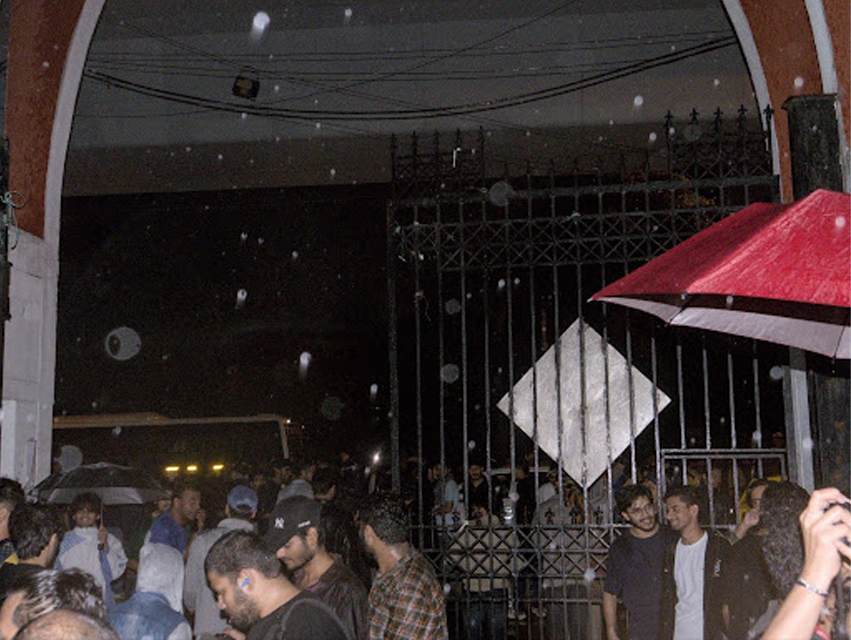
Students and visitors are directed to a small pedestrian entrance constructed behind a closed security chamber towards the right of Gate no. 7 (which remains reserved for the passage of high-ranking professors’ and other administrative staff’s/VIPs private vehicles. On the 29th, though, the gates were wide open, and it poured.
Rehan stood in the centre of a small group of young men at the edge of the Ghalib lawn, on a bench that since the 12th had become a small stage for the then soon-to-be union. He held the tricolour above his head as those around him held up his frail body. Through the rain, the light made it look like they were eclipsed by the moon.
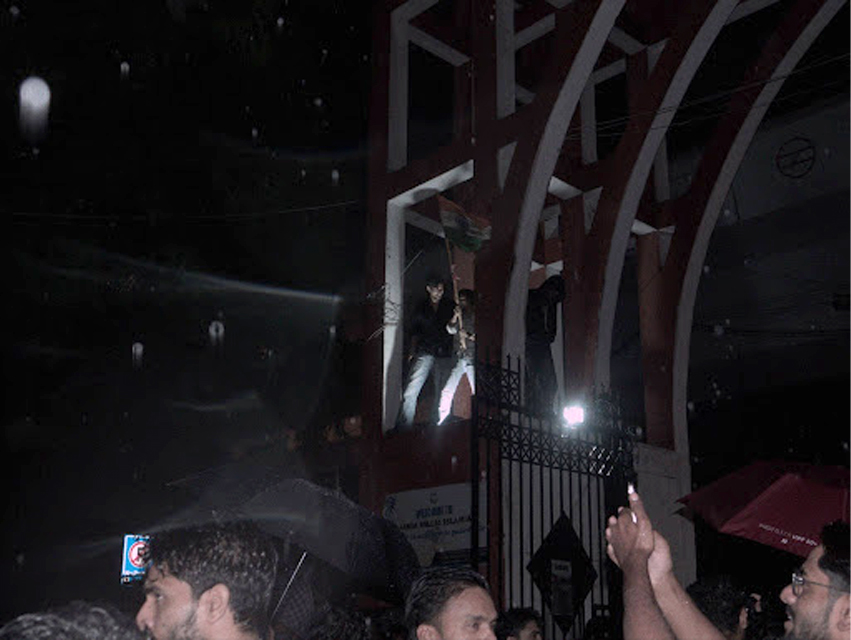
Firecrackers bounced off the metro pillars and flyover walls, sizzling into the wet earth on return; a young man waved the tricolour from the archway hovering over the open gates. For once, the borders of the closed campus that separate the inside from the outside were left, for lack of a better word, unpoliced. Journalists, students, alumni, and locals osmosised inward and outward in the midst of the (momentarily gentle) rain. An unsubtle chorus rang through the perpetually screaming crowd: “Union! Union! Union!”
A scholar pursuing his PhD in Hindi at the university, Saurabh (affectionately called ‘Saurabh bhai’ by all who know him on campus), quoted above, is another of the students (doctoral ones in particular) who have been targeted and penalised for their activism throughout VC Asif’s tenure. A central figure in Jamia’s student politics, he has been campus banned for over a year; despite this, he would be present outside the university gates through the strike, looking in through the green metal bars of the fence like prison walls, even if which side the prison was on was never quite clear. On the 29th, the gates were open, but he remained outside, shawl over his head and a sombre smile on his face.
There are things we are not allowed to say to each other—journalist and source, which is why I did not say them that day. Not to Saurabh, as I bid goodbye to him and headed inside, and not to the hundreds there who, just for the day, wanted to surrender to the high of a long battle won.
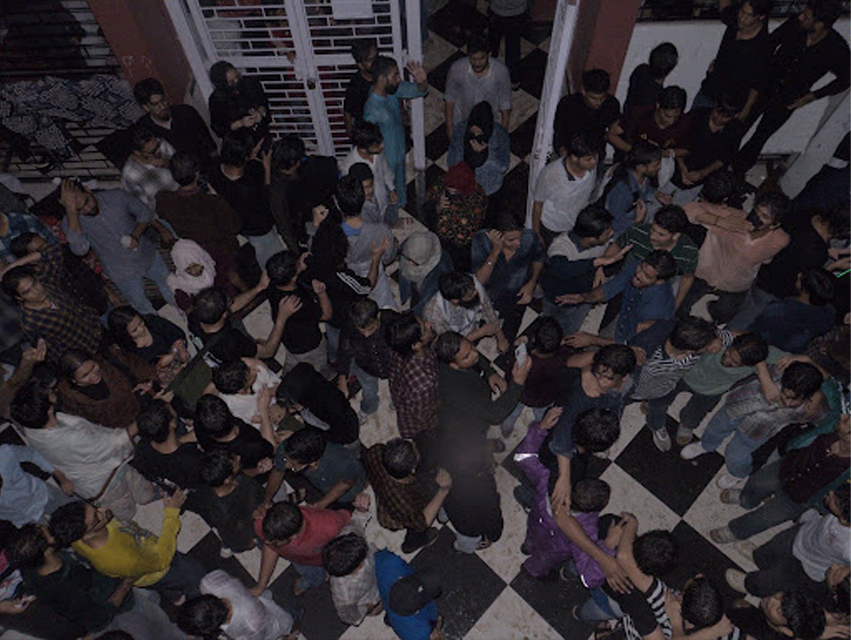
In the Political Science building, Priyanka of AIRSO put the dafli to rest, and let the soft tufts of their hair bounce around the joyful, dancing crowd. AIRSO’s Anjan himself, who had been released earlier in the day along with Munna and Arbaaz, had to sit the celebrations out like Saurabh. NSUI representatives announced at some point that the good news had been delivered to Zeeshan and Faizan, who were celebrating from within Tihar’s jail number three (they too were released by the 31st). Droplets of the water spraying from people’s hair hit my lens—I did not mind.
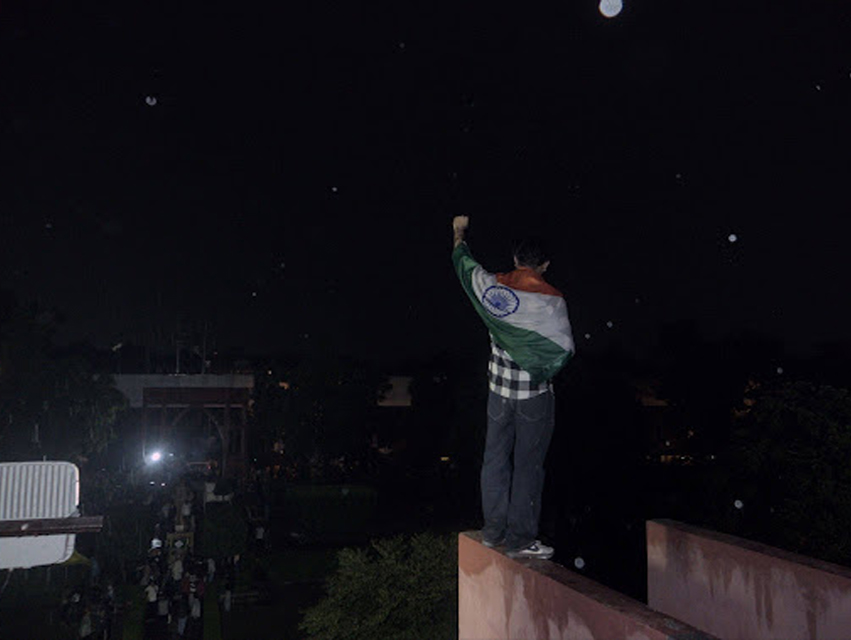
“Will you take a picture of me?” asked Suhail, on the terrace of the Political Science department, where I’d taken my camera in the greed of a few decent elevated shots. Suhail had an Indian flag with him, as large as his armspan. After him, three more young men asked me to take their pictures with it. By the final shot, my hair had been drenched, and with it those thoughts that we are not allowed to say (the cautious optimism, the waiting for the other shoe to fall, and the sober realisation of a battle won with a long war left to go) had dripped away.
By midnight on Jamia’s 106th foundation day, the chains around the iron bars of gate no. 7, the freshly cemented walls sealing the entrances in front of Ibn Sina and the Central Canteen, and the near 500 personnel of the central armed forces that had been occupying the road dividing the campus for three weeks, the barricades announcing emergency ‘security measures’ under BNSS section 163, were dissolved.
The JMISU is risen. The dirt on her grave has washed clean.
Mouli Sharma is a journalist from New Delhi, currently reporting for the Kolkata-based independent news platform, GroundXero. Her work has appeared in publications like The Mooknayak, Frontline, Maktoob Media, The Observer Post, The Leaflet, Nivarana, The Polis Project, Article 14, Feminism in India, SabrangIndia, NewsClick and others. Photographs taken by her.