
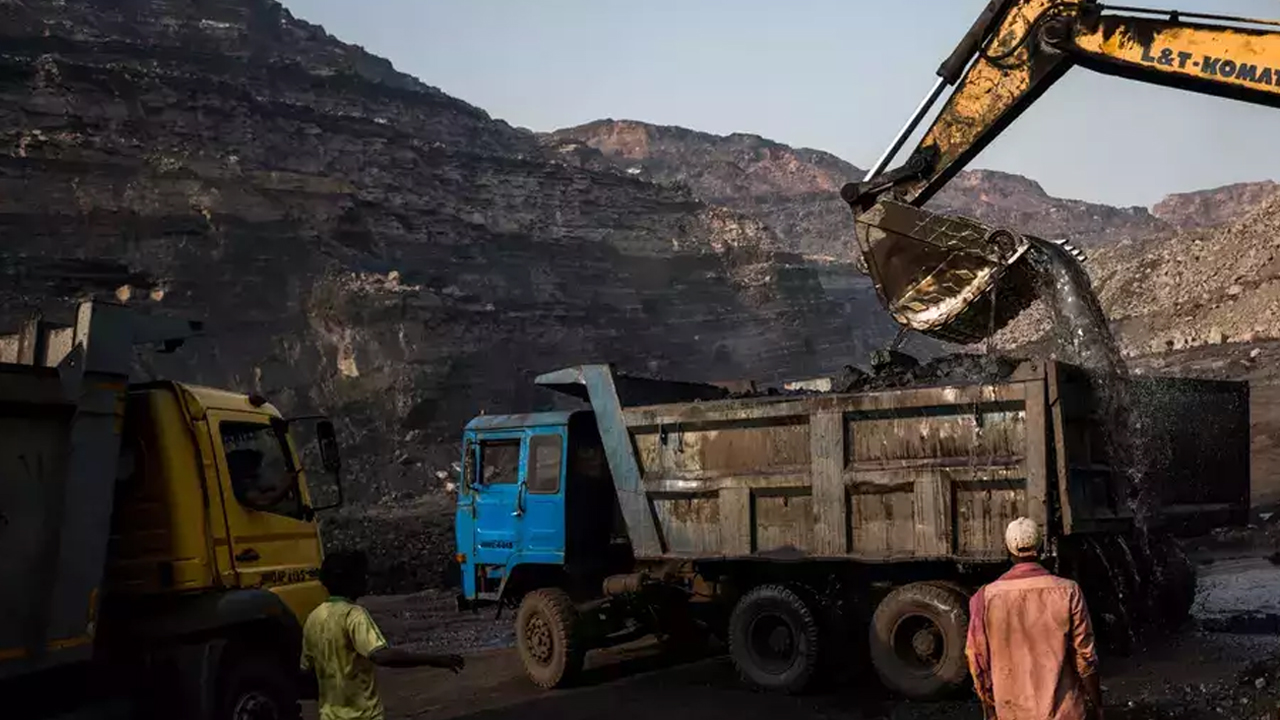
The new mining law curbs states’ power to tax mineral-bearing land. The SKM calls it an assault on federalism and warns that the ‘neo-extractivist’ regime will hand greater control of India’s mineral wealth—and Adivasi territories—to mining corporations.
Groundxero | August 31, 2026
For communities living on India’s mineral-rich lands, the battle over the Mines and Minerals (Development and Regulation) Amendment Act, 2026 is not simply a dispute over taxation. It is about who controls the land beneath their feet, who profits from the minerals extracted from it, and whether the states in which those resources are located will retain any meaningful share of the wealth generated from them.
The Samyukt Kisan Morcha (SKM) has described the new law as an assault on the federal rights of states and a major concession to the country’s mining corporations. The farmers’ organisation estimates that Jharkhand and Odisha alone could lose ₹2.36 lakh crore in potential revenue from retrospective mineral taxes that had become recoverable following the Supreme Court’s 2024 judgment.
The figure—₹1.36 lakh crore for Jharkhand and ₹1 lakh crore for Odisha—acquires particular significance in regions where large-scale mining has transformed landscapes and displaced or threatened the livelihoods of Adivasi communities. Yet the amendment, the SKM argues, does not merely deprive state governments of revenue. It further shifts the balance of power over mineral resources towards the Union government and large mining interests.
The SKM has therefore demanded the immediate repeal of the amendment and appealed to President Droupadi Murmu to revoke her assent and return the legislation for parliamentary scrutiny.
Who owns the wealth beneath Adivasi land?
India’s mineral wealth is concentrated disproportionately in some of its poorest and most heavily Adivasi-inhabited regions. Coal, iron ore, bauxite and other minerals have made states such as Jharkhand and Odisha central to the country’s industrial economy, while mining has repeatedly brought conflict over land, forests, displacement and livelihoods.
Against this backdrop, the SKM’s central objection is that the new law takes away an important fiscal lever from the very states whose territories supply these resources.
The amendment introduces Section 9D, under which states cannot impose new taxes, cesses or fees on mineral rights or mineral-bearing land unless permitted under conditions prescribed by the Union government. It also declares unpaid or pending past taxes invalid while refusing refunds for levies already collected.
In effect, the SKM argues, states that bear the consequences of mining are being denied greater control over the revenues generated from their mineral resources.
The organisation has called upon chief ministers to defend state fiscal rights and use mineral revenues for tribal welfare, agricultural development, rural industries and employment generation. In its view, mineral wealth should strengthen communities and economies in regions suffering from agrarian distress and migration—not simply facilitate further extraction.
Supreme Court judgment at the heart of the dispute
The SKM argues that the amendment was brought specifically to neutralise the financial consequences of the Supreme Court’s landmark July 2024 judgment in Mineral Area Development Authority v SAIL.
In its 8:1 judgment, a nine-judge Constitution Bench held that royalty paid under the MMDR Act is not a tax and affirmed the power of states to levy taxes on mineral rights and mineral-bearing land. The Court subsequently allowed states to recover certain past dues, subject to conditions, with the retrospective operation going back to April 1, 2005.
The SKM contends that the new legislation effectively overturns the financial consequences of that ruling by cancelling tax demands that had not been collected before the new law came into force. It estimates that Jharkhand could lose around ₹1.36 lakh crore and Odisha around ₹1 lakh crore in potential revenue from retrospective taxation.
For states struggling with poverty, unemployment, agrarian distress and inadequate public infrastructure, the SKM argues that this move cannot be dismissed as merely an accounting dispute. It alleged that the cancellation of these liabilities will benefit major mining corporations, including the Adani group, and has described the move as “gross political corruption”.
The issue has already generated opposition in mineral-rich states. The Jharkhand government has reportedly been examining a legal challenge to the amendment, citing its potential impact on the state’s finances. In Odisha, former chief minister Naveen Patnaik has called on BJP MPs from the state to support a rollback, arguing that the legislation could affect the state’s control over its mineral resources and revenue.
From mineral extraction to corporate control
The SKM sees the amendment as part of a broader restructuring of India’s mineral economy. It said that the Act has been brought with the intention of attracting Foreign Direct Investment in the strategically important mineral resource sector including rare earths and thus facilitating large-scale extraction of domestic mineral resources key for defence and electronics by global mining corporate companies.
The SKM argues that the new fiscal framework will make the sector more attractive to foreign and domestic corporate investors by reducing the scope for states to impose additional levies. The organisation warns that this could accelerate large-scale extraction of resources from mineral-bearing regions while further weakening the economic position of the states and communities where those resources are located, and called the MMDR Act 2026 as part of the “Modi Regime’s policy for the recolonization of India.”
For Adivasi communities, the question is inseparable from the long history of mining-led dispossession. The wealth extracted from their territories has powered industries far beyond them, while the social and ecological costs remain concentrated locally. The SKM’s demand that mineral revenues be channelled towards tribal welfare, agriculture and rural employment is therefore also a demand that mineral-producing regions receive a greater share of the wealth extracted from their lands.
Another blow to federalism
The SKM also places the amendment within what it describes as a continuing erosion of fiscal federalism. It points to Entries 49 and 50 of the Seventh Schedule, which relate to taxation of land and mineral rights, and argues that Section 9D effectively places the states’ ability to exercise these powers at the discretion of the Union government.
For SKM, this is not an isolated mining reform. It follows what it sees as a broader centralisation of fiscal powers, including through the GST regime. With mineral taxation now subject to restrictions imposed by the Centre, states could find themselves increasingly dependent on the Union for access to revenues from resources located within their own territories.
The amendment was introduced in the Lok Sabha on August 10, passed by both Houses on August 13 and notified on August 17. The SKM has criticised the speed of its passage, alleging that it was pushed through without substantive parliamentary discussion. It has now called upon political parties, farmers and Adivasi communities to oppose the legislation and intensify the struggle for its repeal.
The struggle over the MMDR Amendment is thus ultimately a struggle over the meaning of mineral wealth itself. If ₹2.36 lakh crore in potential state revenue can be wiped out by legislation, while mining corporations gain greater fiscal certainty and access to mineral resources, who is the mineral economy ultimately being built for?
For the SKM, the answer is clear: the amendment strengthens corporate control over resources while weakening the states and communities that have historically borne the costs of extraction. Its demand for repeal is therefore framed not merely as a defence of state taxation powers, but as part of a larger fight over Adivasi land, natural resources, federalism and the right of communities to benefit from the wealth beneath their own territories.