
They may threaten to ‘sew Jadavpur’s mouth shut’. But a university with thousands of students, teachers and workers cannot be silenced by a threat.
By Tanuj Mullick
On 10 May 1933, books were burned by the Nazis in cities across Germany. Known as Die Bücherverbrennung am 10. Mai, the event was not merely the destruction of thousands of books. It was a public political programme aimed at establishing control over knowledge, thought, history and freedom of expression. Books written by Jews, communists, socialists, liberals, pacifists and others who were considered enemies of Nazism were declared ‘un-German’ and thrown into the flames.
Nearly a century later, when we look at the events that took place at Jadavpur University on 19–20 August, a question inevitably arises: has fascism changed its methods while continuing to attempt to control knowledge, universities and dissenting voices?
On the night of 19 August, BJP MLA for Jadavpur, Sharvari Mukherjee, allegedly issued a call in a video for ‘tandav’ at Jadavpur University. Within a short time of the video going viral on social media and being reported by the news media, at around 12:30 a.m., a mob entered Jadavpur University through Gate No. 4.
The mob was carrying ABVP flags, rods and sticks and chanting ‘Jai Shri Ram’. Immediately after entering the campus, they allegedly began vandalism and attempted arson.
Videos of the entire episode were subsequently made available by a news outlet called Mrittika TV. The faces of several members of the mob can reportedly be seen in the footage. Students of the university identified most of them as people who were not students of Jadavpur University. The one or two individuals who were recognised as students were identified as members of NSF or ABVP.
Among them was Aditya Haldar, a student of the History Department who had recently contested the ICC election as an NSF-supported candidate. Alongside him was Somsurya Banerjee of the Electronics and Telecommunication Department, who is alleged to be an NSF member.
Some students who were present on campus found themselves directly in front of the mob. Several of them were reportedly beaten severely. Around thirty students were forced to take shelter inside Aurobindo Bhavan, locking themselves in an attempt to save their lives.
The mob allegedly continued its attack for a considerable period. They attempted to set fire to Aurobindo Bhavan, threw chocolate bombs, bricks and water bottles, and continued hurling abuses at the students trapped inside.
Here one has to ask a very simple question:
How did a mob of this size manage to enter the university at around 12:30 a.m. without facing any resistance whatsoever?
Does the university not have adequate security?
The available information suggests otherwise.
A few months ago, despite protests by several students, the university administration had removed its old security guards and appointed ex-servicemen as guards, supposedly to ensure the safety of students. These guards reportedly check students’ identity cards before allowing them to enter the campus, even during the day.
Yet CCTV footage allegedly shows that when a mob of approximately sixty people entered through Gate No. 4 that night, the guards were standing there. They reportedly did not check the identity cards of those entering. Even after the mob entered the campus and began its alleged rampage, the guards did not intervene.
The CCTV footage reportedly also shows that, at that moment, a staff member of the English Department, Rasman Kanaujjia, was present alongside the guards at Gate No. 4. He is alleged to be a member of the BJP’s employees’ organisation at the university. Also reportedly present was former Jadavpur University Vice-Chancellor Biswanath Sau, who is known as one of the leading figures of the BJP’s teachers’ organisation at Jadavpur.
What were the two of them doing there at midnight?
This question alone makes the allegation that the attack on the students was carefully planned particularly serious.
After questioning the role of the security guards, one must also question the role of the police.
While trapped inside Aurobindo Bhavan, several students reportedly tried to contact the police. According to their accounts, when they identified themselves as students of Jadavpur University, the police allegedly disconnected the calls.
Students inside Aurobindo Bhavan could also reportedly see through the CCTV system that, from time to time, one or two police personnel were walking outside Gate No. 1.
The police have historically functioned as an instrument of the ruling establishment, and according to the students, this incident was no exception. Even when the mob allegedly attacked the Main Hostel that night, located immediately beside the police station, there was reportedly no effective police intervention.
The role of the Vice-Chancellor also deserves scrutiny.
Students trapped inside Aurobindo Bhavan, terrified by the situation, reportedly called the Vice-Chancellor repeatedly. Neither he nor anyone from the administration allegedly answered their calls.
Even on the following day, instead of meeting the students, the Vice-Chancellor reportedly avoided his office and remained inside a classroom in another university building, which was locked from the outside, until around 10 p.m.
Why this extraordinary retreat, despite the existence of extensive CCTV footage installed at a cost of ₹68 lakh?
It is difficult not to conclude that considerable pressure was being exerted on him from above.
The attack did not take place in a political vacuum.
At a time when spontaneous protests were emerging across West Bengal over Annapurna Bhandar, the Chief Minister, at a meeting on 22 August concerning Annapurna Bhandar, once again issued a warning directed at Jadavpur. He explicitly said that he would ‘sew Jadavpur’s mouth shut’.
During the recent Assembly election campaign in the state, the Prime Minister had also issued threats directed at Jadavpur.
Repeated threats by BJP leaders against the students of a university make one thing clear: they fear the protesting voices of Jadavpur’s Left students and therefore want to suppress them completely.
It is in pursuit of this objective that the university has allegedly faced sustained funding cuts and a halt in faculty recruitment. There are insufficient classrooms. Buildings have not been properly maintained, and only recently the roof of a hostel collapsed.
Repeated threats, harassment in the media, and a systematic, gradual deterioration of the university’s infrastructure have not succeeded in silencing the Left students of Jadavpur. They have continued to speak out against fascist attacks on civil society, from SIR to the eviction of hawkers.
And when they refused to remain silent, an attack was launched against them on the 19th with the objective of ‘sewing their mouths shut’.
Earlier that afternoon, an agitated situation had reportedly developed during a general body meeting of the Engineering and Technology Students’ Union following repeated provocations by students associated with ABVP and NSF.
It was at this point that Nikhil Das suddenly appeared at the meeting. Das is a researcher at Jadavpur University. It is important to note that the meeting was a students’ union general body meeting, so a researcher had no reason to be present there.
Das was accompanied by several associates, most of whom, according to the students, were not university students. They allegedly entered the meeting and began assaulting students. One student was reportedly beaten and dragged out of the university premises. He was later found injured at Sulekha More, approximately one kilometre away.
Once again, the role of the security guards during this incident was reportedly similar to their role later that night.
Nikhil Das is a familiar figure in Jadavpur’s political history. He was one of the accused in the sexual harassment case that became central to the ‘Hok Kolorob’ movement. He is currently known as the secretary of the Jadavpur ABVP unit.
At around 9:30 p.m. on 19 August, after entering the students’ union general body meeting without authorisation and assaulting students, Das himself was immediately admitted to the neighbouring KPC Hospital, claiming that he had been assaulted by Left-wing Naxalite students.
At precisely this point, BJP MLA Sharvari Mukherjee appeared at the hospital. She released a video statement announcing that ‘tandav’ would be unleashed against the students of Jadavpur. She then went to Jadavpur Police Station with her supporters and filed an FIR naming seven students who, according to the account presented here, had themselves been assaulted by Nikhil Das, Somsurya Banerjee and their associates.
Following this, a section of her supporters allegedly entered the university through Gate No. 4 in the presence of Biswanath Sau and Rasman Kanaujjia and unleashed what was described as a ‘tandav leela’.
The ‘tandav’ was not going to end on the night of the 19th.
Although nobody publicly announced that it would continue, it became clear to students and teachers from the morning of 20 August that something larger was unfolding.
Police, barricades and armed personnel began to be deployed outside Gate No. 4.
That afternoon, a BJP-supported ABVP march began from Golpark. Sharvari Mukherjee joined the procession, brought it to Jadavpur Police Station, surrounded the station and demanded the arrest of thirteen students named in an FIR.
A section of the procession then moved towards Gate No. 4.
On one side, the BJP and ABVP presented themselves before the media as people demanding justice through legal means, surrounding the police station and demanding the arrest of students. On the other side, the same mob climbed over the closed university gate and threw sticks, bottles, bricks and eggs at students inside.
They reportedly made repeated attempts to break through the gate. During the attack, a memorial designed by Nandalal Bose at the Jadavpur gate was damaged.
Whether the actions of the mob constituted violations of the law is itself a question that must be investigated. But another question is equally important: why did the police and armed personnel present there not intervene?
Even when a first-year student of the Bengali Department who had gone outside to a shop near the gate to eat was allegedly assaulted by the mob, the police reportedly did not intervene.
Inside the university, however, something else was taking place.
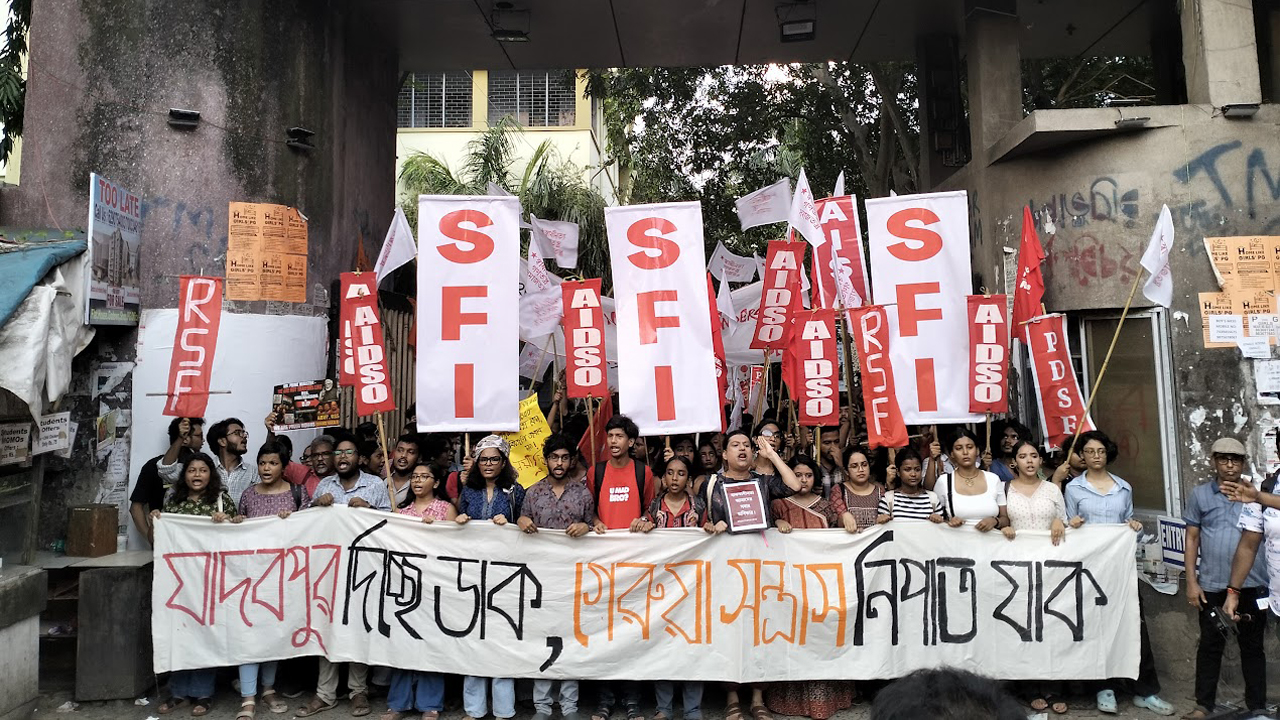
In the midst of all the ‘tandav’, protesting students, teachers and employees stood together.
Despite being repeatedly hit by sticks, water bottles, eggs and bricks, they did not respond by throwing them back.
They stood together, red flags in their hands, refusing to surrender the university to the mob. Their collective presence itself became the answer to those climbing the gate.
Although the fascist mob retreated in the face of the unity of students, teachers and employees on 20 August, the attacks did not end there.
On 21 August, ABVP students allegedly attacked Left-wing students in three colleges across the state.
That afternoon, a citizens’ march was organised at the call of Jadavpur’s student community. Students, teachers and university employees walked alongside ordinary citizens, carrying red flags and raising slogans against fascism.
The attack on students is not confined to Jadavpur. For years, the student community as a whole has been under attack.
On one side, through the NEP and the saffronisation of syllabi, the space available for thinking and knowing is being continuously narrowed.
On the other, whenever students protest, ‘tandav’ is unleashed and attempts are made to ‘sew their mouths shut’. This is not simply a battle over one university. It is a battle over what a university is supposed to be.
A university is supposed to be a place where knowledge is questioned, where history is debated, where political ideas confront one another, where students can organise, where teachers can dissent and where no government or political organisation has the right to dictate what can be thought. That is precisely why fascism seeks to control it. The Nazis understood this in 1933.
They did not begin by burning every book. They first decided which ideas were legitimate and which were not. They then identified the people who represented those ideas. Finally, they created a political atmosphere in which their exclusion and destruction could be presented as necessary.
Today the methods may look different. Books need not necessarily be thrown into a bonfire. Knowledge can be controlled through curricula. Universities can be weakened through funding cuts. Teachers can be prevented from being appointed. Institutions can be starved of resources. Students can be branded as anti-national. And when none of these are sufficient, a mob can be brought to the gates. The objective remains the same: to make people afraid to think, afraid to speak and afraid to resist.
The coming attacks on students may be even more severe. Therefore, the struggle cannot remain confined to Jadavpur. It cannot remain confined to Presidency. It cannot remain confined to JNU. The answer to fascism cannot be silence. The answer cannot be fear. The answer cannot be another mob.
On 10 May 1933, books were burned because their ideas were considered dangerous. On 20 August 2026, the question once again stands before us in a different form: Will we allow those in power to decide which voices deserve to exist? The answer must be no. They may threaten to ‘sew Jadavpur’s mouth shut’. But a university with thousands of students, teachers and workers cannot be silenced by a threat. The mouth of Jadavpur cannot be sewn shut. And the struggle to keep it open is ultimately the struggle to keep the possibility of democratic thought itself alive.
Tanuj is a UG III student of Jadavpur University.