
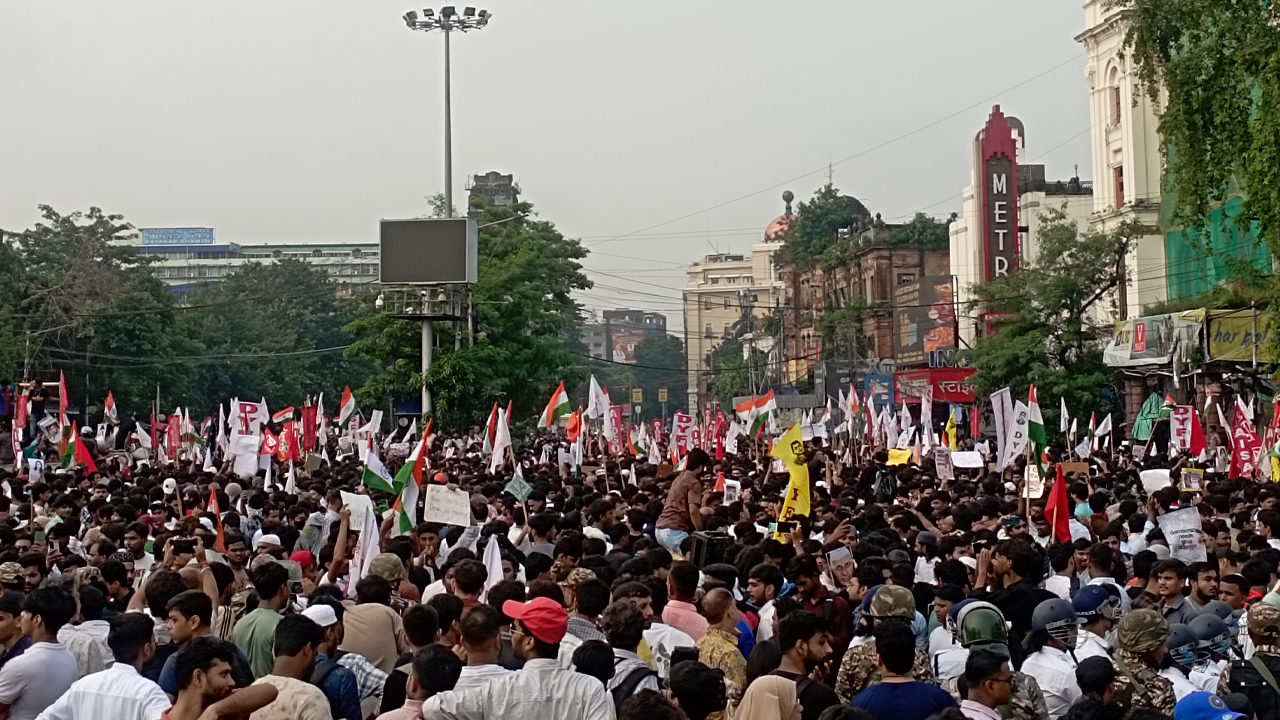
The en masse participation of Muslims in democratic protests — for justice, equality and well-being for all — will depend on the general public accepting them as fellow citizens.
Tashhar Mahmood
Havā mẽ hai jashn, fizā mẽ hai shor
Bhagvē raṅg mẽ liptā huā hai ye daur
Par sōchŏ zarā, dil se pūchhŏ ye bāt
Kyā vāqi’ āzād hai hamārī zāt
Kitābõ mẽ likhā hai hamārā deś āzād
Magar har taraf hai vahśat kā ik fasād
(Celebration in the air, clamour in the atmosphere
These times, they are entwined in saffron
But think a bit, ask yourself this question,
Are our people really free?
Books tell us our country is free
Yet terrifying chaos engulfs all directions)
India will celebrate the 80th anniversary of its Independence in a year but people, especially the country’s youth, are still demanding azadi (freedom), freedom from punjiwad, freedom from samantwad, freedom from Manuwad, freedom from jatiwad … Why? The answer is common knowledge, but very few people dare to spell it out. Education, employment, healthcare, transportation, good governance, justice and all other fields are afflicted with a serious disease, the disease of corruption, binary politics and the “othering” of Muslims. Many, especially those from lower- and middle-class families, are suffering because of rampant corruption, widespread inequality, and the lack of equal and fair opportunities. No wonder students across the country have been demanding that the government fix these problems; they have also been demanding the establishment of a just and accountable system. Their demonstrations reflect the concern of ordinary people, who want positive changes in society and better opportunities for future generations.
India won Independence from oppressive British rule in 1947, but many across the social divide have been asking whether we have been able to establish the rule of law even after almost 80 years of Independence. India is a democratic and secular country where the government, since it is elected by the people, is expected to work for the good of the people irrespective of their religion, caste, race and colour. Yet many believe the present government (central and states) has always accorded greater priority to political and religious issues than to everyday problems faced by the people. During elections, some political parties have been using religious and communal issues to influence the electorate while paying little or no attention to education, employment, healthcare, infrastructure development, social welfare and social justice. The growing focus of some political parties on divisive politics has led many, especially students and the youth, to wonder whether public policies are, at all, designed to meet the real needs of society.
Protest politics is not a post-Independence phenomenon in India. Its roots can be traced to British colonial rule. During colonial rule, people in India came together to raise their voice against every discriminatory and divisive policy, even though the British administration almost always brutally suppressed such protests. The British rulers arrested and tortured and, in some cases, killed the protesters. Despite this, people across the country continued to demand their rights and freedom. Students have always played a vital role in political movements in India. They have often been among the first to raise social and political issues, and demand justice, because universities and educational institutions, as is their wont, encourage free discussions and debates, and promote critical thinking. In fact, students played a key role in the Independence movement. And after independence, they have stood up for people’s democratic rights, demanded educational reforms and social justice, making significant contributions to political and social change.
Ever since the BJP came to power, students of institutions such as the Aligarh Muslim University and Jawaharlal Nehru University have been raising important issues, organizing protests, and demanding that these issues be resolved according to law. In 2019, they faced brutal state action for organizing constitutional protests. One of the major issues seven years ago was the discriminatory Citizenship Amendment Act (CAA) and the National Register of Citizens (NRC). These laws and measures triggered extensive protests across the country. Members of the Muslim community felt they were being unfairly targeted by such measures. For example, the CAA provided a path to Indian citizenship for members of persecuted religious communities from neighbouring countries. But Muslims were not included in those communities. Their deliberate omission compelled them to raise their voice against inequality, communalism, persecution of minorities, and denial of their constitutional rights. When they (students and ordinary people) protested peacefully, fearing millions of them would be targeted by the government’s measures, the state used brutal methods to suppress their voice.
What’s really tragic is that a majority of the people in India didn’t support the protesters. The reason was simple: the majority of the people believed the problem was exclusive to Muslims. The tragic fact is that Muslims have been facing discrimination in almost all fields for decades, despite almost all of them consciously choosing to remain in India after the tragic Partition in 1947 by placing their faith in the secular and democratic ideals of the Indian Constitution. They chose to not only stay back in India; they have also contributed to the social, cultural and political life of the country. They remain an inseparable part of Indian society.
However, whenever Muslims have raised their voice against injustice, corruption or violation of their constitutional and fundamental rights, the right wing has often labelled them as “anti-nationals” and, in some cases, “terrorists”. This has created a sense of isolation among many sections of Muslims. During the protests against government policies, police have ruthlessly cracked down upon Muslims in several places. On some occasions, students who had taken refuge in university libraries were mercilessly beaten up by security forces. Such incidents raise serious questions on the sincerity of the government, its responsibility to ensure people irrespective of their religion, caste, creed and social status enjoy their rights to freedom of expression and protest.
Despite this, a large section of society remained silent, because they believed the issues concerned Muslims, and Muslims alone. To be fair, some individuals and groups stood in solidarity with the Muslim protestors, with quite a few playing a leading role in questioning the government. But it was largely Muslims who faced state brutality, not least because they were encouraging large numbers of protesters or participants across the nation to raise their voice against the unfair CAA and the NRC. What the minority groups got in return for raising their voice against injustice or helping those who stood against the corrupt system is well documented; the same phenomenon is evident in the case of the Cockroach Janata Party (CJP), which organized a massive and successful protest at Jantar Mantar, New Delhi, against widespread corruption and systemic failures in national and provincial public examinations — specifically targeting irregularities and paper leaks in major examinations like the National Eligibility and Entrance Test (NEET). The harassment was not limited to students and student leaders. In recent years, there have been several examples where individuals associated with peaceful protests have alleged bullying and police action against them or their family members.
The case of Mohammad Junaid, a volunteer distributing food (including those sent or ordered by Indians from across the country, and even abroad), is an apt example of the government selectively targeting Muslim protesters (and supporters of the Muslim protesters) at Jantar Mantar. Junaid alleged that the police detained his family members and seized personal documents from them in order to punish him for participating in the Jantar Mantar protest. This police action has raised important questions on the treatment of peaceful protesters and the rights guaranteed to Indian citizens by the Constitution.
Similarly, student leaders and activists such as Kanhaiya Kumar, Umar Khalid and Anirban Bhattacharya and many more have challenged the arrests and criminal proceedings in connection with political and student movements in India. Their cases have generated widespread debates on the freedom of speech, the right to dissent, and the role of state organizations in dealing with political opposition. These incidents have become significant examples in contemporary Indian politics, highlighting the continuing tension between democratic rights and state authority. It is important here to say that dissent doesn’t mean a person or a group is disloyal to the nation.
And yet the state brutally cracked down upon the protesters. Later, while Kanhaiya Kumar and Anirban Bhattacharya continued to breathe in open air, with the former later joining the Congress party, Umar Khalid remained in judicial custody for almost six years for his alleged involvement in a “larger conspiracy” in the 2020 Delhi riots case. He has been repeatedly denied bail by the courts, including the Supreme Court, despite the highest court reiterating time and again that bail is the norm and jail the exception, and despite there being no signs of his trial beginning any time soon. His years-long “incarceration”, along with that of Sharjeel Imam, raises serious questions on due process, the right to a speedy trial, and equal justice for all in a democratic society. Umar Khalid’s case has also triggered debates on whether political belief, identity and/or other social factors influence the treatment of individuals in India’s criminal justice system. A vital question the case raises is: Would Umar Khalid’s case have been different had he not been a Muslim? Such questions continue to fuel discussions on constitutional rights, minority representation, and the functioning of democratic institutions in India for the past 12 years.
In spite of the deteriorating state of affairs across the country, however, the recent protests and demonstrations seem different. This time, the protest at Jantar Mantar (along with others in many other places) was organized against paper leaks, especially the NEET exam — which about 22 lakh students wrote. The shock of their years of dedicated preparation and hard labour, and the sacrifices of their families, going to waste forced more than 20 students to commit suicide. Even the re-exam, many students alleged, was not free of corruption and discrepancies. Ironically, the group leading the protest at Jantar Mantar, the Cockroach Janata Party (CJP), was formed against a controversial remark by the Chief Justice of India, Surya Kant, who referred to a section of today’s youths that criticize today’s changed institutional system, particularly social and RTI activists and the unemployed, as “parasites” and “cockroaches”. His remark hurt students and unemployed youths, sparking widespread public debates, and eventually leading to the creation of the CJP, first as a satirical online youth group and later as a powerful movement. It was an example of youth power transforming public anger into democratic resistance, while demanding accountability for repeated paper leaks and cancellation of public and academic exams, and seeking thorough education reforms. The protesters also demanded the resignation of Union Education Minister Dharmendra Pradhan, holding him accountable for the failures of the entire examination system.
The protest received the support of several public figures, social activists, as well as ordinary citizens across the country. Education reformer, climate scientist and innovator Sonam Wangchuk joined, going on an indefinite fast to seek justice for the students and meaningful reforms in the education system. The movement highlighted the widespread and growing frustration among youths against the failure of the government on the public and academic exam fronts. However, police officers, including those in civil clothes without uniform name tags forcefully shifted Sonam Wangchuk to a hospital and unleashed brutal violence upon the protesters, firing pellet guns and teargas shells, and indiscriminately and mercilessly beating them with batons with nails attached to them, to stop them from marching to the Parliament (Sansad Chalo) on 20 July. That tens of thousands students, teachers, social activists and ordinary citizens took part in the protest is proof that people have started seeing through the disinformation and fake news campaign launched by the ruling party. Police tried every trick in the trade, including closing Metro stations, putting up barricades and deploying thousands of security personnel to subdue the students. Still, the students kept marching.
Initially, the government ignored the Jantar Mantar protest, with Pradhan calling them dahshatgard (terrorists) and BJP National President labelling them “virus”. And when the students started marching peacefully toward the Parliament, police and Rapid Action Force personnel exhibited their criminal mindset, turning a large part of the capital into a warzone. Security forces are supposed to protect the people; instead, they turned into a ruthless bunch out to maim the future of the country.
Now, the right-wing eco-system is also calling other students “anti-nationals”. The security forces have repurposed the old toolkit to come down with criminal force on students. What many people found striking about Jantar Mantar was that the methods used by the security forces against the protesters appeared similar to those they used to crack down on the students of Jamia Millia Islamia university in 2019 and other sites during the anti-CAA movement in Delhi in 2020. The only difference: this time, the entire country was watching and feeling the pain, reminded one of a famous couplet by Ahmed Salam: Jŏ ham pe guzre the ranj sāre, jŏ khud pe guzre tŏ lōg samjhe (The immense grief unleashed on me, when it befell others, it was then that they realized the pain).
In 2019, Muslims alone carried the burden. They were beaten, jailed, and labelled traitors, and a majority of Indians watched in silence. This time, when the same strategies were used against students from almost every community, the public, at last, understood. The issue was not nationalism then, it is not nationalism now. It was always about the state using an issue, any issue, as a weapon to silence dissent. The CJP has erased the artificially created communal divide by most of the mainstream media. As one young protester at Jantar Mantar said, “It has become a forum to talk about our many problems, from unemployment to the lack of freedom to speak up against this government”. Many students from families that support the ruling party, too, joined the protest because their demand was the same as the other students: a fair and credible education system. While the nation burns due to corruption scandals, rising crimes including rapes, unemployment, and decaying infrastructure, the mainstream discourse remains obsessed about Muslims being anti-nationals.
The diversion is deliberate. Instead of fixing the education, healthcare, transport and other necessary sectors, the system uses newer tricks to keep the public occupied with communal polarization and binary politics. Today, India’s youths are finally asking the questions that should have been asked years ago: “Why are leaders not accountable?” It is good to see that India is finally waking up. The student community has eventually realized that injustice against anyone is injustice against everyone. What happened in 2019 and 2020 was wrong, and what is happening to the students today is wrong, too. The administration is responsible for these problems. It also has the responsibility to solve these problems, and change the system completely. Until the government heeds the people and fixes real issues like education, employment and justice, the protests will likely continue.
The nation-wide protests have shaken the government, forcing it to ask the Union education minister to resign. However, the resignation of the education minister does not solve the education problem. The government should realize that it has to change the corrupt system, and adopt justice and ethical policies. The government and its blind supporters should also realize that Muslims were never the problem; instead, they, like all other citizens, seek the well-being of the country and all the people. But the en masse participation of Muslims in democratic protests — for justice, equality and well-being for all — will depend on the general public accepting them as fellow citizens.
Whatever the situation, whatever the matter, this government has always tried to label Muslims as terrorists and traitors. The growing debates between ordinary citizens and pro-government supporters have raised another important question, the question on the meaning of patriotism in a democratic country. In a democracy, patriotism should be gauged by a person’s love for the country, its Constitution, its people, instead of their love for a particular political party or government. Governments are elected for a limited period of time to serve the people; the country and its democratic values are permanent. Questioning the policies of a government or demanding accountability from those in power should not be seen as an act against the country. Constructive criticism and public participation in protests are essential features of a healthy democracy. Loving your country and questioning its leaders, when necessary, can coexist in a truly democratic society.
Tashhar Mahmood has completed his M.A. in History from the Department of History, Aliah University, Kolkata.