
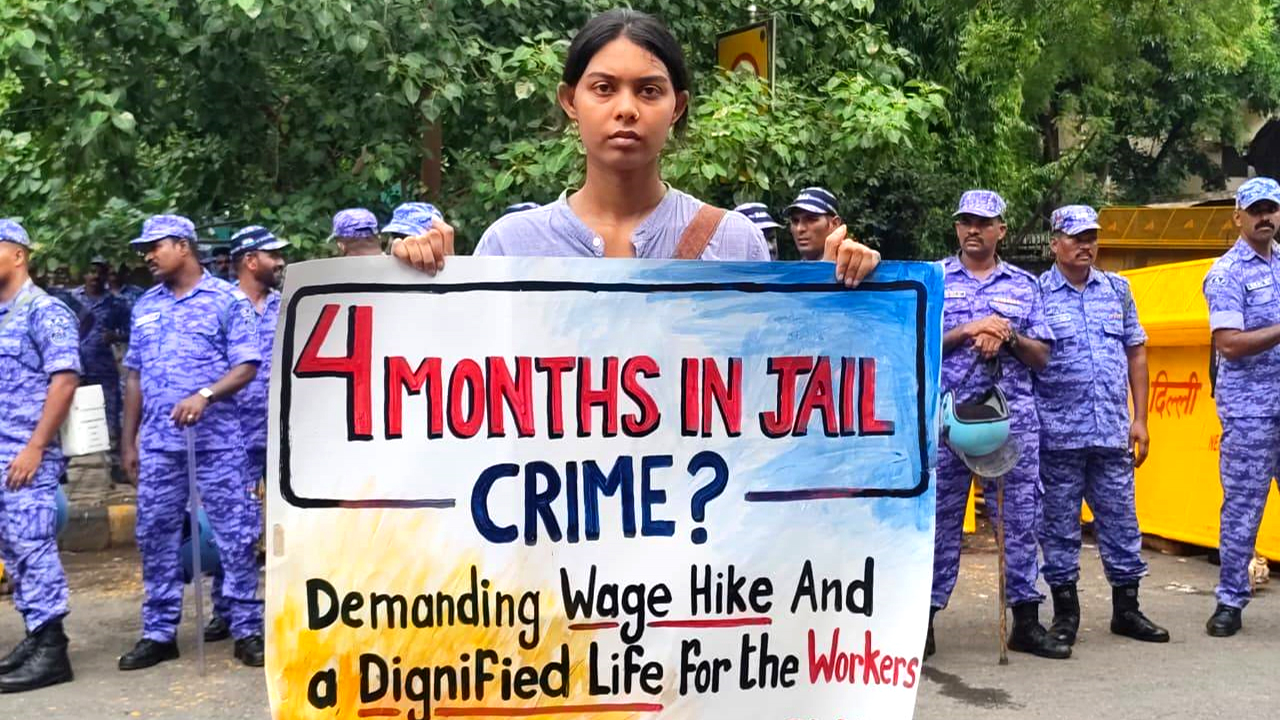
While most of the over 170 people named in the at least 14 FIRs filed in relation to the matter—one of the more controversial aspects of the police action, as filing multiple FIRs in the same criminal action is illegal as per Indian law—are out on bail, the eight prominent activists charged with ‘criminal conspiracy’ continue to remain imprisoned as the judicial process for their release moves along at a snail’s pace.
New Delhi, 11 August 2026
Mouli Sharma
A third of a year has passed since the UP police began a wave of mass arrests to quickly clamp down on a growing worker’s agitation in the state’s industrial hub, Noida. Over 170 people were named in nearly 400 incidents across at least 14 FIRs in the matter, with allegations ranging from destruction of property, criminal conspiracy to outright attempt to murder.
Meanwhile, despite widespread allegations of police brutality, excess, sexual assault, and procedural violations by the UP police, no FIRs till date have been registered against the officers of the UP police, CRPF and SWAT teams involved, nor against the hundreds of industrial giants operating in the region that were evidently in violation of minimum wage and other labour laws for over a decade.
Every month since the first recorded arrests took place on 11 April 2026, when four activists, including three women, were abducted (there was no warrant or cognisable offence involved, and even if there was, male officers aren’t allowed to arrest women in India, and their detention, even by female officers after sundown is outlawed per the Supreme Court’s landmark sundown judgment) by uniformed and ununiformed male police officers from within the Botanical Garden Metro Station, a coalition of the friends, family, and civilians in solidarity with those allegedly being targeted by the state has organised protests and public meetings to ensure the visibility of the continued incarcerations. In August, as in the months before, this coalition, called the Campaign for the Release of Workers and Activists of Noida (CaRWAN) organised a protest at Delhi’s Jantar Mantar demanding the release of all political prisoners, workers, and activists illegally arrested in Noida workers’ protest.
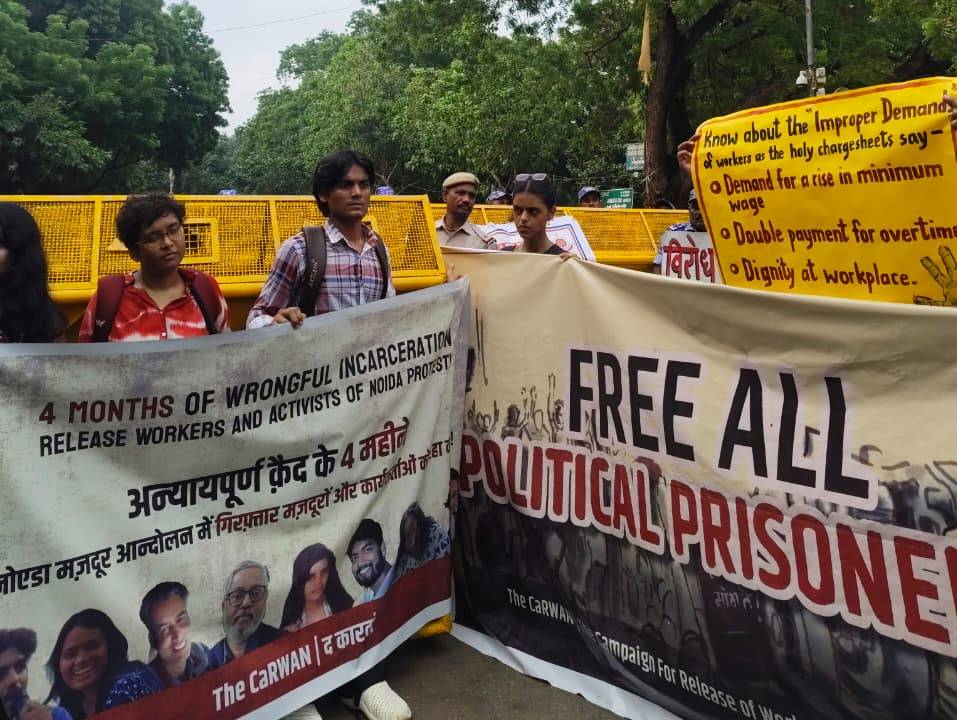
“Following their usual script given to them by their masters, the Delhi Police did not allowed peaceful protesters to enter Jantar Mantar citing “threat to law and order” as an excuse, and imposed BNSS 163,” CaRWAN said, referring to a pattern of preventive police action that has followed their solidarity demonstrations since April. The use, or abuse, of section 163 of the BNSS (or section 144 of the erstwhile CrPC), which empowers District Magistrates to impose temporary or special restrictions on public gatherings, meetings and processions has been the subject of controversy for quite some time in the country. The Indian Supreme Court has warned against its casual, excessive, or extra-procedural use, but time and again, the provision has been employed without due process (which requires lengthy bureaucratic formalities, the issuances of public notices, and most crucially, gazetted evidence of its necessity) by successive governments to obstruct protests and civil agitation, and the BJP administration is no different.
In June, too, as this reporter witnessed, security forces deployed at the Jantar Mantar protest site were recalcitrant to permit the monthly demonstration, and forced the gathering of fewer than thirty people to disperse within an hour after having it postponed from 11 in the morning to near 2 in the afternoon. Come August, this hostility seems to have escalated, and the protest on Tuesday was allegedly outright ‘disallowed’ by the police through the use of section 163, citing proximity to 15th August.
“Delhi Police tried to stop the protest by threatening the protestors with FIRs and detentions. They called the assembly ‘unlawful’ and tried to hassle the protestors. However, the protestors were undeterred and said that the Delhi Police did not care about the law when the goons of UP police in civil clothes abducted students from Delhi violating all laws regarding inter state arrests without any warrants or notice,” CaRWAN said, referring again to the allegations of procedural violation against the UP police, which gained traction through the social media and viral footage of policemen threatening and even beating unarmed civilians during their so-called security operations in the state. Several of these viral videos feature male officers beating women, and have brought the Yogi Adityanath-led BJP administration in UP under fire.
“Indeed, this has become the normal modus operandi of the police—to curb all democratic voices. The protesters, showing an example of rightful civil disobedience, conducted the protest outside the barricades of Jantar Mantar,” said a representative of the Disha Students Organisation, also a part of CaRWAN.
Student activist Chiranshu highlighted a dissonance in the Delhi police’ fluctuating response to the Noida matter, whose pro-activity in today’s protest he alleged stands in stark contrast with their indifference to the UP police carrying out illegal detentions and stalking civilians outside their own jurisdiction and within the nation’s capital.
“The Delhi police who is citing reasons of law and order disruption was criminally absent when the UP police broke every single protocol to harass and illegally abduct activists and citizens of Delhi. The police is saying that the protesters are disrespecting the national festival (India’s 80th Independence Day) by protesting so close to it. Thus, exercising our democratic right to protest has now been labelled as ‘disrespecting the independence day’,” he said. “The police further labelled us as people who want to divide the country by protesting at this time. Thus it has now become our duty to continue our protest in the form of civil disobedience, and remember the movement which united our country in the past.”
“Hundreds of people are currently facing punishment for protesting in the world’s largest democracy,” said Keshav Anand, brother of an accused Aditya Anand and key representative of CaRWAN, referring to the India’s growing roster of political prisoners and the incumbent government’s apparent penchant for suppressing dissent and criticism through allegedly unsavoury means.
“This is not the first incident of people being implicated in false cases under the BJP government. During the last 12 years, this fascist regime has deprived people of even their basic rights. Protesting, striking, and demonstrating have been declared crimes. From the Delhi riots to numerous other cases, we’ve seen people languish in jail for years without charges being proven. The judicial process itself has become a form of punishment. This is precisely what’s happening with the Noida workers’ protest. The BJP government is suppressing democratic voices with the intent of teaching people a lesson through its well-worn toolkit.”
Speaking on behalf of the Revolutionary Workers’ Party of India (RWPI), workers’ rights activist Naureen—who is one of many female activists who have come forward with experiences of sexual harassment and stalking at the hand of the UP police—stated that the rising inflation under BJP rule and the ongoing war in West Asia have caused immense difficulties for ordinary people, a much reported context for the agitation that erupted in Noida that the ongoing criminal cases against protesters undermine.
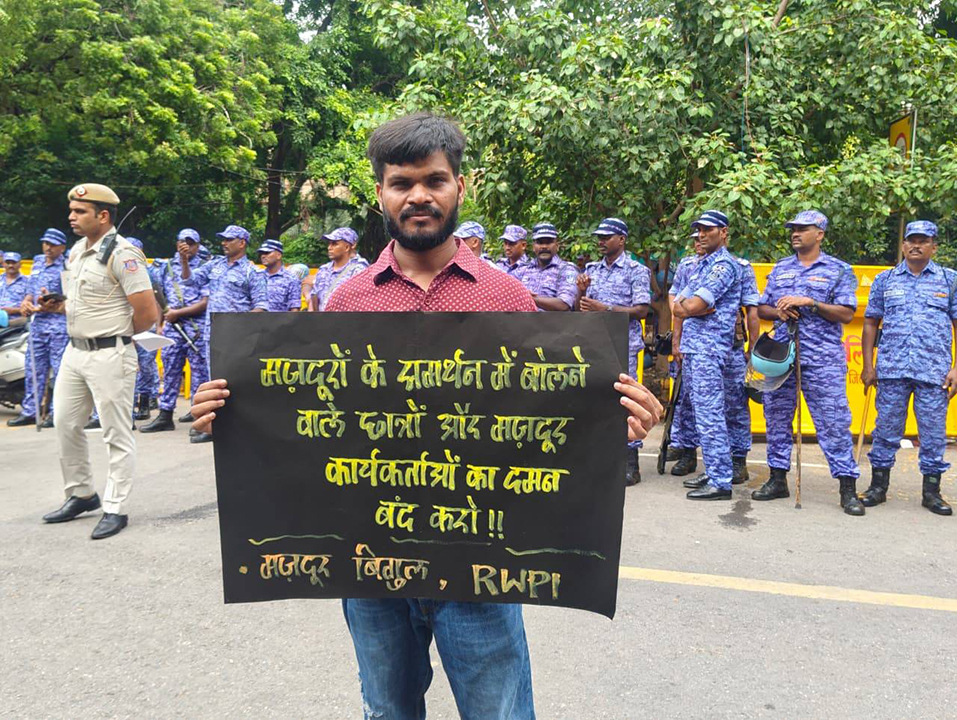
“Instead of paying attention to the demands of the people, the Modi government has served the interests of its capitalist masters,” Naureen said. “Troubled by low wages and worsening working conditions, when workers began taking to the streets across the country, they were threatened into silence through fake FIRs and the fear of the police. Despite this, workers went on strike in several places, from Manesar, Noida, Panipat, and Uttarakhand to Meerut and elsewhere. Alarmed by these peaceful protests, this fascist regime resorted to illegal arrests, raids on people’s homes, fabricated stories, and other vile acts such as intimidating and threatening workers.”
In the police investigation, at least twelve FIRs were registered across multiple police stations in the Gautam Buddha Nagar district, and at least two more under the cyber crime department against social media posts alleging the state’s abuse of authority. As per a May 13 report in the Telegraph, another FIR may have been registered against Jansatta, who conducted a sting operation against the UP police which shockingly revealed that a Noida sub-inspector and a man claiming to be a driver of Noida DCP Vijay Gupta, but the FIR has seemingly disappeared since then.
“We tried to hunt it down for the longest time,” said a representative of CaRWAN. “We think they may have just retracted it considering Jansatta is a much bigger target than people like us.”
The UP cyber crime department was unreachable for comment.
The over 170 arrests are divided neatly into two categories, civilian and political, even though there is nothing apolitical about incarcerated civilians, and nothing uncivilian about political prisoners. The distinction, though, is made clear by the criminal investigative process, in which all but eight individuals have received bail. According to sources close to Satyam Verma, the sixty-one year old veteran journalist whose continued imprisonment under the the draconian NSA, 1980, alongside serious allegations of custodial torture have led to concerns of human rights abuses by the UP police in the instant case, around twenty of these people, who were anything from protesting workers, alleged instigators, or just people at the wrong place at the wrong time, are still lodged in the Luksar jail due to difficulties in procuring security amounts. But it is eight individuals, all of whom have been long time critics of the state and advocates for workers’ rights, some of whom weren’t even present in Noida at the time of the alleged ‘unrest’, that still have a long way to go before their bails are approved, for the simple reason that that they have been named over and over across at least eleven FIRs.
This is the distinction that makes Akriti Choudhary, Rupesh Roy, Manisha Chauhan, Aditya Anand, Satyam Verma, Shrishti Gupta, Yogesh Meena, and Himanshu Kumar’s imprisonment ‘political’. Psephologist Yogendra Yadav describes the phenomenon of political imprisonment as a ‘symbolic act’ meant to serve as a deterrent against acts of solidarity and disagreement. In a country where legal principle affords bail to be the rule against the exception of its denial, even those charged with crimes perceived to be the most heinous are given the benefit of doubt, which is why the fact that the above eight’s bails have been rejected across multiple applications in multiple FIRs feels like precisely the kind of ‘symbolic act’ Yadav speaks of.
Naureen spoke of this dissonance as well: “It is not hidden that over the past 12 years, this government has worked to hollow out all the institutions of democracy from within. It has become commonplace for murderers and rapists to receive bail or have their sentences pardoned, while on the other hand, false cases continue to be filed against those who speak of justice and fairness, and repressive laws such as the NSA and UAPA continue to be imposed upon them.” She warned that such precedent is not only unconstitutional but dangerous, and that without collective outrage today, “tomorrow these fascist rulers will declare speaking against every form of repression and oppression a crime.”
Organisations like the Naujawan Bharat Sabha and the Indian Federation of Trade Unions (Sarvahara) also participated in the protest. Four chargesheets have been filed by the UP police in the matter, while at least ten more await commitment. Petitions for clubbing the multiple FIRs, revoking NSA against Akriti Chaudhary and Satyam Verma, and demanding investigation of and action against the UP police remain pending in the Allahabad High Court and Supreme Court of India.
Mouli Sharma is an author and journalist from New Delhi. She has been featured in publications like The Mooknayak, GroundXero, Frontline, Maktoob Media, The Observer Post, The Leaflet, Nivarana, The Polis Project, Article 14, NewsClick, SabrangIndia, Think Global Health, etc.