
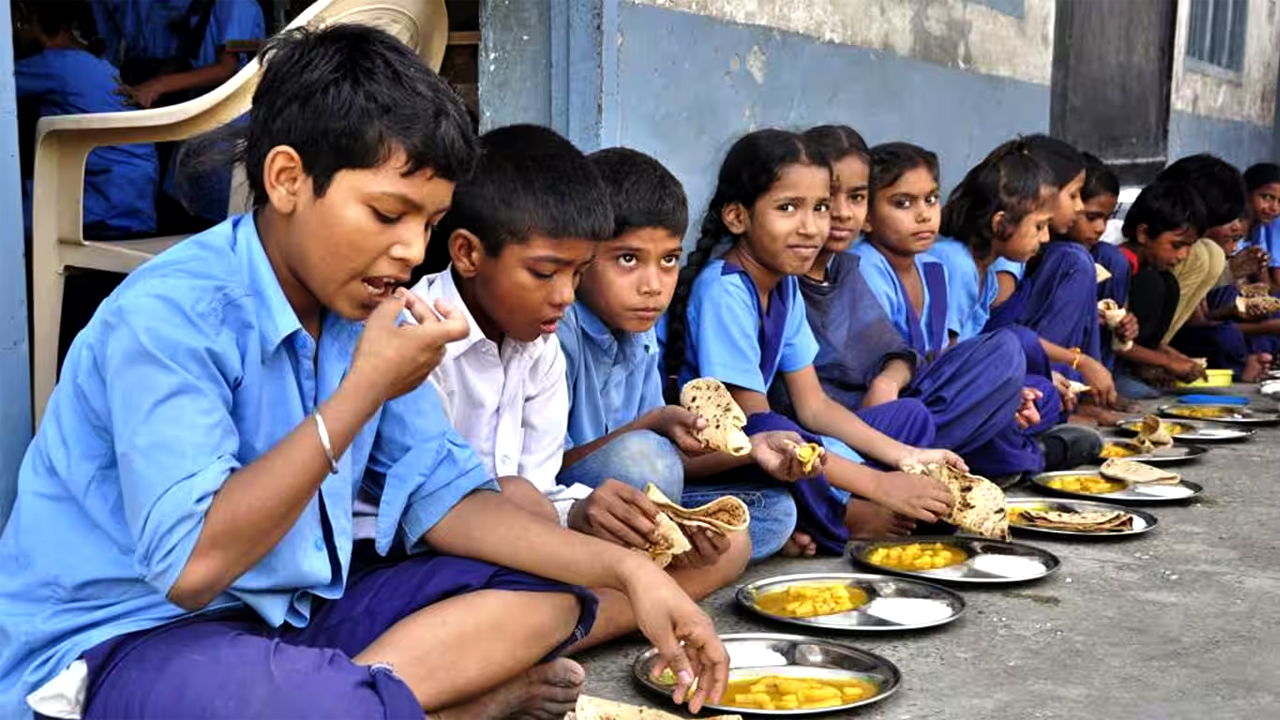
The real concern is not primarily about eggs or ISKCON but about the transformation of rights into charity and citizens into beneficiaries.
by Tinku Khanna
There is a particular kind of politics that hides inside a child’s plate. We are trained to see the noon meal in a government school as charity — a kindness the state performs upon the poor — and so we miss what it actually is: a daily, repeated answer to the question of what a republic owes its children, and of who gets to decide what owing looks like. When the West Bengal government, in its first budget on 22 June 2026, announced that the International Society for Krishna Consciousness (ISKCON) would step in to “assist in the preparation and distribution” of meals in schools under the Kolkata Municipal Corporation, it was answering that question — though it pretended to be doing nothing more than improving hygiene and raising the per-child meal allocation from ₹6.78 to ₹10. Within hours of the announcement, speculation had already begun that the egg would quietly leave the plate. We should read the whole sequence slowly, because it is not really only about lunch.
A meal that was never only a meal
The school meal in India is older than the welfare state that now claims it. Its roots run through the Madras Presidency, where, as early as the 1920s, a Corporation school in Madras began feeding children at noon — an idea associated with the Justice Party’s anti-caste, anti-Brahmin social reform, the politics of the men who understood that a shared plate could dissolve the boundaries the agrahara worked so hard to keep intact. K. Kamaraj expanded it across Tamil Nadu in the 1950s and 60s with the conviction that a hungry child cannot learn; M.G. Ramachandran universalised the scheme in 1982. The Dravidian movement grasped something that the rest of the country took decades to acknowledge: that commensality — eating together, from the same vessel, cooked by the same hands — is among the most radical things a state can organise.
The national scheme arrived in 1995 as the National Programme of Nutritional Support to Primary Education, then was transformed in 2001, when the Supreme Court, hearing the Right to Food case (PUCL v. Union of India), directed every state to serve a cooked mid-day meal rather than handing out dry grain. That word — cooked — did the work. A sack of rice is a transfer. A hot meal is an institution. It requires a kitchen, a fire, a person to tend it, an hour in the day, a place for children to sit, and a community willing to watch over all of it.
And here is the part we have almost forgotten, because it has become inconvenient. The meal was designed to be cooked by us, near us, watched by us. The decentralised model — meals prepared on the school premises by local cook-cum-helpers, by women’s self-help groups, by mothers’ committees — was not an administrative afterthought. It was the heart of the Programme. The 2010 Planning Commission evaluation explicitly recommended that the cooking persons will “consist of local women’s self-help groups or mothers of children studying in the schools.” Odisha built its Mission Shakti around more than six thousand women’s Self Help Groups (SHGs). Rajasthan’s Annapurna Mata put mothers on a cooking-and-watching rotation that cut pilferage dramatically. Gujarat’s Tithi Bhojan invited families to mark births and weddings by feeding children at the school. The poor woman earned a wage, however meagre; she ate alongside the children; she could be complained to and could herself complain; she belonged to the village and could not vanish.
We should be honest about the meagreness. The cook-cum-helper’s honorarium has long been an insult — a thousand or two thousand rupees a month, paid late, for hours of daily labour. To call this “women’s empowerment” without qualification is to flatter a system that exploited women’s care work while underpaying it. But the answer to underpaid women’s labour is to pay it properly and dignify it — not to delete the woman entirely and replace her with a branded van. That distinction is the whole argument of this essay.
How the states learned to fail
The per-child cooking cost was frozen at amounts that mocked the rising price of dal, vegetables and oil — ₹6.78 a day at the primary level, a little over ten rupees at the upper primary. Honoraria stagnated. Monitoring committees existed on paper and dissolved in practice. And then came the tragedies that became examples which eventually would become a nail into the scheme’s coffin: the 2013 Bihar poisoning that killed twenty-three children, contaminated meals, lizards and insects in the rice, embezzlement scandals running into crores. Each disaster was real, and each was used the same way — as evidence that “the system” had failed, when what had actually failed was the funding and the supervision of the system, both of which were the government’s own responsibility. The decentralised kitchen was not allowed to fail on its own merits. It was set up to fail, and its failure was then offered as proof that the poor woman cannot be trusted to cook.
The corporate cauldron arrives
Into this gap walked Akshaya Patra. Founded by ISKCON Bangalore in June 2000, it began by feeding fifteen hundred children in five schools. When the 2006 NP-NSPE guidelines formally opened the door to “public-private partnerships,” that door had a name on it. Akshaya Patra grew into what it accurately calls the world’s largest NGO-run school-feeding programme, today reaching well over two million children across many states from its great mechanised kitchens — facilities that can turn out forty thousand rotis an hour, ferried out in fleets of branded vans before dawn.
The appeal is genuine and should not be waved away. Centralised kitchens are clean. Large-scale automated cooking reduces some kinds of contamination and some kinds of theft. The organisation insists, with figures, that it is the lowest-cost meal provider in the world, topping up the government’s sixty-odd percent with corporate CSR money and donor contributions — the names of India’s tech philanthropy sit on its board. NITI Aayog officials have praised its kitchens; chartered accountants have garlanded its financial transparency. If the only question were “is the food hygienic and is the operation efficient,” the answer would often be yes. But that has never been the only question, and the people who pretend it is are usually the ones who benefit from the narrowing.
The doctrine on the plate
Akshaya Patra’s parent body is a Vaishnavite order that practises a sattvic, lacto-vegetarian diet: no meat, no fish, no egg — and, distinctively, no onion and no garlic, which the tradition classifies as tamasic, foods of the “lower modes of nature” that dull the spirit. This is a sincere religious conviction. It is also, when poured into a state’s school kitchens, a religious diktat administered to millions of children who never chose it. The same children who received five eggs a week at the anganwadi were, on entering school, abruptly made vegetarian.
The contradiction broke open in Karnataka in 2018–19. A report in The Hindu documented children finding the food bland and preferring to eat at home; the State Food Commission found onion and garlic simply absent from the meals, contrary to the state’s own menu. Akshaya Patra refused to comply, declining even to sign that year’s memorandum rather than add the offending bulbs. The Right to Food Campaign and the Jan Swasthya Abhiyan wrote to the government demanding the contract be terminated, with a line that ought to be carved above every PPP file: religious diktats cannot override the established principles of the right to food. The organisation produced favourable nutritional assessments from the National Institute of Nutrition; activists replied that no one had measured how much food the children actually ate or threw away — that a lab certificate of “adequate protein” means nothing if the child, repelled by the taste, leaves the plate full.
In Odisha the state engineered a workaround: it would supply two eggs a week, schools would boil them, and the cost would be deducted from Akshaya Patra’s allotment, since the organisation would not touch non-vegetarian food itself. But the core objection survives all of them: a public entitlement, funded by everyone’s taxes, was being shaped to the dietary purity rules of one sect — and those rules, in the Indian context, are not religiously neutral. The “pure” vegetarian, onion-and-garlic-free sattvic plate is mainly the upper-caste plate. To universalise it is to teach a Dalit, Adivasi, or Muslim child, every single afternoon, that the food of her home is impure or is of lowest moral value.
West Bengal, the last five years
Under the long Trinamool years, the state’s mid-day meal programme was in decline: shrinking coverage, falling attendance, weak oversight, food stretched impossibly thin. A 2026 report in The Wire described a North Bengal school cooking for thirty-seven mouths with three hundred grams of dal, eggs and soybean appearing on the plate only once a week. The 13th Joint Review Mission and the Programme Approval Board, examining 2023–24, found startling mismatches between state and district numbers — an over-reporting of roughly 14.8 lakh children and 16 crore meals over a six-month stretch of 2022, with an implied cost impact above ₹100 crore, after which the Centre cut the state’s assistance by nearly ₹180 crore. Stranger still was the under-spending: actual expenditure of only about ₹515 crore in 2023–24 against far larger allocations in the years that followed, the revised estimate for 2025–26 collapsing to roughly ₹305 crore. Money allocated for feeding children was not reaching children.
So the decentralised, woman-staffed West Bengal system was permitted to rot, much as elsewhere — through theft, fudged numbers, and a chronic inability or unwillingness to spend. By the time the new BJP government arrived in May 20026, the alibi was ready-made. The ground had been prepared for someone to be invited to clean up the mess.
The handover
The new BJP government, having ended fifteen years of Trinamool’s rule, presented its first budget on 22 June 2026. It raised the primary cooking meal allocation from ₹6.78 to ₹10, added an extra thousand rupees to the cook-cum-helpers’ monthly honorarium — and announced that ISKCON would assist in preparing and distributing meals in the schools of the Kolkata Municipal Corporation. ISKCON’s Kolkata vice-president confirmed that the state had asked the order to take on the responsibility, noting that it already runs single kitchens feeding lakhs of children in Delhi. Officials describe it as a pilot project.
Within days the obvious question detonated. Reports circulated that the egg would be replaced by paneer and soybean; the Trinamool’s spokesperson Derek O’Brien accused the government of “imposing vegetarianism” and declared that “Bengal rejects this,” tying it to the egg-and-fish theatre of the election campaign. ISKCON’s spokesman countered that no menu has been finalised and that any circulated list is unofficial. Perhaps. But notice what is and is not in dispute. Nobody disputes that the order’s entire dietary practice forbids egg, fish, onion, and garlic. Nobody disputes that this is Bengal — where fish and egg are not indulgences but the everyday architecture of nutrition and identity, where maachh-bhaat is less a cuisine than a civilisation. To hand the children’s kitchen to a body doctrinally committed to removing precisely those foods, and then to promise reassuringly that the menu “isn’t finalised,” is to mistake the public for fools.
There is a saffron grammar to this, and it would be dishonest to pretend otherwise. A Hindutva-aligned government, in a state it has long wished to culturally annex, routes the most intimate civic ritual it controls — the feeding of poor children — through a religious order whose diet encodes upper-caste purity, in a region whose food culture has always been its most stubborn refusal of that purity. The plate becomes a site of normalisation. Eat this way, daily, from childhood, and learn what the nation now considers clean.
The egg, and the arithmetic of the poor
For a poor child, the egg is the most efficient source of protein, fat, iron, and vitamin B12 that money can buy — cheap, complete, hard to adulterate, impossible to dilute the way dal-water can be diluted. Every serious right-to-food argument for the egg rests on the body of the poorest child, the one whose family cannot provide animal protein at home, the Last Girl whose growth and cognition are being negotiated away in a budget footnote. To replace the egg with paneer and soya chunks in the name of a sect’s purity is not a lateral nutritional swap; for the child who needs it most, it is a downgrade dressed as an upgrade, austerity wearing the saffron robe of shuddhata. The state will say the lab numbers balance. The lab does not have to grow up on the result.
The khichuri school
The egg does more than nourish the poorest child; it is often what brings her to school at all. Look at who actually eats this meal and the class architecture of the whole scheme comes clear. India runs, in effect, two school systems. The middle class — and, straining at the edge of its means, even the lower-middle class — moves its children into English-medium private schools, which serve no mid-day meal and need none, because those families can feed their own. The government school is the other India: the school the poor send their children to, the one many call, half-tenderly, the khichuri school, because the rice and dal at noon is its surest attraction. The proof sits in the attendance register: turnout climbs on the days an egg appears — when Karnataka raised eggs from two days a week to six, attendance rose from 93.5 to almost 99 per cent. For many of these children the meal is not a supplement to their schooling; it is the most dependable thing the school offers. Strip the egg and you do not merely change a menu — you loosen the single thread that ties the poorest child to the classroom.
And that is the indictment buried in the budget. The schools that lean on the meal are starved everywhere else — too few teachers, crumbling buildings, classrooms without a usable blackboard. West Bengal now leads the country in schools with not a single child on the roll; its total enrolment has fallen by more than a million in three years; and thousands of schools stand listed for closure or “merger” — over five hundred of them in Kolkata alone. The corporation schools of this city are emptying out, shuttered or clinging on with a dozen pupils and a teacher or two. A government that took these children seriously would have spent on the thing that is actually broken: the school itself — its teachers, its toilets, its roof. But rebuilding a hollowed-out school is slow, costly, and invisible; handing its kitchen to a temple is none of these, and it photographs far better. So the lunch is reshuffled while the school keeps crumbling, and the poor child is handed a cleaner, purer plate inside an institution the state has otherwise resolved to let die — and even the egg that carried her through the gate is now up for negotiation.
The food of home
The decentralised kitchen had one homely virtue the corporate cauldron cannot reproduce: it cooked local food, the way a child’s mother cooked it. Children ate it because it tasted like belonging. The Akshaya Patra experience across states is the opposite story — children in Karnataka and Odisha reporting food too bland to finish, food that “is not according to local taste,” food from which the very onion and garlic that make Indian cooking Indian have been removed on theological grounds. A meal a child will not eat is not nutrition; it is accounting. The centralised model’s great efficiency is also its great erasure: it standardises the plate, and to standardise the plate in this country is, inevitably, to impose the dominant culture’s plate on everyone else’s children.
What is actually being replaced
Behind the debate about eggs sits the deeper substitution, the one nobody put in the budget speech. When ISKCON’s vans replace the school kitchen, they do not only replace a recipe. They replace her — the cook-cum-helper, the SHG woman, the mother on the committee. A livelihood, however poorly paid, that placed a working-class woman at the centre of a public institution in her own neighbourhood, is converted into a distant, mechanised operation staffed largely by men and managed by a corporate-philanthropic board. This is the feminist heart of the loss, and it is exactly the kind of loss our discourse is built to miss, because the woman in question was never paid enough for her work to register as work.
Read it through the Last Girl. Whose mother loses the small honorarium? The poor woman’s. Whose protein leaves the plate? The poor child’s. Whose home food is declared unclean? The Dalit, the Adivasi, the Muslim child’s. The same axis of caste, class, and gender that the mid-day meal was conceived to interrupt is the axis along which the handover redistributes harm. And the agency receiving the contract arrives clothed not as a contractor — which is what, functionally, it is — but as charity, as seva, as donors doing the poor a favour. A public right is quietly re-described as a private gift. The difference matters enormously, because you can demand a right and supervise it; a gift you can only receive, and be grateful for.
The watching eye, removed
There is a small, devastating finding buried in an old study of Delhi’s centralised kitchens: when the food arrived and was bad, even the teachers did not know whom to complain to. That sentence is the entire critique of corporatisation in miniature. The decentralised kitchen kept accountability local and visible. The mother on the committee watched the dal go in. The cook ate what the children ate. A bad meal had an address and a human face and a panchayat that could be shouted at. Centralise the kitchen and the watching eye is gone; oversight migrates from the village into an MoU, a service contract, a quarterly review nobody reads. The community is demoted from supervisor to recipient. Democratic accountability — the slow, irritating, indispensable business of ordinary people keeping an institution under watch — gave way to the new language of Management — for the smooth efficiency of a vendor who answers to a board, not to a mother.
From citizens to beneficiaries
Here is where the plate becomes, finally, a question about the republic.
A citizen is a political subject: someone who helps constitute the institutions that govern her, who watches them, argues with them, demands of them, and can be answered by them. A beneficiary is something else — a recipient, positioned to be grateful, managed, fed.
Every step of this story moves the poor in the same direction: away from political subjecthood, toward managed beneficiary-hood. The decentralised kitchen made the meal a thing the community produced and supervised. The woman’s honorarium made her a worker with a claim. Replace all of it with a clean corporate cauldron, a Satvic menu, a donor’s benevolence, and a vanished egg, and you have not merely changed who cooks. You have changed what the child is in relation to her state. She is no longer a young citizen being seated, deliberately, at a common table that refuses caste — Tagore’s dream of an India where the mind is without fear and the world is not broken into fragments by narrow domestic walls. She is a beneficiary, fed someone else’s purity, on someone else’s terms, with no one nearby to complain to.
The mid-day meal was one of the few places where the Indian state still touched the poor child’s body with something like a promise: that she belonged, that the nation owed her lunch as a matter of right and not of charity. To hand that promise to a corporate-religious cauldron — in the name of hygiene and efficiency — is to keep the meal and quietly remove the politics. The plate stays full enough for the photograph. What empties out is citizenship itself.
The question was never whether the food is clean. The question is whether the child eating it is being raised as a subject of the state or as a citizen of a republic. They are betting she will not notice the difference. The whole point of feeding her was supposed to be that one day she would.
References
- “Midday Meal Scheme,” Wikipedia (accessed June 2026) — origins in the Madras Presidency, the 1995 NP-NSPE, centralised vs. decentralised models, and Tithi Bhojan. https://en.wikipedia.org/wiki/Midday_Meal_Scheme
- PRS Legislative Research, on the Mid-Day Meal Scheme and the 2010 Planning Commission evaluation recommending that cooking be entrusted to local women’s self-help groups or mothers of enrolled children. https://prsindia.org
- “A Critical Review of Mid-Day Meal Scheme (PM-POSHAN) Using UDISE+ 2024–25 Data,” Education for All in India (Nov 2025) — Odisha’s Mission Shakti SHG model, Rajasthan’s Annapurna Mata parent-participation model, West Bengal’s cook-cum-helper system, and recent quality lapses. https://educationforallinindia.com/a-critical-review-of-mid-day-meal-scheme-pm-poshan-using-udise-2024-25-data/
- “India: Mid-Day Meal Scheme,” Education Above All Observatory — women’s employment and community/mother supervision as design features. https://policy-hub.educationaboveall.org/solution/india-mid-day-meal-scheme
- “‘Lack of monitoring, corruption plague mid-day meal scheme,'” ummid.com (IANS, 2013) — the Bihar poisoning tragedy and structural monitoring failures.
- The Akshaya Patra Foundation, official site — founding (2000), the 2006 NP-NSPE public-private-partnership guidelines, scale, and menu philosophy. https://www.akshayapatra.org
- “Akshaya Patra,” ISKCON Bangalore — the foundation’s 2000 launch feeding 1,500 children in Bangalore. https://www.iskconbangalore.org/akshaya-patra/
- “Explainer: Why controversy around Akshaya Patra’s mid-day meals has resurfaced,” Scroll.in (June 2019) — the no-onion/garlic/egg doctrine, funding split, and Odisha egg workaround. https://scroll.in/article/926441
- “Akshaya Patra’s midday meal runs into yet another controversy over missing onion & garlic,” ThePrint (June 2019) — the Karnataka row, the Right to Food Campaign / Jan Swasthya Abhiyan demand to terminate the contract, and the sattvic/tamasic rationale. https://theprint.in/theprint-essential/246491/
- “Karnataka group of citizens asks Centre to terminate contract to ISKCON-run NGO for mid-day meals,” Scroll.in (Dec 2018) — “religious diktats cannot supersede the right to food.” https://scroll.in/latest/905573
- “‘Bland Mid-Day meal’: K’taka govt accuses Akshaya Patra of providing unhealthy food,” The News Minute (2021) — Food Commission finding that children were not eating the food. https://www.thenewsminute.com/article/92777
- “Unseemly Controversy Erupts Over Mid-Day Meals…,” Outlook (2019) — The Hindu report on children finding the food bland and eating at home; defenders’ responses. https://www.outlookindia.com
- “Mid-day meals: Odisha schools will serve eggs alongside food served by ISKCON-linked NGO,” Scroll.in (Dec 2018) — the egg arrangement and the anganwadi-to-school nutritional whiplash. https://scroll.in/pulse/905850
- Joydeep Sarkar, “In West Bengal’s Schools, the Mid-Day Meal Tells a Story of Hunger, Decline and Failure,” The Wire (March 2026) — the 13th Joint Review Mission, over-reporting of ~14.8 lakh children and 16 crore meals, the implied ₹100-crore-plus impact, the ₹179.65 crore central cut, and fund under-utilisation. https://thewire.in
- “West Bengal Budget 2026…,” India TV News (June 22, 2026) and “State taps ISKCON to upgrade meals in KMC schools,” Millennium Post (June 2026) — the per-child rate raised from ₹6.78 to ₹10, the ₹1,000 honorarium increase, and the ISKCON partnership for KMC-area schools. https://www.millenniumpost.in/bengal/665234
- “‘Imposing vegetarianism’: TMC’s Derek O’Brien targets BJP over Bengal mid-day meal,” ANI / The News Mill (June 24, 2026) — the egg-removal speculation, O’Brien’s criticism, and ISKCON Kolkata VP Radharaman Das’s clarification that no menu has been finalised. https://aninews.in
- “K’taka mid-day meal scheme: 6 days of eggs a week has led to increased school attendance,” Vartha Bharati (DSEL data via The Hindu) — attendance rising from 93.5 to 98.97 per cent as eggs went from two to six days a week; and “Better nutrition and better attendance, yet eggs are being removed,” Countercurrents (April 2025) — attendance rising on egg days, and the casteist framing of a “vegetarian” India (only about a fifth to a quarter of Indians self-identify as vegetarian). https://english.varthabharati.in ; https://countercurrents.org
- “Govt Schools Declined Between 2019–2024 While Low-Enrolment Schools Rise,” The Wire (Dec 2025), and “Nearly 8,000 schools report zero enrolments in 2024-25; West Bengal leads,” Careers360 (Oct 2025) — West Bengal leading the country in zero- and low-enrolment government schools; and “West Bengal: School Education Suffers With Declining Enrolment and Closure of Schools,” NewsClick — the state’s list of low-enrolment schools (531 of them in Kolkata) and total enrolment falling from 17.17 to 15.98 million between 2021–22 and 2024–25 (UDISE+). https://thewire.in ; https://news.careers360.com ; https://www.newsclick.in
Tinku Khanna is a social activist and member of Groundxero Collective.