
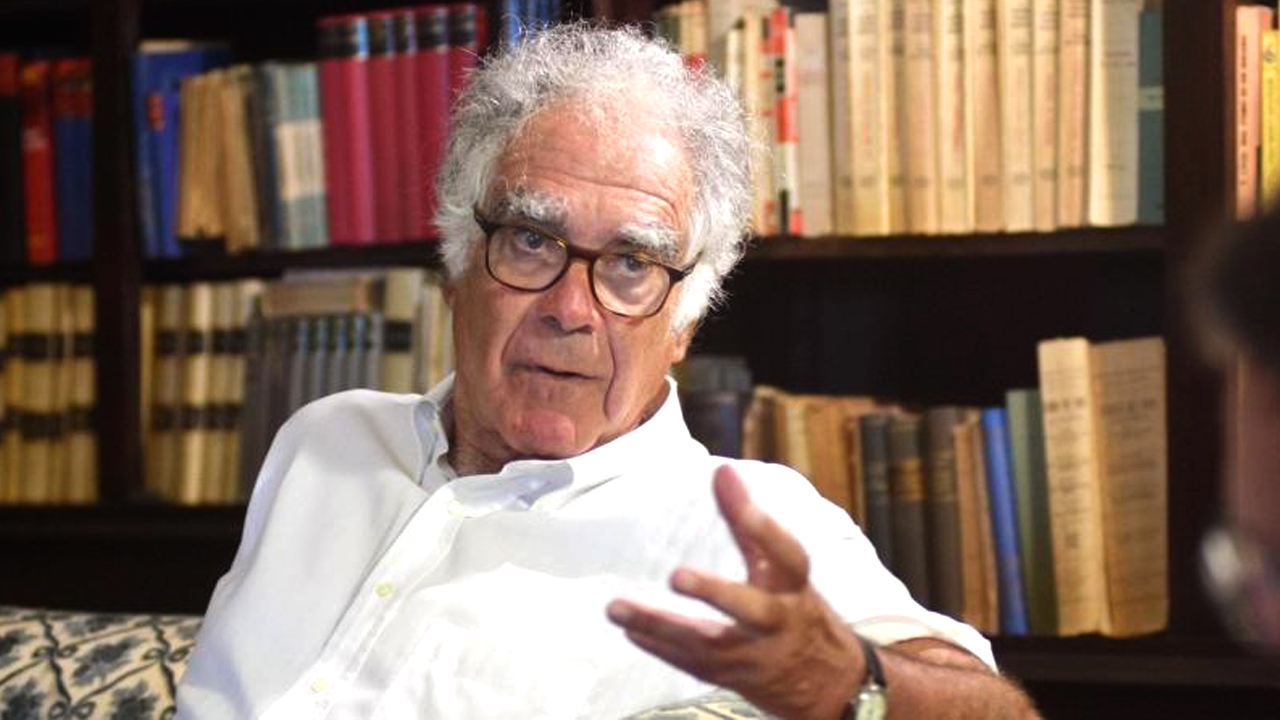
The death of renowned Italian historian Carlo Ginzburg on 17 June 2026, at the age of 87, marks the loss of one of the most original intellectual voices of the last half-century. Best known for pioneering microhistory and recovering forgotten lives from the margins of the archive, Ginzburg also offered profound reflections on citizenship, memory, and moral responsibility. His essay The Bond of Shame remains especially relevant in a time of growing democratic anxieties, reminding us that the capacity to feel shame for injustices committed in our collective name may be one of the deepest expressions of political belonging.
By Bilal Majid
Carlo Ginzburg was one of the most innovative historians of our time, and his death is a sad loss. Through his groundbreaking work in historical study, Ginzburg taught readers of all ages how to find previously silenced voices, question established narratives, and pay attention to apparently trivial details that may indicate underlying power systems. However, out of all his writings, one little article stands out as having great relevance to the political climate we are now experiencing: The Bond of Shame.
In that remarkable essay, Ginzburg advanced a provocative idea. His main point was that we shouldn’t automatically identify with the nation to which we were born and raised. The nation whose actions can make us feel ashamed is often the very one to which we belong. He made the case that shame may entangle us even more firmly than pride. We experience guilt not due to our rejection of a group, but rather our attachment to it. The contradictory ability to feel guilt for one’s homeland is a sign of belonging. With tremendous power, this understanding sheds light on modern India.
Over the past decade, India has witnessed an unparalleled degree of centralisation of political power. The Bharatiya Janata Party, led by Prime Minister Narendra Modi, has become more than just an elected leader; his image is quickly becoming a national icon, thanks to the party’s electoral successes. After decades of coalition government, supporters see this as a decisive leadership move. Opponents see it as a centralisation of power inside the party and its machinery.
The vocabulary of public discourse has evolved, and this is true regardless of one’s political leanings. More and more, people see criticism of the administration as a critique of the country. People who challenge governmental policies are often labelled as “anti-national,” “urban Naxals,” or stooges of foreign interests. This includes journalists, professors, activists, students, and opposition leaders. The line between patriotism and governmental allegiance has grown dangerously blurry.
Ginzburg would have seen this occurrence right away. His article serves as a timely reminder that the inverse principle is essential for democratic participation. A person is not necessarily betraying their country when they experience unease, humiliation, or guilt about governmental acts. A strong feeling of belonging to the political community is more likely to be the source of such criticism. When looking at the plight of India’s religious minority, this becomes very pertinent.
There has been a steady stream of news reports detailing campaigns that target Muslims and Christians, as well as mob lynchings, communal violence, hate speech, assaults on churches, and accusations of forced demolitions. Numerous incidences have been reported by independent journalists, civil society groups, and human rights organisations, which have aroused alarm both inside India and worldwide. Government supporters often argue that such incidents are exaggerated, reported selectively, or disconnected from official policy. But these worries still exist, which points to a more serious problem.
The question is not whether certain occurrences take place. The question is whether minority groups are starting to feel pressured to prove their national identity. When cultural conformity seems to be a prerequisite for citizenship, a democracy becomes precarious.
This situation calls for Ginzburg’s thoughts on shame. He contended, using the Greek idea of aidos as an example, that shame is more than just an individual feeling. Everyone feels obligated to do the right thing. Being a part of the same political group makes it easy to feel guilty about things you didn’t do. Every citizen is involved in the culture that allows violence, therefore it’s not only that every citizen should be worried about the violence that a Muslim family, Christian congregation, or Dalit community in one town or city may face. This conflict is further shown by how disagreement is handled.
A number of well-known political personalities, journalists, professors, and activists have been subject to lengthy investigations, incarceration, or arrest due to strict legislative restrictions within the last 10 years. The detention of journalists covering Kashmir, the application of anti-terror laws against critics, and cases involving activists linked to the Bhima Koregaon probes have all sparked heated debates over due process and civil liberties . Proponents of these policies say that more caution is necessary to protect the country. Some people think that these kinds of legislation are being used more and more to intimidate politicians.
It is not necessary for a historian to decide each and every judicial case in order to spot a larger trend. Elections are essential to democracy, but so too is the freedom to dissent. A decline in public life occurs when disapproval is equated with betrayal. Long before the state legally controls them, citizens start to censor themselves.
A comparable shift is seen in the media environment. There is a growing segment of the television news industry that is playing an active role in political mobilisation rather than only reporting the news. Outrage, rather than study or analysis, is often given more airtime during prime-time discussions. Consequently, critical journalism has taken a back seat to independent internet platforms and smaller media. Also influenced by this setting is India’s stance on the global stage.
Moral and political schisms have opened up as a result of the ongoing genocide in Gaza. Aspirations for more geopolitical power, deeper strategic relations with Israel, and India’s long history of backing Palestinian ambitions are all factors that have informed the country’s reaction. Equally problematic for India’s ties with Iran are the country’s strengthening alliances with Western and Gulf countries.
Within the framework of statecraft, these changes make sense. But they also make us wonder whether we can be consistently moral with them. Is it possible for a country that gained independence from colonialism to turn a blind eye to the widespread suffering of its own citizens? Are foreign policy decisions only based on strategic interests? There is more at play here than just philosophy. These are matters of morality.
After finishing The Bond of Shame, Ginzburg consulted Primo Levi’s works. The “shame of the world” that Levi described is felt not by those who do wrong but by those who see injustice done and realise they can’t do much to stop it. Levi felt ashamed that he was a part of a human race that could cause such pain. That realisation is still relevant today, and not only in relation to Europe or the Holocaust. Any community dealing with growing polarisation, intolerance, and the loss of democracy may relate.
Indian democracy remains resilient, despite the pressures it faces. There are still places to oppose and renew inside its constitutional framework, in civil society, in the court, in universities, and in independent media. Coups and revolutions are not the only means by which democracies fall. The normalization of dread, compliance, and quiet may also contribute to their progressive reduction.
So, the last lesson of Carlo Ginzburg is not doom and gloom but rather responsibility. Uncritically celebrating one’s homeland is not the mark of a real patriot. Refusing to be indifferent is the mark of a real patriot. Experiencing guilt over wrongs done in one’s name does not constitute a betrayal of one’s country. It reflects a belief that India is capable of something better and must strive toward it.
Carlo Ginzburg’s final lesson is not one of despair but of responsibility. Patriotism does not consist in uncritical celebration of one’s nation; it consists in refusing indifference when that nation falls short of its ideals. To feel shame at injustices committed in one’s name is not to reject one’s country. It is to affirm a deeper attachment to it and a stronger commitment to what it ought to be. In times defined by spectacles of performative pride, Ginzburg reminds us that shame can be a democratic virtue. The most meaningful tribute we can offer him is to preserve the courage to say: This is our country, and that is precisely why we cannot look away.
The author Bilal Majid teaches history to undergraduate students at Degree College Tral, Pulwama.