
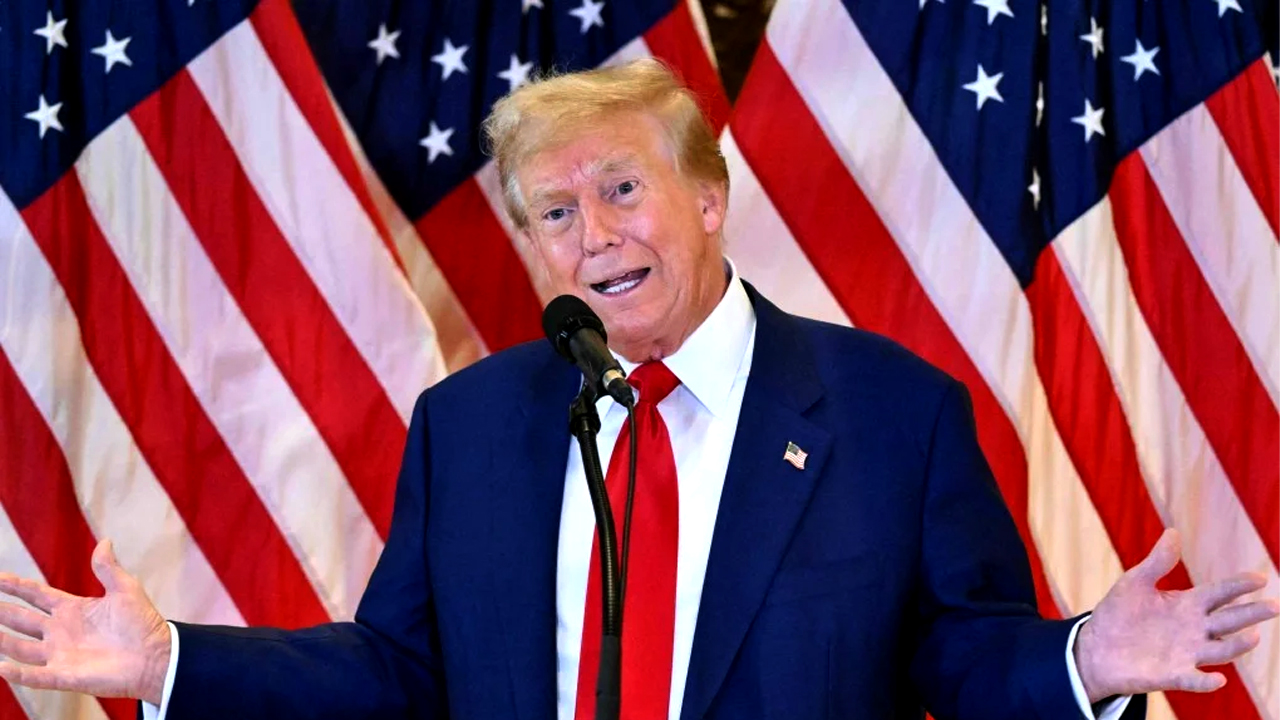
Trump’s trade wars are often misread as anti-globalization. In reality, they represented a restructuring of imperial economic relations, not their dissolution.
By Arkadeep Goswami
(The presidency of Donald J. Trump is often interpreted as an aberration—an irrational interruption in the smooth functioning of liberal internationalism. This essay argues otherwise. Trumpism represents not a rupture but a re-articulation of imperial power under conditions of U.S. hegemonic decline. By rejecting liberal multilateral rhetoric while intensifying coercive economic, military, and ideological practices, Trump reinvented imperialism in an openly nationalist and transactional form. Situated within the longue durée of American empire, Trumpism stripped imperial power of its liberal camouflage, revealing its coercive core in an age of crisis capitalism.)
New imperial power rarely announces itself plainly. It prefers the language of order, stability, humanitarianism, or civilization. For much of the post–Cold War era, U.S. global dominance was articulated through the idiom of liberal internationalism—human rights, democracy promotion, and multilateral governance. Donald Trump disrupted this idiom. His speeches, policies, and instincts replaced euphemism with bluntness, diplomacy with coercion, and universalism with nationalist exceptionalism.
Yet Trump did not invent American imperialism, nor did he dismantle it. Rather, he reinvented its mode of expression. What distinguishes Trump is not the exercise of power, but the refusal to mask it. In this sense, Trumpism marked a transition from liberal imperialism to what may be called neo-sovereign imperialism—an imperial formation that openly disdains international norms while aggressively defending national capitalist interests.
Aimé Césaire warned that colonial brutality is never accidental; it is merely normalized when directed outward. Trump’s presidency made visible what liberal discourse had long concealed: that the global order is sustained not by consent alone, but by coercion, hierarchy, and violence.
Any serious analysis of Trumpism must be grounded in theory. Imperialism, as Lenin argued, is not merely territorial conquest but a structural feature of monopoly capitalism. In Imperialism, the Highest Stage of Capitalism, he identified five defining features: concentration of production, dominance of finance capital, export of capital, formation of international monopolies, and the territorial division of the world among great powers.
While formal colonialism has largely receded, this logic Lenin identified persists. Contemporary imperialism operates through military bases, financial institutions, trade regimes, sanctions, and ideological dominance. Samir Amin emphasized that imperialism today is exercised through the polarization of the global system, where surplus flows from the periphery to the core.
Trump did not reject this structure; he rejected its liberal management. His presidency coincided with intensified trade wars, expanded sanctions regimes, militarized borders, and open threats against sovereign states. These actions were not deviations from imperialism, but symptoms of its crisis.
By the early twenty-first century, U.S. dominance faced structural constraints: the rise of China, prolonged wars in Iraq and Afghanistan, the 2008 financial collapse, and declining domestic legitimacy. Liberal imperialism—rooted in multilateralism and soft power—was increasingly unable to manage these contradictions.
Trump emerged precisely at this juncture. His slogan “America First” was not isolationist in substance; it was imperialist without apology. It rejected the costs of empire while insisting on its benefits. NATO allies were chastised not for militarism, but for insufficient financial contribution. Trade agreements were condemned not for exploitation, but for failing to privilege U.S. capital sufficiently.
This shift signaled a crisis of hegemony—a moment when a dominant power can no longer rule primarily through consent and must increasingly rely on coercion.
Trump’s rhetoric matters not because it is crude, but because it is revealing. When he spoke of “shithole countries,” threatened to “totally destroy” North Korea, or framed immigration as an invasion, he articulated a worldview rooted in civilizational hierarchy.
Empire has long been sustained through discourse by constructing the Other as backward, dangerous, and inferior. Trump’s language fits squarely within this tradition—except that it lacks liberal restraint. In rejecting diplomatic decorum, he did not weaken imperial ideology; he re-naturalized it. Domination was no longer framed as benevolence but as entitlement. Sovereignty became conditional. International law became optional.
Trump’s trade wars are often misread as anti-globalization. In reality, they represented a restructuring of imperial economic relations, not their dissolution. Tariffs, sanctions, and coercive renegotiations were deployed to reassert U.S. dominance within global capitalism.
Sanctions expanded dramatically during Trump’s presidency. By 2020, the United States imposed economic sanctions on over thirty countries, affecting nearly half the world’s population. These functioned as tools of collective punishment, disproportionately harming civilians while entrenching elite power.
This aligns with what David Harvey terms accumulation by dispossession—the use of extra-economic coercion to secure capital accumulation. Far from protecting workers globally, Trump’s policies intensified inequality both within and between nations.
Trump frequently criticized “endless wars,” yet U.S. military spending reached record levels under his presidency. Drone strikes continued. Arms sales increased, particularly to authoritarian allies. The difference was rhetorical, not material.
Liberal imperialism often justifies war through humanitarian discourse—protecting women, minorities, or democracy. Trump dispensed with such justifications. Violence was framed as deterrence, punishment, or transaction. As Frantz Fanon observed, colonial violence does not disappear; it merely changes form. Trump stripped war of moral language, exposing its naked strategic calculus.
No aspect of Trumpism better illustrates imperial contradiction than immigration. While capital flows freely, labor is criminalized. The U.S.–Mexico border became a site of spectacular violence—family separations, detention camps, and militarization.
These policies must be understood within a global imperial framework. Migration from the Global South is not accidental; it is produced by war, extraction, and economic destabilization—often driven by imperial powers themselves.
As Cedric Robinson argued, capitalism has always been racial capitalism. Trump’s border regime reaffirmed this truth, racializing mobility and reasserting the colonial division between expendable and protected lives.
For much of the Global South, Trump was not an anomaly but a familiar figure: an imperial ruler who speaks openly. Latin America, West Asia, and Africa have long experienced U.S. power without liberal disguise.
In this sense, Trumpism globalized what the periphery already knew: that international order is hierarchical, coercive, and uneven. The shock Trump produced in Europe and North America was not due to new imperial practices, but to their domestication.